

Moderator’s Note: We are pleased to announce that we are forming a co-operation with The Nasty Women Writers Project, a site dedicated to highlighting and amplifying the voices and visions of powerful women.The site was founded by sisters Theresa and Maria Dintino. To quote Theresa, “by doing this work we are expanding our own writer’s web for nourishment and support.” This was originally posted on their site on Nov. 16, 2021. You can see more of their posts here.

In the years that my sister Maria and I have been writing for Nasty Women Writers, one of the things that has become increasingly clear is how connected women writers are to one another. Every time I explore the life of a woman writer for Nasty Women Writers, I learn of other women writers she is connected to, inspired and supported by. Some of these connections are through time, meaning one woman writer reads and interacts with the body of work of a woman writer whose lifetime preceded hers chronologically, others are alive at the same time and they interact in person or through letter writing.
Many of these women writers serve as mentors and support to younger writers, others are friends or relatives. However these relationships constellate, there are a lot of connections and interactions. There is a network; a web. Not all of the women we write about on Nasty Women Writers are writers, there are scientists, artists, activists as well. Still the connections are there. And often they are inter-disciplinary.
This surprised me. Why? Because I had always believed the lie that women who are successful or achieve within the context of the patriarchy do so in isolation from other women. I was told that these successful women are anomalies: other women cannot relate to them. I was taught that there were no other women like them and if there were it was way before or long after them — definitely not at the same time because they are so rare an occurrence. The woman who achieved in her field in spite of the odds of a woman doing so within the patriarchal structure stands solitary in her time and place like a lighthouse, alone at the end of a very long, unhappy and bumpy ride. She suffers and she has no friends. Because that is the price you pay.
These stories have been promoted and, I daresay, even romanticized. The successful woman holds her head high because she is not like other women, as though it is a badge of honor to be not like other women. They are far and few in between. WOW. Has this lie been exposed and shattered.
Let’s state right out of the gate that ideals of success and achievement are subjective. Women have been in communion and connection with one another through all time. Let’s get that straight. And women have succeeded and achieved a lot: none of us would be here if they hadn’t. I would say, looking at the population, that women have actually been very successful at the prescribed roles allowed to them within the patriarchal structures. There is nothing unsuccessful about women in general.
However, the point being made here is that if a woman did happen to be successful and achieve in male dominated fields, they had and do have —we are talking about past and present here—women friends who were also succeeding and achieving in male dominated fields. These women supported each other and one another’s work as well. Let’s repeat that. Women who have broken glass ceilings and achieved in male dominated professions have had and do have women friends.
However, these connections have been erased and the web and network of connection through time has been obfuscated. Why? In part to convince women that they don’t want to go that route because they will end up alone and miserable. And to deliberately create ruptures in the flow of energy and information that comes from intact lineages and a feeling of connection and legacy.
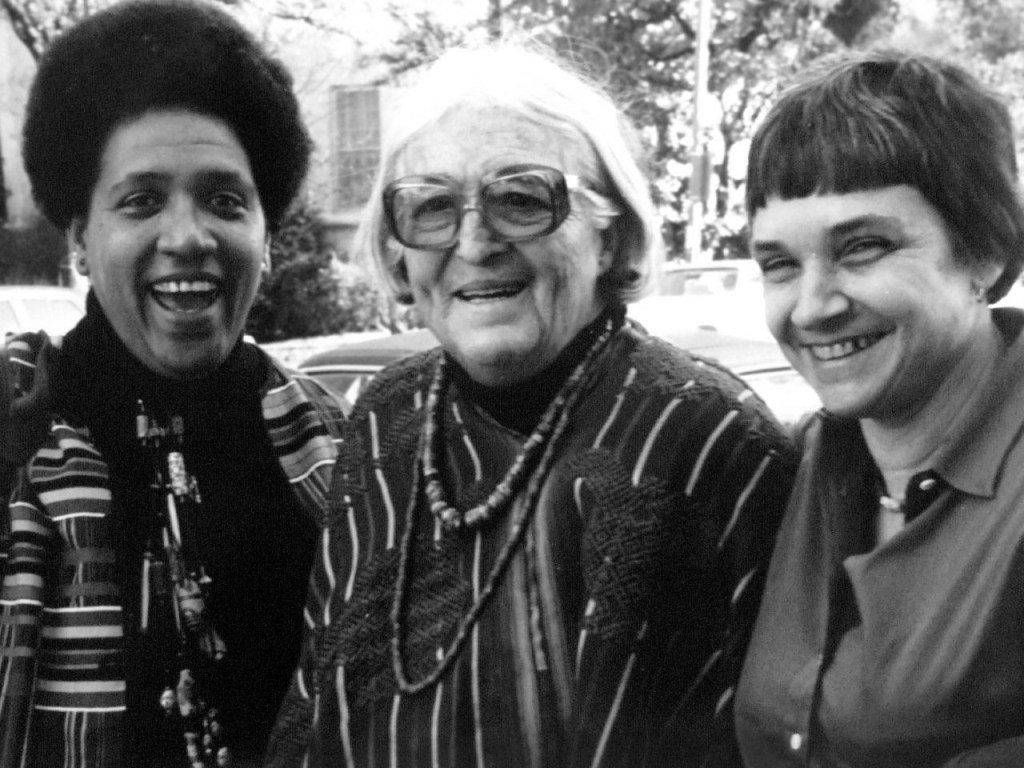
Left to right: Audre Lorde, Meridel Le Sueur, and Adrienne Rich in 1980.
(Photo: Wikimedia Commons By K. Kendall)
In her collection of essays from 1978, On Lies, Secrets and Silence, Adrienne Rich, a woman writer who dedicated much of her work to revealing these connections writes:
“The entire history of women’s struggle for self-determination has been muffled in silence over and over. One serious cultural obstacle encountered by any feminist writer is that each feminist work has tended to be received as if it emerged from nowhere; as if each of us had lived, thought, and worked without any historical past or contextual present. This is one of the ways in which women’s work and thinking has been made to seem sporadic, errant, orphaned of any tradition of its own.
In fact, we do have a long feminist tradition, both oral and written, a tradition which has built on itself over and over, covering essential elements even when those have been strangled or wiped out” (11).
Networks, or what I like to call webs, are important not only in living ecosystems and the internet but for human social health as well. A person who feels held within a web of interconnectedness not only feels supported and nurtured but can avail themselves of this network of support psychically, energetically and physically. A person can draw upon this energetic web and actually give back to it, thereby strengthening it and creating more hubs of interaction. Not knowing that this network is there has indeed left many women alone.
For me personally, finding these relationships and beginning to feel the presence of this web made me feel much more connected, to writing, to women writers, to a legacy of women writing and to those who will come after me. Rather than feeling alone, despondent and misunderstood, I suddenly felt supported, connected and inspired. If all these women were connected through time creating a web of interconnection, then I could tap into that and get nurtured from it as well. I could contribute to the web. Every time I sit down at my desk to write I can call upon this web for support and camaraderie. If all these women writers saw each other and supported each other’s work, then it is not true that women’s work is unsupported and unimportant. It changes the game completely.
Part 2, tomorrow
BIO: Theresa C. Dintino is the author of Membranes of Hope: A Guide to Attending to the Spiritual Boundaries that Keep Lifesystems Healthy from the Personal to the Cosmic, The Tree Medicine Trilogy which includes: The Amazon Pattern: A Message from Ancient Women Diviners of Trees and Time, Notes From a Diviner in the Postmodern World: A Handbook for Spirit Workers, and Teachings from the Trees: Spiritual Mentoring from the Standing Ones. She is also the author of The Strega and the Dreamer, a work of historical fiction based in the true story of her great-grandparents, Ode to Minoa and Stories They Told Me, two novels exploring the life of a snake priestess in Bronze Age Crete, and Welcoming Lilith: Awakening and Welcoming Pure Female Power. Find out more about Theresa at ritualgoddess.com
Discover more from Feminism and Religion
Subscribe to get the latest posts sent to your email.
 Feminism and Religion
I do believe that woman support other women as writers and I like the idea of asking how to tap into this legacy as we write….A peculiar thing happened to me this morning when I went to post my nature reflection for the day… I was told that I had been rejected by the “World Circle of Crones” – never heard of it!
LikeLike
Sarah, it struck me as a good thing that you have not heard of that group, hater’s be gone!
LikeLiked by 1 person
Hi Sara,
yes, that is the gift now, to tap into this legacy and be supported by it. Just knowing it is there at all offers so much sustenance.
LikeLike
Great idea, thanks for that Theresa, it is time now for women to promote women! I wanted to let you all know about a book. We are witnessing George Orwell being held up culturally as, a moral man, that we should look up too. Ann Funder has given us the real version of who George Orwell was in her recent book, WIFEDOM. Though WIFEDOM is certainly not knew to radical feminists or to women who have lived WIFEDOM and still do, this is a great book! It is a deeply telling book about who is being held up for women and men culturally, as moral men. Warning, first it will piss you off, as the truth so often can. WIFEDOM is a brilliant naming book, naming misogyny and how it is played out for men by men culturally. Three cheers for Ann funder!
LikeLike
Thanks, Cate and thanks for the book reco also. sounds interesting, albeit upsetting.
LikeLike
Yes WIFEDOM is upsetting Theresa and, nothing we do not know already, as women! Good on Ann funder, to name it and that she did, brilliantly! I agree with you wholeheartedly Theresa, the patriarchy is afraid of women coming together, we are their greatest fear. Change women, change the world, this is how we will end codependency for good. I LOVE IT.
LikeLike
I was using that term wifedom 30 years ago!
LikeLike