

“Instead of looking to the male world for approval, I had to learn to rely on my own instincts. In some strange way, the rejections I faced strengthened me, but only because they forced me to learn to live as I saw fit and to use my values and judgment as my guides.”
The Flowering: The Autobiography of Judy Chicago
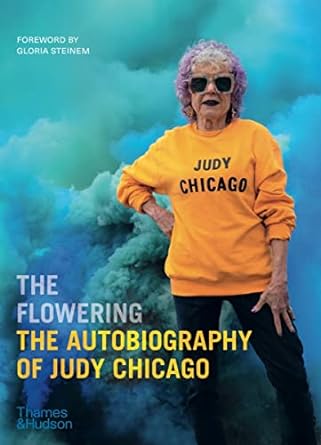
Janet: I live near New York City and am fortunate to be close to many museums. The New Museum has been showing an exhibit by Judy Chicago that takes up the entire facility of four floors. And it is remarkable. Not only is the breadth of her work astounding but so are the stories of how she has had to fight to be accepted in a man’s world of art. Joyce Zonana first recommended that I go. This blogpost came about as part of a discussion between the two of us.
Joyce: Walking into “Herstory,” the monumental Judy Chicago retrospective that recently graced the New Museum in New York City, was like what I imagine it might be to walk into a great temple—or cathedral—dedicated to the Goddess in all Her manifestations. One is greeted at first by a series of huge pastel-painted slanting beams, titled “Rainbow Pickett,” first created in 1964. Rather than serving as a barrier or a fence, as the term “pickett” suggests, the beams form an entranceway, a portal reminiscent of the gothic arches framing the cathedrals of Notre Dame” and Chartres in France They are simple, elegant and meaningful.
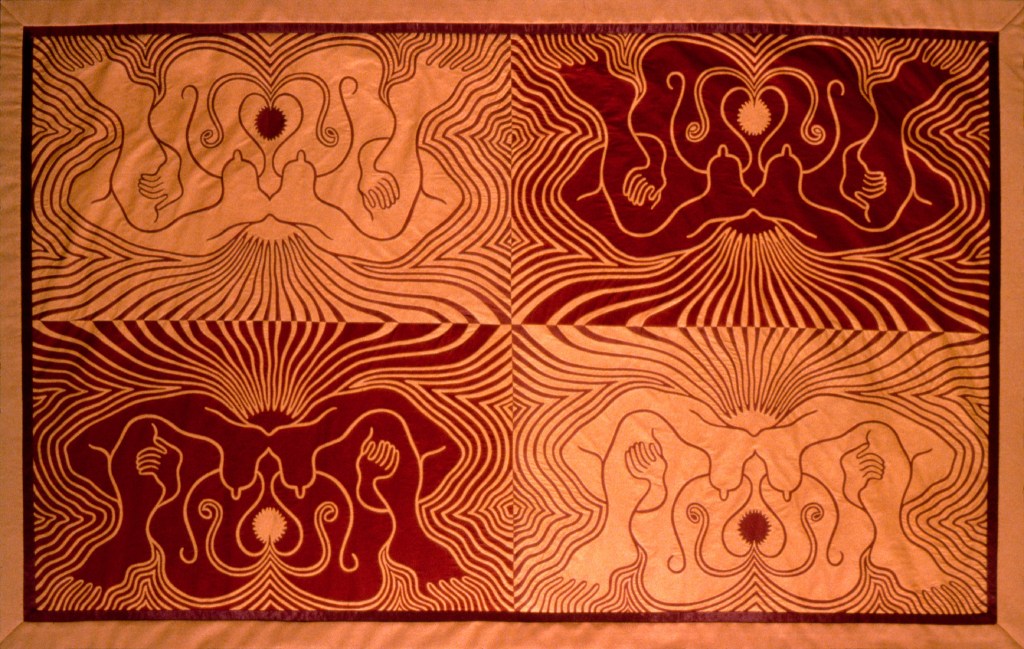
The spacious, high-ceilinged museum spaces we entered, adorned with works from throughout Chicago’s fifty-year career, embraced us like a womb … Immediately, I felt as I had felt in the ancient caves Carol Christ led us into on the Goddess Pilgrimage in Crete—surrounded, held, nurtured. From the first, Chicago’s works affirmed and explored female anatomy and experience—from the playful “Woman House” constructed in San Francisco in 1972 to the iconic “Dinner Party” now permanently housed at the Brooklyn Museum. Along the way she has worked in various media, from the most traditional “female” crafts like needlework, weaving, and pottery to the most contemporary new forms, like video and performance art. She has created monumental earthworks and miniscule icons, boldly-colored images and gently lyrical scenes.
(used by permission) see below
Janet: Her fertile mind is not only artistically brilliant but also filled with a strong social consciousness. Her art stands on its own merits. It is also a commentary on our culture which cries out for change. Here is what she wrote in a NY Times editorial piece from 2020 (This excerpt also appears at the beginning of her book, The Flowering: The Autobiography of Judy Chicago):
“From my perspective, one that has broadened over time, the purpose of Feminist Art is to challenge patriarchy, which oppresses not only women and people of color but animals as well. In my New York Times essay, I tried to point out that the origins of the coronavirus were in utter disregard for the well-being of the planet and our hideous treatment of other creatures. They are being made to suffer because of one of the underlying assumptions of patriarchy, which involves privileging human life over all others. This is as much an extension of white male privilege as the racism that underlies our society. As one of my PowerPlay paintings suggests, patriarchy is literally “Driving the World to Destruction.” Pg 3
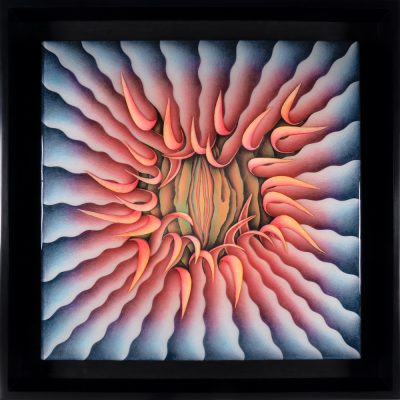
Joyce: Chicago’s art has the power simultaneously to make us think and to marvel: it is both beautiful and thought-provoking both visually entrancing and politically powerful. The very combination of these qualities is itself profoundly feminist, uniting as it explores the purported “opposites” torn asunder by patriarchy: thinking and feeling, “masculine” and “feminine, ”heaven and earth, the sacred from the profane.
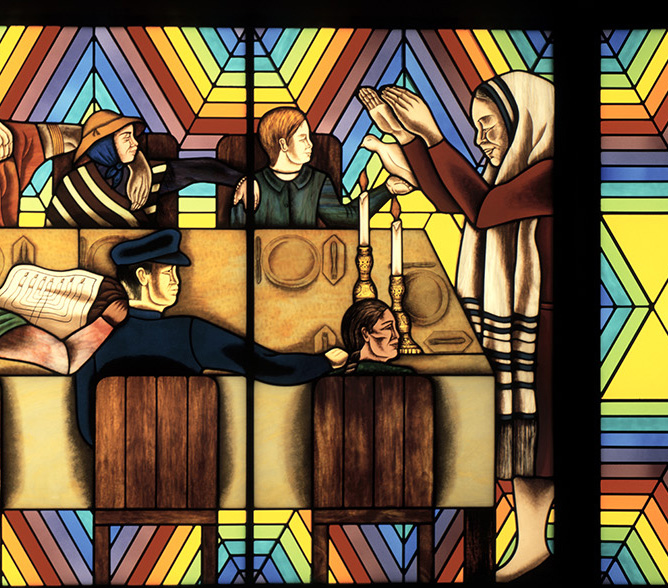
Rainbow Shabbat, from the Holocaust Project, 1992. The full image can be seen on Chicago’s gallery website – here
As one moves through the exhibit, one moves through the various stages of Chicago’s personal and political evolution. A final set of rooms in the main part of the exhibit is devoted to “The Holocaust Project, “and includes a deeply disturbing black and white painting, reminiscent of Picasso’s “Guernica,” of bodies writhing in the torment of the Shoah. The concluding image in this series is a luminous stained-glass panel depicting a sabbath dinner, called The Rainbow Shabbat, sealing, for me, the impression of being in a cathedral, and signifying, the survival of the Jewish people despite the Nazi extermination workings. Perhaps they also suggests Chicago’s new affirmation of the Jewish heritage she rejected when she changed her name from Judith Sylvia Cohen to Judy Chicago. The companion with whom I experienced the exhibit—also a Jewish feminist artist—was disturbed by this piece, featuring as it did several seated men (bearded patriarchs of course) reading from their prayer books. But I was drawn to the towering woman standing at one end of the table, the matriarch lighting the sabbath candles that signify the presence of the divine on earth. You can see the image here. I see her as the one who is absolutely in charge—an incarnation of the Goddess who animates all of Chicago’s work.
On the top floor, Chicago has included an “exhibition within the exhibition,” a display she calls “The City of Ladies,” showcasing artworks and archival materials from over eighty artists, writers, and thinkers, including Simone de Beauvoir, Hildegard of Bingen, Artemisia Gentileschi, Zora Neale Hurston, Frida Kahlo, Hilma af Klint, and Virginia Woolf, among many others.
I could not help but read this gesture as Chicago’s nod to Christine de Pizan’s 1405 Book of the City of Ladies, an allegorical dream-vision in which Christine recounts how she was visited by three goddesses—Reason, Rectitude, and Justice—who direct her to ignore patriarchal oppression and to build a virtual city that will house historical and legendary women who have gifted humankind with their intelligence, virtue, and creativity.
Surely Chicago is herself such a woman, offering us her exhilarating vision of what a female-centered world might look and feel like.
* * *
If you are in or near NYC, this exhibit runs at the New Museum through March 3. The Dinner Party is on permanent exhibit at the Brooklyn Museum. Her work will be exhibited in London May 22, 2024 to Sept 1, 2024. You can see learn more about the New Museum’s exhibit here.
Judy Chicago has a rich website with her artwork, info about her exhibits and more. You can visit her website here.
Be sure to especially visit her on-line gallery to view her artwork.
* * *
Images used with permission:
- Judy Chicago
The Crowning: Quilt 5/9 from the Birth Project, 1982
Reverse applique and quilting over drawing on batik fabric
56.5 x 89 in. (143.51 x 226.06 cm)
Executed by: Jacquelyn Moore Alexander
Collection of Florida State University Museum of Fine Art
© Judy Chicago/Artists Rights Society (ARS), New York
Photo by Michele Maier - Judy Chicago
Peeling Back, 1974
Offset lithography on rag paper, 28.5″ x 22″
© Judy Chicago/Artists Rights Society (ARS), New York
Photo © Donald Woodman - Judy Chicago
Rainbow Shabbat, from the Holocaust Project, 1992
Stained glass
54 x 192 in.
Fabricated by Bob Gomez, hand painted by Dorothy Maddy
Collection of the Jordan Schnitzer Family Foundation
© Judy Chicago /Artists Rights Society (ARS), New York
Photo © Donald Woodman/ARS, New York
Discover more from Feminism and Religion
Subscribe to get the latest posts sent to your email.

 Feminism and Religion
Oh wow Joyce and Janet I had to go through this ritual (whoops wrote ritual instead of virtual – curious – yes?) tour twice. I was enthralled by the images and your text. An amazing tribute to an incredible artist… and oh you are right patriarchy is destroying us all – and I like it that you included animals in this storying…. Here’s another quote that resonated ” The very combination of these qualities is itself profoundly feminist, uniting as it explores the purported “opposites” torn asunder by patriarchy: thinking and feeling, “masculine” and “feminine, ”heaven and earth, the sacred from the profane.” This might be the most toxic aspect of patriarchy beside its obsession with war and need to control EVERYTHING. I had exactly the same response to the stained glass piece: “But I was drawn to the towering woman standing at one end of the table, the matriarch lighting the sabbath candles that signify the presence of the divine on earth.” Mostly, I don’t like NY – I feel claustrophobic – and the noice – though I was brought up there – as a daughter of an artist I absorbed art museums the way our bodies do foods without thought – the only aspect of NY I still miss…
Thank you both so much for this gift…
LikeLiked by 1 person
Love your “ritual tour” as opposed to “virtual tour.” It does feel like a ritual. That deepens the experience profoundly. And to have these concepts in such a multi-layered visual experience just speaks to the talent and power of Judy Chicago.
LikeLiked by 1 person
Adjunct to first comment; “Instead of looking to the male world for approval, I had to learn to rely on my own instincts. In some strange way, the rejections I faced strengthened me, but only because they forced me to learn to live as I saw fit and to use my values and judgment as my guides.” What I like so much about these words is that Judy does not deify rejection – she says it might have strengthened her but only by FORcE – too often I hear the words… “it (suffering) made you who you are… blah blah blah. Suffering is NOT a virtue…. I’m thinking about this because yesterday was ash weds in the christian tradition that I came out of (although I rejected it). And I always feel dragged down by this period that ends up with a man who lived his life with integrity and through his instincts ending up being rejected by all and crucified until dead… good god – if this isn’t deifying suffering what does??? And don’t tell me that these stories don’t carry resonance whether believed or not – because they do – christian or not this ugly story is out there – being lived through during patriarchal breakdown in the most horrific ways.
LikeLiked by 2 people
Judy Chicago has a whole body of work that copes with the rejections she lived with and worked through in her life. I think most of us can relate to being rejected and finding ways to be more authentically ourselves in the face of these challenges. Of course Judy Chicago does it brilliantly.
LikeLiked by 1 person
Thank you for this beautiful tribute Janet. Chicago is such a powerhouse and has broken so many glass ceilings. We all owe her a great debt. I am so grateful for her example and leadership and for this piece.
Blessed be.
LikeLiked by 1 person
Thank you Theresa, I couldn’t agree more re: her example and leadership and owing her a great debt.
LikeLike
Thank you for your beautiful tribute to Judy Chicago. I still laugh today looking back at the look on men’s faces as they went around the table at the showing of the dinner party! Later senators crying out perversion when they discovered that Judy had been given grants to do her work, imagine. I like your comment on Christianity and suffering which the church fathers created, a suffering Jesus who gave up his life for us, an utter betrayal of Jesus I later learned whose real message was about ascension and energy balance, The vertical line signifying ascension and the horizontal line signifying balanced energy. Jesus was teaching us who we are, the father (and mother) and I are one God is who we are and one is all there is, God is everything, all there is is love. The teachings of Jesus has been so twisted and so was Mary Magdalene, the wife of Jesus, made a whore by Christianity, the church fathers have much to answer for!
LikeLiked by 1 person
I haven’t seen the Dinner Party yet and so look forward to getting to the Brooklyn Museum. Judy Chicago describes in her book The Flowering the whole process of not only creating the artwork but also all the politics that she had to weather to get it financed, shown, taken care of so that it was properly handled before it was permanently housed at the Brooklyn Museum Some of the stories are harrowing and most are enraging.
LikeLiked by 1 person
I plan to read this book
LikeLiked by 1 person
Thank you so much Janet, this is a book every women needs to have in their hands, at a time when many women understand how women were treated within patriarchy, good on Judy! Three cheers for Judy Chicago!!!
LikeLike
Thank you Janet and Joyce for highlighting Judy’ Chicago’s contributions and energizing me to dig deeper into all that she has to offer. I’ll keep this short as I have to go buy Judy’s book right now! I’m especially excited since I will be in Brooklyn in May ( I live in California) and have always wanted to see the Dinner Party.
LikeLiked by 1 person
Delighted you are energized and ready to dig deeper. Actually her quilt work reminded me of your own, especially of having women express themselves through working with textiles.
Let me know when you are going, if I am able, I will join you. The Dinner Party and dinner! A certain poetic symmetry.
LikeLike
We need to remember that men are oppressed as well under patriarchy – a system that is intent upon destroying us all.
LikeLiked by 1 person
Loved this post!! Thank you, Janet. I wish I were closer to go (and have put the New Museum tour on the divine feminine app) and will have to have the virtual tour suffice!
LikeLiked by 1 person
Thank you, Caryn. I haven’t seen the virtual tour and hope it does the works justice. And thank you for putting it on the divine feminine app.
LikeLike
Joyce sent me this article awhile ago and finally reading as I spread my own legs to air my vagina that is having some issue which I am treating with yogurt! The very first work of art, depicting a woman in labor, is so powerful. The energy of giving birth – the contractions, the power and concentration a woman must command as she listens intently to her body guiding her, as her vagina dilates and opens so that a new being can emerge into the world, is so powerful and is my favorite piece you have chosen to share. Curious if people are finding that libraries are carrying her autobiography?
LikeLiked by 1 person
Hi Joan, I am so glad you found power in Judy Chicago’s work and merit in our blogpost about it. I, too, love the images of life emerging into the world and to think it has been so hard to get works like these into the public sphere as if birth images were not considered worthy topics, or otherwise pornographic.
I can’t speak to libraries in general as each one is so different, but I have found that if my own library doesn’t carry a book I want, I can usually order it through inter-library loan. Also colleges and universities in your area might have libraries you can access, and they tend to have broad topics of available books.
LikeLike