

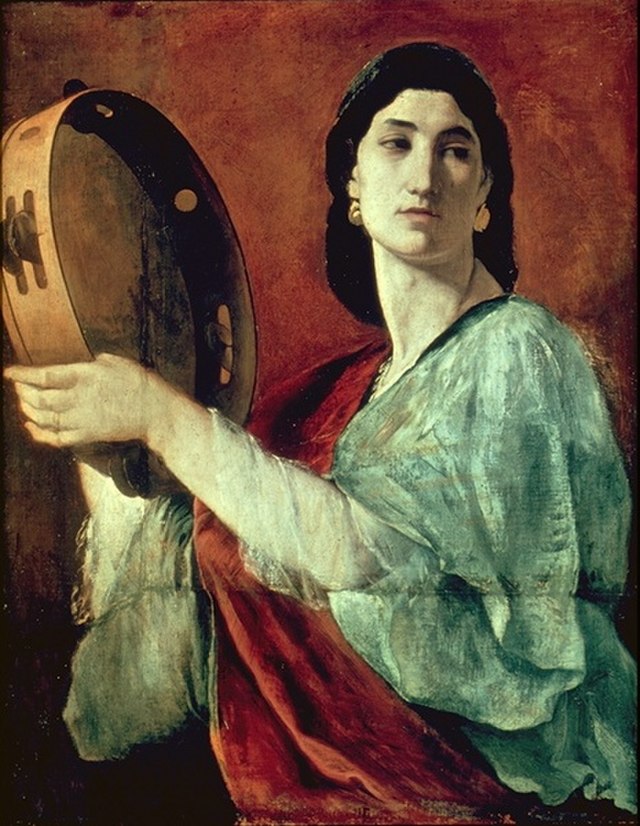
Intro: I have been working on a project inspired by Charlene Spretnak and her book Lost Goddesses of Early Greece. I am writing biblical stories through the eyes and words of the women. The scribes who wrote down the tales of the bible, wrote mostly from men’s point of view. And they had their own which was to destroy evidence of the Goddesses. I tell Noah’s story through Naamah, his wife. Abram and Sarai’s journey to Egypt through the eyes of Sarah. Exodus in Miriam’s voice. In my telling, Miriam went to Midian with Moses and, while there, experienced the Burning Bush and worked with Moses’ wife Zipporah to protect knowledge of the Goddesses. Below is an abridged version of this section of Miriam’s tale.
I look around at your world today. You, yes you, are my descendants. My beloveds. I mourn for what you’ve lost. No, I am angry, how could things have gotten this bad? I dare you, I dare any of you to challenge my work. We did everything we could. It should not have taken this long to find our clues. But then I see the job the scribes did. It was better and more thorough than even we, who saw so much, could have imagined. I look around at this precious earth we bequeathed to you and see how damaged it is.
Where are the beautiful groves we left behind? Were the scribes successful enough in their work to destroy them all? I see a few, but the lush forests, the sparkling waters that supported them, where did they go? The Earth is a body, and She needs nourishment too.
I fear I have returned too late, but I will try to guide you, to see the lessons that we hid. What we did, we did with love.
Returning my tale to Midian, I was still looking for direction when Moses announced that he had been directed to go back to Egypt. Moses had been tasked with convincing the Pharoah to release the Habiru from their enslavement. Since I was looking for ways to keep the scribes from erasing our collective wisdom, I felt that I needed to go where he was. That is with the Habiru people. Both of us felt the weight of our assignments. They both felt too enormous, impossible on their face. Moses had his task and I had mine.
Zipporah and their two sons were coming with us so I had a soul-sister who would be an invaluable help. On the way into Egypt, Zipporah and I met as often as we were able. We did work well together. When we surveyed the body of knowledge, we were able to see images of the Goddesses all over the place, woven into our lives. If the scribes were out to erase or curse those Goddesses, we needed to find ways to embed them in people’s consciousness so they would not be forgotten. I fear we were only partly successful. We did embed some of the knowledge which did preserve it, but we buried them so deep that most people in your modern times can not remember. Did we do our job too well or not well enough?
For example, in your holy book, all through the story of Exodus and in other tellings as well, the Habiru people were promised a land of milk and honey.
This was our doing. We whispered of a land of abundance and sweetness and used the terms milk and honey every day to many people. We did this so much and so often that it created a longing, a desire in the people for lands that would be abundant in the pastures and sweet in their gifts. We repeated it so much, it became a rallying cry.
When the scribes included this phrase in their texts, I wonder what they were thinking. Did they understand that this was a land of the Goddess? It certainly wasn’t going to be a male divinity who supplied milk from His own body. And bees are sacred to the Goddess, honey is Her domain. The land of milk and honey is Goddess terrain. The scribes thought they were being so clever by using this phrase to announce that the Habirus would conquer these lands. But we were cleverer still. To your own day, the lands of milk and honey are still invoked with longing as a paradise of sorts. Think about that, people are yearning for the Goddess without even realizing it. You, are yearning for the Goddess.
Zipporah and I saw our work as sprinkling gems among sand, scattering traces of gold into the soils of the earth. Treasures that are hidden but available.
Here is another sample of our work. When people pray to a being called the Almighty, they might be picturing a large muscle-bound man rising out of a roiling cloud and throwing thunderbolts. Little do they realize they are praying to a female deity. Almighty in Hebrew is Shaddai and shad means breasts. The goddess with breasts is the same female divinity who created the Milky Way in the heavens from the overflow of her own milky teats. The same Goddess who sends down the gentle dew that coats the earth in the early morn, who coaxes the shoots to grow and the buds to blossom. Our Goddesses were not thunderbolt types of deities. They tended more towards caring for Her Earth children. But don’t let that fool you. They could handle thunderbolts with the best of them, it just wasn’t their preferred source of power.
We thought the scribes might try to remove Shaddai as a divine-name and so we created songs to honor Her and Her breasts. To further hide her essence, we used dew and tears instead of milk for suckling. We sang our songs at all public gatherings. We drummed their rhythms. We moved our feet to their cadence. We embedded the names, the ideas into people’s minds so they would not so easily be removed. Here is part of a song that Zipporah wrote. I don’t see it in your own writings and so I am excited to share it now.
Almighty (Shaddai) mountains, almighty (Shaddai) strength
Nurse me with your freshwater dew and salty tears
Let them feed me wisdom along with the language of the birds.
Here is part of a song that I wrote. I see it in your holy book although someone named King James takes credit for it. It sits at Genesis 49:25
Even by the God of thy father, who shall help thee; and by the Almighty (Shaddai),
who shall bless thee with blessings of heaven above,
blessings of the deep that lieth under,
blessings of the breasts, and of the womb.
Heh, heh, do you see what we did? Almighty as Shaddai included with the blessings of the breast? We snuck that in there, right under the noses of the scribes.
We were so successful in our efforts that even today Shaddai appears 48 times in your holy texts. And this was not even our greatest success in preserving the Goddess within the texts.
Discover more from Feminism and Religion
Subscribe to get the latest posts sent to your email.

 Feminism and Religion
Although I am not too informed about matriarchy/patriarchy, it occurs to me that this is a form of gentrification/colonialism. Thanks for the piece…
LikeLiked by 1 person
Good point there jammyali. It is perhaps one of the oldest forms of gentrification/colonialism.
LikeLike
Wonderful! I love what you did with this, especially the meaning you give to the land of milk and honey and the Almighty — shaddai. I love the whole project. I’ve done similar interpretations of the stories of Hagar and Elizabeth and Mary from a female perspective for women’s retreats. I’m excited for your project.
LikeLiked by 2 people
Oh Beth, I’d love to read your takes on Hagar, Elizabeth, Mary and any others. I have stayed to the Hebrew stories. Delighted you are taking on the CE women too. And thanks for your excitment!
LikeLike
I looked for them a while ago and wasn’t able to find them in my computer. Perhaps I have print copies somewhere. Or they may be on an external hard drive that has files from an old computer. I’ll keep looking.
LikeLike
Beautiful, intriguing, inspiring!
LikeLiked by 1 person
Thank you Elizabeth!
LikeLike
I love how your story makes me think about how being in the situation of these women would feel, how I might react. Your story makes the women real. And I always learn so much from your posts. Wonderful!
LikeLiked by 1 person
Thank you Carolyn, I so appreciate your vote of support.
LikeLike
Janet, this is beautiful. I look forward to the book! I didn’t know that about Shaddai!
LikeLiked by 1 person
Oh Theresa from your keyboard to the book goddesses lips! I so hope I can make this all into a book. Right now it is a “project.”
And it really is remarkable how many goddesses and goddess names are hidden in the text, either translated out of reach or diminished (think Eve). I’m glad I could contribute to the understanding of Shaddai.
LikeLike
As a Semitic Polytheist and someone who believes Miriam is a Saint, this is really awesome! I am adding this to my random links of the day so others can come here! Thank you!
LikeLiked by 2 people
Hmmm MM, Miriam as Saint? I don’t know that much Christian theology but isn’t that a Christian concept or are there Jewish saints too? Or does Miriam fit the definition in some way?
And Semitic Polytheist, you certainly do follow a very ancient line of thinkers there. Thank you for spreading this message.
LikeLiked by 1 person
Thank you, yes in my journey to find God I found that there was a whole host of Gods in his family. I also worship Asherah who I believe is his wife and renamed “the Holy Spirit” in the Bible. As for Miriam, in certain mystical Jewish sources she’s treated as a Saint. An ascended master. This is why we use the Hand of Miriam. It calls her protection for warding off evil. There’s even a Jewish mystic temple I follow called the Temple of Miriam the Prophetess
https://templeofmiriam.com/
LikeLiked by 1 person
Interesting stuff MM. There are so many ways to look at this and, for me, each take just adds to the layers of beauty and mystery being revealed. I do appreciate this take. And I do agree that Miriam was special, but for me, I am not yet ready to add any labels such as saint or ascended master onto her. (I’m not even sure what an ascended master is). I think I might be willing to go with Prophetess.
LikeLiked by 1 person
As Ascended Master is basically a Saint. Someone who has ascended to the divine. Such as the Buddha, Catholic Saints, etc…there are many who believe all the Prophets are Ascended Masters. But I leave that for anyone to draw their conclusions. And that’s totally okay. We all have part of the truth inside of us. Let the truth in your heart speak to you and manifest as you feel it. I believe in a bunch of things that people disagree with lol. And many believe in things I don’t agree with. It’s all perspective.
LikeLike
Love this project! It’s wonderful to see the growing body of work from women which write us back into our rightful place in the spiritual life of humanity.
LikeLike