

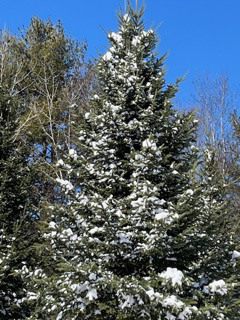
I am submitting this essay on March 25th, the original Mother’s Day according to some pre – Christian mythology. It seems important to be writing about the ‘Old’ Trees of Life, today, of all days.
Sixty years ago, Suzanne Simard intuited that the trees in the forests that she and her family logged (with horses) were all connected and operated as a complex cooperative living organism. Trees, understory plants, flowers, insects, animals, fish, and fungi were all parts of one integrated whole.
Suzanne was a trailblazer, one of the first females to graduate from the University of British Columbia as a forester. Her first job seemed daunting. It was up to Suzanne to determine why some newly planted tree seedlings kept dying.
Twenty percent or more of the seedlings that the forestry industry plants after stripping away entire forests and compacting the soil wither away. Foresters replace bare soil with seedlings of a single species (like spruce or pine) that will provide them with the fastest economical gain.
Foresters used (and continue to use) Round Up, a deadly herbicide, to destroy all other plant life because they believe that any plant or understory tree will compete with the seedlings to the detriment of the eventual cash crop.
Suzanne intuited that one problem lay underground. She uprooted dying/dead seedlings and peered beneath the surface of the soil. She recalled as a child digging up masses of colorful rootlets that seemed to be attached to complex underground webs in diverse forests where healthy seedlings flourished.
In newly planted strip logged sites the web of tiny underground rootlets was missing.
Suzanne went back to school to become a scientist to prove what the child once intuited, that the trees were in a dynamic relationship with one another and every other living organism that made up a forest.
A second problem that Suzanne addressed was the fact that removing all the other plants and trees from a strip logged site invited in disease. All trees and plants work together to deal with pathogenic fungi, and she demonstrated that birches, for example, protected trees if allowed to grow along with the cash crop. Alders provided seedlings with nitrogen a vital nutrient.
In 1997 the prestigious scientific journal Nature credited Dr. Simard with the discovery of the ‘Wood Wide Web’ the existence and importance of an intricate pattern of threads called the mycelial network. This complex network connected trees and plants and nourished all life.
The second problem that Suzanne addressed and proved was the fact that removing all the other plants and trees from a strip logged site invited in disease. All trees and plants work together to deal with pathogenic fungi, and she demonstrated that birches, for example, protected trees if allowed to grow along with the cash crop. Alders provided seedlings with nitrogen a vital nutrient.
Most important is Suzanne’s understanding that some Old Mother Trees must be left in any forest that is logged to help seed future generations. If the ‘Old’ Mother Trees are removed who will be left to pass on the wisdom of the forest?
Although Suzanne’s painstaking research continues to be replicated by other scientists after thirty – five years it is still considered ‘controversial’.
Naturally, the primarily male forest industry did/does not want to know that stripping huge tracts of land with giant machines that compact the soil and destroy the underlying networks is an issue to be taken seriously. Consequently, forestry practices remain the same.
If this isn’t a tale about how patriarchy attempts to dismiss/destroy a woman who uses not just her intellect but all her senses to change the face of “his story” I don’t know what is.
After Suzanne wrote her compelling memoir called “Finding the Mother Tree” she went on to establish the 100 Year Mother Tree Project where she and her students, many now renowned scientists themselves, continue this painstaking research most of which is done in the field and takes years.
Thanks to Suzanne’s work we now know that Mother Trees favor their own kin, send them nutrients, and even when dying these Old Trees continue to nourish not just their kin but other tree species.
Suzanne has incorporated Indigenous scientific scholars as well as well as their stories into her ongoing research. She was as stunned as I was to learn that Indigenous peoples have known about mycelial networks for millennia. How did they learn, she asked some of her colleagues.
The plants told them.
I’ll end this essay with some practical information and a question that perhaps some will ponder.
About 90 percent of all plants have underground symbiotic mycorrhizal (root fungi) relationships with other plant beings that are beneficial. These complex webs that branch and unite and are always on the move just below the surface of the earth creating a living skin that keeps trees, plants, grasses, fungi all connected to each other. These tubular networks keep plant life healthy by providing minerals carbon water etc. to vegetation through the rootlets. What this means practically is that overall plants cooperate with each other. (About ten percent of the fungi are pathogenic and kill trees and plants but this is not the rule). If cooperation has been dominating plant relationships for 400 plus million years and continues to today, then how did we get the idea that Nature competes more than S/he cooperates?
Discover more from Feminism and Religion
Subscribe to get the latest posts sent to your email.


“how did we get the idea that Nature competes more than S/he cooperates?” An excellent question that has many layers and implications! I think we live in a culture that decided millennia ago that competition and conflict are how the universe operates and has created an assumption that this is correct. The Indigenous people knew differently because they didn’t decide how they wanted the world to be and then created the assumption for future generations that this is correct, but rather deeply listened to the truth around them. I think this wonderful article not only tells us so much about how nature really works, but also how we can perhaps try to find our way out of the ecological catastrophe we are in – deeply listening to nature and being willing to change not only what we think we know, but how we think about everything. As always, a very thought-provoking and beautiful post!
LikeLiked by 1 person
The problem here is obvious – no one wants to listen – people want life to stay the same – even if it kills them.
LikeLike
As I’ve written to you before, I love Suzanne Simard’s “Finding the Mother Tree.” You summarize her work so well, and ask the important questions we all should be asking. I suppose after working to upend patriarchy for so many years and knowing full well its persistence that I shouldn’t be surprised that the forest industry hasn’t immediately changed its practices in response to her work, but I am. It is stunning and appalling that they have not. Thank you for spreading the word.
LikeLiked by 1 person
The forestry practices remain EXACTLY the same… and clear cutting has increased experientially – In Canada it’s all they do – and worse all trees and wildlife are moving north to survive a frying climate – but to what end? These migrants like their human counterparts have no place to go.
LikeLike
Thank you for reminding me of the Mother Tree Project. Suzanne Simard is one of my heroes.
LikeLiked by 1 person
She is not only a ‘heroine’ ( I WANT FEMALE!) but helps me stand what I observes as species after species struggles to survive in the mess humans have made
LikeLike
I read Suzanne Simard’s book. Thank you for distilling its essence so clearly. Thank you for this question: “If cooperation has been dominating plant relationships for 400 plus million years and continues to today, then how did we get the idea that Nature competes more than S/he cooperates?” This shift in observation, perception, and reflection, and action is essential. Your work and Suzanne’s is part of a new, ancient way of seeing.
LikeLiked by 1 person
As far as I’m concerned, this is the most important question of all because as an ethologist I have studied many animals that turned out to have sophisticated relationships that were based on cooperation NOT competition…. I may be making a generalization here but it is my belief that cooperation is absolutely necessary for the continuation of all life – too bad patriarchy has killed this perception by brainwashing us with the lie that ‘nature is red in tooth in claw’ – OH so convenient for the endless hunts and murders – violence of all kinds – And why not follow a more realistic timeline? Plants were here first… one day a fungus and alga met up as they climbed onto land… one ate rock to become soil, the other photosynthesized to get food for the two – the original partnership… to this day a lichen MUST be in partnership in order to survive. Nature has always known as Indigenous folks have or anyone that pays attention…. but so few do not… yesterday in my fury after one woman tried to choke me with lies I wrote a post about “all the happy people” who are colluding with our government to destroy us all….Thanks so much Elizabeth. Love having you back!!!!!
LikeLike
By the way, you are one of the few people I know that has actually read this book…. supposedly a bestseller????
LikeLike
I read it and I gave it as a gift to several people! May everyone read it!
LikeLiked by 1 person
I can’t help but think that the ground beneath us is a giant brain cooperating. Great question, competition or cooperation?
Whenever we walk, particularly in the woods I hear the environment talking. It’s hard to clearly discern what is being communicated. It is more of a feeling of connectedness that there seems to be no words for.
I am ordering this. I read the preview of the book after reading this post. I love Suzanne’s intuition guiding her to what the language of the environment is.
Thanks for sharing this information. As usual I really enjoy your writings Sara.
LikeLiked by 1 person
And I am delighted that you are going to read this book. It really a story of “Woman’s Way of Knowing” using intellect and all her senses to discern what is what and how intimately connected we all are….The forest speaks through our senses to a place beneath words… you are on the right track. Thank you!
LikeLike