

Moderator’s Note: Part 1 was posted yesterday. You can read it here.
Rejecting the notion of “comparative suffering” is critical for those who are committed to the work of social justice, human rights, and antiracism. There is no Guinness world record for “human suffering” for which groups or individuals need to vie to outrank one another. The human capacity to empathize with one people’s suffering does not diminish our capacity to empathize with another group’s suffering, even when those respective groups are at war with one another.
On March 26, I began my talk on a women’s panel titled, “Global Women Speak,” for Mount Saint Mary University with this reminder. Before I could speak about the humanitarian challenges facing Palestinian women in Gaza today, I felt compelled to make this argument due to my experience six days earlier at another women’s interfaith panel. In this previous panel, a co-panelist rudely cut me off four times within a span of one minute when I began to address Palestinian suffering, although she had already addressed Israel’s current challenges in response to a question that we were all asked. For several days following this jarring experience, I kept wondering, what felt so threatening to this co-panelist about the stories of Palestinian suffering that she felt compelled to shut it down?
The fear that amplifying the suffering of one group would diminish sympathy for your group’s suffering stems from a scarcity mindset, a mindset that believes there isn’t enough human sympathy to go around in the world. Brene Brown elucidates in her podcast, “The entire myth of comparative suffering comes from the belief that empathy is finite. That empathy is like pizza. It has eight slices. So, when you practice empathy with someone or even yourself, there’s less to go around.”
As I braced myself to speak on a topic that some folks deem threatening or controversial enough to suppress, I reminded the audience, “Our ability to empathize with the suffering of one group does not negate our ability to empathize with another group’s suffering. It simply means that we are human, and we acknowledge the humanity of all people.”
What happened next brought tears to my eyes. After I spoke, a co-panelist, Rabbi Sarah Bassin went out of her way to thank me, instead of censure me, for bringing attention to the suffering of Palestinian women. She said, “I think a lot of people might assume that a rabbi and a Muslim academic might not be coming from the same perspective on this conflict, but what Hadia shared of recognizing the humanity and the pain and suffering of one does not at all diminish the plight of another, I could not agree with that more.” I could feel the tears swell in my eyes, as I experienced this powerful moment of two women reaching across ideological or religious differences to “witness” the other’s humanity.
Her validation of my community’s suffering, as an Arab American woman, came as a sharp contrast to being silenced by a Jewish co-panelist on another women’s panel the previous week. More importantly, the rabbi’s empathetic response came as a sharp relief to the dominant public posturing of erasure or comparative suffering.
Unlike narratives about the suffering of other ethnic minorities, stories about Palestinian suffering have not generally received a welcome reception. In my own county of Mecklenburg, our County Commissioners passed a resolution that condemned only the loss of Israeli life without mentioning, not even in a single line, the loss of Palestinian life. By the time of the resolution’s passing on October 17, three times as many Palestinians had been killed as Israelis. What if the resolution had extended sympathy to both communities? What if, like the rabbi, the commissioners rejected the temptation to deny or ignore Palestinian suffering in order to empathize with Israeli suffering?
As an Arab American, the resolution’s complete erasure of Palestinian deaths sent a clear message to my community, a message we have heard time and time again: Palestinian lives don’t matter to those who wield political power. This silencing and erasure of Palestinian stories from the public space is part of the dehumanization of Palestinians. It implicitly determines who is worthy of our public sympathy and who is not.
Yet what if we no longer deemed it necessary to erase or diminish one group’s suffering in order to empathize with another group? What if including some groups in our circles of empathy didn’t require us to exclude others? Rabbi Bassin reflected a remarkable capacity for sharing empathy during this polarizing period between our respective communities. “Humanitarian needs are humanitarian needs regardless of the people who are impacted,” Bassin stated. “I personally want to say, thank you, Hadia, for the way you spoke about the plight of Palestinians.” We emphasized different aspects of the same conflict without animus – still hearing the other. She elucidated the impact of the conflict on people living in Israel and how the reports of gender-based violence in the attacks of October 7th reflect an underemphasized aspect of so many conflicts around the world. I highlighted the humanitarian impact of the ongoing Israeli assault on Gaza and its disproportionate impact on women and children. Neither of us felt threatened by hearing these narratives and the pain they reflect.
Tapping into the ethical paradigm of her religious tradition to amplify the moral imperative to eliminate suffering, Rabbi Bassin reminded the audience that her advocacy for all marginalized people, including Palestinians, does not contradict or undermine her Jewish identity, but quite the opposite; it stems from her Jewish identity. Similarly, Islam gives me the theological understanding of God’s mercy as infinite and expansive, an attribute that humans are asked to emulate as much as possible. In a prophetic tradition, Prophet Muhammad states, “Be merciful to those on earth and you will be shown mercy from the One above the heavens.”
If we reduce inclusivity to simply “having a seat at the table” without addressing structural and systemic sources of oppression and injustice, then we run the risk of being a part of the problem, not the solution. As Jessa Crispin argues in her book, Why I am No Longer a Feminist: A Feminist Manifesto, “By fighting your own way into inclusion, you are not improving the system, you are simply joining the ranks of those included and benefiting. You are doing your own excluding and exploiting. In other words, you, a woman, are also the patriarchy.”
As women, our feminism must be committed to addressing structural oppression facing women due to any aspect of their identity, including their religion, race, ethnicity, or nationality. A recognition of the intersectionality of women’s identities means that our advocacy for women should recognize all barriers to human dignity, freedom, and security. A commitment to women’s empowerment necessitates a commitment to their safety as human beings first. We cannot claim to be pro-women yet condone military violence against female bodies. We cannot claim to be pro-women yet shut down other female voices when they bring attention to the suffering of women due to war, whether in Gaza, Afghanistan, Sudan or the Congo. Instead of seeking token representation in hierarchal systems, we can stop doing our own “excluding” and level out the playing field for everyone. Genuine inclusivity requires us to challenge frameworks that view empathy as finite and suffering as a competition.
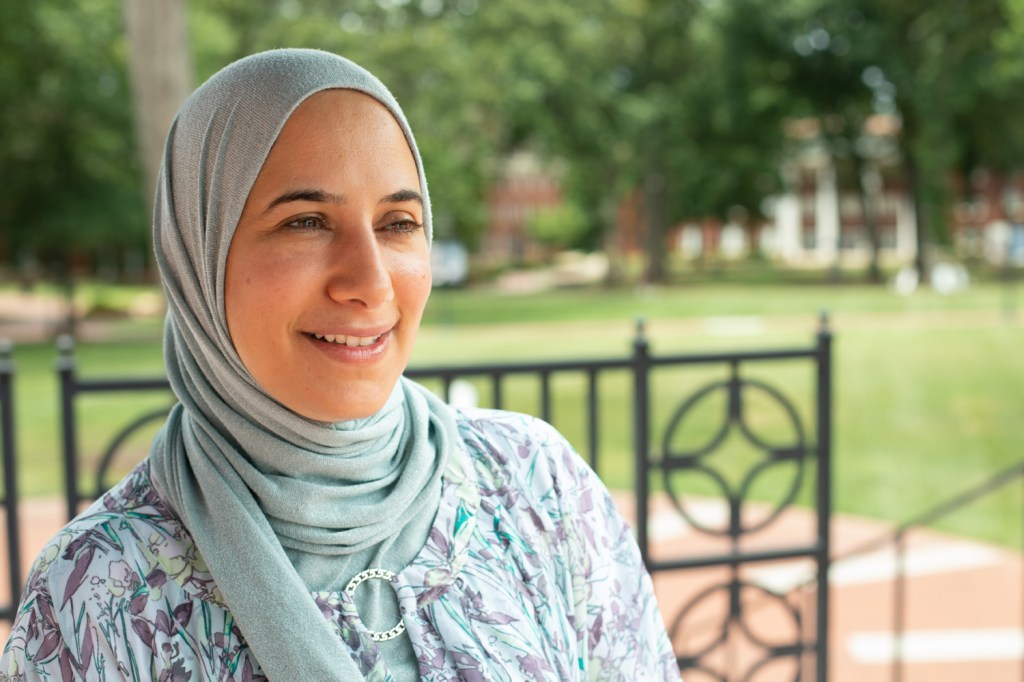
BIO: Dr. Hadia Mubarak is Assistant Professor of Religion at Queens University of Charlotte and the author of Rebellious Wives, Neglectful Husbands: Controversies in Qur’anic Modern Commentaries.
Discover more from Feminism and Religion
Subscribe to get the latest posts sent to your email.


You have said this so beautifully, Hadia. I’m so glad your experience at this panel was so different from the previous, that it was affirming, empathetic, and hopefully, healing as well. Thank you for both these posts.
LikeLike
Wonderful, Hadia! This idea of only so much empathy to go around seems almost to be embedded in our DNA. I hear arguments regarding care for animals using that same “scarcity” model. ”I think we need to care for all starving humans before we spend money on animals.” As if we couldn’t do both and more! Comparative suffering also runs rampant. A woman might be miserable in her living situation, but perhaps she’s not in dire straits (not being beaten or starved), so she’s advised to “think of all the other women that have it worse than you.” Meaning: ”Shut up.” I think when we understand that all of us depend on each other, animals, the trees, plants, the air….we can then know how important it is to validate all suffering and seek justice.
LikeLike
Comparative suffering is, I think, a form of covert abuse – us against them mentality – suffering is universal and needs to be respected as such.
LikeLike
What a great article. For women, comparative suffering was born out of being brought up within a dominator culture, we now know of as patriarchy, the truth is that being like God is blissful, so much for dogma!
LikeLike