


As if I could.
Almost three days of spring flooding seems so normal now that I expect it. Hard to believe it’s only been raining like this for less than a year. A warming climate creates torrential rain, three to five feet of snow at once, wildly fluctuating temperature shifts and who knows what else. After all, this is just the beginning. The end is out of sight.
One robin awakened me this morning with a symphony and kept up his chorale for an hour. It was still raining then but robin warbled on, harbinger of spring.
Today was the day I promised myself I’d tackle the cellar, now flooded even with a sump pump that runs around the clock. Our poor patch of northern earth is just too saturated.
After going downstairs and cleaning the de – humidifier my next job was to open the vents that had been closed for months. What a job, the idiot that put the covers on just after I broke my hip jammed the carefully cut protectors in too hard. Ah, fresh air pouring in after all these months lifted my spirits as I slogged through sticky wet mud …
The water will go down eventually; meanwhile patience is required. I am trying to lean into what I cannot change.
When I stepped outside the humid air wafted a metallic scent, but without a breeze it was a perfect day to clear the garden of the last of her remains. Old stalks and leaves were almost transparent crumbling in my hands, drained of nutrients.
My precious soil has been in the process of being nurtured by nature since late last summer when flowers bloomed, and plants began to wither. No chance to heap up detritus to protect a few varieties with a broken hip last fall, but with warming temperatures it was enough to have a garden full of leaves.
What makes me feel so happy is that every ounce of soil in my garden, around and under my house (dirt floor) is feeding the underground mycelial network that supports all life on terra firma, stretching across the earth like a net, unless destroyed by mining, forestry practices, cities, agriculture, pesticides – a whole host of deadly threats. Only 10 percent of these networks that stretch across undamaged earth are protected.
Although we know nothing about how these incredibly complex tubular root-like systems work, we do know that without their existence life would cease to exist as we know it. “The symbiotic mycorrhizal networks formed by plants and fungi comprise an ancient life-support system that easily qualifies as one of the wonders of the living world” states mycologist Merlin Sheldrake.
Amazingly, mycorrhizal fungi funnel and store 13 billion tons of carbon in the soil every year. 13 billion tons of carbon – a third of the world’s emissions. How can we not pay attention?????
It seems to me that if we want to support earth’s living skin we must learn to walk lightly or to leave nature alone, returning sovereignty and sentience to the one that birthed us.
I have been engaged with both practices for decades without understanding why, except that I wanted to let Nature take the lead. Even in those early years after planting a garden and fruit trees and adding organic manure I did little but clear a small space around the house while letting the summer garden go wild. I learned by paying attention that nature will do the rest as she recycles life through the process of living and dying. This planet is a miracle always in the making.
All trees, plants, mushrooms (fruiting bodies of fungi) tap into the friendly underground mycorrhizal fungal network, this impossibly complex informational highway. Some do this directly, others indirectly. Some fungi have many partners, others just a few. Either way every living thing is connected to the entire web that seems to know what is going on everywhere at once. This idea is so mind-bending it sounds like science fiction.
The web transports carbon, water, nitrogen, phosphorus, and other nutrients using millions or billions of root-like hyphae to reach the plants and trees that need to be fed. The networks also move in many directions at once reversing directions without warning. To witness this movement occur microscopically is incomprehensible – my mind cannot take it in. I ask as Merlin does, “What are they doing”?
A simple example of how some fungal highways work is to help a ‘mother tree’ send nutrients to her seedlings and to other species even when she’s dying.
Amazingly, this network also funnels, stabilizes, and stores 13 billion tons of carbon in the earth each year, a third of the world’s carbon emissions! It’s no wonder that the older I get the more focused the conservationist (in me) becomes on caring for the soil beneath my feet…

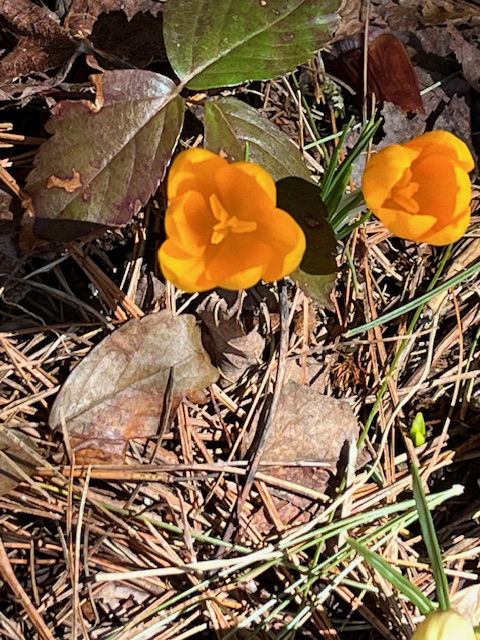
The crocus distracted me. I love crocus and look forward to their appearance every year, especially since mine bloom at different times over a period of a few weeks if it stays cool. I love to sit still to see who comes to pollinate the flowers. I notice that some insects prefer one color over another. Hover flies seem to prefer the deep purple crocus in my garden.
A non – native, crocus date back to the Bronze age – 2100 BCE. Egyptians, Greeks and Minoans all grew crocus as a source of saffron and to be used medicinally.
Around the crocus hundreds of pinecones were scattered throughout my garden along with reddish brown needles. My rake felt like a magic wand as I removed the cones and needles (too much acid). After shoveling so much snow all winter using this tool felt like picking up a feather! The “baby man” only showed up to shovel snow when he felt like it. Not when he was needed and by mid-January I was mostly on my own.
As I cleared the remains of detritus lime green rosettes of celandine welcomed me as did the columbine. Some of the crocuses were shut tightly against another round of rain.
Emerald shoots were popping up everywhere, narcissus, ajuga, violets, mayapple, and the first marsh marigolds were stirring in the frog pond. I wondered if any croakers (wood frogs) would mate here this year. The last milky ice disappeared while I worked; but most everything around the pond was still dormant. At the side door the ice had also melted so I raked that area too in anticipation of the next round of wildflowers that would last until mid – late June. The next project will be to clear the old rock garden…
April 13th and the first round of spring chores is done. There is something about beginning spring clearing that opens the door to possibility without that feeling of hardship closing in. I’m not sure what I might be doing this year after cleaning up around the house removing branches and stones, moving wildflowers at risk, digging endless ditches to re -direct the rains, writing, and taking to the woods, but I can feel a sense of anticipation rising. In less than a week I’ll have organic manure to add to the wildflowers some of which need a more alkaline soil…then I will scatter ‘forget-me nots’ to thank the soil and to mark this turning towards the sun.
Discover more from Feminism and Religion
Subscribe to get the latest posts sent to your email.

 Feminism and Religion
A wonderful post.
LikeLiked by 1 person
I always feel as if I’m walking with you in your landscape when you write your posts. So much life bursting out all at once! The fact that jumped out at me from your post was “Only 10 percent of these networks that stretch across undamaged earth are protected.” Posts like yours help spread the word about the importance of this network, and hopefully soon the protected areas will grow till it will be unthinkable to disrupt this essential feature of our Earth. Thanks for all you do.
LikeLiked by 1 person
Thanks Carolyn.. it amazes me that we manage to keep a life force that is so essential for any life to exist on land under wraps while we continue to disrupt the complexity that defines all of nature with our human belief that we know more than this planet does about what works and what does not…. even now as we face societal collapse our hubris keeps us ‘above it all’…. technology will save us – really?… don’t even know how to deal with this – mycelial networks have been studied for many years – notable is Scientist Suzanne Simard who has FINALLY received recognition for her work – but others came before her and until Merlin Sheldrake got into the picture the whole reality was shot down by mechanistic (read PATRIARCHAL) conservative science again and again. Every flower or vegetable garden could not exist without these networks… no trees, np plants, no food no people no LIFE on land and we continue to ignore.
LikeLike
I love hearing about the “friendly underground mycorrhizal fungal network.” And I love your loving attention to the ground under your feet, the way you are in friendship and partnership with all the grows in the garden you share with all the life around you.
LikeLike
I felt that same sense of anticipation as I raked the straw and leaf cover off the perennial garden. I wasn’t sure if the daffodils would make it through this winter of no snow cover during the coldest months, but hardy and persistent, there were the green shoots. I love crocus, too. All of the crocus I planted in the garden have migrated to the lawn. I don’t know whether this was of their own accord, or if squirrels thought they had a better idea of where they should grow, but now they have spread throughout the grass. No wildflowers emerging here as yet, but I eagerly await the marsh marigolds which tend to be our first arrivals. Thank you for giving us a glimpse of spring in Maine.
LikeLike