

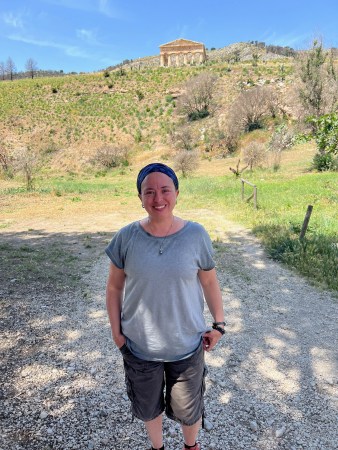
This May, I visited Sicily to present at the European Academy of Religion’s Annual Meeting. There I saw various historic, religious sites: parts of the city of Siracusa; the Valley of the Temples in Agrigento; mikvot in Palermo; various churches including the Cathedral in Palermo and the Church of St. Cataldo; the Segesta temple; and lake Pergusa where Hades emerges from the land to abduct Persephone. In this blog, I will focus on this lake. As an ecofeminist focusing on religion, this place gave me mixed feelings.
I have always been fascinated with various religious pantheons. I remember the first time I studied the Greek and Roman pantheons was in English class in ninth grade. Each of us were given a goddess or god to research and tell their stories in speech format as if we were the god/dess themselves. My connection to Persephone comes from her son, Dionysus, whom I was assigned.
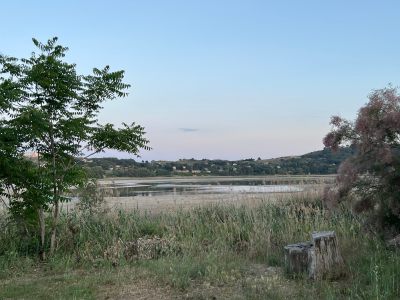
But Persephone’s story is not a happy one. One day while Persephone is in the fields picking flowers, Hades emerges from the underworld and abducts her. The spot where he emerges from the underworld to abduct her, according to the story, becomes the lake. This lake and the surrounding area provide a Greek explanation of the change of seasons – in the grief of a mother for her absent daughter.
I have always found the mother-daughter bond of Persephone’s story inspiring. With it in mind and knowing that there is a nature reserve for birds at the lake, I was quite looking forward to visiting it. I surely owe some of this interest in ancient Greek goddess sights to our own Carol P. Christ. Every year, she would host goddess pilgrimages to sites around Greece and though I never went on one with her (note 1), I felt like this trip to Sicily might mirror aspects of her trips.
In other words, I had relatively high hopes that there would be an opportunity especially by the lake to feel at least some of the holiness of the story – even if the lake itself also brings to mind the violence done to both women and nature. Then I learned, that there is a Formula one racetrack surrounding the lake. Don’t get me started on the issues I have with Formula One: from its association with the sexual exploitation of women and girls to the damage the emissions of useless driving in circles does to the environment.
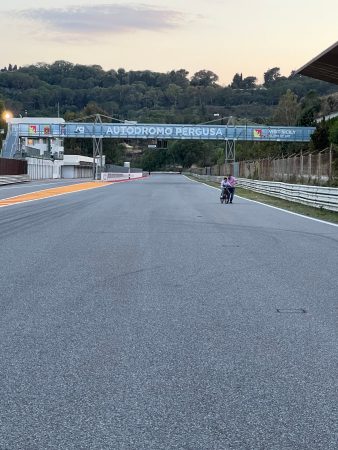
Anyway, the reader is probably wondering what my lake visit was like, so let me move on. It really was nothing like I had hoped, but it was somewhat what I expected. The racetrack dominates the place. In fact, I barely saw the lake for the first five minutes or so of our visit. What I did see, while walking on the racetrack, were families using the recently repaved racetrack to teach their children how to ride bikes or roller skate. They made me smile. I was also pleasantly surprised to learn that the track itself is rarely used – a few times a year for vintage car races. In fact, the climate and its dust doesn’t bode well for racetracks – making the surface slippery.
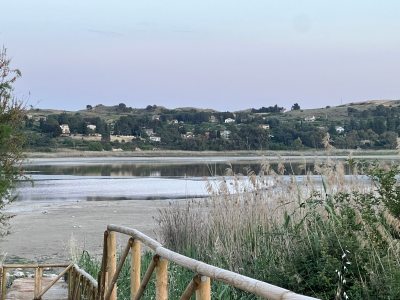
The lake is the only natural lake on the entire island of Sicily and it contains salt water – or at least saltier water. There are various scientific theories as to the origins of the lake and evidence of the worship of Persephone and her mother, Demeter, on Sicily during its Greek colonization, with this area holding specific spiritual significance.
Close to the lake were informational signs, declaring the surroundings a nature reserve and detailing the native and migratory birds as well as the native flora and fauna. The signs also informed the visitor that water level fluctuation was very normal and was responsible for the water’s salty nature. I have to admit the level of the water was the first thing that hit me. It was little more than a large puddle. I wondered how low is normal and how much is due to the ways in which patriarchy drives the destruction of our environment.
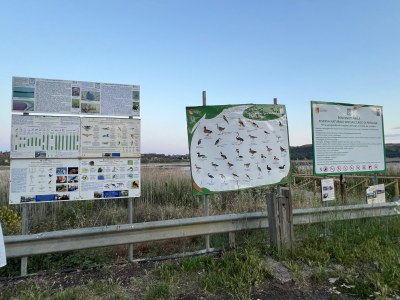
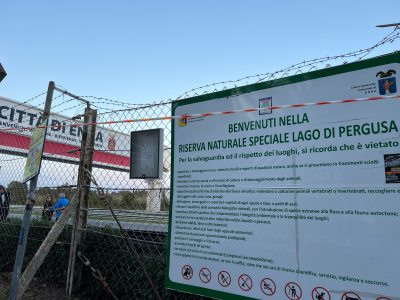
In addition, there were a number of contradictions at the lake. I spotted a sign that warned visitors to keep noise down; does this apply to the racetrack? I also was astonished at how the racetrack engulfs nature to the point that I question how one could pretend that nature here matters. Add to this the fact that I already mentioned, the racetrack was recently repaved, while the signage for the nature reserve appeared to be in various stages of decay. Sadly, there was no mention of the Persephone story on any of the informational signs. Is the story is so well known that it goes without saying?
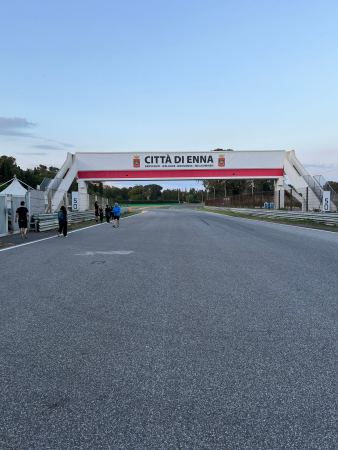
While there, I didn’t feel a smidge of spiritual connection; I felt mounting anger and profound sadness, which only grew the longer I stayed. The smiles at the beginning a distant memory. My focus had shifted to the destruction of the land, and I felt sadness for the low water levels and mounting rage at the pristine racetrack and dilapidated elements of the nature reserve. I left angry and bitter and sad.
A few months later and on further reflection, I think about my experience in a new way. My emotions were what Persephone and Demeter felt near the lake. Persephone was abducted against her will and tied to Hades and the underworld through trickery, and Demeter wanted to end the suffering of her daughter in captivity. At modern-day lake Pergusa, patriarchy in the form of a racetrack encircles a vulnerable lake teeming with unique birds, flora and fauna. Thousands of years apart and for completely different reasons, Persephone, Demeter, and I were linked in the grief we shared. I’d call that a spiritual experience, even if it wasn’t the one I hoped for.
Note:
- These pilgrimage trips still continue. See here for more information.
Discover more from Feminism and Religion
Subscribe to get the latest posts sent to your email.

 Feminism and Religion
Such a compelling read our have invited, Ivy. I am struck by how my very body responded to your words, HEaRt felt thoughts, and poignant experience. What surfaced in me is the f/act of with-ness-ing. tHERe you were in a place, in a space that is bearing with-ness-ing as you too bear with-ness. And I sense and feel a shared-journeying of and for and because of a visceral and rooted kin-ship of what can never be eradicated from the soul of knowing, even as the literal, concrete [very literal] articulation of place feels barren. Womyn’s voices echo. Your pen with-ness-es. And indeed your HEaRt.
Sawbonna! With gratitude.
LikeLike
Such a compelling read our have invited, Ivy. I am struck by how my very body responded to your words, HEaRt felt thoughts, and poignant experience. What surfaced in me is the f/act of with-ness-ing. tHERe you were in a place, in a space that is bearing with-ness-ing as you too bear with-ness. And I sense and feel a shared-journeying of and for and because of a visceral and rooted kin-ship of what can never be eradicated from the soul of knowing, even as the literal, concrete [very literal] articulation of place feels barren. Womyn’s voices echo. Your pen with-ness-es. And indeed your HEaRt.
Sawbonna! With gratitude.
LikeLike
Brilliant and spot on reframing of what is a spiritual experience. Thank you!
LikeLike
Hi Ivy,
Ugh, a racetrack surrounding a nature preserve? How awful, and yes, how patriarchal. Thank you for making the connection between your gut-wrenching experience there and the gut-wrenching experience Demeter and Persephone went through. Mother Earth and women are still being abused and defiled, sadly.
LikeLike