

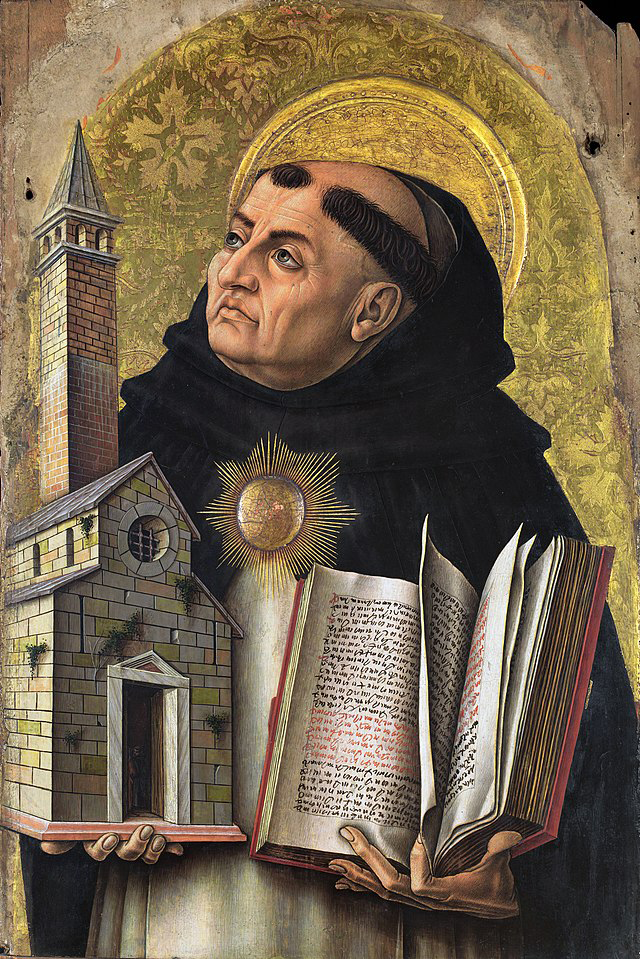
12th century theologian Thomas Aquinas didn’t think much of women. He’d known less than a handful during his lifetime – his mother, who sent him off to a Benedictine monastery when he was five, as was the custom at the time, and later abducted and imprisoned him, with the help of her other sons, seeking to “rescue” him from his choice of becoming a Dominican priest; his two sisters who were sent to him while imprisoned to dissuade him from his choice; and the prostitute his brothers sent into his prison cell to try to tempt him to sin and break his vows – unsuccessfully. So perhaps it is no wonder that Question 92 of his Summa Theologica asks, “Should woman have been made in the original creation?” Though more likely his question was prompted by the milieu of misogyny in which he was raised and lived, having been educated in the theological tradition of Augustine who believed women to be the “lesser” sex and necessarily subject to men, and highly schooled in and known for reviving the thought of Aristotle, who said of women, “a woman is a misbegotten man.”[i]
Indeed, the first “objection” — or reason — in his logic exploring the question of whether women should have been made in the first place is based on Aristotle’s assertion that woman is a “misbegotten man.” Further, nothing defective should have been made in the original creation. Therefore, women should not have been made.
The second “objection,” is based in Augustine’s assertion that “that which acts is more honorable than that which is acted upon.”[ii] Since it is written in Genesis 3:16 that women are to be subject to and thus acted upon by men, and “subjection and inferiority are the result of sin,”[iii] woman should not have been in the original creation, which was without sin.
Taking up the second objection, Aquinas “reasoned,” or perhaps simply took as truth Aristotle’s rationalizations that subjection in the household – woman to man, is for woman’s benefit for it is proper that those who are of lesser intellect and morals should be governed by those wiser than they are. This benevolent subjection, therefore, can exist before sin. Thus, woman is naturally subject to man in a way that is before sin. So, women could have been made in the original creation.
Even more compelling is Aquinas’s response to the first objection. While he granted that women are somewhat misbegotten, since, according to Aristotle, females are produced by some “material indisposition” or perhaps a moist south wind, but with regard to their general nature, Aquinas wrote, women are not so much misbegotten as intended for procreation. Thus, Aquinas concluded, it was necessary for women to be made, for it is said in Genesis 2:18 that woman is to be a helpmate to man – not in the ordinary work of life, he clarified, for clearly other men are more “effective” in providing such help to each other – but to be helpmates in the work of procreation. And so, an answer to the perplexing question of why women exist at all — the purpose of women is the procreation of the species and, Augustine would add, the procreation of sons in particular.
Ah, but what of the post-menopausal woman? Why in the world should women outlive their usefulness to men? Undoubtedly this puzzle contributed to the suspicion promoted by 15th century Dominican friars, Heinrich Kramer and Jacob Sprenger, who wrote the Malleus Mallificarum – The Hammer of Witches — that stoked the fires of the witchburnings in Europe at that time, that women who lived past a certain age of usefulness, old women – hags, crones – were witches.
But enter Republican vice-presidential candidate, JD Vance. At last, he has given us an answer. The “whole purpose of post-menopausal women,” he has said, is to help raise grandchildren.[iv] I’m so glad he has found a reason for me to exist.
Granted, I’ve been glad in the past year and a half to have become a grandma, and I am grateful for all the time I’ve been able to spend with my grandson. He has brought such joy to my life. But I am wary of the narrative that caring for him is my sole reason for being. It is just an extension of the Thomistic exegesis that the sole purpose of women is procreation.
Indeed, Vance, who converted to Dominican Catholicism – the Catholicism of Aquinas, as well as Kramer and Sprenger – in 2019, is espousing and building upon the misogynistic arguments of Aquinas, Aristotle, and Augustine[v]– that the sole purpose of women is to procreate the species, care for the children born of that act of procreation, and serve men in whatever ways the far superior being would see fit for her betterment. This is reflected in his views restricting women’s reproductive autonomy, on childcare, and on the role and purpose of women in society.
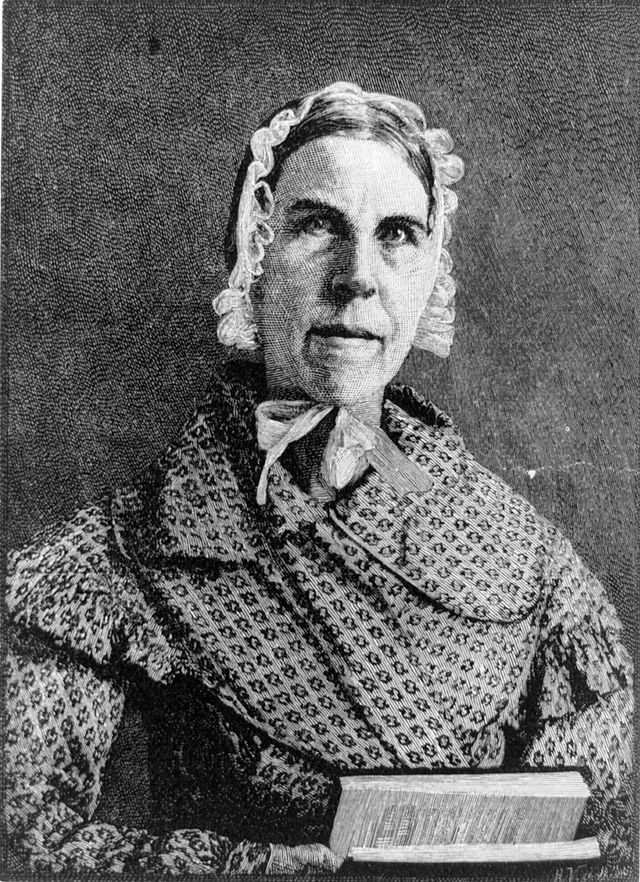
Challenging these degrading views of the Church toward women, 19th century feminist Sarah Grimké argued that woman must be “the arbiter of her own destiny” and that she cannot know and fulfill her purpose, her “mission” as she called it, until she can feel herself “called by the divinity within,” not by men, adding, “man never can legislate justly for women.”[vi] As we forge “a new way forward,”[vii] may we bring with us the wisdom of our feminist foremothers, knowing that we and we alone can determine for ourselves our own unique purpose in life.
Sources
Aquinas, Thomas. St. Thomas Aquinas on Politics and Ethics, trans. Paul E. Sigmund. New York: W. W. Norton & Co., 1988.
Grimké, Sarah. “Sarah M. Grimké’s ‘Sisters of Charity.’” Ed. Gerda Lerner. Signs: Journal of Women in Culture and Society 1 (Autumn 1975): 246-256.
[i] Aristotle, The Generation of Animals, II, 3.
[ii] Augustine, On the Words of Genesis, 12, 16.
[iii] Aquinas, The Summa Theologica, Question 92, in St. Thomas Aquinas, 37.
[iv] Vance made the remark at a conservative event in an interview with Charlie Kirk on September 4, 2024.
[v] He especially admires the thought of the last, Augustine, who is also his patron saint.
[vi] Grimké, “Sisters of Charity,” 253-255.
[vii] “A New Way Forward” is one of the slogans of the Harris-Walz presidential campaign.
Discover more from Feminism and Religion
Subscribe to get the latest posts sent to your email.

 Feminism and Religion
Thank you, Beth, for this analysis of how we got to where we are! I hadn’t been aware that there had been a question of whether we deserved a place in Creation at all! This kind of discussion is so important so that we can understand the context of our own times, and like Sarah Grimke, refute the disinformation and twisted logic of previous centuries that still cast a shadow today.
LikeLiked by 2 people
Thank you for this perspective on the 12th century “influencer.” Goddess help us and all of us help each other!
LikeLiked by 3 people
Yes, the question of the existence of women has been a rather vexing one for a long, long time. This is why some Second Wave feminists were concerned when scientists first began experimenting with cloning and IVF, fearing that if men could find a way to reproduce without women, they would eliminate all of us!
LikeLiked by 2 people
They would never do that — who would they feel superior to if women weren’t around? Who would be their bangmaids, nurses, and livestock bearing their young?
LikeLike
Thank you for the succinct reminder of the prevailing stalwart theological/mythical validation used and resurrected in today’s oppressive narrative reinforcing that we are born to be enslaved as domesticated livestock. How the hell did we regress back to this just state of culture and consciousness when we have lived long enough to see progress on all fronts for women, LBGT and POCs. I am incredulous. Thank you for keeping our eye on the philosophical ball.
LikeLiked by 2 people
I wonder how he would explain the Mother of God, our Mary. I think he got around this tricky bit by saying she was the only human born without sin. I welcome discussion.
LikeLike
I think you’re right. That’s where the idea of the Immaculate Conception came in, I believe.
LikeLike
Your question is so apt. I wish we knew the answer other than the pervasiveness of patriarchy — but we can’t let that be the last word!
LikeLike
Following Aquinas’s logic, Mary would have been necessary for the reproduction of God in Jesus. He did also believe in her immaculate conception, as well as the immaculate conception of Jesus.
LikeLike
These men are utter horror stories. And the irony is XY chromosomes define the male genetically. Y is a degraded X so they are actually not the powerful original species at all. What is scary is that men have always tried to control women, reproduction and sexuality. The IVF is just the latest scary world that everyone seems so enamored of. What could go wrong? But hey, Mary Daly blew these horrifying men out of the water over 45 years ago, and yet we are stuck endlessly in feminism 101 and the latest male attacks on our lives, scholarship and spaces. This was an excellent article for all women needing a solid clearly written overview of who these males really were, and the ideology of male supremacy that has been a virus in western culture. JD Vance is the latest incarnation. Y chromosomes the damage they do.
LikeLiked by 1 person
It is horrifying that these ideas are still so prevalent and that J.D. Vance believes that we’re only fit to be mothers and grandmothers. It makes my blood boil! Thank you for this enlightening post, Beth.
LikeLike
Thanks for this historical analysis; it pulls a lot of things together.
Goddess knows I’m not a fan of Mr. Vance but the Grandmother Hypothesis is actually a serious evolutionary analysis to explain why we live beyond menopause. A human infant needs years of care to survive. In a nomadic society a woman can really only carry/care for one child at a time. So if she has another while the first is still too young to care for herself, her post-menopausal mother can take over. Archaeologists have actually found Neolithic bottles with milk residue, as if they functioned as baby bottles. So Vance’s statement is a good example of appropriating and twisting information about women to fit a misogynistic agenda.
LikeLike
I always have to laugh when men say they’re the superior sex. Men are utterly ruled by their penises, and will do all kinds of foolish and self-destructive things just to feed their genitals’ appetite for their supposed inferiors (women). What must it feel like for them to constantly have to tell themselves they’re superior, more logical, and closer to God than women, when their natural inferiority to women is staring them in the face? Women bear children, men cannot. Women are not controlled by a desire for sex, while men will copulate with — as has often been said — “anything with a hole in it.” Dead bodies, animals, vacuum cleaners…and couches. Being completely controlled by your animal desires sounds pretty “close to nature” to me! But men are typically bigger and stronger, and have no problem with using violence to get what they want. So they set themselves up as the leaders of culture and religion and science, making laws that prevented women from exercising their own agency for thousands of years. It’s sad to think the sex that will punch a hole through a wall when they lose a video game, that will shoot other men for cutting them off in traffic, and that will murder women for refusing to date them have any sort of access to societal power at all.
LikeLiked by 1 person
Interesting. There’s also the common practice of “othermothers” — Patricia Hill Collins talks about this in her “Black Feminist Thought.” In many African societies, the mothers’ sisters often are “othermothers” to children.
LikeLike
I think some men have always been jealous of women’s biological role in reproduction. (Even the ovum can choose the sperm.) We can refuse to have sex with them, use birth control and abort unwanted pregnancies, or refuse to nurse and care for children once they are born. Authoritarian men respond to that control with rape, anti-abortion and anti-birth control legislation, and forcing women into reproductive and childcare roles exclusively, among other heinous things. In the days before DNA testing, matriliny was also much easier to establish than patriliny. People could witness and testify to the birth of a child from its mother; establishing paternity beyond a doubt was far more difficult, leading some men to keep the would-be mothers of their children under lock and key. Sadly, all of these dangers for women still exist in the world. Then, once you are no longer fertile, you might continue to be forced into childrearing servitude, or just be discarded altogether.
LikeLike