

The Catholic mystic women of the medieval and early modern era—such as Hildegard of Bingen, Julian of Norwich, and Theresa of Ávila—can seem unknowable to us now. How did they nurture their fiery love of Christ within the rigid patriarchal (indeed, misogynistic) structure of medieval and early modern European Christianity? How did they find the strength and bravery to write about Jesus as husband, mother, lover? The writing of these mystic women can strike us even now as shocking, given that they often described Christ as their husband, their lover, or even their mother.
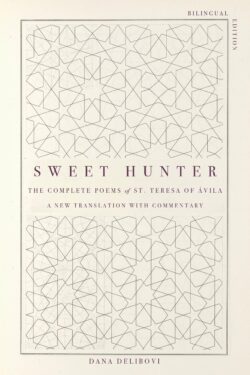
In Sweet Hunter: The Complete Poems of St. Theresa of Ávila (Bilingual Edition), poet and professor Dana Delibovi gives us the words of the sixteenth-century proto-feminist in a timbre close enough to our own to help close this gap. As Delibovi notes in her perceptive and illuminating Introduction, she centers Theresa’s balance of the mystical and the practical in her translations. Indeed, Delibovi admits that, “I had to fight the temptation to pretty-up her words and make them seem, well, more saintly.” And yet, it is this precisely this direct language that, paradoxically, heightens the divine fervor behind the writing, as when a shepherd speaks of Mary in “It’s Dawn Already”:
What, is she related to the mayor?
Who is she, this pure one?
—She’s the daughter of God the Father.
She sparkles like a star.
Theresa was born in 1515 into a wealthy, bookish family who were, on her father’s side, conversos—Jews forced by the Inquisition to convert to Catholicism, or leave Spain. As Delibovi notes, “Clouds of suspicion hung over conversos, so the family needed to be clearly and publicly Catholic, with children raised to be devoted to Christ.” It is perhaps this practical need for a public expression of one’s Christian belief, combined with her family’s support for her intellectual pursuits, that helps explain what another scholar characterizes as Theresa’s “muscular confidence” (what an apt phrase!).
Delibovi turned to translation after a varied career as a copywriter and an adjunct philosophy professor. She’s a poet and a Consulting Poetry Editor at the literary journal Cable Street. She charmingly describes the trajectory of her longtime fascination with Theresa, noting how, “back in college . . . I imagined her traipsing the Spanish countryside, bent on free expression and monastic purity . . . scribbling away at her great works of prose.” Delibovi goes on to admit that it was only much later, facing “blessed misfortune” in her own life, that she “embraced the mystical, intuitive, and poetic in Theresa . . . from that point on, my ardor for the poetry carried me like a wave toward the translations in this book.”
That ardor for Theresa’s poetry, and the poetry’s own monastic purity and mystic intuition, is evident throughout these striking translations, such as the poem titled “To Live Without Living,” which includes these lines:
I live without living,
and so sublime a life do I await,
I die, because I do not die
A straightforward expression of longing is nestled in seemingly simple language that reveals multiple meanings upon multiple rereadings.
As noted above, medieval mystic women often couched their love of Christ in maternal terms, and Theresa is no exception, as in the lovely “Talking of Love”:
I beg you for a love that abides,
my God, so my soul might have you
to feather a sweet nest
in whatever place in suits you.
And yet, Theresa also shrugs off any sense of monastic abnegation in other poems, where a hot need burns, heightened by Delibovi’s direct language, which cuts to the molten core of Theresa’s longing:
When the sweet Hunter
shot me and left me wounded,
when my soul lay panting
in those tender arms,
to balance out the cost
of a new life, I took this trade:
my Love belongs to me,
and I belong to him.
Delibovi has taken a creative (and, to my mind, convincingly useful) organizational approach in Sweet Hunter. The translations are organized in four thematic sections, each of which is preceded by a brief explanatory overview: “Many Mansions” (visionary works); “O Sisters (didactic or educational pieces); “Their Flocks by Night (pastoral pieces presented as shepherds’ dialogues); and “Made Flesh” (poems centered on the divine embodiments of Christ on the cross, and the sainted martyrs). The book’s unique structure, and Delibovi’s assured commentary throughout, offer a thorough and compelling introduction to Theresa’s context and worldview. And, the engaging freshness of the translations collapses much of the distance between this fervent mystic of Ávila and the contemporary reader, making Sweet Hunter a fascinating and moving volume. It can be purchased on Amazon or on the Monkfish Publishing site.
This piece was originally published in Medievalists.net

BIO: Kristen Holt-Browning’s poetry chapbook, The Only Animal Awake in the House, was published by Moonstone Press as a runner-up in their 2021 Annual Chapbook Contest. She was also a finalist in the Kelsay Books 2022 Women’s Poetry Contest. Her work has appeared in Hayden’s Ferry Review, Hunger Mountain, Necessary Fiction, and several other publications, and she is the recipient of a Hortus Arboretum Residency for Literary Artists. Kristen holds an MA in English from University College London and lives in Beacon, New York with her husband and two sons. Her first novel, Ordinary Devotion, is forthcoming from Monkfish Books in November 2024.

BIO: Dana Delibovi is a poet, essayist, and translator. Her book of translations and essays, Sweet Hunter: The Complete Poems of St. Teresa of Ávila, will be published by Monkfish in October 2024. Her translations of Teresa’s poetry and her essays on Teresa’s legacy have appeared in journals including Presence: A Journal of Catholic Poetry, U.S. Catholic, After the Art, Confluence, Catholic Poetry Room, and an anthology from Word on Fire. Delibovi is a 2020 Best American Essays notable essayist and Consulting Poetry Editor at the literary e-zine Cable Street. She lives in Lake Saint Louis, Missouri.
Discover more from Feminism and Religion
Subscribe to get the latest posts sent to your email.


Interesting post…. Mystics today are seen as an aberration, perhaps crazy or delusional – but these women exist – they simply have gone into hiding – the language varies but the message is the same – suffering is the door that opens to mysticism and after that a kind of belonging… always to that greater than oneself.
LikeLike
A beautiful review of a beautiful book about a woman who continues to intrigue and inspire. FAR readers I highly recommend Kristin Holt-Browning’s novel Ordinary Devotion. Coming November 9th!
LikeLike
I am not a Christian, but I really appreciate these interpretations of Christianity by women. I have a friend whose family was Catholic, and when she was dying she said to the priest: I don’t want any of this Jesus stuff. I want you to celebrate women. He couldn’t, of course, avoid the traditional Catholic ritual, but he quoted St Theresa in his eulogy. It was a really beautiful ceremony, appreciated by her friends of various religious/ethnic backgrounds.
LikeLike
Wow, did I resonate with the lines:
I live without living,
and so sublime a life do I await,
I die, because I do not die
Thank you for uncovering this significant feminine contribution of insight.
I place my hope in this verse from the Gospel Mark: “For whatever is hidden is meant to be disclosed, and whatever is concealed is meant to be brought out into the open.”
LikeLike