

You can read part 1 here
After being nailed as a witch I separated myself from the word and witch power in general. The word witch had a very dark side and could be used in the same frightening manner as it had been during medieval times to label and to expel any woman who lived on the edge (source of my original sense of unease). Especially one who lived alone in the woods and loved animals like I did.
Why had I been singled out? I was an outsider whose crime was to animate nature. Anything associated with nature was suspect if not ‘evil’.
Feminists beware. If you claim to be a witch – recall that the word is loaded. Personally, I think the label has backfired reducing our overall power as women. Perhaps making us more suspect than we already are.
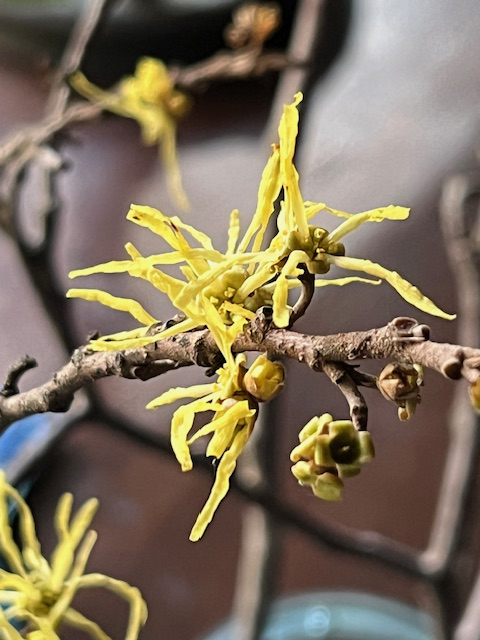
The name ‘witch’ is European in origin. When colonists came to this country, they noted that Indigenous peoples used the forked branches of Hamamelis to find underground sources of water and believed it was a form of witchery, a practice that demonized a beautiful tree along with the Native peoples who used it. “Wicke” is a Middle English word for “lively’ and “wych” is from the Anglo-Saxon word to bend (or shape). Witch hazel branches respond to underground water in the presence of some people like me.
The aggressively conservative colonists (like so many people today) were afraid of natural processes. If Native peoples used a tree branch to find water ‘witchery’ must be at work. These superstitious people understood nothing about how nature operates and weren’t interested in learning about the continent they ‘conquered’.
It’s important to note is that the word ‘witch’ never appeared until the King James version of the Christian Bible was written in the 1600’s. The word was made up. Thus, there is no such thing as a witch. This disparaging title became a way to demonize(mostly) women who worked with plants and animals learning from nature much the way many Indigenous peoples, herbalists and holistic healers still do.
Not much has changed.
Personally, I would like to see the word witch removed from our feminist lexicon. I do realize that I am creating controversy by expressing this opinion.
Why not begin to call ourselves by other self – generated names: activists, intellectuals, intuitives, artists, writers, musicians, advocates, naturalists, scientists, doctors, herbalists, healers, truth tellers, dreamers, visionaries, neuro-divergents?
I also think this is an idea worth considering because the negative qualities associated with ‘witch’ include FEAR. The latter is often unconscious and therefore more dangerous. Unconscious fear drives us; we can’t control it. There is also a patriarchal drive to power that may be hidden in the word witch that in my opinion needs to be addressed. Make no mistake, although no one will admit it, fear of witches is alive and well.
What has been called witch power is actually the flow of natural power that is intrinsic to all aspects of nature. Because all living beings are connected those most sensitive, visionaries, healers and the like can tap into this flow quite easily, but we all have the ability. Nature responds to humans in unusual ways if loved and cared about, but its important to remember that her primary purpose is not to serve humans (or any species) but to redress imbalances, so the planet survives.
In myths and fairy tales most of our mythical figures have been trying to inform us about what natural power is and isn’t for millennia. Personifications of natural forces can be seen in European Figures like Baba Yaga and oh so many others who control the weather and converse with animals, plants, trees.
To reiterate, ‘Natural Power’ just is. It is most evident in those women and men who live closest to and or have relationships with some aspect of nature. Those who understand something about natural power never assume that they know it all. These people have developed enough humility to know that their experiences are always filtered through a personal lens that may have collective overtones but can never tell the whole story.
The good news is that as self-directed feminists, activists, dreamers etc. we can learn to persevere against impossible odds, an excellent quality to cultivate in view of our present global crisis. What remains is to gather ourselves together as one united force for we are part of nature and once acknowledged, natural power may support us for we will have restored that which was broken.
Discover more from Feminism and Religion
Subscribe to get the latest posts sent to your email.


Hi Sara. I am sorry for what happened to you. Teaching children connectedness to Earth is so important. I hope some thread of your sharing and teaching stuck with them.
I agree with most of what you wrote here. Many beautiful, well intended people were tortured an killed because of fears and superstitions… being labeled witches. I’m not sure about removing the word witch from the feminist lexicon?… I mean this with respect and not to dismiss your point of view. I myself am just questioning it.
I recently took some herbalism classes and one of them was a Plant identification hike.
I did not know this group of 20 people and we were asked to describe ourselves briefly. I described myself a “kitchen witch”. It felt risky. That I would be judged.
I have a family healer ancestry that goes back to the 1450’s and on. Some were labeled witches by society. I felt a need to say “I am a kitchen witch” to honor my ancestors. To not be afraid to say the word “witch” that would of appalled the Evangelical circle I was raised in. Such a statement may have caused a person to be on the “radar of mistrust” and possibly be persecuted in the times of King James and on to now.
I know of an ancestor that was killed by the church in Scottland. He didn’t believe that the blood of christ was literally the blood of christ when taking communion. Also, The Ogles who were called “The Healers” who were considered outcasts here in America. They grew their own medicine and couldn’t afford doctors.
I don’t know if it was the “right” thing to say? My brain struggled a bit because of my awareness of the history of the word.
I am very pagan in my practices as some of my ancestors were. Much of my life and medicine is centered around rituals in my kitchen and garden. It may sound a little out there but, I really felt some of my ancestors around me that day saying “We are here with you.”
Evangelical upbringing would’ve told me to be ashamed of such a description. It felt good to say “witch” as opposed to shameful.
Thanks for sharing your thoughts as this read has got me thinking.
LikeLiked by 2 people
I like your thoughtfulness – this was part of the reason I wanted to raise the question – in your case identifying yourself as a healer might even be moore appropriate….
LikeLike
Thanks for the reply. I have identified myself as a healer as well among other things. Earth and nature as my teacher is what is most important to me. It is not static and nor am I. Things to think about?
I do so appreciate your life experience and what you write about. Goddess, Earth, and Nature.
I think at the end of the day many of us choose our own descriptives and labels. Then there are those that choose for us. The intent behind what we say is so important.
Thanks for teaching me about the Witch Hazel tree. I have a new love and respect for her. Blessed be
LikeLiked by 1 person
Thank you for this thoughtful post, Sarah. I still like the word witch. I like the idea of reclaiming words that have been negatively charged by patriarchal power. Perhaps reclaiming can backfire and we need new ways of expressing who we are and how we relate to the earth that we are all made of. Much to ponder.
LikeLiked by 2 people
just glad that you are reflecting on this idea – I do think witch is backfiring – more and more – it’s putting yet another label on us that is being used against us….I think originally this was a positive but now?
LikeLike
I’m especially struck by your observation that the Puritan European settlers were afraid of natural processes and this fear devolved onto those they considered to be witches. This is so true today – the fear of Nature and of being in communion with Nature is at the heart of so much that impedes our ability as a society to move forward in a positive, healthy way. It shows the importance of the work of bringing more people, especially children, who are isolated and out-of-touch with Nature and Her processes into closer reconnection with Nature. When people become familiar with what they fear, often that fear begins to dissolve.
LikeLiked by 1 person
Yes…the fear of nature keeps her red in tooth and claw…
LikeLike
Sara, so sorry about your dreadful treatment at the school. Was this the final outcome, that they no longer wanted you to instruct the children about nature?
I too still like the terms witches and witch. I think it’s not only reclaiming their initial holy function as worshipers of nature, and spiritual and herbalist adepts, debunking the demonization by the patriarchy, and adds the element of a refusal to be cowed by this demonization. To me, the term contains all of that in a single powerful word.
But I was drawn to witches long before I had any knowledge of all this. As a child, my first memories of playing, I wanted to play witches with my friends, probably inspired by the fairy tales my mother read to me. They weren’t evil in these stories but powerful and exciting in the best way. I also insisted on naming all of our cat’s kittens after witches. I was intrinsically drawn to them. And I still am.
However, I have never lived alone in a cabin out in the woods in continual direct contact with nature as you do, and I can see how that proximity to the women who were so terribly persecuted might give you a different reading on the word.
LikeLike
it was the final outcome…. I grew up with fairy tales and some were good and some were not – as for the word witch I repeat – its a loaded term with positive and negatives – I choose not be to identified with witch – all I have to do is look around at the hideous halloween decorations – that’s enough. Why not use other words of power to describe ourselves? I think that’s my ongoing question –
LikeLike
You’re certainly entitled to choose the descriptor that appeals to you. But as one among a great many feminists who reclaimed “witch” since 1970, I need to point out the inaccuracy of this claim:
“the word ‘witch’ never appeared until the King James version of the Christian Bible was written in the 1600’s. The word was made up. Thus, there is no such thing as a witch.”
‘Witch’ dates back to Anglo-Saxon times (with correlates in Dutch and Frisian). It was very widely used long before James I. We see Margery Jourdemayne, the Witch of Eye (wytch of Ey), being burned in 1441. In my book, _Witches and Pagans: Women in European Folk Tradition_, all of Chapter 2 looks into the etymology and uses of wicce, wytche, and other forms of the word. (Veleda Press, 2016)
There are many things to say, but I’ll highlight an Old English translation from a Latin penitential from France. It uses the boilerplate priestly denunciation of pagan reverence for Nature, against people who “bring their offerings to earth-fast stone and also to trees and to wellsprings, swa wiccan taeca∂.” The translator added this last explanatory phrase, “as the witches teach,” which did not appear in the original text. It was a crucial recognition that a thousand years ago, the English regarded witches as teachers, even spiritual authorities—and that they revered Earth and Water. They were not “devil-worshippers” or curse-throwers, as their accusers claimed.
And this is why we reclaimed this ancient term. There is real heritage behind it, and we won’t do away with the legacies of persecution by abandoning the term. Which doesn’t address the fear inculcated over centuries, much less change it. Instead we need to educate people about this history. The Baba Yaga, the Three Weird Sisters, la Befana, Perchta and many other beloved figures are inseparable from “witch.” We can’t just turn the page on their demonization. A cleansing of cultural consciousness has to take place.
By the way, that’s also true of mekhashephah, the Hebrew word in that notorious passage in Exodus 22:18: “Thou shalt not suffer a witch to live.” The Hebrew root כְשְף means “to utter magical words or incantations.” Mekhashephah encompasses the meanings of “enchantress, sorceress, soothsayer, diviner, wonder worker, fortune teller, or spell caster.” Much like English witch.
LikeLiked by 1 person
The word witch originated with the Bible – it carried such a powerful charge that it was then attributed to anyone who stepped out of line – regardless of when they lived – as you say it is personal choice – keep it if you want – perhaps some incantation may come to you that will shift the presidential win by a madman into a bad dream,
LikeLike
If you can’t deal with facts, and simply restate your claim without substantiating, then there’s no point in continuing.
LikeLike
whose facts? yours?
LikeLike
I wrote an entire book, fully annotated, with facts from philologists, historians, and other scholars who have addressed this issue, after 40 years of researching it myself. You can take it or leave it, but I’ve substantiated my statement, while you have not done so.
LikeLike
Our school community decided to practic mindfulness by doing little things. After recess, the children would lie on the floor or rest their heads on their desks while listening to instrumental music with their eyes closed for ten minutes. This allowed them time to transition from the rowdiness of play to learning. The children liked it for the most part. Fighting went down and academic scores improved. There was even a few minutes of silence at the staff meetings.
The school had to discontinued the mindfulness practice because a handful of parents were certain evil spirits would enter their children’s heads while they were relaxing. (Not sure what they thought happened when the children slept.) The school responded to the vocal minority. So in some ways, things have changed very little.
I’m sorry your administration abandoned you–as adminstrators often do. You did what you were told, they should have praised you.
LikeLiked by 1 person
Your story is frightening – to allow children to abandon self reflection is teaching them to abandon their souls – and I don’t think the story has changed at all – we are more allergic to self – reflection that ever before – our only hope left to this miserable country…If you need another sone – please check out Song of the Cedars written by Cosmo Sheldrake et al on you tube – the words are simple and profound – perfect for children. I am currently using it as a morning meditation. Thank you for the comment.
LikeLiked by 1 person