

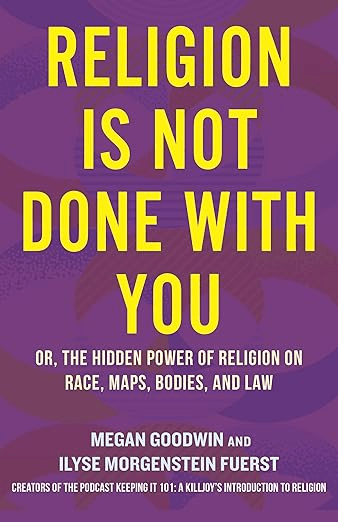
Goodwin, Megan and Ilyse Morgenstein Fuerst, Religion Is Not Done With You: Or, The Hidden Power of Religion on Race, Maps, Bodies, and Law. Boston, Massachusetts, Beacon Press, 2024, 165 pages.

If I were still teaching university classes in Religious Studies, I would certainly choose Goodwin and Fuerst’s book as an introduction to this broad, often misunderstood, subject we call religion. Their writing style has a youthful familiarity—probably purposively done—to broaden their reach to all audiences. The theme running throughout their work is religion is what people do.” “Religion isn’t just feelings or beliefs—it’s systems and assumptions…that shape our lives every day.”
Both authors have master’s degrees and doctorates in religion. Goodwin focuses on gender, sexuality, and American religions. Fuerst puts her attention on Islam, race and racialization, and South Asia. Both women claim to be religious people who “care about justice and repairing our broken world.” They understand that “religion is a force for change—not always bad, not inherently good, but always changed and changing.” It’s important, they assert, “to call out bullshit takes on religion: takes that insist religion is always and everywhere good and takes that want to write religion off as irrelevant, irrational, or regressive.”
Goodwin and Fuerst clearly demonstrate that religion shapes all of our institutions—educational, government, healthcare, and even our calendars. Not only is religion about what people do including prayers, rituals, leadership, morality, and fancy buildings, it’s also about “why we vote on Tuesdays in the US and where our understandings of race, gender, and sexuality come from.” But above all, “religion is always about power.”
Because people are “messy, alive, and always changing,” religion also is messy, alive, and always changing. “Our job,” the authors state, “isn’t to police religious belonging—our job is just to try to keep up with all the many millions of ways people are doing religion.”
Contending that religion has no place in polite conversation is an “effective way to hide systems of power in plain sight.” If religion is hidden from view, it’s impossible to understand “white supremacy, or misogyny, or classism, or ableism.” We must call out religion when it encourages Islamophobia, anti-Semitism, and anti-Black racism. “[T]o not talk about religion lets injustice flourish.” It’s also possible to understand and celebrate the positive potential of religion in promoting a kinder world.
The authors give an excellent example demonstrating the systemic influence of religion on healthcare. What happens if you’re pregnant, in a severe car wreck, injured, and unconscious? The law requires you be transported to the closest trauma 1 response center. To treat you effectively risks terminating your pregnancy. If the trauma center is owned by a corporation controlled by the Roman Catholic Church (and many are), the care you get will not depend just on your doctor’s expert judgment. The religious organization will deliver the care they think is proper for you to receive. Even if you want to terminate your pregnancy to save your life, the facility will default to the Church’s decree.
Chapter 1 “Religion is (not) Baseball” deepens the authors’ discussion of religion as they reassert there is no religion without people and no such thing as a “religiously inherent” person. Religion is a social construct. That means we (people) inculcate the word with meaning. Like all social constructs, “religion is a way of not just identifying but organizing humans for the purposes of maintaining existing hierarchies.” People use religion to “create culture through community and ritual” as well as “cultivate and disrupt power.” As human beings, it’s not possible to opt out of culture. Religion, understood as belief, is a miniscule part of what forms community, identity, and practice. Religion and belief ought not to be used interchangeably. “Systemic and structural power is what matters when we are thinking about religion.”
Chapter 2 “Religion is Global” discusses the term “world religions,” noting that the term “divides traditions, cultures, even whole populations, into ‘major’ and ‘minor’ religious traditions.” The phrase obfuscates “violent imperial histories.” World religions made (and continue to make) borders. “Empires use religion to draw and redraw physical and political borders,” deciding (intentionally or not) whose humanity is worth defending. Western European empires used religion (a word created in the 17th century) to divide and conquer, but also, people use religion “to survive, disrupt, and resist empire…in the wake of colonialism and imperialism.” Systems are made by people. Those same systems can be remade to become more just.
Chapter 3 “Race is (made of) Religion” asserts that white Western European Christianity created race in an American context. Race is a modern social construct, and people use religion to construct it. “When systems and institutions privilege one group of people to the material and social disadvantage of other groups of people, this is oppression.” It’s not about individuals and whether or not they feel oppressed. The question is: “Which group benefits the most from existing systems and thus fights hardest to preserve those systems?” Guys with guns and pens seized land that became the United States, murdered and terrorized Native peoples. Then, wrote that forcible conversion is for Native People’s own good. Somehow, though, even when victims convert, “there’s something a little bit less sacred, a little bit (to a lot) less human about Christianity when it’s done by non-Europeans.”
Chapter 4 “Religion is Politics” attempts to show how “nations create contemporary systems like courts and healthcare…drawing on religious understanding of what bodies are for.” Politics is a word used for institutions and systems that shape and govern everything about our lives. (Americans vote on Tuesdays because the Founders assumed everyone would be in church on Sundays and folks might need Mondays to travel to the polls.) The United States “codes specific Christian commitments and worldviews as good old American values” while simultaneously attempting to make the whole world into its image.
The concluding chapter “Religion is a Flight Risk” focuses on air travel—see something, say something—meaning relying on stereotypical visual (turban} and auditory (Arabic) cues to report.
When we understand how religion works in society, the authors’ admonishment, “Go be a problem who makes good trouble for great justice” takes on a clarity and urgency—something we can only do by asking questions (no sacred cows) and thinking critically (who benefits?).
Discover more from Feminism and Religion
Subscribe to get the latest posts sent to your email.

 Feminism and Religion
You certainly ‘cover’ the subject of religion – but I think the way this term is used has nothing to do with religion – the root of the word religion means to link back – doesn’t that suggest that the genuine religious impulse is to close the circle?
I have no religion. What I do have is an intimate connection to nature, which has allowed me to become her student – and what I have learned over a lifetime is that above all nature privileges cooperation over competition so that all aspects of nature learn to live with difference in a realistic way…. I would like very much to emulate this way of being with humans but I find it impossible to do because most people are not willing to join the conversation….
LikeLike
i think the question you ask, Sara, is wide open. You offer an honest possibility. The authors would (I think) include your “intimate connection to nature” as one way to do religion. The word religion has no firm meaning. No word does. What people DO comes under that very wide umbrella we call religion. “To tie back” has a plethora of meanings.
LikeLiked by 1 person
You are right of course – but my connection to nature is not tied to any religion but to my experiences….and that’s the key – my experience – not to someone else’s. Not exactly sure where you are going with the other comment…
LikeLike
Nature privileges cooperation over competition. This sums up everything about religion. Accepting truth, reality and facts is cooperation, otherwise its competition. To coexist with existence itself its necessary to cooperate with nature, otherwise nature will challenge our very existence
LikeLiked by 1 person
I prefer to go direct, we can all talk to God. God is just waiting for us to show up.
LikeLike
I like this idea of just showing up for whatever
LikeLike
Yes. Thanks for commenting, Cate. However, the authors focus is on how the many, many ways people DO religion and examining that effect on whole populations throughout the world although their focus is on the US. Policies and laws, based on religious practices, permeate all our systems– government, education, etc. They believe it’s important to know that.
LikeLike
I find that your review of this work, Esther, is a rich catalyst. A riveting catalyst. A call. A call and response: to voice. To HEaR. To be HEaRd.
…“religion is always about power…” is a compelling sentence. Indeed! Power and how and what it means to whom, for whom, wHERe, when, and how. Personal. Communal. Societal. In all its forms. All its expressions, including those we cannot see or with-ness; but, are present none the less. In and of us. With us.
Sawbonna is my “religion”. Shared-humanity. Walking on the body of Godde. Breath. Tears. Awe. Wonder. Great gallons of tears speaking grief and too, joy. Guffawing. Teeth grinding. Being wHERe we are and who we are: with the HEaRt of our intellect and the intellect of our HEaRt ever in-forming, re-forming, trans-forming. Being ever re-formed, in-formed, trans-formed.
Un-learning. Reaching. Teaching. Word-ing. Re-wording. Inspired and indeed fired, I am, by your article.
Sawbonna,
Margot/Raven Speaks.
LikeLike
Wonderful comment, Margot. Thanks. You illustrate quite well the messiness of life. I love it.
LikeLike