

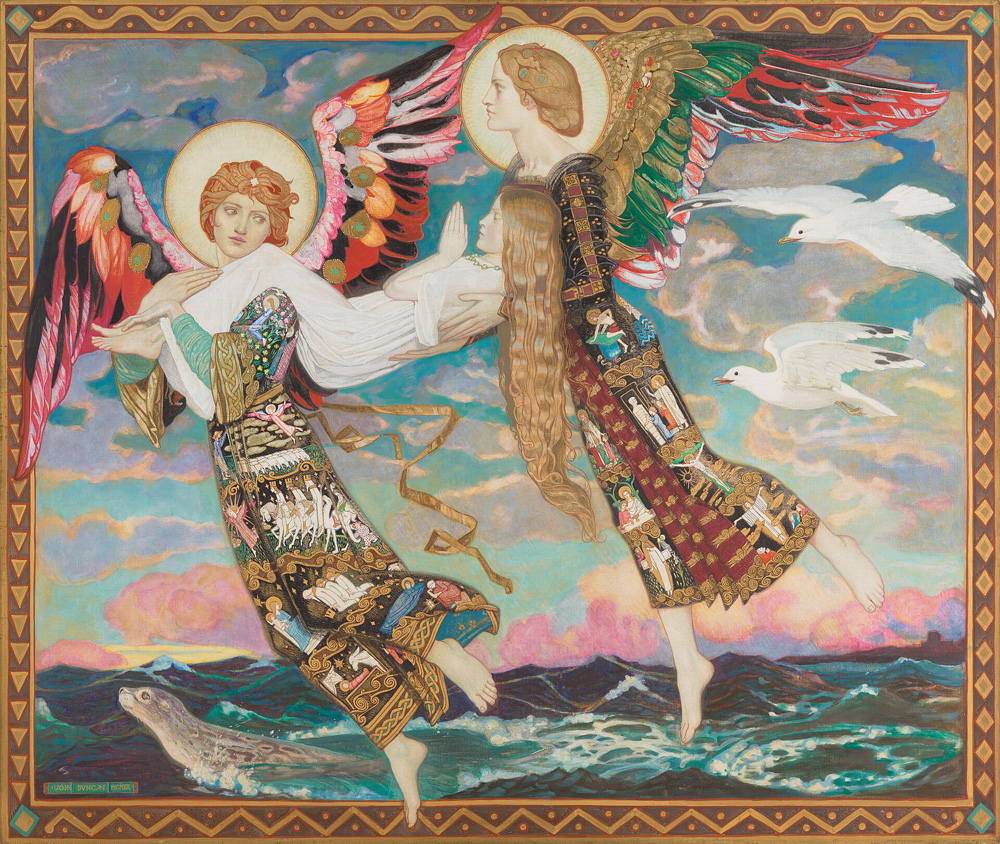
Duncan (1913)
One of my favorite saints is St. Brigid of Kildare, the patroness of poetry, learning, healing and protection. She is frequently called upon during childbirth. Brigid’s hagiographies are noteworthy for her remarkable abilities to heal and perform miracles—including her ability to make pregnancies vanish, for those who ask. In Vita Prima and Vita Brigitae (Life of Saint Brigit) published around 650 C.E. by Cogitosus, an Irish monk from Kildare, it is claimed that “Saint Brigid, by the very powerful strength of her faith, blessed a woman who had fallen [pregnant]…and the conception in the woman’s womb decreased and she restored her to health…without childbirth and its pangs.” The pregnant people in Brigid’s tales turned to Brigid to help them reclaim and restore their dignity. Consequently, their abortions served as catalysts for change. “Abortion miracles” have narrative and theological functions: they expose constructs of sexuality, chastity, purity, and sin. In addition, they test our understandings of healing—physical and spiritual—by revealing the intersectionality between medicine, pregnant people, power, and personal agency. Scholars have theorized the presence of “abortion miracles” in hagiographies, and whether they are to be read as a kind of defiance towards early Christian morality, or as a demonstration of chastity’s role and value in early medieval Irish Christianity. Some Irish penitentials view medieval abortions as malefic acts or as a kind of malevolent magic; however, according to Arica Roberts (2020), it can be argued the abortion miracles found in Irish hagiography can instead be read as “medicines of penance” and as contributing to healing.
As we navigate heavily charged political landscapes in the United States, we must continue to uplift the full spectrum of the reproductive experience in its nuanced capacity. SisterSong, a US-based organization whose mission is “to improve institutional policies and systems that impact the reproductive lives of marginalized communities,” defines Reproductive Justice as “the human right to maintain personal bodily autonomy, have children, not have children, and parent the children we have in safe and sustainable communities.” As an educator and as a parent, these are also among my primary concerns. Pregnancy is a nonlinear journey; to take a binary stance towards birth and fertility is a profound failure to acknowledge the ways in which abortions, miscarriages, infertility, and pregnancy losses are woven into the very fabric of our lives and communities at large. Our reproductive experiences should not be shrouded in shame, yet many of us navigate these paths alone, often in silence, secrecy, and judgement. It does not have to be this way. By turning to the hagiographies of St. Brigid, unique pathways for engagement can emerge—approaches that affirm reproductive justice alongside, and as contributing to, the realms of the miraculous.
For a time, I lived in Dublin. Abortion had recently been legalized in Ireland, and the year after my husband and I moved back to the United States, Roe was overturned. My twenties have been a critical period in my life, a time in which I became deeply involved with pregnancies—not just my own. My roots are Alevi and Christian, and through spiritual inquiry, I continue to find evidence in support of pregnant peoples’ agencies. The Turkish word for abortion translates to “take away”—and this action of taking away is not seen as an ending or a sin. Since becoming a mother, I often wake with the sunrise—a vigil I share with my infant daughter. In these vulnerable hours of early morning, I have noticed the dawn rarely breaks in a single beam of light. The coming of the dawn is not a cosmic spotlight illuminating our so-called rights and so-called wrongs. Instead, it is misty and grey—murky, ambiguous, mysterious and liminal. It reminds me of Imbolc and of its symbology: the inner flame, snow drops breaking through the winter earth, tones of red and pink streaking February skies, invisible growth and sacred release. May this imagery inspire us as we move forward in our activism centering reproductive justice, as we honor those who came before us, and as we usher in a new dawn.
References and Further Reading
- Roberts, Arica S. (2020). Gendered Womb-Healing: Malevolent Magic and Spiritual Medicine in the Early Medieval Lives of St. Brigit. Peritia, 31(1), p.193-208.
- SisterSong’s Website: https://www.sistersong.net/
BIO: Elanur Williams I am a teacher who has taught in elementary and adult education contexts. In my spare time, I enjoy writing poetry and creative nonfiction. I hold a B.A. in English & Creative Writing from Concordia University Montreal, a M.Phil. in Children’s Literature from Trinity College Dublin, and a M.S.Ed. in Literacy Studies from University of Pennsylvania Graduate School of Education. I am Turkish/American, and grew up in southeastern Pennsylvania and Istanbul, Turkey. Currently, I write and teach from New York, where I live with my husband and daughter.
Discover more from Feminism and Religion
Subscribe to get the latest posts sent to your email.
 Feminism and Religion
What an excellent piece, Elanur, showing us a much broader way of understanding this polarizing subject (especially in the US) of abortion! Thank you for writing this essay.
LikeLike
Dear Esther,
Thank you for your comment, and I so appreciate your kind words.
LikeLike
Thank you for writing this excellent essay, Elanur, on the very polarizing (especially in the US now) subject of abortion!
LikeLike
Hope shines in your writing/words, and in the image, the “poem” if you will, of you holding your child in your arms. Wisdom too shines via St. Brigid, whom I hold as dear kin-sister.
Joy Comes With Morning
https://www.youtube.com/shorts/WYmjYqomKPs
Sawbonna,
Margot/Raven Speaks.
LikeLike
Hope shines in your writing/words, and in the image, the “poem” if you will, of you holding your child in your arms. Wisdom too shines via St. Brigid, whom I hold as dear kin-sister.
Joy Comes With Morning
https://www.youtube.com/shorts/WYmjYqomKPs
Sawbonna,
Margot/Raven Speaks.
LikeLike
Dear Margot/Raven Speaks,
Thank you so much for your comment! I adore “Joy Comes With Morning” – it is so beautiful and thank you for sharing it with me. May we rise together, slowly, silently, under sweet scented skies to receive morning’s all-embracing warmth.
Many blessings to you!
LikeLike
My “likes” to posts have not been showing up. So I am typing my thank you here, Elanur.
LikeLike
Thank you for this enlightening post. I really enjoyed it and I hope you write for FAR again. Blessings to you and your family.
LikeLike
Thank you for your comment and for your encouragement! I love reading FAR and would love to contribute again, should the opportunity arise. Many blessings to you and your family.
LikeLike
I love your analogy of dawn light, its variety and subtlety. And I love your bringing to light this dimension of the goddess-saint!
LikeLike
Thank you! Your comment is much appreciated. Bright blessings.
LikeLike