

All Navajo ceremonial practices emphasize healing human illness, emotional, mental, and physical, while restoring balance and harmony between humans and the rest of Nature. The most sacred of these ceremonies occur during the winter months. All the winter ceremonies have at their center the healing power of animals. The best known of these is probably the Night Chant that lasts nine days and nine nights and is held sometime around the winter solstice – the timing of these ceremonies is fluid. Like the Night Chant, the Mountain Way Chant probably stretches back into prehistoric times from 60,000 – 4000 B.C.E.
The Mountain Way Chant, the second and equally sacred although less well-known ceremony is also a nine-day night chant that marks a transition between the seasons of winter and spring. The Mountain Way Chant takes place in late winter before thunderstorms strike and the spring winds arrive ( any time after First Light which occurs in the beginning of February until the Spring Equinox). It’s important to know that these ceremonies are not only fluid but can occur as many times as are needed. One purpose is to call up the rains. The ceremony is led by a medicine man that addresses, in particular, the mental uneasiness and nervousness associated with transitions, helping to bring individuals and their extended families back into balance and harmony with the rest of nature (my italics).
As previously mentioned all Navajo healing ceremonies target body, mind, and spirit, calling on everyone – the individual, kin, the medicine man, and the Spirits of Nature to help restore harmony. Before a medicine man (they are seldom women), is called, a hand trembler (often a woman), will diagnose the source of illness which can be anything that is causing disharmony. Through prayer, concentration, and sprinkling of sacred pollen, her hand will tremble and pinpoint the cause, which then determines the proper ceremonial cure. Then the “singer” (the medicine man) who knows what ceremony is needed is called and preparations are set in motion.
There are nearly a hundred Navajo Mountain Way chants and each is nuanced and complex. All reflect different aspects of the Navajo Creation myth. Each includes purification rites, chants, songs, dancing, prayer sticks, and sand paintings. In order for a ceremony to be effective, everything must be done exactly as prescribed in the Navajo Creation Story. Besides these nine-day ceremonies there are others whose ceremonies require four days, and many simpler ones requiring only a single day, each with its own dry-painting (sand painting).
In the rest of this essay, I will not attempt to discuss the entire Mountain Way Chant – it’s much too complex – but will focus on the roles that the bear gods play in the sand paintings, mention briefly the role of plants, trees, and discuss bear songs that are pivotal to this ritual.
To the Navajo, bear gods are sacred and central to the healing of disease and disharmony all year long but especially in the early spring, (curiously, the Mountain Way Chant occurs sometime around or before the bear’s actual emergence from winter dens). The Navajo also understand that bears are close relatives and call them “The Mountain People”. The Navajo believe that bears have tremendous healing ‘root’ and protective powers (western scientific studies are just beginning to tap the mysteries behind a bear’s ability to heal itself by ingesting certain plants and roots, recycle body waste, and prevent bone and muscle loss during hibernation).
The ‘Dine’ who now number over 200,000 in population, are the largest, and one of the most culturally intact Indian tribes in North America. Reigning over a reservation of some 25,000 square miles in size, the Navajos, like many other tribal peoples have long respected and honored bears as being fellow “beings” with whom they share the land. For the Navajo the bear is the Guardian of the West.
Historically there were two main species of bear that resided in Navajo territory: the grizzly bear (Ursus arctos) and the black bear (Ursus americanus). While the grizzly bear has been hunted to extinction in the Southwest, the Black bear still inhabits mountainous areas including those within the Navajo Reservation. Bears are also believed to be Guides and Guardians embodying great strength and self-knowledge.
To the ‘Dine,’ the bear embodies the powers of life and death as well as the importance of introspection, soul searching, insight. The bear dies in the fall (hibernation) and is reborn in the spring; the female emerges with new cubs or last year’s yearlings. Bears have played a major role in Navajo tribal legends and ceremonialism for millennia. It is hardly surprising that they are central figures in the Mountain Way Chant.
On the fifth night of the Mountain Way Chant a dry painting of the bear in his den is created under the direction of the medicine man. Using powdered clays of various colors, the purpose of the ceremonial painting drawn in the center of the Hogan is to summon up the powers of the bear as healer to frighten the patient and thus banish illness and disharmony. The name of the first painting is called “Frighten Him On It.”
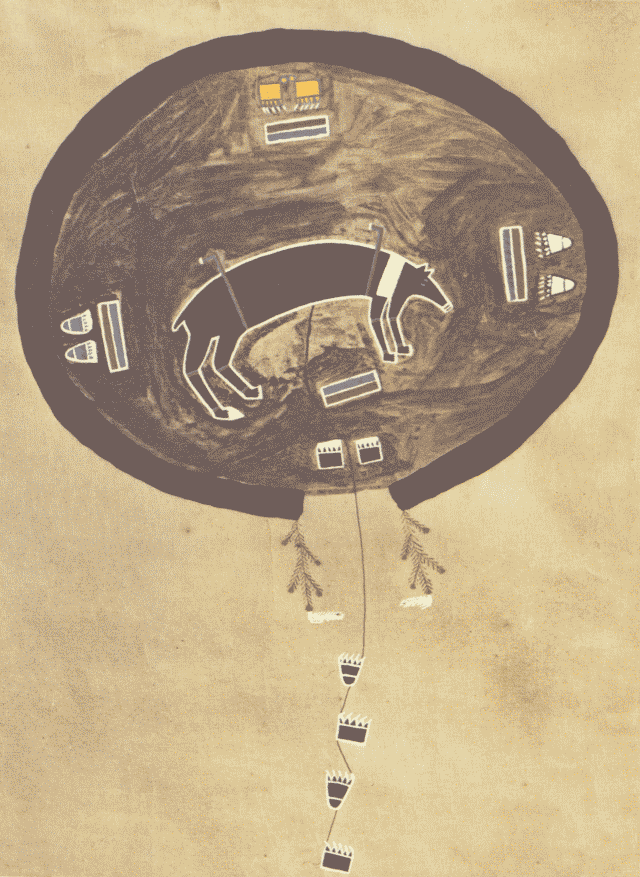
The above photo depicts a sand painting of the den of a hibernating bear. Bear-tracks made from earthen colors lead into the circle. Bear-tracks and sundogs (horizontal rainbows)* are represented at the four quarters, and the bear himself, streaked with sunlight, is the center image. The twigs at the entrance of the bear den represent the trees, behind or under which bears often dig their dens in the sides of mountains. Everything in the sand painting is supposed to remind the individual of bears. The person enters the painting and sits down on the animal. The room is bathed in deep silence. Suddenly, a man, painted and clothed as a bear (historically a grizzly), rushes in, uttering terrifying snarls and huffs. All the assembled participants join in to frighten the illness away.
The bear as the most powerful healer “scares” illness/disharmony away. The bear also appears in the same capacity during the sixth night of the Night Chant.
Part 2 will be posted next week.
*(1) For those that don’ t know – sundogs occur when ice crystals acts as prisms, separating the sunlight into different colors and forming a sundog. … Mainly, sundogs are visible while you are facing and looking towards the sun while rainbows occur in just the opposite location. In New Mexico one sees them frequently.
Discover more from Feminism and Religion
Subscribe to get the latest posts sent to your email.

 Feminism and Religion
Hello, this spoke to me as if I were awakening. I heard some kind of ping in my mind. I cannot explain it.
I know that there is Native American in my genealogy but I’ve never pursued finding out more.
Now, I am starting to think I should do so.
I’m not sure how to go about it but I think it worthy of investigation.
I do love your posts.
Blessid Be for sharing your wisdom with us.
LikeLiked by 1 person
Patty, I would pay close attention to that nudge – you are being ‘called’ into deeper relationship – don’t worry where to begin – anywhere will do because you will get a sense of where to go next…I started with studying Native mythologies – but you could choose any Indigenous Nation – Since the Navajo ‘caught’ you maybe you could start with them. Just be respectful and never attempt to appropriate any Native tradition as your own. My only caveat. I write all of my ceremonies and I use different traditions – some native -some not – but am careful – I do NOT take on any material as my own.
LikeLike
Hi, I write my own ceremonies and spells.
I just need to learn more.
Thanks so much.
LikeLiked by 1 person
Thank you Sara for this wonderful information. Here in Western North Carolina we relate with black bears every day. However, after Hurricane Helene I saw only one bear, the next day, wandering the streets aimlessly. It’s hibernation (torpor) season now, and there are certainly plenty of large fallen trees with huge root balls for denning in. I pray that our bears emerge healthy, balanced and with beautiful cubs. It means a lot to learn of the Dine traditions, relating so closely with bears.
LikeLiked by 1 person
YES, I FELT THE SAME WAY WHEN I DISCOVERED SO MANY TRIBES HONOR AND REVERE BLACK BEARS AS ROOT HEALERS – NO SMALL THING THAT! I HOPE YOUR BEARS EMERGE SAFELY – HERE IN MAINE WE SEEM HELL BENT ON KILLING THEM ALL –
LikeLike
Thank you for this awe-some post for it fills me with awe for the bear and for those who know how to connect with bears. I am fascinated by how the roots and recycling of waste keep their bodies strong and healthy through hibernation. I look forward to part 2!
I know that one cure for hiccups is being startled or frightening. It makes so much sense that illness can be dislodged by a fearsome bear.
LikeLike
ah too am fascinated by the bear’s ability to recycle waste and sleep without losing muscle mass – no one knows how they do this – shock sometimes DOES have that effect – I had a really bloody dream this morning – that shocked me into seeing a perspective i would have missed otherwise
LikeLike
Thank you for this informative and inspiring post, as always. I always learn so much from your posts! I especially love how bears and humans have this special relationship in the Navajo, as well as other traditions. And I find special resonance with your line “the Navajos, like many other tribal peoples have long respected and honored bears as being fellow “beings” with whom they share the land” with your emphasis the word “share.” If only everyone could learn to share the land with all other beings while maintaining that important reciprocal relationship with the Earth.
LikeLiked by 1 person