

Subtitle: Remembering Eve and the Power of Creative Transgression
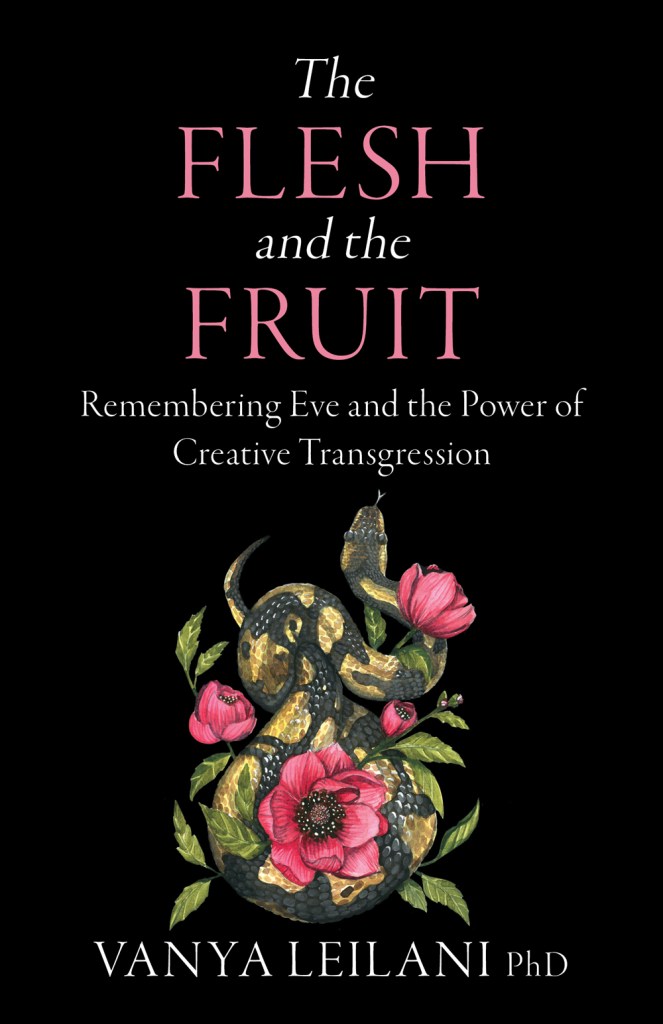
I have learned that every good story of spirit has many layers of meaning and pathways of understanding. Dr Leilani has found particularly relevant and even beautiful aspects of the biblical story of Eve. She uses Eve’s actions as a template of her own spiritual journey. Her pathway begins in obedience (listening to the voice of authority), travels through transgressive acts (eating of the fruit), and finally results in a self-knowing that had not been possible at the beginning of her journey. In this book we follow along on her quest to learn about herself with Eve as her inspiration.
This is a luscious book. Vanya Leilani’s insights are not only profound but are written with a poetic sensibility. I found myself speaking some of her passages out loud because the vibration of her words are powerful and feel so sensuous on the tongue. I wanted to take them into my body, as well as read them on the page.
Dr. Leilani had a fascinating childhood growing up in an intentional Christian community in a rural area of Brazil. At the time it felt idyllic to her. Here is how she describes waking up in the morning:
“From my room at the top of the hill, I would begin to hear singing, praying, crying, and laughing as hundreds of seekers found secret places for reaching out to God. It was magical. I loved the messy cacophony of humanity and divinity in those sounds that rolled up the hill, past the banana leaves, and into my little pink room. . . My small child’s heart basked in the sense of purpose and meaning. Most of all, I loved these images that filled me with a sense of wonder, a sense of connection to something unnamable, a sense of the world’s unseen spiritual depths (17).”
But as she grew up and began exploring for herself she began to see that the world of her childhood was a “too small paradise.” As many religious communities do, hers required obedience to beliefs and an acceptance that involved not asking questions. It involved fulfilling the model of the forever “good girl” who never transgresses nor disobeys truths as handed down by the community.
As she writes, “Eve is dangerous because she chooses knowing over goodness, sovereignty over safety. She disobeys in order to answer the call of her heart and body. She is guided by her longing (6).”
Dr. Leilani found herself longing for a larger life, one that included questioning meanings and beliefs. In blazing this pathway, she paid a heavy price, losing the community she grew up in, friends, even family. But once she discovered Eve’s door, one of transgression, she could not turn back. As she writes,
“My life could no longer be a walking announcement of The Answers. My life would become an act of devotion to the questions. Later, Rilke’s words – live the questions, live everything – would rage across my thirsty heart, carving out a compass where there was no map (21).”
Hers is a journey of passions which requires her to create her own pathway. She goes on to explain. “Creative transgression is a movement that both destroys old forms and creates new possibilities (23).”
Transgression puts together the roots of trans for step and gredi for boundaries. Together it means to “go beyond or to cross imposed limits. (20).”
Dr. Leilani notes that transgression gives Eve’s story power. She reminds us that “the Eden story is homeopathic: it carries our illness and our medicine (36).”
In describing her own pathway of longing, illness and medicine, she writes, “But my longing was stronger than obedience. It is not that I wasn’t afraid – I was terrified. But the desire to live more freely in the truth of my experience was stronger than the fear. My devotion to the questions was stronger than my devotion to the answers. And, I was profoundly devastated (56) . . . What I have discovered over and over again is that living the questions in much, much harder than living the answers. This shift in my life brought profound loss as what I knew was slowly dissolved, as I waited in the dark, as I let people down, as I learned how to bear being misunderstood and falsely named. Creative transgression has a way of undoing and unraveling us. Our days become like sieves as we watch what we have held dear and our cherished plans slip past us into the unknown (60).”
On a personal note, I read through this book twice and loved it both times. I knew I was in trouble in writing this review when I was only on page 17 (on the 2nd go-round) and I already had 15 passages underlined. How can I write a review, I thought, when what I really want to do is quote the entire book? This is a small book, under 200 pages but is so packed with insights, layers of meaning and revelations that it is hard to pick out a few key points that a review requires. I hope I have done the book justice.
I will complete with Dr. Leilani’s own words. Take them in, listen to their rhythms, and then I invite you to read the book in order to feel their full context and content. It is well worth it.
“Eve knows through her senses; her way is a sensual way. Eve’s transgression was not ideological or theoretical. Her transgression involved reaching hands, the sensuality of taste buds, and inglorious digestive juices. It is embodied action. . . .Eve knows through her body. This is the miracle: she trusts what she sees more than the instructions she was handed. She trusts her own authority. And so, too, may it be for us (108).”
For more information and to buy the book at Womancraft Publishing click here.
To buy on Amazon, click here.
Discover more from Feminism and Religion
Subscribe to get the latest posts sent to your email.

 Feminism and Religion
HERe! Right HERe, Janet, I stop. I smile. I HEaR so very deeply what you say, “How can I write a review, I thought, when what I really want to do is quote the entire book.” Your review did the same for me. I highlighted and highlighted. And paused. So many questions bubbled and are bubbling up still. In the stillness as the wind howls outside my window and another snow-storm speaks. I am soon to return to the choice morsels you selected from Vanya’s book, digesting and dialoguing with how they mean for me.
~~~
And from Vanya, “But my longing was stronger than obedience. It is not that I wasn’t afraid – I was terrified. But the desire to live more freely in the truth of my experience was stronger than the fear. My devotion to the questions was stronger than my devotion to the answers.“
Sawbonna,
Margot/Raven Speaks.
LikeLiked by 1 person
Thank you for your comment Margot. I am delighted that you also loved this book and are inspired to return to the beautiful and powerful words she writes.
LikeLike
Living the questions does unravel us but isn’t it the only way to become who we are?
LikeLiked by 1 person
Amama ua noa (so let it be without limit), Sara. Perhaps that is the original sin, the one that says it isn’t OK to question. In that, we lose ourselves.
LikeLiked by 1 person
You may be right – I personally think you are
LikeLiked by 1 person
I had a similar experience strangely enough in my own church. But unlike this author who has something beautiful in her community more or less, I didn’t have anything beautiful. Just perpetual boredom and stepford wives and hypocrites. Glad I got out of it.
LikeLiked by 1 person
Glad you did too MM. It does beg the question, which is harder to leave, a community that is beautiful but otherwise authoritarian or one that is nothing but boredom and irony? I guess they both present their unique challenges.
LikeLiked by 1 person
It’s true, some people love beautiful lies. I don’t. They’re the same to me. I’m Pagan and proud of it lol
LikeLiked by 1 person
I will complete with Dr. Leilani’s own words. Take them in, listen to their rhythms, and then I invite you to read the book in order to feel their full context and content. It is well worth it.
LikeLiked by 1 person