

As we move deeper and deeper into full autocratic rule, the timeless themes found in mythology help me find my way.
My first thought for these days was of Pandora, whose story in the myth of Pandora’s Box serves as a powerful metaphor for the complexities of human choice—relevant today by the choice of many to elect Trump, resulting in multiple destructive consequences.
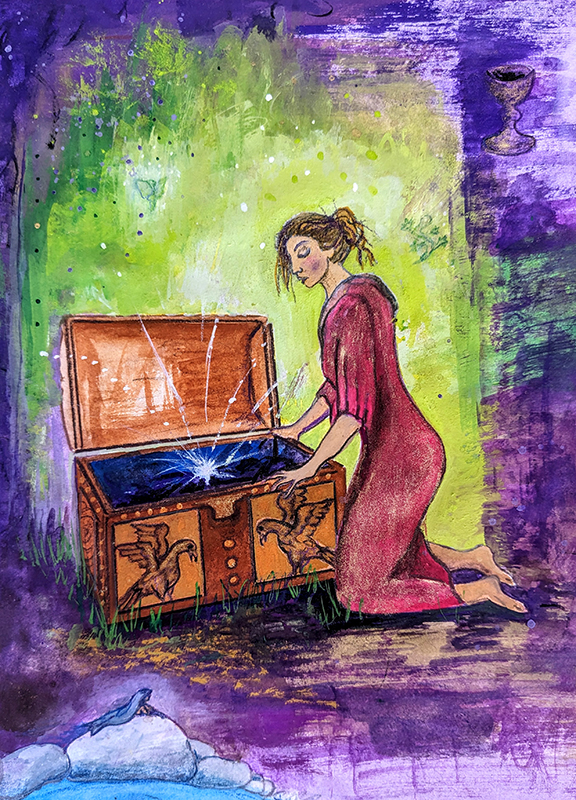
Yet I resisted using Pandora’s story as a metaphor, as this tale casts her as the evil bringer, setting the stage for the denigration of women.
But then I learned that there is an ancient and very different story of Pandora—as a goddess who brought life-giving gifts to humanity. But first let’s explore the traditional Greek version of Pandora’s Box, with its heavy dose of misogyny and male feelings of superiority.
According to Greek writers, during the Golden Age of Men the only humans were male. During this Golden Age the males lived in relative comfort, free of old age and death.
But as the Olympians battled the Titans for control of the Heavens, Zeus took away the gift of fire in punishment for one of the Titan’s actions. But Prometheus took pity on the men, defying Zeus by stealing fire back and gifting it to humanity again.
Zeus proclaimed a terrible sentence for Prometheus. He was bound with unbreakable chains to a mountaintop where his liver was torn out daily by an eagle.
That wasn’t enough for the angry Zeus. He also punished humanity for accepting the gift of fire with a devious punishment that would last forever.
Zeus commanded Hephaestus to make a new human out of clay in a feminine shape, previously known only to goddesses. Once her form was completed the other Olympians endowed her with a variety of gifts—some beneficial, but many not.
Hermes gifted her with speech and a quick wit, but also made her a skillful liar. Though Aphrodite gifted her with great beauty, charm and grace, she knew these same gifts would cause men to fight for her favor. Athena taught her weaving, a much needed skill, but she did not bestow her with wisdom or might. She was designed to be deceitful, manipulative and an expert in the use of feminine beauty and wiles.
Given the name Pandora, “All Gifted,” she was sent to live among the men, in particular to Epimetheus as a gift. Though he had been warned by Prometheus not to accept anything from Zeus, Pandora’s beauty, like that of a goddess come to Earth, was irresistible.
Pandora brought with her a pithos (an ancient Greek jar) fashioned by the Gods, often mistranslated from Greek as a box. The Gods told her she must never open that jar.
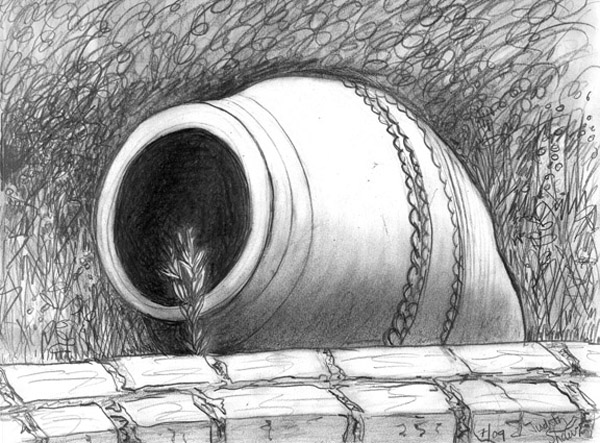
We all know this part of the story. Pandora, burning with curiosity, ultimately opened the jar. Horrified to see all the various forms of suffering escaping into the world, she quickly closed the jar—with hope, the only good thing in the jar remaining.
This story tells us that the first woman brought the end of the Golden Age and eternal suffering for humans. But even from this patriarchal account, the compassionate nature of women could not be completely denied. Pandora gifted humans the ability to maintain hope, even during the darkest of days. Hope remains a powerful force, helping us through difficulties. Hope allows us to maintain a vision of better days and to triumph over disasters and dictators.
Pandora’s story doesn’t end there. She gave birth to a daughter, Pyrrah—the first human not born to a goddess. Pyrrah married Deucalion. After surviving the great flood sent by Zeus as yet another punishment, they then repopulated the Earth by casting stones over their shoulders, which turned into a new race of men and women. In this way, the first woman, Pandora, and her daughter created the human species.
It’s likely there’s a pre-Greek version of Pandora’s myth in which she was revered as a Mother Goddess. Gaia, the original Greek Creator Goddess and mother of all the deities was worshipped under the epithet “Anesidora,”(“giver of gifts”). Pandôros is one of Gaia’s names. Perhaps in the original story it was Gaia who came to Earth as Pandora, bringing life-giving gifts to humanity.
Archaeological evidence, dating from long before Hesiod first wrote the story as we know it, supports this view. There are painted pottery images of Pandora emerging from the ground, in the same way that Mother Goddesses are often depicted.

As a Mother Goddess, Pandora’s gifts were those of fertility, nourishment, protection and compassion. Even in the story of Pandora’s Box she brought the gift of weaving, an important skill that allowed early humans to create warm clothing.
Mythology reveals so well how the patriarchy upended ancient goddess worship, as stories like that of Pandora illustrate. If the earliest version of Pandora’s myth was true, then her story of a powerful, life-affirming deity needed to be changed. Pandora, like the biblical Eve, became the cause of all the evils of the world.
When taking the two versions of Pandora’s story into account, I find that the meaning of her story for this time is even deeper than that of the power of hope for the human spirit. The myth’s rewriting speaks to the destructiveness of patriarchal consciousness and its inability to recognize itself for what it is—an unbalanced way of being that seeks its own self-aggrandizement over the good of all, that seeks death over life. It projects all the horrors is has wrought onto woman, blaming her for the violent discord in the world.
We see this writ large by the Trump administration as they project their own evil intent onto the Democratic Party who, at least in words, supports the feminine principles of nourishment, protection and compassion. Not to mention their literal war on women and minorities—in health, in employment, in economic opportunity, and in protection.
Today we find ourselves at a crossroads. Either we choose to continue with this long history of conquest, violence, and oppression based on patriarchal consciousness or we choose to fully embrace the ancient wisdom of Mother Goddess, who calls us to live in harmony with each other and nature.
The first path leads to the destruction of modern civilization. The second leads, through difficulty, to a bright, new day. Will we, as a species, heed her call?
View Judith’s art on her website. Click here.
Find Judith’s Celtic Goddess Oralce deck on her website. Click here.
Discover more from Feminism and Religion
Subscribe to get the latest posts sent to your email.

 Feminism and Religion
Thank you for this piece, Judith. Mythology and “story” is so very important to understand. It informs us how to live in the “here and now.”
LikeLike
For sure Esther. I guess we could add the importance of teaching and understanding history into that mix with myth and story as important factors in growing understanding.
LikeLike
You Nail it Judith -“The myth’s rewriting speaks to the destructiveness of patriarchal consciousness and its inability to recognize itself for what it is—an unbalanced way of being that seeks its own self-aggrandizement over the good of all, that seeks death over life. It projects all the horrors is has wrought onto woman, blaming her for the violent discord in the world.”
I think this is why I now stay away from Roman/Greek/Celtic etc mythologies – I don’t think they can’t help us by spinning a new cocoon round the old story – please know this is just my opinion – they depress me – reflecting our current state of affairs…. and how could it be otherwise we have been headed this way for thousands of years?
Woman = Earth. We are ONE. Note that nature weaves females and males – all beings – human and non human – and some like lichens are both – into one story that only works in partnership. Nature is the weaver … we’ve become the destroyers.
LikeLiked by 1 person
Yep- we truly are one interconnected being—like individual drops of water who are simultaneously separate from and yet merged with the great ocean of being.
I understand your feelings on mythology, but I still find meaning in what these tales reveal about the past time of Goddess worship, the transformation into patriarchy and how in spite of all the oppression, the Way of the Goddess remains and gains strength once again.
LikeLiked by 3 people
Oh Judith I think that’s just fine! I think we all need to choose the myths that we find most helpful to express how we feel. The goddess will be with us until we are no more – How could I have forgotten? I absolutely LOVE your painting – it is so expressive of what I call an ancient truth – She endures…
LikeLike
I loved your re-telling of the Pandora story — or should I say the unearthing of her true story so distorted by patriarchy. Thank you for that.
I especially loved your artwork.
LikeLike
Thanks Beth, I always love unearthing the stories of feminine wisdom hidden within the myths from patriarchal times.
LikeLike
This is beautiful. It reminded me of how J-hope has also incorporated the story of Pandora into his music of hope (in his album Jack in the Box). He is deeply committed to feminism and spreading love and hope. Something we all need for sure.
LikeLike
That’s cool. A musician like J-hope has great reach so I’m very glad to hear about his commitment.
LikeLiked by 1 person
Brilliant and starkly, beautifully clear!
LikeLiked by 1 person
Thanks Elizabeth, That means a lot coming from you!
LikeLike