

I moved to the mountains to move mountains, to find peace in the hidden crevices of an endangered planet.
We pull out her hair, clumps at a time, self-harming her* in a myriad of new ways.
Wildfires burn up our forests, floods destroy precious lowlands. Loggers strip the possibility of new life from the soil. Our childhood stories become our adult lives: The Giving Tree who gave it all. . . .
The land doesn’t break; just dips and hides in private caves.
I moved to the mountains so that the predators of my past wouldn’t find me.
Their spirits crawl out from unvisited graves.
[Excerpted from the poem, Mountain Life by Rebecca Rogerson.
They slip past the disappearing forests of canopied evergreens that once shaded and protected Ki’s children. [Ki is short for Kin – more on what this word means in Part 3.]
Mountain Reflection on May Day
Part 1
On long walks in fragmented forests, alone now, my dogs are old and ill, I seek the gift of silence so I can listen to trees, bees, and the haunting songs of the hermit thrush.
I trust dreams, visions, the grace of living in the moment; the latter is becoming harder to do.
I moved to the mountains to accept my vulnerability because no one else will. I surrendered my life to Nature who has had 3.7 billion years to develop Ki’s wisdom.
I wish I was not still seeking the intoxicating scent of evergreens. Air pollution permeates the void left behind making it harder for trees and people to breathe. Pinenes heal.
Scholar Dr. Mark Anderson who has spent his lengthy career as Director of the Nature Conservancy and is now also associated with Northeast Wilderness Trust tells us that western Maine has become a hole in the sky. We are no longer storing carbon because of the lack of mature trees. This is the wave of our future.
Part 2
May Day warmed under a piercingly bright golden sun with the buzz of a thousand tiny wild bees hovering close to ground to gather nectar and pollen from bloodroot, squill, and crocus. Winter wren’s poignant song floods my senses. One turkey danced with his auburn tail shimmering burnt umber in the sun. No hens about– the lone jake just kept prancing and dancing as if to celebrate May Day and the Greening of spring. The animals appear at Ki’s turnings.
I sat on my dad’s bench to weave willow strands onto a newly budded wreath. Is it possible to reweave what is broken on earth and in me? I soaked the willows, gathered in the rain the week before. I follow Ki’s instructions, with a prayer to let go of outcomes…
A trip to my favorite forest for the afternoon allowed me to stay present to awe as I leaned into Nature’s Greening.
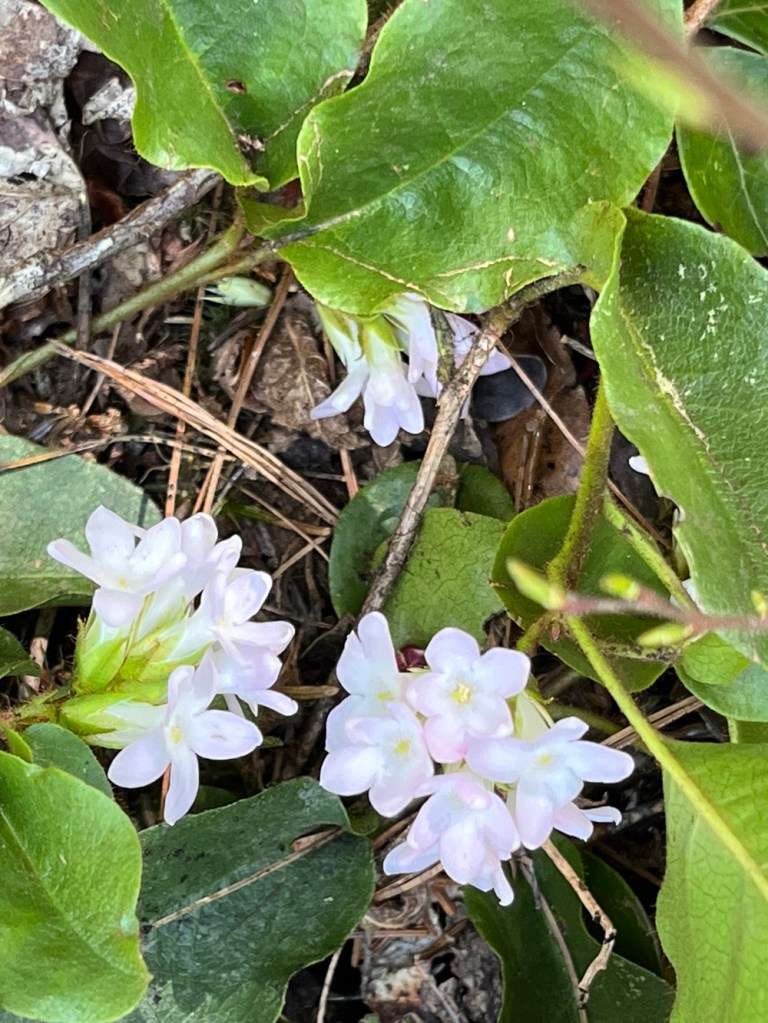
Walking some of my beloved paths I noted the changes from the week before. Slender spikes of magenta trillium, shimmering wintergreen leaves replace dull brown, the delicate opening of my favorite wild viburnum, hobblebush, was visible in all three spring phases. Lavender blue, and white wood violets peeked out of nourishing old leaves, a rare native honeysuckle was budded, false hellebore is in ki’s emerald glory, and the first budded trailing arbutus had pink pearl trumpets announcing to the bumblebees that they are ready for pollinating. When I bend down to sniff the perfumed arbutus I am transported into another dimension. At the vernal pool (endangered) clusters of wood frogs’ eggs are attached to twigs just under the surface, croaking love songs over.
Time spent peering into the river’s still mirror or listening to rippling water flowing over stone soothes me; some streams are still clear and full of fish fry. A visit to my beloved hemlock forest offers me strength, the kind that is focused on respectful relationship for all, the kind that spans generations.
I met three geese who live in community at the edge of the pond. When I saw the first goose, I was reminded of a story that speaks to how life begins again.
In the Anishinaabe Indigenous Creation story when the Tree of Life was uprooted the branch that Sky Woman held was severed. She tumbled into a great hole of darkness and kept on falling….A goose finally broke her descent and deposited her on the back of a great turtle. The animals dove into the water to procure the precious soil to cover turtle’s back, and a new earth was born.
Part Three Ki
“When Earth Becomes an It”
This is the name of an essay by Author/scientist Robin Wall Kimmerer which was recently published in an international women’s anthology Dark Matter: Women Witnessing. Dreams before Extinction. I have been privileged to be a contributor to this collection of extraordinary stories – created by women in community.
To date this volume is the finest offering of women’s writings I have read or participated in. These heart-centered essays attach us to other women who are struggling with many of the issues familiar to us all.
I want to focus on Kimmerer’s essay because as a hybrid writer When the Earth Becomes an It – highlights my ongoing problem. I have been stuck for years with the English language that creates a barrier between what I feel and the words I need to use as a nature/science writer and story- teller.
Let me make it clear that I believe all nature is animate. More than that I believe that all non – human beings are not only alive but sentient (feeling, sensing, seeing, hearing, tasting, scenting) – some even read the future for those capable of listening. I’ve come to understand that nature’s intelligences far surpass our own.
When I first encountered Kimmerer’s’ ideas on how much we are influenced by the language we use, I had already been driven crazy as a nature/science writer by the way we objectify and de- personalize nature turning her automatically into the ‘Other’. To give you an example: a red maple is blushing, budding crimson to gold, and I gaze up at it with a sense of wonder.
I have used awkward pronouns like She, S/he, he, they to desperately try to get around this ‘Otherness’ without success. I always end up “it”- ing.
Kimmerer’s suggestion to use ki when addressing another non- human being is one that I have begun to use in writing and voice as a form of personal protest against Othering.
I didn’t realize that I would fall in love with the word that fits what I feel/experience so acutely.
The use of ki, short for kin instantly connects us to bear, bloodroot, or jack in the pulpit in an intimate way. If we want to explain more about particulars, we are free to do so once we have established that we are related to whoever we are talking about.
Another example. We share 50 percent of our DNA with trees but that isn’t enough for most people to imagine trees as kin.
When I look out my window on this rainy day the first delicate lime green wild chokecherry leaves are unfurling. I no longer think about the sex of the tree, ki’s mythology, or natural history but only that this wild cherry and I are kin.
Language and words structure how we see and experience the rest of the world, and I think that unless we begin to change our language we can’t possibly begin to think about nature as animate or teach our children to do the same.
We simply could not continue to treat the earth the way we are if we thought of ki as Kin.
Although, I have been familiar with Kimmerer’s suggestion for some time I have only just begun to use it in my writing, and it feels just right.
Yesterday while I was in the forest any time I spoke to a bush or plant, or listened to flowing waters, or was serenaded by bird song not one thought interrupted my sense of presence to those beings. My kin were all around me. When I stopped to clasp my arms around a portion of my favorite hemlock ( ki’s circumference is too large) I whispered ki and felt a response emanating from that tree.
I would like to respectfully challenge anyone to use the word ki when meeting bird or bug to see what happens. I think it wakes us up.
Although for some who feel more separate from nature or too used to learning about a species rather than experiencing ki may find it awkward to address any non – human being as kinwithout letting the mind take over with questions/judgements/categorizing etc. please don’t give up.
I think I can promise that if you practice this exercise something will happen. Treat naming as a form of meditation. Begin with your houseplants or if you are a gardener address the first sprout you see as ki.
In this time of earth’s travail changing our language might be a way to reestablish kinship with individuals and the planet that happens to be our home. Perhaps then we might not feel so lonely.
Discover more from Feminism and Religion
Subscribe to get the latest posts sent to your email.


Hello Sara, Thanks so much for this thoughtful piece. Not being a native English speaker, English is still the first language in my mind and the language I communicate in with the world and my tree and plant and animal friends. I usually say things like ‘hello you’, ‘hello grandmother’ (to an old yew tree), ‘hello friend’ to the birds and bees, or simply ‘hello river’. Would you propose saying Hello ki to all of them? For me that creates a level of abstraction and impersonality, a move away from intimacy rather. As if we’re inventing something other, yet another distinction that separates or creates distance. I too see all nature as animate, and acknowledged even in my PhD thesis the Hollyhock I would greet every morning on my way to the university. “She” helped me through many a challenge, with her steadfast presence… She feels like family, friend, kin, yes, all. And, ‘she’ feels more intimate than ‘ki’ – a word I’ve indeed come across in Kimmerer’s work, but it doesn’t feel personal enough to me. And why not saying kin instead? Just some thoughts that are coming up while pondering your article! Thanks again! Eline
LikeLike
Like you I have spent my life addressing trees, flowers, roots, waters in personal manner, sometimes acknowledging this being as he or she according to how I feel …. (all are kin and could replace ki according to whim -) THE POINT IS TO REMIND ONESELF THAT WE ARE FIRST KIN – not for folks like us but for others who feel more separate… this works on a personal level BUT does not work as a science/nature writer where it is normalized to ‘it’ everything. And the use of ki/kin does away with that othering instantly by reminding the reader that naming ki establishes our relationship with this being first BEFORE going into scientific categorizing that will instantly separate the writer from the person (whoops – haha – I meant subject) because science is stupid enough arrogant enough to see itself as’ impersonal’… If you are not a writer and all nature is alive for you there is no reason to change the way you address your friends. BUT if you are discussing research then inserting ki/kin in first and then using that word anytime an it is required – FREES us….. because I am both a lover of nature and a research writer I have been driven crazy by so called objectivity required by the latter… and the use of ki/kin first collapses that separation. Another thing when I am in the woods because I have been trained as an ethologist/ecologist it is easy for me to start thinking about what pollinators like my marsh marigolds best for example which pulls me out of the moment…. and the use of ki allows me just to be with this flower I love. I hope I have explained a critical distinction between the personal and the scientific perspective. Science’s objectivity got us into this mess – I want break down these walls…. and for ki just works as a form oof personal address after I have told my marigold I love her… hopefully I have clarified the distinction – am just starting to write about this so need all the help I can get! I want to hear more comments like yours
LikeLiked by 1 person
Ah yes, that’s a great distinction! Thank you. I’ll sure reflect on this for my next pieces of writing (at the moment I’m writing a chapter for a Bloomsbury collected works on Solitude – my chapter is on Nature & Solitude; as an anthropologist I feel they consider my language too subjective already, but I’ll see if I can make a note on this at least!
LikeLike
I am thrilled that “I Moved to the Mountains” was somehow inspirational for this poem. It seems we live in similar natural places. I loved the lines, “A trip to my favorite forest for the afternoon allowed me to stay present to awe as I leaned into Nature’s Greening”. It really speaks to the experience of spring!
LikeLiked by 1 person
I am thrilled that “I Moved to the Mountains” was somehow inspirational for this poem. It seems we live in similar natural places. I loved the lines, “A trip to my favorite forest for the afternoon allowed me to stay present to awe as I leaned into Nature’s Greening”. It really speaks to the experience of spring!
LikeLiked by 2 people
Yes your poem and my added words speak the same language – thank you!
LikeLike
Part 2 reminded me of a book I read as a teenager in the late ’50s. My memory is that it was called Journey into Spring. It described a family road trip across the southeastern (?) US with detailed descriptions of the unfolding of the season. (The next book in the series, was called North with Summer.)
I am a big fan of Robin Wall Kimmerer. I look forward to reading the book you describe. I completely agree that it’s important to pay attention to language, as it shapes our thought. I’ll have to think about “ki”. Does it replace “you” or “it” or both?
LikeLike
oh beloved avatar thanks for your opening once again these jaded old white man eyes to the possibility of reforming this language to show more connection. i bless your work and heart, brooksie in las cruces nm
LikeLike
Thank you so much for the word ki for speaking to our kin. And thank you Robin Wall Kimmerer. Pronouns for all our relations has posed the same problem for me, and I feel a great sense of relief and recognition. Here’s an excerpt from a poem about my mourning for a great oak friend ki fell after standing for more than 300 years.
some people called you grandmother
some grandfather, he, she. they wanted
you to be a person, you were, you are
an arboreal being, no pronoun is adequate
for you, so I keep saying tree,
oak, great white oak, tree, beloved tree
fallen tree, hollowed, hallowed tree
however you know yourself I am with you
sorrow doesn’t rest on the seventh day
LikeLiked by 2 people
OH Elizabeth how I love your poem!!!!! truly you are so gifted! i am also grateful that Ki/kin doesn’t deems so foreign to you – but you would know because you are a writer – and oh what a problem this poses for some of us. I am just beginning with using ki and find the word so comforting…. Thank you for this feedback…. what iw wonder – is this problem not relevant except to those us who know the earth is animate – if so it poses other problems – I’d love your feedback on this
LikeLike