

Branwen’s Story
Branwen, sister of King Bran the Blessed, was cherished for her gentleness, compassion, and beauty. As the mother of the future king in the tradition of the Old Tribes of the British Isles, she embodies Sovereignty. She is the source of all life, ruling over both the spirit and the land.
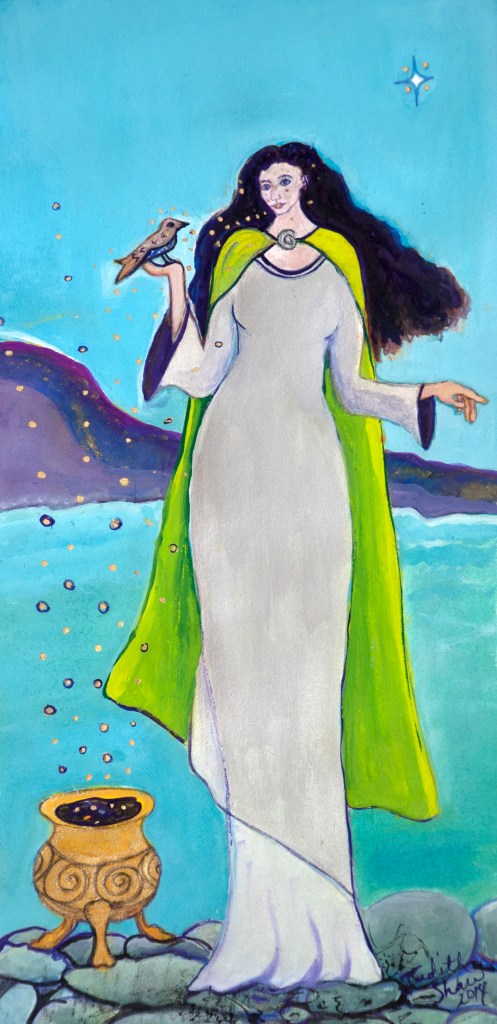
We first meet Branwen when the Irish King Matholuch arrives, his fleet signaling peace with a great shield pointing outwards. He asks for Branwen’s hand in marriage—a significant event, as no woman of the old tribes had ever left her people for a foreigner, much less she who would give birth to the next king. Nonetheless, Matholuch is welcomed ashore, and Branwen is summoned.
As I have already written about Branwen (read here) and to avoid repetition, I’ll fast-forward to the end, where the cauldron of life and death reenters the story, the same cauldron associated with Badb.
After being cast out and mistreated by Math, Branwen sends a message of her plight to her brother, King Bran. Horrified, he gathers the men of Wales and sails to rescue her. Thanks to Branwen’s pleas for peace, her release is negotiated without war.
The price for peace is that Branwen’s son, Gwern, will become the Irish High King, replacing Math. The Irish also agree to build a house large enough for Bran, a giant. It seems her hardships are over, and peace will reign for her and her lands.
However, the compassionate Way of the Goddess, as exemplified by Branwen, is not destined to last. Her angry, violent brother, Evnissyen, brings catastrophe by throwing Gwern into the fire during a celebration, killing the child and shattering hopes for peace.
War erupts between the two peoples. At the end of the day many lay dead. Then the Irish made the fateful decision to use the Cauldron of Life and create demon warriors from the dead ones. This was the very cauldron Bran had given Math to secure the marriage with Branwen, along with a warning that the Cauldron was to0 powerful to ever use.
Terrible battles ensue, and all seems lost. Finally accepting responsibility for his destructive actions, Evnissyen sacrifices himself by entering the cauldron alive and breaking it apart from within. Toxic fumes engulf the land, killing all except those sheltered in the Irish Halls of Tara and Bran’s new house. Even the islands between the two lands sink under the Cauldron’s fumes.
King Bran informs the Irish that they will leave the island to seek peace and reconstruction. However, treachery strikes again as the remaining Irish warriors ambush the Welsh, delivering a fatal blow to Bran with a poisonous spear.
Not wishing to endure a lingering death, Bran asks his brother to behead him and carry his head back to Wales. Only seven men return to the Isle of the Mighty, accompanied by Branwen and Bran’s magical, talking head.
In addition, all who had been left in charge of King Bran’s court, including his son, had been killed during the men’s mission in Ireland. Another, not a son of the king’s sister but the son of a previous king, took control—the first time male lineage prevailed in that land.
The companions passed their first seven days at Harlech, the abandoned site of King Bran’s courts, where it became clear that Bran’s head was wiser than he had been in life. He attempted to heal the trauma within them, but sadly, Branwen was beyond hope and died of a broken heart. The hope for unification of the Old Ways and the New, symbolized by her marriage to the Irish King, was lost.
Yet the lessons of the soul continued as Bran’s head and his seven companions journeyed to the magical, timeless land of Gwales, the Pembrokeshire island furthest out to sea. Here, they learned important soul lessons before bringing Bran’s head to its final resting place in London.
Their feast at Gwales marked both a beginning and an end—the end of the world of the Children of Llyr, a time when women and the Goddess were honored as sovereign beings, and the beginning of the absolute rule of men.
As we learned about Badb’s cauldron—though it signifies life, if it overflows, the world will end. That is what happened when Evnissyen threw himself into the cauldron alive and broke it apart from within. This ending of one era and beginning of the next is captured in a Druid’s prediction after the destruction:
“The Island of the Mighty will have many kings now, but none will reign in peace, and none will found a dynasty. And in the end fair-haired invaders will sweep over all and subject us all—New Tribes and Old alike. Bran might have prevented that, had he not given away his sister and the Cauldron, that symbol of the cup within her body—the power of birth and rebirth, the power of woman. Now for ages women will be as beast of the field and we men will rule, and practice war, our art. By it we will live—or by it, rather, we will struggle and die.”
Is Badb’s cauldron boiling near to overflowing again?
Are the multiple storms converging on the world a reflection of the chaos accompanying the decline of male-dominated rule and the art of war? Could our time be the one in which the death loving Patriarchy will finally end, making way for something new?
Yet what world will we create out of the destruction of the old way? Will it be a world imposed on us by the technocrats’ dream of robotic life in outer space. Or will it be a world which lives in harmony with Earth and all her children?
Both Badb and Branwen offer important yet distinct lessons for us during these liminal times..
Badb mirrors our negative patterns and unloving thoughts, empowering us to release even deep-seated ancestral burdens. She embodies our passion for a loving world with vitality and courage while also manifesting purity and light. She is the Keeper of the Cauldron of Life, Death and Rebirth
Branwen, on the other hand, embodies love and compassion, guiding us away from the negative actions that Badb might inspire. Through love, she seeks to unite different views, forgiving and striving for peace despite all her suffering. Branwen embodies our ability to endure suffering in the face of tyranny, while maintaining our nurturing values of compassion, and love.
Perhaps times of extreme disruption are the best opportunities for us to look within and embrace chaos, emerging renewed and transformed, ready to create a world aligned with our soul’s inner dream—a world where we all understand that everything is connected: allowing love, compassion, and abundance thrive.
May we call upon the wisdom of both Badb, who empowers us with courage and fierce determination, and Branwen, who embodies love, empathy, and gentle resolve.
View Judith’s art on her website. Click here.
Find Judith’s Celtic Goddess Oracle deck on her website. Click here.
Discover more from Feminism and Religion
Subscribe to get the latest posts sent to your email.

 Feminism and Religion
Thank you for both of your posts, but especially this Part 2. I’ve taken some classes with a professor of Welsh history and mythology and never heard Branwen’s story presented with such clarity, and more importantly, with reference to the rise of the Patriarchy.
As an astrologer, I see we are in the backlash to a paradigm shifting event that took place in January of 2020. Saturn and Pluto came together in Capricorn (consensus mind, authority, corporations, government, traditions, patriarchy) for the first time since the mid 1500s. At that point Henry VIII and Martin Luther made successful breaks with the Roman Pope. But the backlash was still in play during the reign of Eliz 1. Those who wanted a Catholic on the throne again were creating plots to assassinate her which her ‘handler’ Cecil was able to thwart (he created the largest spy network ever known back then for this reason).
Now, we have the paradigm shift coming for hierarchy and patriarchy. The Roman Church was weakened by Vaticangate and we’ve had one and now another Pope who actually follows the teaching of Jesus. Suddenly the dictators come out of the woodwork, worship of the golden calf and the zealots with them.
We don’t have a Goddess to represent us now, but we have ourselves awakening to our power which is not violence, as you say, the the power of joined intention and vision. The’ve said it’s always darkest before the dawn and I will continue note the darkness while I continue to visualize the dawn.
LikeLike
Thank you, for all of this.
LikeLike
Glad you enjoyed my thoughts on this and Shellie’s thoughts on what we can learn from astrology about our times.
LikeLiked by 1 person
Shellie,
I appreciate your kind words about my interpretation of Branwen’s story. I am not an academic; I simply follow where my heart leads.
Though I am not an astrologer myself I have studied and followed it for my whole adult life. I find that astrology helps me make sense of the world and understand better the larger forces at work. The universal forces at work right now, as seen in the stars, are most certainly world shattering. I too will continue to note the darkness while visualizing the dawn, as you say.
But I do believe that we still have Goddess and she resides within us all. As we learn from so many of the Goddess archetypes, she is both creator and destroyer. She is the fire that burns and the cool rain that rejuvenates. But she doesn’t control, she guides.
LikeLike
I loved your conclusions from these myths, Judith. So deep and beautifully put. Yes, I think we’re witnessing the death throes of the patriarchy in all the extremist violence and governments, most notably our own, which is so bad, it is like a charicature with its forbidding of DEI. I think the patriarchy is on the way out and these two goddesses offer us precisely the qualities we need to navigate our rebirth. Thank you!
LikeLike
Poignant, brave, and beautiful post, Judith. Thank you! I was very struck by this sentence: “a warning that the Cauldron was too powerful to ever use.” It certainly resonates with our time. But the cauldron, as you note so eloquently, is also the source rebirth and renewal. Thank you for reminding us that we carry it within us.
LikeLike
Elizabeth,
Thanks for your kind words about this post. Yes I thought that the Cauldron being too powerful to every use, mirrors the nuclear threat we live under every day. But different of course as nuclear bombs do not have birth and renewal in them except for that which would come after it’s destructive use. The Cauldron is life in all its aspects; the bomb is only death
LikeLike
Thank you for this wonderful part two Judith! I have always admired Branwen’s deep love and appreciate how you have paired it with Badb’s fierce determination. May these Goddesses guide and inspire us through these difficult times. Blessed be. ❤️🍃
LikeLike