

As I paddled the lake this morning, I found myself thinking this is what the end of the world looks like. The sun was rising red through smoke from Canadian wildfires and a smoky haze engulfed the lake to the point I could barely see the not-too-distant opposite shore. I was paddling by the state forest, where the March ice storm had stripped the tall pines of their upper branches, bent the birches, and uprooted and sent out to sea the largest of the trees. The camping spot at the spring was inaccessible so covered was it by downed trees and branches. All was bent, broken, and dying and the forest itself appeared to be weeping. Adding to the surreal aspect of this moment was the plethora of motorboats pulling skiers and jet skis bouncing along on what would otherwise be a quiet, calm lake – oblivious to or simply not caring that they were frivolously burning the very fossil fuels that had fueled this environmental crisis and catastrophe. It was as if I were watching an Octavia Butler dystopia play out with the rich and privileged burning up the last of the fossil fuels with disregard for the earth and disdain for earth’s advocates.
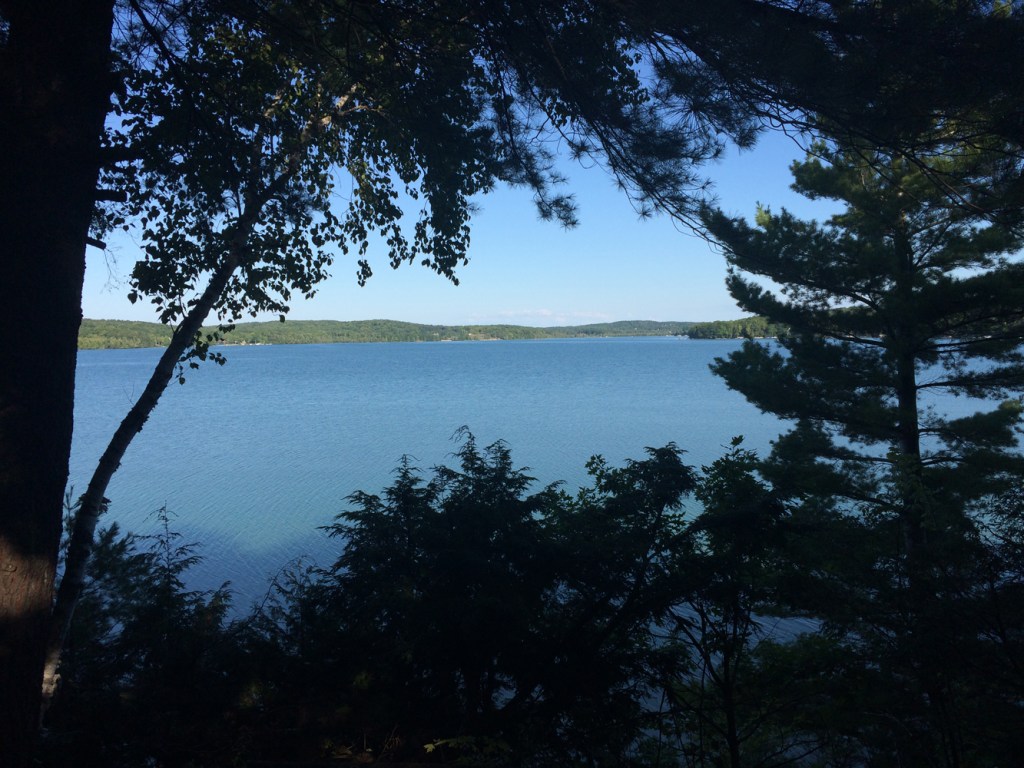
I began going to this lake in northern Michigan when I was two. Every year my mother would comment on how blue the sky was, how clear the air – such a contrast to northeast Ohio where we lived with its rubber factories, making the sky a hazy gray, even on the sunniest of days. We would marvel at the depth of the blue. This visit I never once saw a blue sky, nor even across the lake. I have hundreds of photos of the beautiful vista from the hill upon which our cabin sits, simply because of the stunning blues, but this year I took not a one.
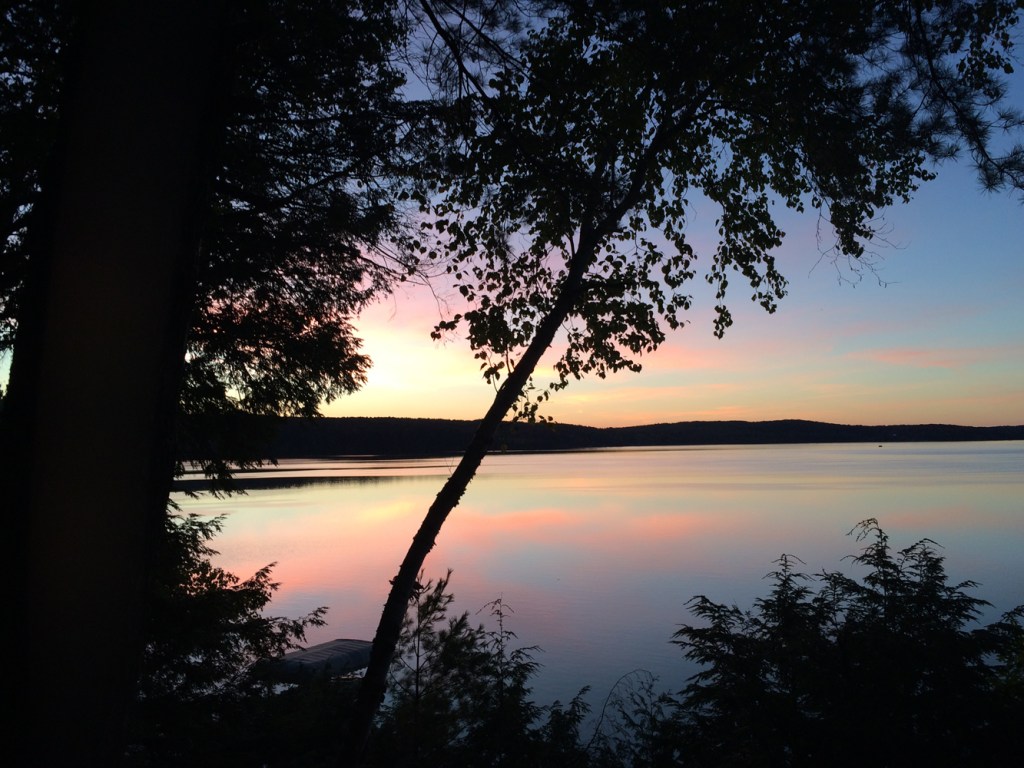
Our family had a tradition of every evening sitting together on the hill to watch the sunset. Even if we’d gone out for dinner or for a walk down the road, we had to get back in time for the sunset. We’d seen dozens, hundreds of gorgeous sunsets from that hill. But this time the one I photographed was the last of our time there as the setting sun would drown in a thick bank of smoke near the horizon. At best, it would be a red ball, but usually it just disappeared.

Later I headed to the old forest where I have always found such serenity amidst the tall trees, only to find that they, too, were mostly destroyed, bent, and broken. A huge ice storm had hit the entire northern third of Michigan in the last days of March, coating the trees with an inch of ice just before being hit by 70 mph winds. The heavily forested land lost thousands, millions of trees. The storm was called “historic,” “generational.” No one who had spent their lives in the area had ever seen anything like it.
I spoke with a local farmer, who was mourning the loss of half of the trees in their woodlot, saying she wouldn’t see it returned to its vibrancy and beauty in her lifetime. But at that moment she was distressed by the poor air quality and how it was affecting her flowers and her crops. When I mentioned that I had noticed my dog having trouble breathing in the smoky air, she said she felt like an old dog, having to be out in it day after day at her farmstand. And if it was having this effect on her, what was it doing to the birds, she wondered.
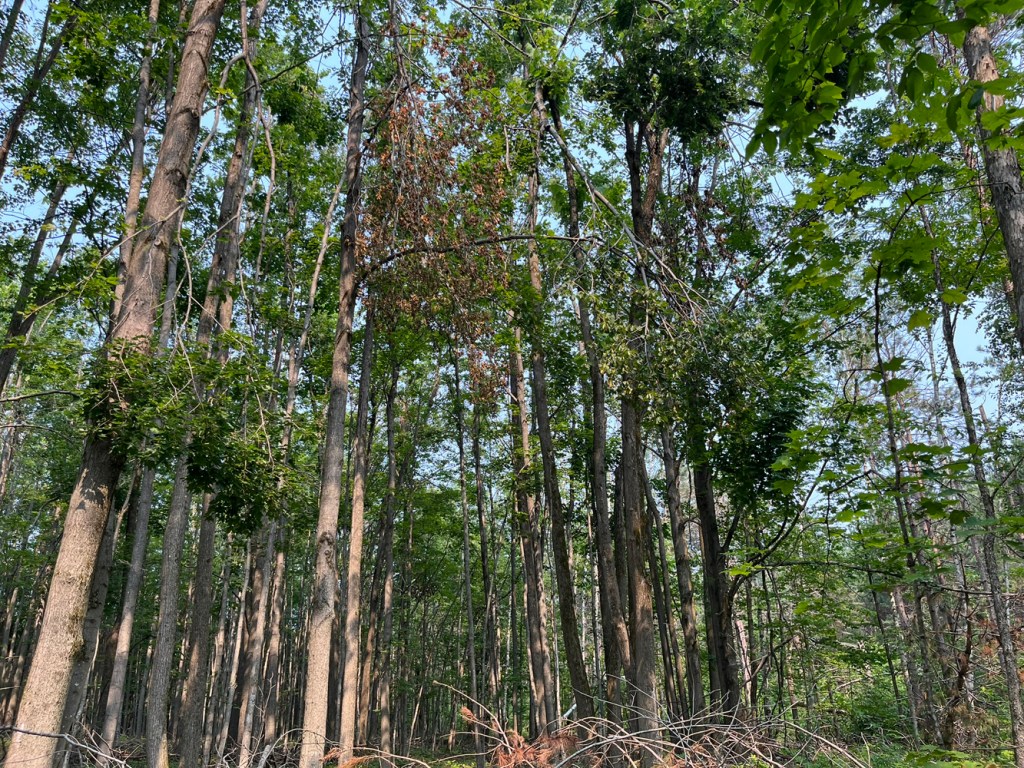
I, too, had wondered how the birds were faring in this smoke. I had noticed the decrease in bird song in the woods around our cabin, but especially when paddling by the state forest which usually was alive with a joyful dawn chorus of peewees, warblers, tanagers, blue jays, and kingfishers. Now I saw only one kingfisher and one jay. The green heron that I’d seen for the past several years was gone. Where normally I would see two or three flocks of mergansers, generally with a dozen or more in the brood, now I saw just one with two little ones. Between the fire and the ice, they had lost both their habitat and the clean air they needed to breathe.
We now know the smoke is affecting the water as well. The smoke and ash deposit nutrients into the lakes, something they do not need. They also can result in more mercury being deposited into the lakes, creating concerns about its transformation into methylmercury, with its toxic effects on fish, in whom it bioaccumulates, and the humans and other animals who consume the fish.[i]
Returning to my paddling — the smoky haze was thick, the dead and dying trees littered the shoreline, and yet the motorboats kept zooming by. Part of me wondered if they were among those feminist thealogian Carol Christ identified as believing in an apocalyptic vision of the world coming to an end as part of God’s will. What Christ called “the new fundamentalist movement” in 1987 is the very same Christian nationalism that has taken root in seats of power in the US government today. Among its tenets is the belief that these are the End Times and the goal is to hasten the apocalypse and Christ’s return. While I mostly don’t believe these beliefs are influencing the environmental disregard of the jet skiers and water skiers at play, they certainly are apparent in the Trump administration’s dismantling of protections for the environment, of climate change mitigation policies, of calling for the cutting down of national forests, of ending the climate change research of the National Oceanic and Atmospheric Administration, of dismantling the research branches of the EPA, his incentives to “drill baby drill,” and more. His recent paving over of the White House Rose Garden seems the final symbolic gesture of his contempt for all things living. The US and its destructive policies are primarily responsible for the fire and ice, the floods and droughts, the toxic air and water the world over.
So, my initial pondering haunts me. Is this indeed the actual end of the world – the end of bird song, the beauty of sunsets and clear blue skies, clean air to breathe, forests and fruit trees and flowers? The many contributors to the brilliant anthology, What If We Get It Right?, argue that this need not be our future. As the editor, Ayana Elizabeth Johnson, notes in the Introduction, “We already have most of the climate solutions we need – heaps of them,”[ii] and the volume is full of them. According to the authors, and what is clearly apparent, what is most lacking in this moment is the political will, and it is up to us not to fall into despair, but rather to resist and proactively work to bring about a change in the political direction of this country.
Johnson argues that “we need something to aim for. Something with love and joy in it.”[iii] So, to end on a more hopeful note, I turn to Johnson’s vision, that is within reach if we can but grasp it, “if we get it right, the world is a lot more green, more full of life, . . . the combustion phase of humanity is over, . . . we have re-localized and we eat well; . . . our homes are comfortable; . . . there is no traffic in cities; coastlines are greener; . . . they tyranny of the minority is over; . . . we are out in the world; . . . the pace of life is more humane; . . . our surroundings are verdant; spring is not silent.”[iv] May it be so.
References
Christ, Carol P. Laughter of Aphrodite: Reflections on a Journey to the Goddess. San Francisco: Harper & Row, 1987.
Historic ice storm cripples northern Michigan; 90,000 without power
Johnson, Ayana Elizabeth, ed. What If We Get It Right?: /Visions of Climate Futures. NY: Random House, 2024.
The Lakes are not okay: Wildfires Bring Long-Term Damage to Minnesota’s Waters – WDIO.com
Steingraber, Sandra. Having Faith: An Ecologist’s Journey to Motherhood. NY: The Berkley Publishing Group, 2001.
[i] The anerobic bacteria present in lakes and streams convert inorganic mercury into toxic methylmercury. Minamata disease, caused by mercury poisoning from eating contaminated fish and seafood, was first identified in Japan in 1956. It causes ataxia, numbness in the extremities, and muscle weakness, and in extreme cases insanity, paralysis, coma, and death. In fetuses, it causes microcephaly and cerebral damage.
[ii] Johnson, 3.
[iii] Ibid., 4.
[iv] Ibid., 428-433.
Discover more from Feminism and Religion
Subscribe to get the latest posts sent to your email.

 Feminism and Religion
May it be so, indeed! Thank you for your mourning and your determination.
LikeLiked by 2 people
Great post, Beth! The following is so true, not only about the environment, but all of life as it seems harder and harder to move forward positively in our evolution: “…what is most lacking in this moment is the political will, and it is up to us not to fall into despair, but rather to resist and proactively work to bring about a change in the political direction of this country.” Thank you for posting!
LikeLiked by 2 people
Thank you so much for your response, Esther. The news gets more horrific by the day, but we will continue to resist!
LikeLike
When I moved here this time one year ago, there were geese in flight so often each day we started calling it Mother Goose Airlines.
At the beginning of spring, we had a great number. They mated. There were babies, and now they seem to have moved on overnight.
I donât really have words to describe what Iâve noted here in Bristol VA except we had three near cold snaps during late spring and a couple of times in summer. Weâve all noted changes here.
There are more rodents in evidence this autumn and the bats are also more active than I remember them.
Of course, last year I was limited to where I went on our property which is a green space with water animals but there is a definite difference this year.
Weâve roamed this entire square of businesses and green spaces and everyone we speak to notes a difference.
It is hard not to be sad.
I work with the American Council Of The Blind Audio Description Projects Performing Arts committee and the biggest projects we have surround the national park trails and making them so people with limited abilities can be among them with the same knowledge which is presented to the fully sighted into formats for those who have print disabilities brochures, maps, and other things to assist with enjoying and investigating trails with audible materials. Hiking is a sport I once enjoyed with glee and have hoped to re-enter now that Iâve a guide dog who would enjoy it.
Now weâre faced with removal of programs, people, and funding. The atrocities being presented to us during these times make one want to run and hide. Yet each day I go out with my Labrador Cross Blue who is my Seeing Eye dog and seek nature.
Love to you for posting.
LikeLiked by 1 person
Dear Patty. I am so moved by your response and by the work you are doing to making national trails accessible to those with limited sight. What a wonderful project. What is happening to the earth, as well as the park service, is very sad indeed. I’m so glad you are able to be out in nature with your dog. I don’t need my dog to help me navigate the trails, but I can’t imagine being out in the woods without him. He is my constant companion and very dear friend. Thank you so much for your response. Love to you, too.
LikeLike
Hello, Beth.
All dogs are wonderful. I do not want to imagine a world without them.
Yes, I enjoy my work very much.
LikeLiked by 1 person