

In this essay, I address a gap in goddess spirituality, between a rhetoric of celebrating the body, and lack of truly embodied practice. I reflect on the archetypal language commonly used in goddess spirituality, tracing its roots in Greek mythology and depth psychology while questioning its cultural limits.
By introducing the notion of “goddess architectures”, I explore how ecological, social and cosmological contexts shape symbolic structures, and how sacred feminine power can be named, distributed, embodied or obscured across cultures. Finally, I propose movement as a way back to lived experience beyond symbolic and linguistic frameworks.
Goddess Spirituality into the Lived Body
Over the past thirty years of researching and practising goddess spirituality, I noticed a persistent discrepancy. While this field speaks about honouring the body as sacred, in practice it often feels like rhetorical lip service. The language of embodiment is present, but remains disconnected from the body on many levels.
This observation may arise from my background as a dancer, as well as from the body–mind split I encountered, and had to reproduce, within academic dance scholarship. As a result, I have become acutely aware of “bodies of work” that speak about, but not from the body.
Almost unnoticed (but not surprisingly!), my work has become a response to this gap. I am interested in how goddess spirituality can be brought into the lived body, and how movement can function as a mode of inquiry. A way of sensing, inhabiting and questioning sacred feminine power, rather than invoking it through occasional ritual or approaching it through other disembodied forms of practice such as meditation.
9 Archetypes of the Divine Feminine
In preparation from my Goddess Qi Gong course, I chose nine archetypes of the divine feminine. This provides a meaningful arc, short enough for people to commit to the journey, yet covering sufficient aspects of womanhood. It also felt right to work in three triads, each with a different emphasis.
The Maiden–Lover–Mother triad addresses our personal life sphere. The triad of Warrior–Queen–Crone has more outward focus, towards society, activism and leadership. Finally, the triad of Unraveller–Healer–Mystic adds a layer of soul journey, individuation and connection to the mystery.
As I began preparing the workbook and movement routines, I began researching which goddesses to select as inspirations for each archetype. I noticed how easily Greek goddesses slid into these archetypal roles. Artemis as Maiden. Athena as Warrior. For Celtic and Norse goddesses this was also reasonably straightforward. Freyja as Lover. Danu as Mother. Cailleach as Crone.
Egyptian or Middle Eastern goddesses were significantly more complex to place. I noticed that, the further back in time I went, or the further away from Europe, the harder it became to find good matches for each of these archetypes. I wondered why that was the case.
Greek Orientation of Archetypal Thinking
This way of working with goddess archetypes as distinct characters and personalities is firmly rooted in classical Greek mythology. Deities had their own traits, developmental stories, conflicts and relational entanglements. They were seen as “forces within the world because they were forces within the minds of human beings” (Samuel 1990: 135).
It is hardly surprising that modern depth psychology found such fertile ground here. Archetypes, became lenses through which people’s inner lives could be understood as patterns shaping perception and behaviour.
My own goddess journey has been influenced by this lineage. One of the first books I studied, Goddesses in Everywoman by Jungian psychiatrist Jean Shinoda Bolen, explicitly offers Greek goddesses as symbolic maps of the female psyche to support personal development and the process of individuation.
However, the archetypal goddess is a culturally specific, largely European, way of making sense of human experience. It reflects the classical worldview from which both the myths and the concept of the archetype itself emerged (the word itself is derived from Greek, and means original pattern).
Cultural Expressions of the Divine Feminine
So trying to map goddesses from different cultures onto these archetypal categories revealed important differences. Across different pantheons, feminine sacred power is organised in different ways. Some goddesses resist categorisation because they are not portrayed with recognisably human qualities, but as primordial forces. Others occupy several roles at once, or none of them at all.
For example, in some traditions, there is no figure that resembles what we might call a Queen archetype. In others, erotic or generative power is not concentrated in a personalised Lover figure, but dispersed across land, fertility cycles and seasonal rites. Elsewhere again, the sacred feminine is embedded in landscapes, ritual practices or agricultural rhythms rather than expressed through individual deities.
These variations raise a larger question: how does a culture structure and distribute sacred feminine power? Which qualities are emphasised and celebrated, which are marginalised, and which remain entirely unnamed? This intriguing question begins with language.
As I am learning French, a language shaped by different roots than the Anglo-Saxon Dutch and English I grew up with, I repeatedly find that some concepts simply cannot be translated. This in turn recalls my earlier PhD in dance anthropology, where I encountered profound differences in how cultures classify the senses, articulate bodily experience, and express relationships between body and land.
Goddess Architectures
And so the notion of “goddess architectures” emerged. Every structure arises from concrete contexts of social organisation, ecology, history, survival needs and cosmology. This includes how the sacred is imagined and organised, so this means that the sacred feminine is equally shaped by cultural perceptions.
If certain forms of feminine authority are invisible or taboo, what does that reveal about gender roles and dynamics social control or spiritual emphasis? Equally, what we are tempted to label as ‘missing’ may not be missing at all. It may simply be organised differently, understood through a worldview that prioritises continuity, reciprocity or survival rather than psychological individuation.
Although archetypal language is a powerful bridge between inner experience and embodied practice, it is important to recognise it as one particular lens, rooted in a Greek-inflected and psychological tradition of meaning-making. As with any system, it is simply a map for a journey. Yet how can we include things we aren’t aware of?
This complexity invites a return to lived experience, prior to verbal articulation, where grammar, semantics or discourse structure meaning.
Movement as the Bridge
For me, movement is one of the ways we can return to that layer of lived experience. Movement helps us to travel deep within, and far without; into intimate sensations and perceptions, and beyond the boundaries of the individual self. In moving meditation we can reconnect with the place where wisdom dwells before it becomes manifest, a knowing that exists before it takes shape in cultural and symbolic structures.
From there, it may be possible to catch glimpses of what has been obscured, neglected or overshadowed by dominant narratives. Their strong glare seems to cause a kind of cultural night-blindness to what lies outside the spotlight.
With Goddess Qi Gong, I am not trying to integrate different traditions into a single universal system. Rather, I am inspired and moved by the many expressions of the sacred feminine. I invite participants to sense into their own personal architecture of feminine energy, instead of a fixed pantheon.
One woman asked me, under which archetype would Lilith belong? That is not a question to resolve conceptually, but to explore directly with her. For one woman, she may express Lover energy, for another that of the Unraveller or the Mystic. What matters is not how culture has defined her, but how you can encounter her through your moving body, as possible companion, sacred disruptor and teacher.
Movement is a deep invitation to explore what ‘holds’ or ‘dissipates’ your energy, understand how cultural conditioning decides what is accessible or forbidden within your unique body, and how you can express feminine power in a truly embodied way…
If you’d like to experience a taster, my recent Substack essay Midwinter and Midlife, contains a 30 minute video of moving with Arianrod, Welsh goddess who holds the mystery of cyclic time… It’s a wonderful practice at the turn of the Year, to reflect on midwinter and midlife!
You can read more about the Goddess Qi Gong journey and the 9 archetypes here. We’ll start on January 20th, and I would love to see you in circle! For now, I wish you a very good, inspired and healthy New Year!
References
Samuel, Geoffrey. 1990. Mind, Body and Culture. Anthropology and the Biological Interface. Cambridge: Cambridge University Press.
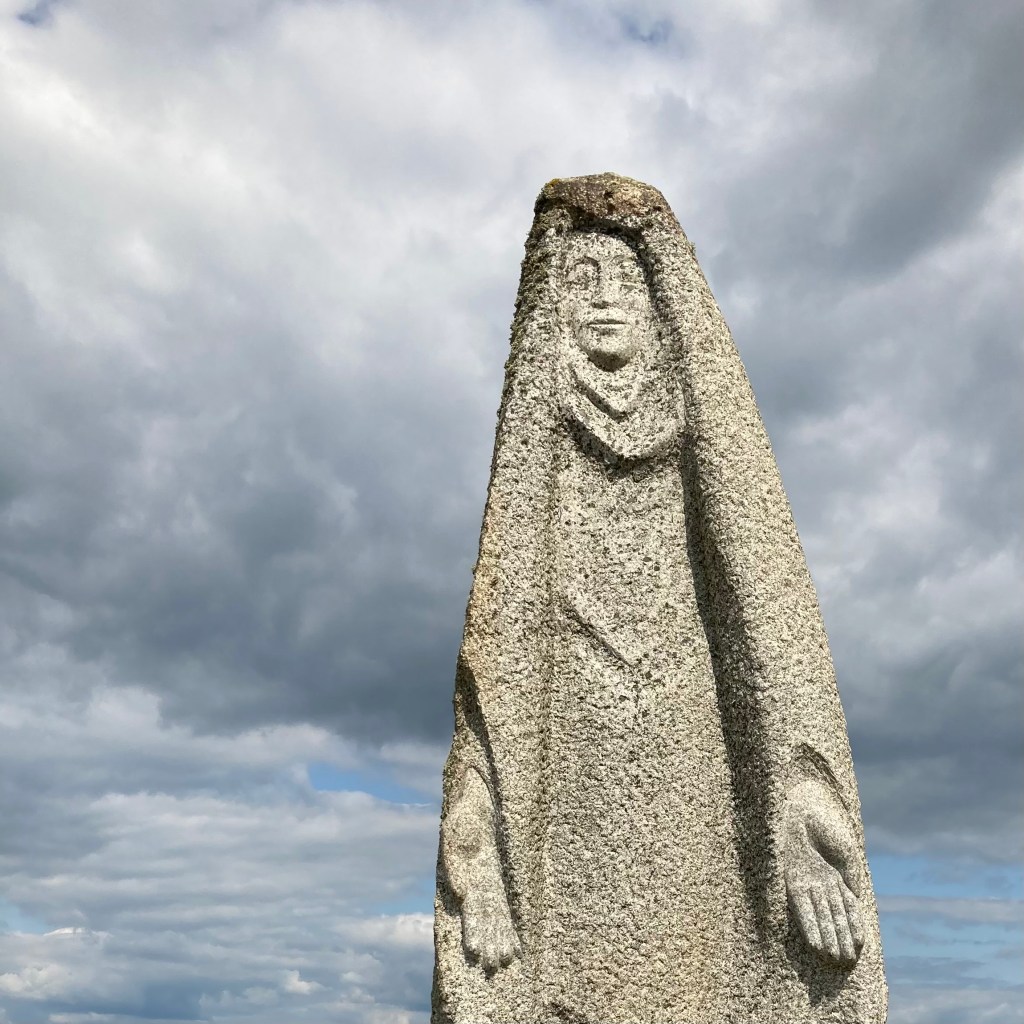
Image: Statue of St. Anna, La Pointe de Bilgroix, Bretagne, France, Eline Kieft 23 August 2021
Invitations

Goddess Qi Gong: Move the Archetypal Feminine Within
🧙🏽 9 weeks of transformation
📅 20 January 2026
💻 Closed Online Group for Women in Transition
✍🏽 Read More & Join the Circle
Summer Solstice Pilgrimage
Join me in Avebury, an ancient landscape of stone circles, avenues and hidden chambers, a place to rest and recharge just after Midsummer!
💃 Deep Retreat Time
📍In person, Avebury UK
📅 22-26 July 2026
✍🏽 Read More
Bio

Eline Kieft is a Qi Gong teacher, anthropologist and changemaker exploring embodied ways of knowing. With a PhD in dance and training in shamanic practice and Movement Medicine, she bridges academic insight with embodied spiritual practice.
Her book Dancing in the Muddy Temple blends theory and practice in service of land, body, and spirit. Now leading Wild Soul Centre for Embodied Consciousness, she offers coaching and courses to support deep transformation and inner strength through movement and the body. Try out her Qi Gong Membership for free! You can also find her on LinkedIn, YouTube, Instagram and Substack.
Discover more from Feminism and Religion
Subscribe to get the latest posts sent to your email.

 Feminism and Religion
excellent article – it does puzzle me that you never bring in Indigenous women (and men) because everything they do is embodied… there is no separation between spirit and body – as a former Jungian Analyst I was ‘caught’ by archetypes because I had been living them not just in my mind but in my lived experience and needed to understand what was happening – eventually I got it that this Greek emphasis on archetypes hid patriarchy in it’s folds which of course was one of reasons it worked for me!. I stopped practicing. I couldn’t agree with you more “the language of embodiment is present, but remains disconnected from the body on many levels”. I believe this is the rule rather than the exception.. embodiment has become a kind of catch word like spirituality – it carries little substance… To the degree that we become embodied however we may do this….the more we heal this split… your way is one way … I do it through direct experience with nature – one reason why winters are so hard on me psychologically – so much of the earth is sleeping – but mountain climbers will tell you that on a steep cliff you are absolutely in the present – this is embodiment too. Rupert Sheldrake has done a life time of work on consciousness and embodiment through science and his remarkable sons are continuing the practice through one becoming a scientist (ENTANGLED LIVES) and the other a musician who demonstrates embodiment through music.
LikeLike
Hey Sara, thanks for your thorough reflections & sharing. I think one of the reasons for that is starting with my own experience, and ‘reclaiming’ in a way the lore of the lands here in ‘Atlantic’ Europe. I’ve been burned too much by (in my view unfound) cultural appropriation critiques, that now I’ve left academia I am letting that rest for the time being… I love the experience of winter too, out there in my snow/ski pants, with a hot water bottle tucked in my pants and a thermos full of tea… I’m going out to the neolitic stones tomorrow, and rest with winter! Hope you find the time to be in nature before too long! Happy New Year!
LikeLike
I am in Nature all the time! If you had the ice we have you might find daily tasks difficult – today I hope to meander on froze snowshoe paths
LikeLiked by 1 person