

Part 1 was posted yesterday

Knitting and other forms of needlework made a resurgence when Second Wave feminism reclaimed traditional “women’s work” as a form of feminist expression, promoting crafting as a tool of feminist empowerment. The most prominent example of this was Judy Chicago’s 1979 The Dinner Party that celebrated prominent female historical and mythical figures. A massive artwork, it consists of 539 quilted triangle pieces from all over the world, embroidered place banners, and ceramic plates arranged on a large triangular table.
Women form the vast majority of those engaged in knitting resistance,[i] and beyond the reclamation of women’s domestic arts, craftivism provides women a voice that is often usurped and talked over in masculine political spaces. As one of the participants in a resistance knitting circle that was studied by feminist scholars stated, “’Because politics is still very sexist and configured for men . . . I think women don’t get very far . . . I think craftivism is . . . something that’s accessible to women . . . and is an alternative form of expression.”[ii]

Knitting as a form of resistance has been criticized as being a “white women” project, primarily due to the predominance of white women in knitting magazines, patterns, and posters, but Black women in particular have made efforts to correct that notion. The famous 19th century feminist activist Sojourner Truth insisted on holding her knitting in portraits taken of her to show the importance of knitting which she regarded as a crucial skill, one she taught to formerly enslaved women to provide self-sufficiency and empowerment. The Yarn Mission, formed by CheyOnna Sewell in St. Louis in 2014 in response to police violence after Ferguson, is centered around knitting for Black Liberation but with an intersectional lens, emphasizing justice and anti-oppression resistance for all marginalized people.[iii] “Is knitting traditionally a white activity?” questioned Sewell. “Absolutely not. Knitting has often been a tool for sustainability and survival. A way to stay warm. A way to comfort and protect our loved ones. This has been true for many cultures.”[iv] “As a black woman, you’re invisible,” said Yarn Mission member Taylor Payne to Sarah Kendzior, a Guardian reporter. “But knitting makes people stop and have a conversation with you. If someone asks me what I’m doing, I say, ‘I’m knitting for black liberation,’” — creating an opening for dialogue about race and racism that other forms of activism do not.
What is the specific appeal of knitting as a form of activism? Sarah Corbette most famously defined knitting and other craftivism as a form of “gentle protest.” After engaging in activism for years, she felt burnt-out. “I didn’t like shouting, demonizing people or telling people what to do . . . stitching calmed me down, . . . “ [v] She continued, “We need to stop seeing protest as only being about shouting in a crowd and start having the kind of smaller conversations that actually connect to fellow human beings and help to influence them gently . . . and with kindness, decency, and thoughtfulness.” [vi] Knitting resisters also contend that this form of protest is more effective. “You don’t change your mind if somebody comes and shouts in your face,” said one knitter, “your minds change with conversation, discussion and calm debate. That’s what I’m trying to do . . . and I think that’s true to a lot of craftivism that I’ve seen.”[vii]
The calming influence Corbette mentioned has been an important part of knitting resistance. The women who participate in the Yarn Mission credit knitting as a form of activism that helps relieve the stress of daily racism and acts as a solace for their community still wounded by police violence. Similarly, a friend, writing about her discomfort with conflict and dissent while also recognizing that it is an integral part of creating change wrote, “Having a crochet project in hand is my strategy for metabolizing that discomfort instead of getting reactive.”[viii] And this is the case not only for the knitters but also for those witnessing them. As reported by the Duluth Monitor after a particularly contentious City Council meeting: “Amid the deteriorating circus of Duluth City Council meetings, pockets of civilization still remain. At yesterday’s meeting, as speakers came and went and two men nearly came to blows in the back of the room, the steady movements of knitting hands exerted a calming influence on the room.”
Knitting resistance does far more than create calm and artifacts and symbols of resistance and protest. It knits together the fabric of communities of resistance. As Corbette wrote, “Making the same thing together and struggling together . . . helps create a sense of community. . . .”[ix] Over and over again, knitting resisters talk about the act of knitting resistance projects together – whether in the same room, in collectives, or in far-flung internet communities – as creating connection and, in Corbette’s words, “. . . a sense of common purpose, bigger than ourselves, a sense of solidarity and reminder that we are not alone in our fight to eradicate unloving practices in our world.”[x] Those researching the Pussyhat Project similarly noted the sense of solidarity in the way participants talked about their involvement: “The pronoun ‘we’ appears in every sentence on the homepage . . . ‘We are crafters’; ‘We are a Worldwide Movement’; ‘We support women’s rights’; ‘We did it! We created a sea of pink!’”[xi] Chloe, one of the women interviewed in the knitting circle said, “’It does feel like it’s a collaborative form of protest rather than a . . . male anger form of protest. . . . I feel it is a very female way of going about things. . . “[xii], and I think that’s true . . . [of] a lot of craftivism that I’ve seen.” And as one of the other knitters, Abby, noted, ‘Feeling like a small part of something larger is really an important aspect of it . . .That’s where the power of it is . . . It’s that coming together with others.’”[xiii] As I knit Melt the Ice hats, I have felt that same sense of solidarity with all of us knitting MTI hats as we post problems, solutions, and variations on Facebook and other social platforms; as we collectively created the shortage of red yarn; as I’ve gifted the hats to friends; and as I look out at the many of us wearing red hats at protests and around town.
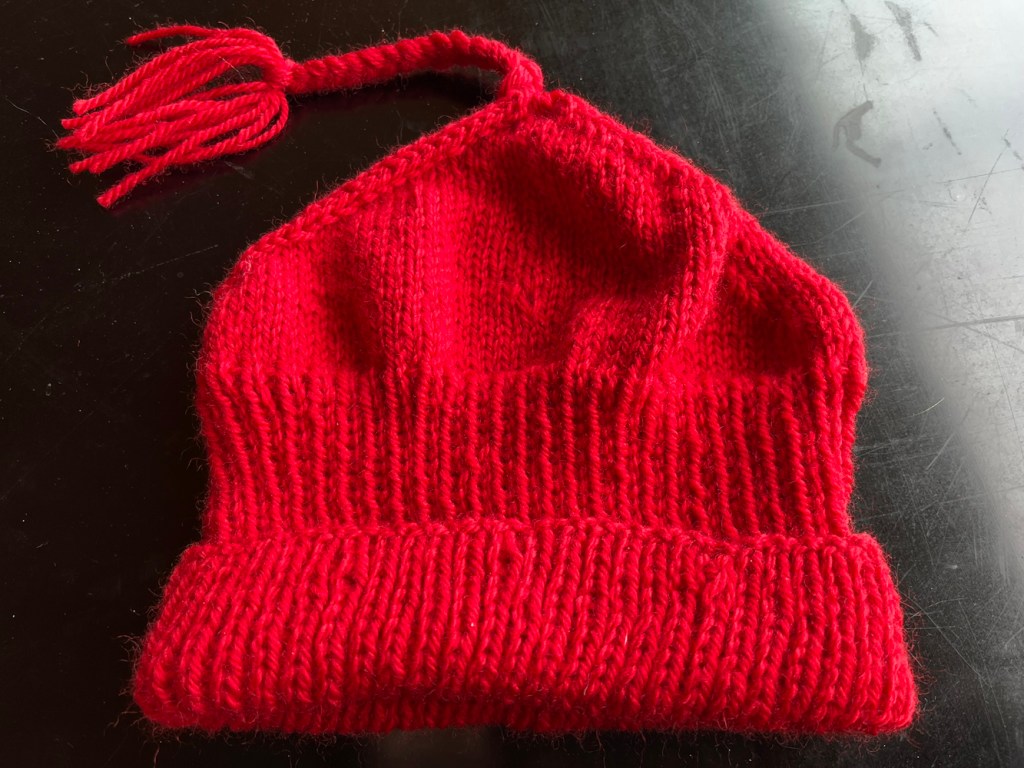
In surprising and perhaps unseen ways, the collective combined efforts of small acts of individual knitters have created compelling and profound resistance movements. “People consistently underestimate the power of knitting. They don’t recognize its radical properties,” said Sewell.[xiv] Ultimately, knitting resisters regard this form of activism as being motivated by an unconditional love for the cause, whatever it may be, for humanity and earth, and for each other. Said one of the Pussyhat knitters, “The way in which this project connected human hearts was amazing. Love is the most powerful thing on earth.’ “[xv] Just as I was about to post this, this quote came across my feed: ” Some folks question the validity of creating MTI resistance hats; wrong color, not ‘authentic’ version, wearing one makes you a ‘target’ etc. . . . My thoughts go to the intention behind the process; my version averages 80+ rows x 104 stitches… that’s 8320 stitches per hat focused on a better, safer America. 15 hats = 124800 stitches of hope and love for America’s healing.”[xvi] And so, with needles and yarn we knit together our hearts, our lives, r resistance – making the world better with each stitch.
Note: The Melt the Ice Project is ongoing and the Twin Cities are still under siege by ICE. To support or participate, see Melt the ICE Hat | Needle and Skein.
References
Corbette, Sarah P. How to Be a Craftivist: The art of gentle protest. Unbound. 2018.
Duluth Monitor, February 24 at 7:46 PM.
Ellis, Corinne Freedman. Facebook post. 2/25/26.
Literat, Iona and Sandra Marku. “‘Crafting a way forward’: online participation, craftivism and civic engagement in Ravelry’s Pussyhat Project group.” Information, Communication & Society 2020, VOL. 23, NO. 10, 1411–1426 https://doi.org/10.1080/1369118X.2019.157391.
Parnell, Julia Arthur. 50501 Project Washington Facebook post, 3/5/26.
The Yarn Mission | The Yarn Mission knits for Black Liberation.
Vachhani, Sheena J., Emma Bell, and Alexandra Bristow. “The Affective Micropolitics of Craftivism: Organizing social change through minor gesture.” Organization Studies 2025, Vol. 46(4) 525 –547.
[i] The Amazon analytics service that provides internet traffic data shows the gender split of Ravelry is around 98% female and 2% male. They also show that the participants tend to be older than the average population.
[ii] Fiona, in Vachhani, 533.
[iii] She formed a second chapter in Minneapolis in 2015.
[iv] “Ferguson’s Radical Knitters.” The Guardian.
[v] Corbette, 5.
[vi] Corbette, 35 & 44.
[vii] Chloe, in Vachhani, 533.
[viii] Ellis.
[ix] Corbette, 90.
[x] Corbett, 92.
[xi] Literat, 1421.
[xii] Vachhani, 533-34.
[xiii] Ibid., 535.
[xiv] “Ferguson’s Radical Knitters.” The Guardian.
[xv] Literat, 1419.
[xvi] Parnell.
Discover more from Feminism and Religion
Subscribe to get the latest posts sent to your email.

 Feminism and Religion
Knitting crocheting weaving – women reweave the world with every stitch – all my great aunts, grandmothers knitted crocheted – this is one of the highest ART forms…. thank you for this wonderful article.
LikeLiked by 1 person
Thank you for this, Sara. Yes, women reweave the world.
LikeLike
I sent this piece to a woman (57) who has been married and divorced for two years after a 20 year abusive marriage and is trying to find her way in the world. One thing she does with incredible skill is to knit and crochet the most beautiful shawls, hats blankets etc etc – she has not yet owned this talent of hers as an art form but what I see is that she is also weaving her new life – the response I received after sending this material was that she had never THOUGHT of her life in this way!!! YAY… re weaving the world and self are part of one process regardless of outcome. And guess who helped!
LikeLiked by 1 person
oh no my comment disappeared again… I sent this piece to a woman who is re-weaving her life (she’s 57) after a 20 year abusive marriage through knitting and crocheting with incredible skill and who is an artist in her own right but hasn’t owned it yet – her response to your piece was that she had never thought of her work in this way! YAY!!!
LikeLike
Inspiring!
LikeLiked by 2 people
Beth I am thrilled to read ( and share) this well thought out and researched article on craftivism. You really had me in Part one with Madame la Farge from a Tale of Two Cities! I am the founder of the Women’s Woven Voices project , an international collaborative art project that supports women’s empowerment through writing, weaving, and sharing their stories. ( to learn more you can find my article in the 2023 FAR archives) From 2018 to 2023 I invited women from around the globe to weave a strip of cloth – their story cloth- and create a collaborative tapestry with over 1,000 participants from 10 different countries. The tapestry was an integral part of the Women’s Village at the Parliament of World Religions in Chicago. Over and over again the participants said that the weaving felt transformative and many used the word “healing” to describe their experience of making their story cloth. As a lifelong knitter I can attest to the feeling of community that knitting evokes and to the power of projects like the pussy hat and MTI hats. Thank you so much for laying this out so beautifully.
LikeLiked by 1 person
Thank you so much for sharing all of this with me. I’m so glad to learn about the Women’s Woven Voices project. I’m eager to learn more about it, and I’ll look for your FAR article. What a beautiful idea for the woven tapestry. Do you have a photo of it?
I’ve always wanted to weave, but have never gotten a loom, but knitting does give me a taste of it.
One of my favorite collective projects was for our Women’s Studies program’s 25th anniversary. I sent out a request to all of our alums and current students and faculty to embroider a quilt square the represented WS to them. Then a local quiltmaker pieced them together in a beautiful quilt that hung in the WS office. It was wonderful to make that piece together.
Thank you again.
LikeLike
Beth I am thrilled to read ( and share) this well thought out and researched article on craftivism. You really had me in Part one with Madame la Farge from a Tale of Two Cities! I am the founder of the Women’s Woven Voices project , an international collaborative art project that supports women’s empowerment through writing, weaving, and sharing their stories. ( to learn more you can find my article in the 2023 FAR archives) From 2018 to 2023 I invited women from around the globe to weave a strip of cloth – their story cloth- and create a collaborative tapestry with over 1,000 participants from 10 different countries. The tapestry was an integral part of the Women’s Village at the Parliament of World Religions in Chicago. Over and over again the participants said that the weaving felt transformative and many used the word “healing” to describe their experience of making their story cloth. As a lifelong knitter I can attest to the feeling of community that knitting evokes and to the power of projects like the pussy hat and MTI hats. Thank you so much for laying this out so beautifully.
LikeLike
Thank you so much for sharing this with me, Sara, and for sharing it with your friend. I’m delighted that it helped her see herself in a new way. I love to think of her knitting and crocheting as reweaving herself.
LikeLike