

This was originally posted on March 26, 2015
 Last week, Supreme Court Justice Ruth Bader Ginsburg was in the news again, but not for reasons you would expect. She, along with Rabbi Lauren Holtzblatt, penned a feminist essay about the Exodus title “The Heroic and Visionary Women of Passover.” Finding this story was exciting, especially because I am so drawn to the Exodus story (the intrigue and curiosity of which caused me to return to school and study, as one of my main areas of focus, Hebrew Scriptures – along with Archaeology and Ancient Near Eastern History). Now women’s roles in this story are being elevated thanks to Justice Ruth Bader Ginsburg and Rabbi Holtzblatt.
Before I discuss the message and the importance this message brings, I think it is important to know an important fact about Justice Ginsburg. Ginsburg is not observant, but does embrace her Jewish identity. When her mother died, she was excluded![Ruth_Bader_Ginsburg_official_portrait[1]](https://feminismandreligion.com/wp-content/uploads/2015/03/ruth_bader_ginsburg_official_portrait1.jpg) from the mourner’s minyan because she was a woman; an event in Judaism that is meant to comfort the mourner, brings a sense of community, and is considered obligatory – a means of honoring our mother/father. This important event left an impression and sent a loud message that inspired and influenced her career path – she did not count – she had no voice – she had no authority to speak. No wonder her life and career focuses so much on women’s rights and equality.
from the mourner’s minyan because she was a woman; an event in Judaism that is meant to comfort the mourner, brings a sense of community, and is considered obligatory – a means of honoring our mother/father. This important event left an impression and sent a loud message that inspired and influenced her career path – she did not count – she had no voice – she had no authority to speak. No wonder her life and career focuses so much on women’s rights and equality.
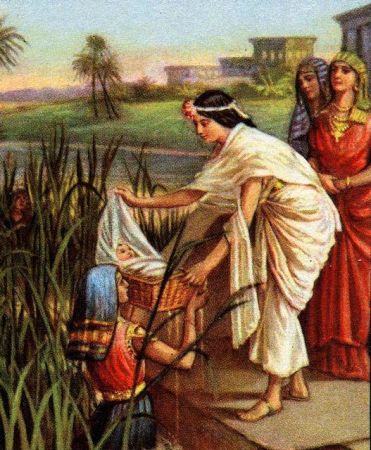
As many of us know, the story of Exodus is focused on two things 1) Moses and 2) liberation from the bonds of servitude and enslavement; women are rarely discussed. In the essay co-authored by Ginsberg, women are described as playing a crucial role in defying the orders of Pharaoh and helping to bring light to a world in darkness. In the Exodus event, God had partners – five brave women are the first among them, according to Ginsburg and Holtzblatt. These women are:
- Jochebed/Yocheved, Moses’ mother, who protected her infant son from death; an o
 rder issued by Pharaoh to kill the Israelite baby boys;
 - Shifra/Shiphrah and Puah, midwives, who, again, defied the Pharaoh’s order refusing to kill the newborn son.
- Miriam, Moses’ sister, who stood watch over her brother to ensure his safety and played a role in the exodus event itself; and finally
- Batya/Bithiah, Pharaoh’s daughter, who saves Mose from the water, feeds him, and raises him as one of her own.
Without their defiance, their willingness to choose to protect a child from certain death; a death ordered by Pharaoh, the story would have stopped there.
As the essay so eloquently states:
these women had a vision leading out of the darkness shrouding their world.
These five women can be seen today symbolically. Often our world is shrouded in darkness with repeated events of war, death, and destruction. News stories, social media, and television, are all filled with scenes and stories of violence and heartbreaking oppression. The story of the Exodus is one still lived out today in cases of human trafficking, rape, abuse, and other atrocities that oppress, threaten, or otherwise victimize a person, striping away their human dignity. It is hard to see, let alone try to be that light of hope, even within small circles. But every now and again, a Jochebed (mother), Shifra or Puah (midwife, nurse, co-worker), Miriam (sister, friend), and/or Batya (figure of authority) appears, performing or engaging in some act of bravery as a symbol of hope – they are a light in an increasingly dark world.
I will end with this. Within the Jewish tradition, Passover offers a time of reflection:
Jews are commanded to tell the the story of the Exodus and to see ourselves and having lived through that story, so that we may better learn how to live our lives today.
Whether you celebrate Passover or not, it is important to take the time to periodically reflect on our own lives, our actions, our response, and our legacy – in other words, our own story. As part of that reflection, ask yourself the following:
- Will my story inspire the next generation?
- Do my actions bring light to a darkened world?
- Or do I just stay in the dark, do nothing, and fade from existence?
Michele Stopera Freyhauf is a Ph.D. Candidate in the Department of Theology and Religious Studies and a Member of the Centre for Catholic Studies at Durham University as well as an Instructor at John Carroll University’s Department of Theology and Religious Studies. Michele has an M. A. in Theology and Religious Studies from John Carroll University, and did post-graduate work at the University of Akron in the area of History of Religion, Women, and Sexuality. She is also a Member-at-Large on the Student Advisory Board for the Society of Biblical Literature and the student representative on the Board for Eastern Great Lakes Biblical Society (EGLBS). Michele is a feminist scholar, activist, and author of several articles including “Hagia Sophia: Political and Religious Symbolism in Stones and Spolia” and lectured during the Commission for the Status of Women at the United Nations (2013 and 2014). She also wrote “The Catholic Church and Social Media: Embracing [Fighting] a Feminist Ideological Theo-Ethical Discourse and Discursive Activism” that appears in the recently released book, Feminism and Religion in the 21st Century: Technology, Dialogue, and Expanding Borders, edited by Gina Messina-Dysert and Rosemary Radford Ruether. Michele can be followed on Twitter @msfreyhauf and @biblicalfem. Her website can be accessed here and is visible on other social media sites like LinkedIn and Google+.
Discover more from Feminism and Religion
Subscribe to get the latest posts sent to your email.

 Feminism and Religion
“But every now and again, a Jochebed (mother), Shifra or Puah (midwife, nurse, co-worker), Miriam (sister, friend), and/or Batya (figure of authority) appears, performing or engaging in some act of bravery as a symbol of hope – they are a light in an increasingly dark world.”
This spoke to me this morning as every day can seem more hopeless than the day before.
LikeLiked by 1 person
I liked this essay so much because it highlights the importance of the effects of our religious affiliations and the ceremonies that accompanied them. Ginsberg is one powerful example, bless her.She used her religious invisibility as a child to make powerful changes – a true heroine (why do we call women heroes today?) What this woman’s story suggests to me that as difficult as it may be it is important to acknowledge our religious roots. I am not a Christian – but painfully aware that today marks the beginning of holy week – a week that ended in a horrific betrayal and death of someone who was a healer, created space for women and was supported by them in his death and afterwards. I feel grief every year as I walk through holy week saddened – though for many years I denied this part of the Christian story -you don’t have to believe that someone is a god to feel the piercing knife of betrayal in ones own life – this is where we see that betrayal of one kind or another is part of every religious and mythical story – we can use the times to reflect and ask those questions that were posed above –
Will my story inspire the next generation?
Do my actions bring light to a darkened world?
Or do I just stay in the dark, do nothing, and fade from existence?
LikeLike