

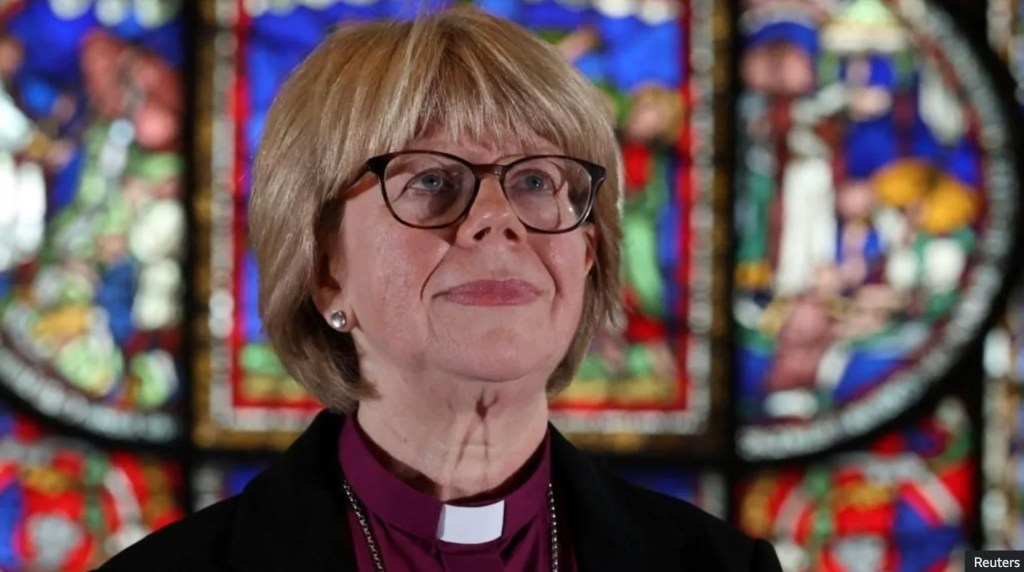
On 25 March, 2026, in a profoundly significant historic ceremony, the 106th Archbishop of Canterbury was installed in Canterbury Cathedral. Her name is Sarah Mullally. She is the first woman to hold the position of spiritual leader of the Church of England and the Anglican Communion worldwide. As such, in spiritual authority in the UK she stands second only to the King.
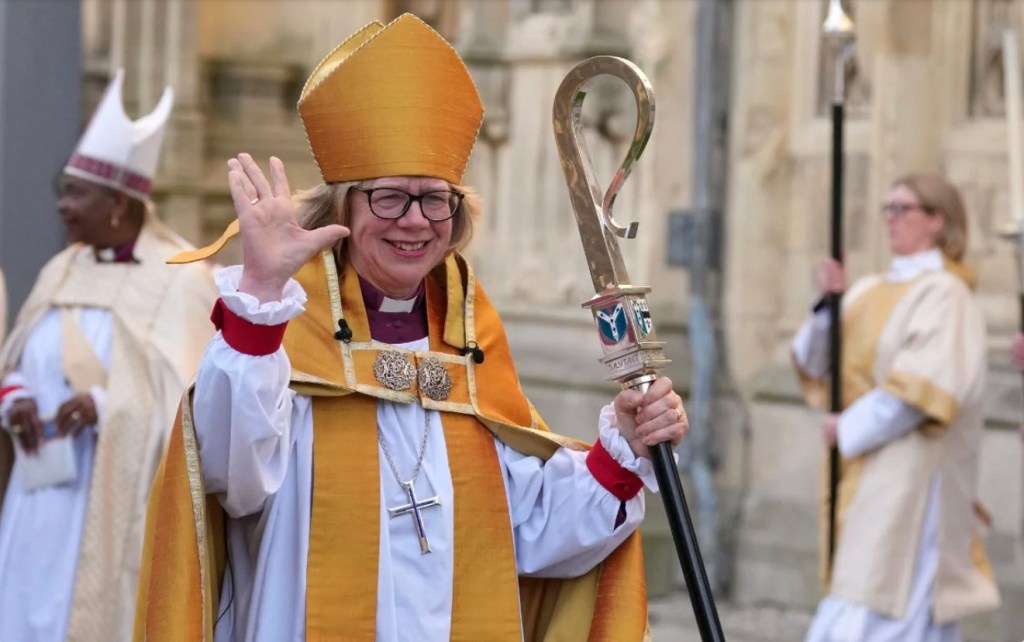
archbishop of Canterbury in Canterbury, England, Wednesday, March 25, 2026, the first
woman ever to lead the Church of England. Photo: AP/Alastair Grant.
Dame Sarah Mullally is married with two children, and worked for decades as a midwife and nurse before she was ordained as a priest in 2002. In 2018 she was named the first female Bishop of London, and in 2026 the first female Archbishop of Canterbury. Her installation (aka enthronement) as Archbishop took place one day before her 64th birthday. She describes herself as a feminist and has ordained both men and women.
Dame Sarah succeeds the former Archbishop of Canterbury, Justin Welby, who was forced to resign last year over his part in concealing crimes of child abuse associated with the church. A report into the scandal found that Welby “could and should” have reported John Smyth’s abuse of boys and young men to police in 2013, but did not so do. Smyth was just one among hundreds of known abusers whose crimes were systematically enabled within the church, up to the highest echelons. After Welby stepped down, the Archbishop of York, Stephen Cottrell, took on many of his duties and was considered a strong candidate to replace him – until Cottrell too was found to have helped cover up a separate case of sexual abuse. Amid these scandals, the Church of England was left without a leader for almost a year, with church attendance continuing a pattern of steep decline.
The election of the first woman Archbishop of Canterbury offers a healing balm and a powerful antidote to the toxic structures of the old boys’ network in the Church of England. In her first address after the announcement of her nomination, Dame Sarah spoke openly of this need for healing:
“In living in the service of others, we must also confront the dynamics of power— an issue brought into sharp focus by the recent safeguarding reviews and reports. As a Church, we have too often failed to recognize or take seriously the misuse of power in all its forms.
As Archbishop, my commitment will be to ensure that we continue to listen to survivors, care for the vulnerable, and foster a culture of safety and well-being for all.
This will not be easy. Our history of safeguarding failures have left a legacy of deep harm and mistrust, and we must all be willing to have light shone on our actions, regardless of our role in the church.”
In an interview a few days week before her installation as Archbishop, Dame Sarah again pledged to “do all I can to ensure that the Church becomes safer and also responds well to victims and survivors of abuse” as the church seeks “to become more trauma informed, listening to survivors and victims of abuse.”
Thabo Makgoba, the archbishop of Cape Town, called Mullally’s election a “thrilling development,” while Emily Onyango, the first female Anglican bishop in Kenya, said that with Mullally as the new Archbishop of Canterbury “things will be done differently…. We know there will be justice in the church.”
Dame Sarah is already doing things differently. She and her husband Eamonn spent the week before her installation as Archbishop walking the historic “Becket Camino” from St Paul’s Cathedral in London to Canterbury Cathedral. She is the first incoming Archbishop of Canterbury in the modern era to complete such a pilgrimage as spiritual preparation for her new role.
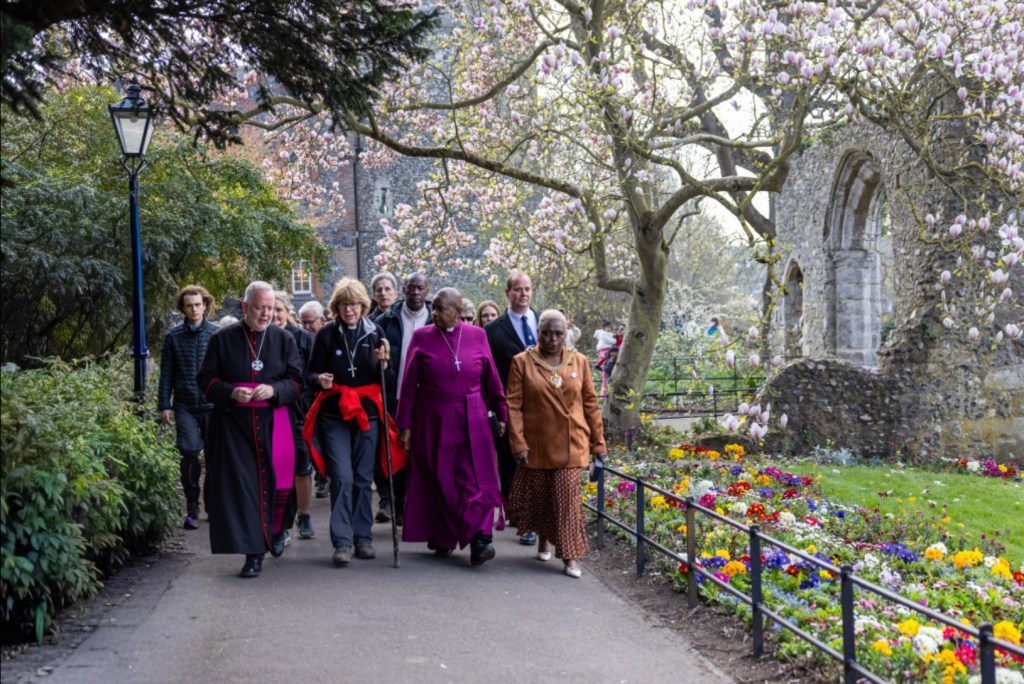
Photo: Canterbury Cathedral Facebook page.
It was a historic moment in Canterbury when the future Archbishop and a small party of pilgrims arrived in the centre of the medieval city at the end of their 90-mile walk from London.
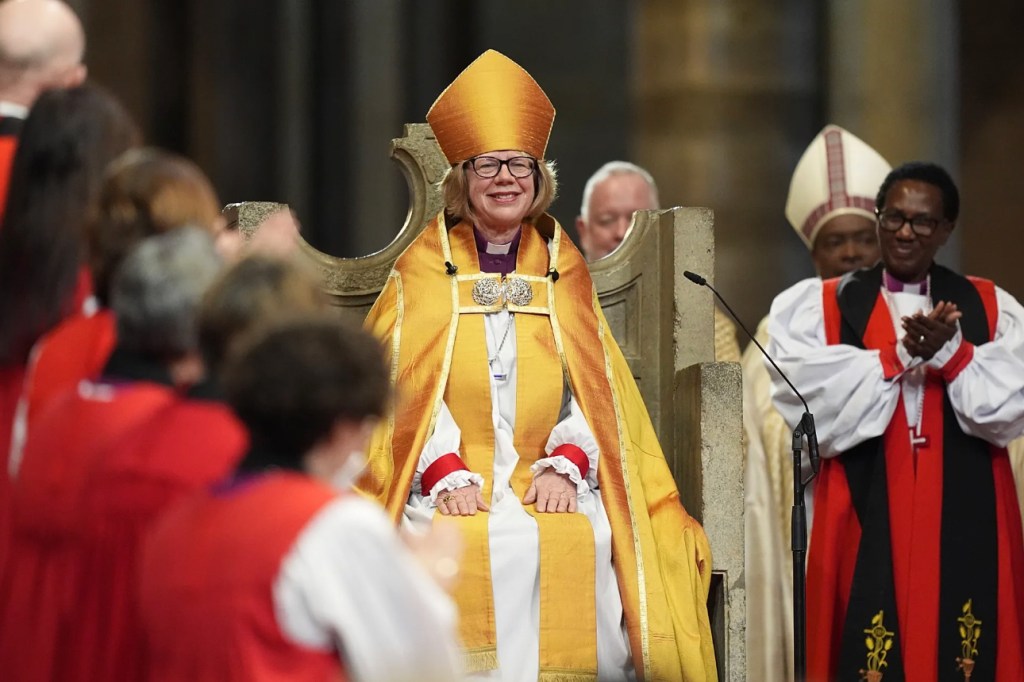
At her enthronement ceremony, Archbishop Sarah wore a bishop’s mitre, cope (ceremonial cloak) and stole of deep-yellow silk. She chose to fasten her cope not with the usual highly-ornamented morse clasp, but with a humble clasp made from the belt buckle of her old nurse’s uniform, representing her 35 years of service as a nurse and midwife.
As if to bring to life Archbishop Sarah’s simple statement that “Hatred and racism of any kind cannot be allowed to tear us apart,” the African Choir of Norfolk played a central part included in the Archbishop’s installation ceremony. This 15-piece ensemble, led by Anna Mudeka, sang the Swahili acclamation ‘Hata Milele, Jesu ni bwana’ (‘Even forever, Jesus is Lord’) followed by a Herero song, ‘Muhona Muhona matu kutanga, Havihe viyaungurwa, iyo vehehe’ (‘Our creator we praise, everything was created by you’).
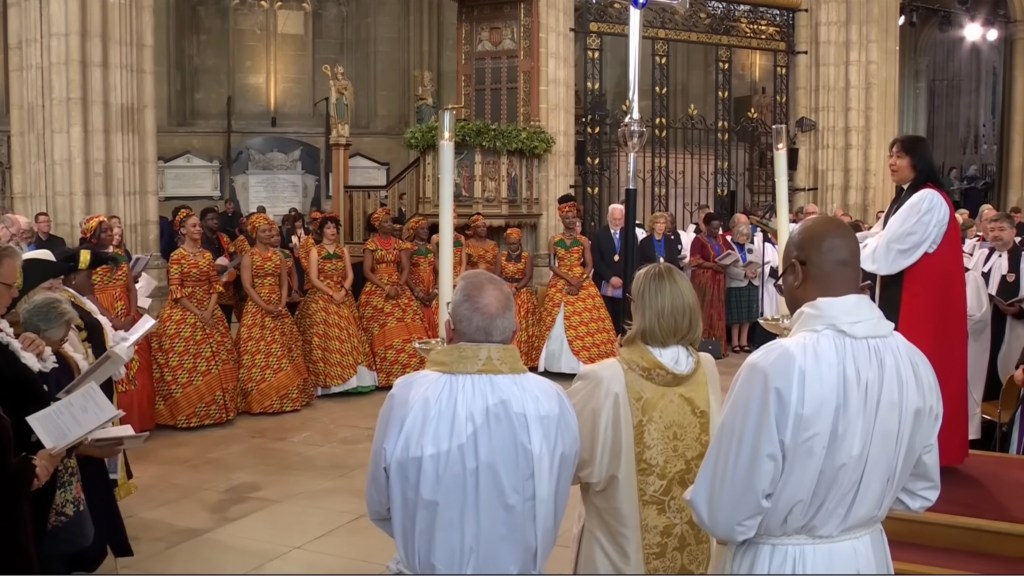
Photo: Canterbury Cathedral Installation Livestream.
These elegant African women beautifully embodied praise and prayer through song and dance. The group moved through the Cathedral with exquisite grace, wearing full-skirted dresses and headwraps of handwoven Ghanaian kente cloth. The rich colours of kente are deeply symbolic, featuring green for vegetation, planting and harvesting, and spiritual renewal;
blue for peace, love, and harmony; black linked with rites of passage, intensified spiritual energy, and ancestral spirits; yellow-gold showing high status, wealth, fertility, beauty, and all that is precious; and red, the color of healing and the Mother Earth. The vibrant colours made a visual song of praise all by themselves, embellishing the sweetness of the women’s song.
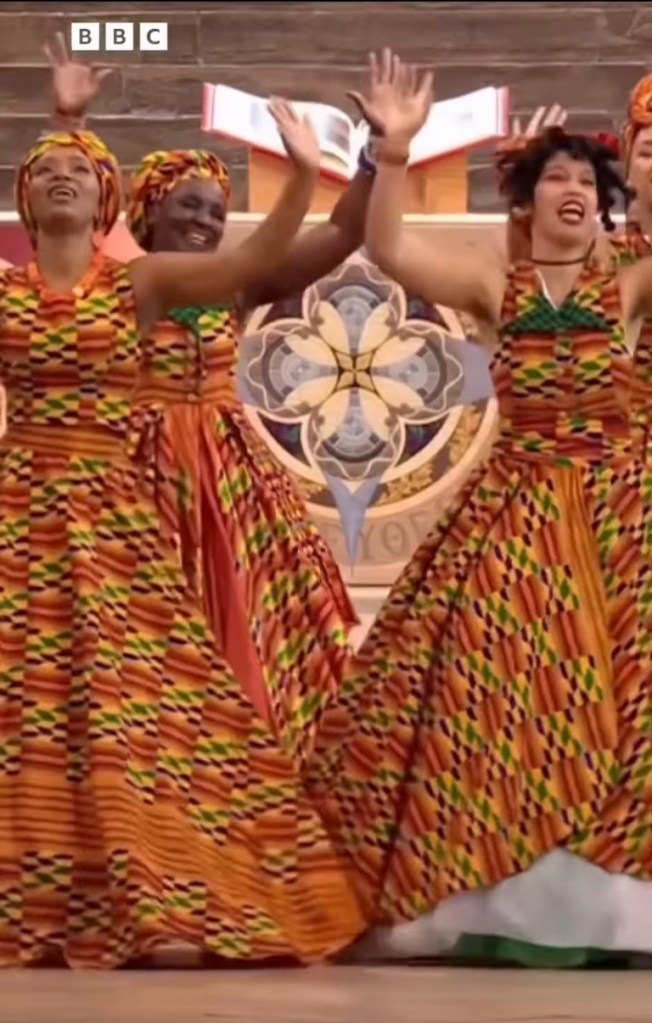
Photo: BBC.
The singing was supported by guitar, maracas and djembes, and in one woman’s hands, the subtle rhythms of the kayamba, a flat rectangular shaker made of reeds and filled with seeds. The kayamba is held horizontally like a winnowing tray, and is played with the same technique of staccato shakes used in winnowing. I described this technique in my recent FAR post, Heartbeat of the Mother: Rhythms from Ancient Times, and mentioned how frame drums were once used by women for winnowing. When I wrote in that article, “We can imagine the collective rhythms made by this communal activity, and how easily they might lend themselves to singing and dancing,” I had no idea that within a few weeks the world would be able to see such a lovely example of this in Archbishop Sarah’s installation ceremony.
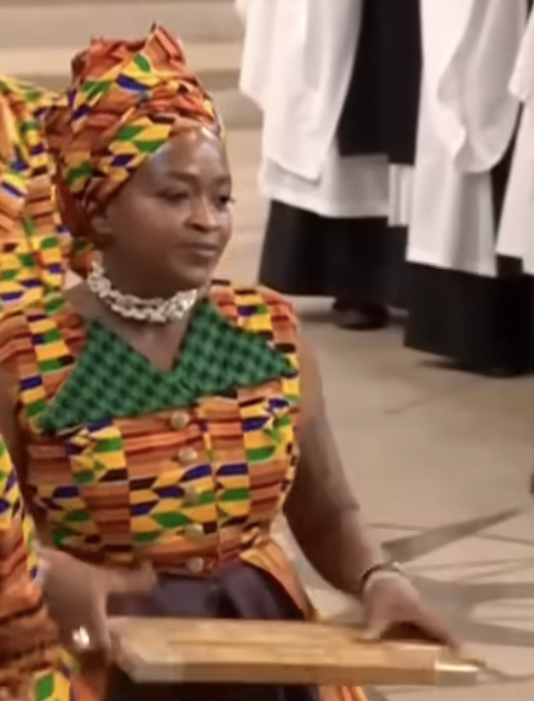
The seeds inside the kayamba, as well as the link to ancient rhythmic techniques of winnowing, create a literal connection to Mother Earth as the source of life. Added to this, the women’s voices lifted high in joyful ululations rang high in the vault of the Cathedral nave, as if also to awaken the sky, source of life-giving rain. This, for me, is true prayer and praise, and made the African women’s contribution the highlight of the ceremony.
Let’s end with the words of Archbishop Sarah Mullally, and join her prayer for “…hope for all those around the world caught up in war. For those living in extreme poverty. For those on the front lines of the ever-worsening climate crisis. For our Palestinian Christian brothers and sisters, and all the peoples of the Middle East. For the people of Ukraine, Russia, Sudan, Myanmar and the DRC. May God end the horrors of war, comfort those who mourn, and bring hope to those living in despair.”
Amen.
Installation of Sarah Mullally as Archbishop of Canterbury on Youtube:
The African Choir of Norfolk appear from approximately 1:01:45 to 1:14:00.
Short clip of the African Choir of Norfolk here:
Discover more from Feminism and Religion
Subscribe to get the latest posts sent to your email.


The Church of England has many beautiful traditions some very ancient going back before Christianity – I like it that this woman chose a pilgrimage as a way to begin – if more of us made pilgrimages rather than bucket lists maybe our perspectives might change?
LikeLiked by 1 person
Also, life is a wonderful journey
LikeLike
Ah, that is a wonderful thought. All of my own pilgrimages have certainly changed my perspectives. And in contrast to the concrete goals which make up a bucket list, on a pilgrimage we never know quite what we are going to find…
LikeLike
I have heard bucket list as places to get to…. pilgrimages have a different intent
LikeLike
I love references to frame drumming and its origin in winnowing. I had a drum with little metal balls inside, decorated with fish, that I played vertically and called an ocean drum. So it’s interesting to read about the kayamba, played horizontally and representing earth and sky. The fire, I guess, would be added as the winnowed grain is baked into bread.
LikeLiked by 1 person
Yes, absolutely, fire is present in the process of baking the bread – or using sunlight to ‘bake’ loaves of sprouted ground grain, in the Essene way – of which the winnowing is but one inseparable step. Fire of sunlight to ripen the grain. Water in the rain rituals, which so often employed frame drums and took place on threshing circles, asking for the right balance of rain and sun to ripen the crops and feed the people. There are also percussion instruments made from water pots – the stamna in Greece, the udu in Nigeria – which like frame drums are mostly played by women, and which I believe are likely to be just as old as frame drums, if not older. I like to imagine your ocean drum, audibly bringing the element of water to life…
LikeLike
I love this – all the ways the drum relates to the elements. (I have an udu as well.)
LikeLike
I love that the Archbishop of Canterbury was a nurse and a midwife before entering the priesthood! I also love that she made a walking pilgrimage. Thanks for introducing FAR to Sarah Mullally!
LikeLiked by 1 person
The other faiths of the world need to follow suit. Including many smaller more occultic religions. Though thankfully I am in a Pagan temple with many Priests and Priestesses. Many wise elders.
LikeLike
Praises for the new archbishop! I have to ask, why is the king considered the highest spiritual authority?
LikeLike
Good question, Annelinde! The Monarch has been the official supreme governor / spiritual authority of the Church of England since the Protestant Reformation, specifically since 1534, when the Act of Supremacy officially broke ties with the Roman Catholic Church to establish the Church of England. In the UK, the C of E is the only ‘established’ (or state) church, and is inextricably interwoven with the state’s legislative and executive branches. (Other denominations in the UK have no official ties to the government.)
Thus the monarch is both the head of the church and the head of state. And this is why the Church of England officiates on state occasions such as coronations; 26 C of E bishops sit in the House of Lords; the C of E receives significant amounts of public money; C of E laws can only be amended through Acts of Parliament; the monarch and their successors must be Protestant and “join in communion with the Church of England”; and the Archbishop of Canterbury has the second-highest role of spiritual authority.
There is a strong movement to separate church and state in the UK (in fact the C of E was disestablished in Wales in 1920), supported by many secular organisations who believe the state should not favor one particular religion, especially in our day and age. This position is known as disestablishmentarianism, and the opposing stance – i.e., those who wish to maintain the status quo of united church and state – is of course antidisestablishmentarianism…
This might seem like more information than anyone would want to know, perhaps, but it is important to know how this history crucially influenced the founding of the U.S.A, as many colonists left Britain for the New World in order to escape the sometimes brutal suppression of non-Anglican faiths, as well as the mandatory taxation benefitting the Church of England.
In direct rebellion against the doctrine of an established church (i.e., one specific church supported by and united with the government), the founders of our nation enshrined the separation of church and state in the First Amendment of our Constitution. This amendment specifically prohibits Congress from either establishing a state religion or prohibiting the free exercise of any religion.
The creation of a secular government dedicated to protecting religious freedom for all was a hugely radical step for its time, and a key founding principle of the USA. This fundamental tenet of our nation is precisely what is under attack in the current administration, whose ‘Religious Liberty Commission’ (aided by the right-leaning Supreme Court) openly seeks to destroy the historical separation.
Good perspectives on the many ways in which our separation of church and state is being targeted right now are offered by brilliant political historian Heather Cox Richardson. And the still-extant union of church and state in the UK, where the monarch is both head of the government and head of the state established church, offers a good example of what our Constitution was aiming to avoid.
LikeLike
Thanks so much, Laura. I do follow Heather Cox Richardson for her insight into current events and history as well.
LikeLike
Thanks for this explanation. I love this type of detail. When I was growing up in the 1950s, my father cited “antidisestablishmentarianism” as the longest word in the (Webster’s) dictionary. I would answer “antidisestablishmentarianists” is longer. I just looked it up, and there are now a lot of created technical words that are longer, and this word became popular in the ’50s when someone spelled it on the TV show “The $64,000 Question”. I note that it is not in the vocabularly of my spell-checker.
LikeLike
Thank you for this post. It gives me hope that Carol Christ’s call to end patriarchy and war is achievable, even if it does not happen in my lifetime. (I am 89 years old.) I deeply appreciate this positive step, just as I admire Pope Leo standing up to President Trump. I add that I am not a follower of either religious leader, but a Jew by choice.
LikeLiked by 1 person
I agree with you, Winifred, and even though I also do not follow either of those religious leaders as a congregant I feel they are setting an extremely valuable example which can inspire all people. It is so important at this time to have spiritual, political, and cultural leaders who demonstrate the courage to stand up for goodness, rightness, kindness and the golden rule.
LikeLiked by 1 person