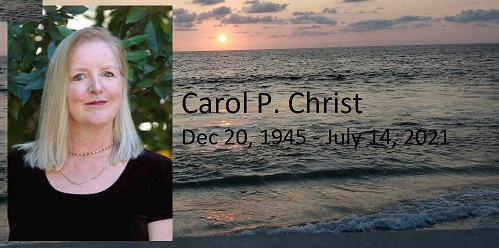
The Legacy of Carol P. Christ: GOD AND WOMAN AT YALE*

This was originally posted on June 25, 2012
As a graduate student, I was told in every way possible that I could not be a woman and a theologian.

When I was studying for my Ph.D. at Yale in theology in the late 1960s and early 1970s, my skirts were short as was the fashion of the day.  The male faculty and students and their wives dressed in ways that would not call attention to themselves or their sexuality.  I was also over 6’ tall.  When I walked into a room, I was consciously and unconsciously perceived as a threat to a world which these men had simply assumed was “theirs.”  Their response was to categorize me as a sexual being (I was once introduced as “our department bunny”) and to erase my mind.  I was to discover that the male graduate students were making bets in the dining hall about “where she will sit today.”  One of my friends frequently fell down and feigned to “worship” me when I passed him in the hallways.  I had never received so much attention from men before and it was flattering.

Continue reading “The Legacy of Carol P. Christ: GOD AND WOMAN AT YALE*”

Carol P. Christ’s Legacy: Are Most of Us Abused Children? And is Child Abuse the Root of Evil?

This was originally posted on July 16, 2012

Child abuse does not have to be physical or sexual. The most widespread forms of child abuse are psychological, and therefore harder to see, acknowledge, and eradicate. As abused children, we unconsciously pass on patterns of abuse visited on us to children, and to others we have power over including students, employees, and even friends and lovers.

The recent visit of a friend who is suffering greatly in a “battle” with her own “demons” reminded me of the important work of Alice Miller. My friend’s “demons” take the form of a persistent self-criticism laced with the feeling that “if only” she did or didn’t do certain things, her world would fall into place. My “demons” generally take a different form, telling me that I am helpless and that there is nothing I can do to ease my suffering.

Such “demons” were not implanted in my friend and me by the devil. They took root in interactions with our own parents, who were not themselves any different from most of the parents of their time and place. Recognizing that our parents were not “bad” people should not blind us to the great harm they did to us. However, when abused children speak of their abuse, the statement that their parents did not intend to harm them usually functions to deflect attention away from child abuse that really did occur. What happened to my friend and me was something like this. In many small and perhaps also a few traumatic interactions, we learned that our feelings do not count.  “Don’t talk now, your father is tired.” “Stop making so much noise, your father has a headache.” “Don’t ask your mother for attention, can’t you see that she has more than enough to do with your younger brother.” Harmless in themselves, such messages, when repeated over and over, lead the child to believe that there must be something wrong with the feelings she has.

Continue reading “Carol P. Christ’s Legacy: Are Most of Us Abused Children? And is Child Abuse the Root of Evil?”

Carol P. Christ’s Legacy: Love Divine, All Loves Excelling

This was originally posted on Sept. 9, 2011

In my last blog I wrote that the image of God as a dominating other who enforces his will through violence–found in the Bible and in the Christian tradition up to the present day–is one of the reasons I do not choose to work within the Christian tradition.  To be fair, there is another image of God in Christian tradition that I continue to embrace.  “Love divine, all loves excelling” is the opening line of a well-known hymn by Charles WesleyCharles Hartshorne invoked these words and by implication the melody with which they are sung as expressing the feelings at the heart of the understanding of God that he wrote about in The Divine Relativity.

Love divine, all loves excelling also expresses my understanding of Goddess or as I sometimes write Goddess/God.  Though I am no longer a Christian, but rather an earth-based Goddess feminist, I freely admit that I learned about the love of God while singing in Christian churches.  Hartshorne wrote that he knew the love of God best through the love of his own mother, and I can say that this is true for me as well.  My mother was not perfect, and she did not understand why I wanted to go to graduate school, my feminism, or my adult political views, but I never doubted her love or my grandmothers’ love for me.  (I count myself lucky.  I know others did not have this experience.)  Like Hartshorne, I also learned about the love of God through the world that I always understood to be God’s body.  Running in fields and hills, swimming in the sea, standing under redwood trees, and encountering peacocks in my grandmother’s garden, I felt connected to a power greater than myself.


Continue reading “Carol P. Christ’s Legacy: Love Divine, All Loves Excelling”

Carol P. Christ’s Legacy: Is This How Patriarchy Began?

This was originally post on June 19, 2017

In my widely read blog and academic essay offering a new definition of patriarchy, I argued that patriarchy is a system of male dominance that arose at the intersection of the control of female sexuality, private property, and war. In it, bracketed the question of how patriarchy began. Today I want to share some thoughts provoked by a short paragraph in Harald Haarmann’s ground-breaking Roots of Ancient Greek Civilization. Haarmann briefly mentions (but does not discuss) the hypothesis that patriarchy arose among the steppe pastoralists as a result of conflicts over grazing lands. As these conflicts became increasingly violent, patriarchal warriors assumed clan leadership in order to protect animal herds, grazing lands, and the women and children of the clan.

On the recent Goddess Pilgrimage to Crete, while we were driving through sparsely populated grazing land, my friend Cristina remarked that the shepherds on foot wearing traditional clothing that she had seen several decades earlier had been replaced by men in shirts and jeans, driving farm trucks. Her nostalgic reverie was interrupted by our young Cretan bus driver who said, “You would not want to be alone with one of those men, not now and certainly not then.”

Continue reading “Carol P. Christ’s Legacy: Is This How Patriarchy Began?”

Legacy of Carol P. Christ: What Does Mother’s Day Mean in a Patriarchal and Matricidal Culture?

This was originally posted on May 9, 2016

When we seek immortality or spiritual “rebirth,” are we not saying that there is something wrong with the “birth” that was given to us through the body of our mothers? In She Who Changes and in “Reading Plato’s Allegory of the Cave as Matricide and Theacide,” I asserted that our culture is “matricidal” because it is based on the assumption that life in the body in this world “just isn’t good enough.”

What is so wrong with the life that our mothers gave us that we must reject it in the name of a “higher” spiritual life? The answer of course death.

Can we love life without accepting death?

Can we love our mothers if we do not accept a life that ends in death?

Jesus was said to have encouraged his disciples to leave their wives and families in order to follow him.  When he was told that his mother and brothers were outside and waiting to speak to him, he is said to have said:

“Who is my mother, and who are my brothers?” And stretching out his hand toward his disciples, he said, “Here are my mother and my brothers!  For whoever does the will of my Father in heaven is my brother, and sister, and mother. (Matt. 12:48-50)

Continue reading “Legacy of Carol P. Christ: What Does Mother’s Day Mean in a Patriarchal and Matricidal Culture?”

Carol P. Christ’s Legacy: Great Goddess, Mother Goddess, Creatrix, Source of Life

This post was originally posted on February 5, 2018

The symbol of the Goddess is as old as human history. The most ancient images of the Goddesses from the Paleolithic era are neither pregnant nor holding a child. In Neolithic Old Europe the Goddess was most commonly linked with birds or snakes and only rarely portrayed as mother. Yet we tend to equate the Goddess with the Mother Goddess. I suspect that images of the Virgin Mary with Jesus on her lap and prayers to God as Father have fused in our minds, leading us to think that the Goddess must be a Mother Goddess and primarily a Mother.

In a recent blog, Christy Croft reminded us that in our culture, women’s experiences of mothering and motherhood are not always positive:

[The mother] doesn’t always appear in our stories in simple or easy ways. Some of us mother children we did not or could not grow in our bodies; some of us birth babies who are now mothered by others. Some of us are not mothers at all. Some of us had mothers who could not love us unconditionally, or did not have mothers in our lives, or had mothers who brought us more pain and humiliation than comfort, from whose effects we are still recovering, are still healing.

Continue reading “Carol P. Christ’s Legacy: Great Goddess, Mother Goddess, Creatrix, Source of Life”

Carol P. Christ’s Legacy: Was There a “Golden Age” before Patriarchy and War? by Carol P. Christ

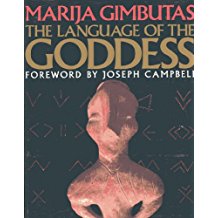
Marija Gimbutas coined the term “Old Europe” c.6500-3500 BCE to describe peaceful, sedentary, artistic, matrifocal, matrilineal and probably matrilocal agricultural societies that worshipped the Goddess as the power of birth, death, and regeneration in all of life. Gimbutas argued that Old Europe was overthrown by Indo-European speaking invaders who began to enter Europe from the steppes north of the Black Sea beginning about 4400 BCE.  The Indo-Europeans were patrilineal and patriarchal, mobile and warlike, having domesticated the horse, were not highly artistic and worshiped the shining Gods of the sky reflected in their bronze weapons.

In the fields of classics and archaeology, Gimbutas’s work is often dismissed as nothing more than a fantasy of a “golden age.” In contrast, scholars of Indo-European languages, Gimbutas’s original specialty, are much more likely to accept the general outlines of her hypothesis. The German linguist and cultural scientist Harald Haarmann is one of them.

Continue reading “Carol P. Christ’s Legacy: Was There a “Golden Age” before Patriarchy and War? by Carol P. Christ”

Carol P. Christ’s Legacy: Kassiani: Placing a Woman at the Center of the Easter Drama

This blog was originally posted on April 13, 2015. You can read the original comments here.

For many years I been told of the beautiful Hymn of Kassiani, sung only on Easter Tuesday night, but I had never heard it until this week. For many this song is the high point of Easter week.

Kassiani, also known as St. Kassia, was a Greek woman born into a wealthy family in Constantinople (now Istanbul) about 805 to 810 AD. According to three historians of the time, she was intelligent and beautiful and selected as a potential bride for the Emperor Theophilos. The chroniclers state that the Theophilos approached her and said: “Through woman, the worst,” referring to the sin of Eve. Clever Kassiani responded, “Through woman, the best,” referring to the birth of the Savior through Mary.

Apparently unable to accept being put in his place by a woman, Theophilos chose another bride. Kassiani founded a monastery in Constantinople becoming its first abbess. She was an outspoken theological advocate of icons during the iconoclastic crisis (for which she was flogged). One of only two women to publish under her own name during the Byzantine Middle Ages, Kassiani wrote both poetry and hymns. Up to 50 of her hymns are known today, with 23 of them being part of the Greek Orthodox liturgy

.

Continue reading “Carol P. Christ’s Legacy: Kassiani: Placing a Woman at the Center of the Easter Drama”

Carol P. Christ’s Legacy: Please Keep It in Your Pants by Carol P. Christ

This blog was originally posted on November 6. 2017. You can read the original comments here.

Trigger warning: this post describes sexual abuse

Last week while responding to a comment on my blog, I suddenly remembered a series of incidents in which men I did not know exposed themselves to me in public places. The first time occurred at a park around dusk during an outing with a group of girls. I was about 11, I may have wandered away from the group, or I may have been with others. What I remember is seeing a man with his pants down sitting on a park bench, possibly the first time I ever saw an adult man’s penis. I told or we told, but the man was not reported by the adults. Fast forward to the beautiful gardens of the Palace Schoenbrunn in Vienna where I was confronted by a penis while lost in thought when I was 19. I ran, but said nothing. In my 20s at the early showing of movies in New York City men would sit next to me and jerk off into paper bags. I learned to move whenever a man was near me in the theater, but I never told the ticket seller. A few years later, I crossed paths with a man who had his penis out on my favorite walk in the hills of Alum Rock Park in San Jose. I never walked carefree in that park again. When I was looking for the cave of the Furies on the Acropolis Hill in Athens, a man followed me waving his penis. I told the guard, but when the police came, he was gone. I arrived home in distress. My boyfriend said I was over-reacting. I learned to stay clear of men in cars on the streets of Athens at night after seeing things I did not want to see more than once in their hands. I coded this behavior as part of the background of my life. There was a man who from the basement apartment a few doors up from the Cycladic Museum pressed his erect penis against the window. I told the guard at the museum who said, “We have called the police more than once, but he always cries, and they let him go.” On a trail I had walked many times with my dogs near Lafionas in Lesbos, coming around a bend, I encountered a young farmer, who as soon as he saw me, pulled out his penis and urinated against a fence. That was the last time I walked the trail. We are supposed to learn to consider this behavior as well, if not normal, anyway, not such a big deal. After all, I wasn’t hurt, or was I?

Continue reading “Carol P. Christ’s Legacy: Please Keep It in Your Pants by Carol P. Christ”

Carol P. Christ’s Legacy: “THE OLD RELIGION” OR A “NEW CREATIVE SYNTHESIS”?

Moderator’s Note: Carol Christ died from cancer in July, 2021. Her work continues through her non-profit foundation, the Ariadne Institute for the Study of Myth and Ritual and the Goddess Pilgrimage to Crete. This blog was originally posted June 30, 2014. You can read its original comments here.

Is Goddess feminism an old religion or a new creative synthesis? Can it be both?  Goddess feminism draws on the feminist affirmation of women’s experiences, women’s bodies, and women’s connection to nature; the feminist critique of transcendent male monotheism as the symbolic expression of male domination of women and nature; and 19th and early 20th century discussions of Goddesses and matriarchy.

Most Goddess and other spiritual feminists have experienced Wiccan rituals, which are often simply called Goddess rituals.  For many of us, elements of Wiccan practice strike a chord of knowing, while other aspects seem odd or strange or even just plain weird.  What are the roots of Wiccan ritual?

Continue reading “Carol P. Christ’s Legacy: “THE OLD RELIGION” OR A “NEW CREATIVE SYNTHESIS”?”