

 ‘Someone needs to gather the stories, to keep the cauldron,’ said the late Goddess feminist artist Lydia Ruyle during one of the last times we spoke, at the 2014 Glastonbury Goddess Conference. I had hinted at my concerns around conducting doctoral research in the presence of ongoing conflict within the Glastonbury Goddess community (especially when my broadly-stated site of interest is ‘politics’), and in reply she had stressed the need to ‘hold space’ for the different voices and perspectives in the UK Goddess movement, and that conflict would be inevitable. ‘There needs to be a weaver,’ she said.
The following day I recorded an interview with Lydia and some of her friends at Café Galatea on the High Street, which she had been keen to ensure since the previous summer—with poignant foresight, given her death in March 2016. I’m not sure if she was expecting that I should fully take on the role of this ‘weaver’—there are more stories than one PhD thesis can claim to encompass—but the theme is present in my writing. Her words lead me to reflect on the weaving together of politics with memory and storytelling, and on the need to honour the plural histories of the British Goddess movement. Continue reading “Goddess Politics and the Cauldron of Memory by Kavita Maya”
 As a child, I learned all about my religion from my grandmother, in her small and remote Romanian village. She told me many Bible stories from our Christian Orthodox tradition, often disguised as bedtime fairytales, but it was not doctrine that I learned from her, as much as ritual. She taught me the prayers to say at night so I don’t have nightmares, the candles to light in church for luck, the list of dead and living to give the priest for blessings, the making and delivering of food as offerings in memory of the recently deceased.
  Have you ever wondered why it has to been so important for the Roman Catholic church to disempower women and suppress their rightful place in history? And have you ever questioned why it was so important to distort symbols and legends, which for thousands of years BC, had been connected to women and our innate spirituality?
 I’ve been asked by both academics and Pagans what inspired me to pursue doctoral research on the British Goddess movement: of the many ways that people first
  (Spoiler alert: She’s already here)
 Despite the chocolate bunnies, eggs and toy chickens in the shops along with the coaxing to buy and celebrate Easter at this time in Australia, it is not Spring: Earth here does not seem to co-operate with the Consumer Faith, built as it is around the Northern Hemisphere and dominant Christian calendar. In the Southern Hemisphere it is Autumn, the dark part of the day is lengthening.
 Last month I came face-to-face with a fisher.
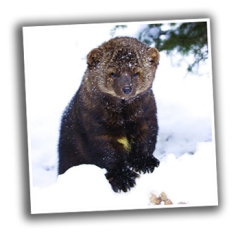 The elevation difference brought us face-to-face. I found myself staring into a fierce, furry-brown, teddy bear face. It exuded a stout confidence and an instinctual danger thumped. Eye-to-eye, neither of us moved. What was this thing? Suddenly from the reservoir of memory a recognition emerged—it looked like a wolverine. But wolverines aren’t in these woods, right? Fifteen unflinching seconds passed and then it leapt back into the woods. I stood mesmerized by the beauty and surprise of it—this was not something ordinary.
  I still think that Valerie Saving was right.
 She appeared on a hill on December 9, 1531. She spoke to Juan Diego in his native tongue of Nahuatl; the language of the Aztecas. She asked for a church to be built at that very site in honor of her, the Virgin Mary. Juan Diego took the request to the local priest, but his story was not believed. On December 12, following further instructions from La Virgen, Juan Diego was able to find and pick roses not native to Mexico. He rolled them up in his tilma and returned to the priest. When he unrolled his tilma to present the roses, there on the tilma was the image of La Virgen de Guadalupe; she was as dark as the natives themselves.
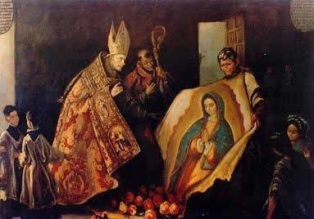 La Virgen de Guadalupe
 Feminism and Religion