GODDESS WITH US: IS A RELATIONAL GOD POWERFUL ENOUGH? by Carol P. Christ

carol-christLast week I wrote about Protestant Neo-Orthodoxy’s deification of male power as power over.  This week I want to ask why the relational Goddess or God* of process philosophy has not been more widely embraced, both generally and in feminist theologies.

Could it be that a relational God just isn’t powerful enough? Are some of us still hoping that an omnipotent God can and will intervene in history to set things right?  Do we believe an omnipotent God can save us from death?

Process philosophy provides an attractive alternative to the concept of divine power modeled on male power as domination.  According to leading process philosopher Charles Hartshorne, the power to coerce, power as power over and domination, is not the kind of power God has.

The concept of divine power as omnipotent (having all the power) leads to what Hartshorne called “the zero fallacy.”  If God has all the power and can dominate in all situations, then the power of individuals* other than God is reduced to zero.  In effect, this means that individuals other than God do not really exist, but at most are puppets whose strings are pulled by the divine power.

Moreover, as Hartshorne argued, the power to coerce is not the kind of power Goddess “should” have.  Although many have been forced to submit to them, tyrants and bullies do not empower others.  Should we not understand the “highest power in the universe” as empowering of others?

For process philosophy Goddess is understood to be the most sympathetic or empathetic of all relational beings.  Continue reading “GODDESS WITH US: IS A RELATIONAL GOD POWERFUL ENOUGH? by Carol P. Christ”

Neo-Orthodoxy: The Apotheosis* of Power as Power Over by Carol P. Christ

carol-christRecently I have been thinking about Neo-Orthodoxy, the leading  Protestant theological movement of the twentieth century, as a deification of male power as power over.  In the language of the schoolyard, this translates as “mine is bigger than yours.”  Or more precisely:  “God’s is bigger than yours.” 

Neo-Orthodoxy dominated Protestant theology in Europe and America in the mid-twentieth century and structured my theological education at Yale in the late 1960s and early 1970s.  Yale may have been “the bastion” of Neo-Orthodoxy, but Neo-Orthodox perspectives reigned in all the Protestant seminaries and were even celebrated in the media.  Neo-Orthodoxy may have some commonalities with fundamentalism but it was by no means an anti-intellectualist approach to theology.

A reaction to the perceived “impotence” of German Protestantism in the face of Hitler, Protestant Neo-Orthodoxy asserted “the commanding power of God” over against reason and culture.  Its leading advocates included the Swiss theologian Karl Barth, the German New Testament scholar Rudolf Bultmann, and the German theologians teaching in the United States, Reinhold and Richard Neibuhr, and Paul Tillich.  For all of them in different ways, the “Word of God” was a dynamic force that imploded into history challenging individuals and communities to turn away from egotism and “idolatry” defined as worship of something less than God–for example, self, nation, or wealth. Continue reading “Neo-Orthodoxy: The Apotheosis* of Power as Power Over by Carol P. Christ”

5 Interesting Facts about Women and Religion by Kile Jones

Kile Jones, atheistPart of my research is focused on how the social sciences relate to “religion” and religious studies.  More specifically, I spend time examining the sociology of religion.  I look at stats, demographics, and polls.  I look at rates of attendance, frequency of prayer, levels of “religiosity,” apostates (or the less religiously-loaded term “exiters”), and political outlooks.  I also look at how bias this area of study is in favor of religion.  One facet of this work that has always interested me, is the differences in “gender” and “sex” as they relate to religious beliefs and observances.  Accepting the fact that there are spectrums of sex, gender, and identity, and the presence of difficult philosophical questions surrounding self-identification and the limits of labels, some really interesting facts and statistics crop up time and time again.  In what follows I will lay out a couple of these interesting facts, along with some thoughts on them: Continue reading “5 Interesting Facts about Women and Religion by Kile Jones”

The Words Ring Hollow by Kelly Brown Douglas

July 2008 the United States House of Representatives passes a resolution apologizing for the more than two hundred years of slavery and the decades of Jim Crow that followed.

June 2009 the United States Senate passes a resolution apologizing for slavery and Jim Crow.

October 2007 Tallahatchie County Mississippi Board of Supervisors and Sheriff William Brewer, Jr. sign a resolution apologizing to the surviving family of Emmett Till for his murder and for the acquittal of the two men who murdered him.

March 2013 Montgomery Alabama police chief Kevin Murphy apologizes to Congressman John Lewis for the failure of police to protect Lewis and other Freedom Riders from mob attacks when they rode through Montgomery in 1961.

April 2012  “I am sorry for the loss of your son,” George Zimmerman says at his bail hearing to the parents of Trayvon Martin. Continue reading “The Words Ring Hollow by Kelly Brown Douglas”

“We Are Atheism” and Amanda Brown by Kile Jones

Kile Jones, atheistSo far, as a regular contributor to Feminism and Religion, I have interviewed a “pro-science” woman and one who started an online community for grieving unbelievers.  In this post, I will interview Amanda Brown, an atheist activist who co-founded a project called We Are Atheism.  Amanda grew up in Independence, MO, in the Assemblies of God and the Restored Church of Jesus Christ of Latter Day Saints. Since then, she has been involved in helping atheists “come out” and share their experiences.  So without further ado, here is the interview:

943021_10100185792782141_825478688_n

Why did you start “We Are Atheism”?

I started We Are Atheism because I saw a gap in the age of atheists coming out of the closet.  I also wanted a way for people to see for themselves that atheists are real people.  We Are Atheism is focused on the fact that atheists are mothers, fathers, teachers, brothers, friends, and so much more. When I was at the 2011 Secular Student Alliance Conference in Columbus, OH, I heard most of the leaders tell stories about their groups and how many of them didn’t know other atheists. I thought this was horrible, and being a person who was in the same position, I wanted to start something that would bring our community together.  Those who met on the internet could take their community from online to the neighborhood. Continue reading ““We Are Atheism” and Amanda Brown by Kile Jones”

The Story of Juneteenth by Kelly Brown Douglas

Tomorrow is a special day for me. It is Juneteenth.  On June 19, 1865, news finally reached Galveston, Texas that slavery had been abolished. This was of course two and a half years after Lincoln issued the Emancipation Proclamation. While the actual impact of the emancipation for the enslaved remains a source of historical discussion if not debate, the fact of the matter  is that the proclamation of emancipation and the reality of freedom for black women and men did not necessarily coincide. To be sure, for a variety of reasons, the Emancipation Proclamation did not have an immediate impact on the daily lives of enslaved women, men and children.  While the “official” historical records marks   January 1, 1863 as a day of emancipation, the historical record for the descendants of enslaved men and women marks June 19, 1865 as the day of freedom. For, it was on this day that the last slaves were free.

While the celebrations of Juneteenth have waxed and waned over the years, it remains a day in which African Americans reflect upon the “mighty long way” we have come as well as the “mighty long way” we have left to go on the pathway toward freedom.  As I celebrate Juneteenth, in the words of a black gospel song, “My soul looks back and wonders how they got over.”  And so it is that my theological imagination is stirred, for it is clear that it was by faith that they (the enslaved) got over. And so I ask, what kind of faith was it that allowed them to get over, that is, to survive a life of bondage? This question is even more pressing to me each time that I am reminded that there were those who were born into slavery and died in slavery, and thus, as Toni Morrison once exclaimed, “never drew a free breath.” So, what kind of faith was it that carried these people through life? Continue reading “The Story of Juneteenth by Kelly Brown Douglas”

RAPE CULTURE IN THE MILITARY AND “TURNING BOYS INTO MEN” by Carol P. Christ

carol p. christ 2002 colorRape is not something that “just happens” in the military. It is an inevitable product of military training. Unless and until we understand this and change the way soldiers are trained, we will never be able to stop rape in the US military or any other military system.

The right to rape women of the enemy has been considered one of the “prerogatives” of warriors since the beginning of warfare.  Propaganda-Poster-MasculinityCould “military training” which “turns boys into men” by calling them “girls” or “women” or “gay” in order to break down their self-esteem and remold their “character” as soldiers be one of the reasons rape is such a pervasive problem in the military? Are “boys” being taught that the only way to “prove” their “manhood” is to replace “identification” with women—their mothers, sisters, girlfriends, wives—with a new “identity” as a “dominant male” who “dominates” women and weaker men?  I fear that if we fail to address the “core issue” of “military training,” we will never get to the root of the rape culture that pervades the military.

Unfortunately the model of training boys to be men by humiliating them with taunts that they are “girls” or “gay” is not limited to the military but is also a regular part of sports training.  In both the military and sports, terms like “sissy,” “wuss,” “pussy,” “faggot”–and worse–are regularly used by male authority figures in order to “spur” boys “on” to feats of “physical achievement” that require “punishing” their own bodies and the bodies of others.  The use of these epithets in the context of humiliation makes it clear that “a man” is not “a woman” or “a gay”:  “a man” is someone who has eradicated all of his “feminine” qualities while learning to dominate and humiliate women and effeminate men.

Is it any surprise that rape of women and effeminate or gay men is pervasive in the military and in sports culture? Continue reading “RAPE CULTURE IN THE MILITARY AND “TURNING BOYS INTO MEN” by Carol P. Christ”

Betraying Bodies by Kelly Brown Douglas

Her name was Tricia Meili. Their names were Yusef Salaam, Raymond Santana, Antron McCray, Korey Wise and Kevin Richardson.  On April 19, 1989 all of their lives were irrevocably changed. They would never meet, but their lives would become forever linked.  When they entered into Central Park on that night, did they know that they were stepping into a haunting history of dismembered bodies?  Tragically, their bodies would become another story to be told in that history.

On that April day in history some 34 years ago one white female body went into Central Park for her routine jog. Five black and brown male teenage bodies went into Central Park to hang out, but soon became a part of a crowd engaged in mischievous if not dangerous and out-of-control harassment of other park visitors. As the night wore on, police were called and arrests were made. It would later be discovered that Tricia was brutally and sadistically raped, but not by Yusef, Raymond, Antron, Korey or Kevin. Yet, the five young teenagers were badgered into confessions, charged with the rape and sentenced to prison. Continue reading “Betraying Bodies by Kelly Brown Douglas”

(Femen)ism? by Kile Jones

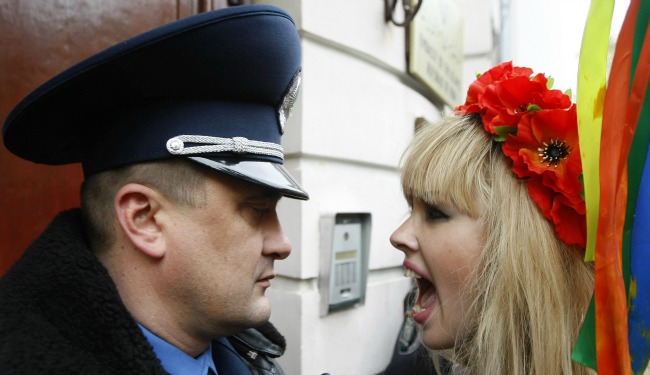
Kile Jones, atheistAs most of us are aware by now, there is a “feminist-sextremist” group from Ukraine called “Femen.”  This group has been very controversial by their public demonstrations of nudity, the words they paint on their bodies, and their explicit condemnations of political structures and organized religions.  They were started by Anna Hutsol in 2008 and have now spread throughout Europe and the Middle East.  The question I pose for this post is: Does Femen harness or hinder the power of the feminist critique?

Image from Konstantin Chernichkin/Reuters

Femen is precisely the kind of movement that pushes us in our understanding of feminism, the means by which it is best expressed, and the issues surrounding moral condemnation and religious sensitivity. Continue reading “(Femen)ism? by Kile Jones”

Feminism and Football By Marcia W. Mount Shoop

Marcia headshot“How did race and privilege affect the NCAA investigation of the football program at University of North Carolina?”

This was the question a student posed to me recently when I gave a Skype lecture to a Sports Ethics class at the University of Washington’s Center for Leadership in Athletics

I am going to take a wild guess (and I may be wrong), and assume that most readers of the FAR blog don’t know much about the NCAA investigation of the UNC football program.   I have outed myself on this blog before—I am more than just a feminist theologian; I am also a football coach’s wife.  Lots of people wonder how I manage to pull that off and still look at myself in the mirror.  That’s a complicated question.  I am finding that the challenges presented by our experience at UNC are creating more and more space for the feminist and the coach’s wife to find a common purpose.  Which brings us back to the question at hand—race and privilege and how it played into the football investigation at UNC.

You may want to investigate the many details of this investigation, but I would like to invite this feminist community to see what you think about this question of privilege in particular.   I will provide just a few factual statements for you all.  You tell me if you can think of ways that race and privilege may have been at work to the detriment of certain groups in this situation.  Continue reading “Feminism and Football By Marcia W. Mount Shoop”