 There is never a reason for physical violence. There is never a reason to hit your partner or child to the point where they are unconscious or bruised. There is never a reason to inflict violence against someone else, but apparently there are exceptions to these rules if you’re an NFL football player.
In my native state of Wisconsin, watching football on Sunday is synonymous with attending church prior to the game. Watching football on Sunday is a cultural norm in many, if not all, different regions of the country where individuals, whether you like it or not, gather each Sunday to both praise and pray that your team ends up on top.
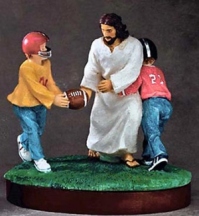
In Wisconsin, you attend church with your family and head to your desired destination where you gather with friends and family to eat, talk about your life, and of course watch your local football team battle their weekly rival. Although I am not much of a football fan these days, I have very fond memories of attending football games, watching them with my family and talking about the Green Bay Packers’ Super Bowl chances. It was my time to both bond with the men of my family as well as catch up on the gossip the women would whisper back and forth to each other at the dinner table while the men were in the other room screaming at the TV.
Although I’m sure I will watch more games in my future, lately, all I do is cringe when I think about the growing violence that women and children face and have faced in the large shadow of an organization worth north of $9 billion dollars.
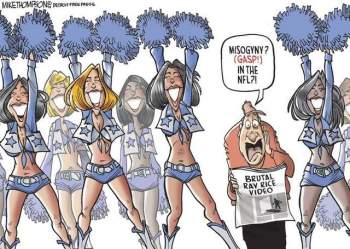
The biggest scandal to hit the news waves lately is that of Baltimore Ravens running back Ray Rice’s assault of his wife in an Atlantic City elevator. Although Rice and the various other incidents regarding NFL players and violence is disturbing, the biggest problem facing the NFL isn’t just its treatment of women but its continual commodification of them as a disposable resource emblematic with the culture of violence that it has created.

If you didn’t know, women make up an estimated 45% of the NFL‘s more than 150 million American fans and have, in recent weeks, become their most valuable resource and source of criticism. However, after a long string of incidents stemming back from NFL teams underpaying cheerleaders to the Ray Rice incident, one needs to ask what the roles of women, if any, are outside of the disturbing images of the abused wife, hypersexualized cheerleader? Is being dragged out of an elevator by your abusive husband the only way to get women’s issues addressed in the NFL by fans, league owners, and the NFL commission?
The roles of women in the NFL and religion have many similarities. Aside from end zone celebrations where players praise God for his apparent direct role in helping them score a winning touchdown or certain players edifications as gods on Earth, women make up the crux of both NFL fandom and attendance but are responsible for the gatherings similar to the ones I, and many others, grew up with.
Although putting women in charge of drafting new policies that address the “woman problem” currently facing the NFL, it too reeks of the similar dismissive and patronizing actions women face when trying to obtain leadership roles in their religious traditions. Supercilious progress for the sake of progress isn’t progress and progress under the guise of silence is still misogyny. We need women in positions of leadership in both the NFL as well as in religious traditions. The culture of violence and silence will only continue, albeit with a Band-Aid firmly in place, holding the painful experiences and histories of women, long forgotten and often overlooked, until society values their rights just as much as the men leading the prayers and those that are being prayed for on Sundays across America.
Ann Braude said it best in her foundational text Sisters and Saints that “if we want to understand the history of American women, we need to examine the religious beliefs and activities that so many have found so meaningful.” Without women, we wouldn’t have many, if not all, of the religions that are present throughout the world today and in case we forget, without women, we too wouldn’t have the millions of little boys who grow up being taken to and from practice by their mothers with the hope that they too could one day become the professional football players that fans scream and pray for.
Without women, there is no NFL and without women, there is no religion. Kelly Brown Douglas said it best on this very blog when she stated, “It is the violence that violence creates.” Although I agree with her, I would only add that while violence does indeed create violence, the real sin isn’t the violence itself but rather the silence that follows.
Let us pray that we will continue to not be silent and that we will rise up and fight for the millions of women (and men) each day who do not live in fear that their significant other’s multimillion dollar contract will not be reinstated but rather that they and their children may not see another day on this Earth.
John Erickson is a Ph.D. Candidate in American Religious History at Claremont Graduate University. He holds a MA in Women’s Studies in Religion; an MA in Applied Women’s Studies; and a BA in Women’s Literature and Women’s Studies. The LGBTQ and women’s rights movements, masculinity studies, gender theory, and the utilization of technology in forming communities and creating new teaching methodologies influence his research interests. His work is inspired by the intersectionality of feminism, queer identity, LGBTQ history, and religious and sexual cultural rhetoric. He is a Non-Fiction Reviewer for Lambda Literary, the leader in LGBT reviews, author interviews, opinions and news since 1989 and the Co-Chair of the Queer Studies in Religion section of the American Academy of Religion’s Western Region, the only regional section of the American Academy of Religion that is dedicated to the exploration of queer studies in religion and other relevant fields in the nation. When he is not working on his dissertation, he can be found at West Hollywood City Hall where he is the City Council Deputy and Chief of Staff to Councilmember Abbe Land. He is the author of the blog From Wisconsin, with Love and can be followed on Twitter @JErickson85
 The other day, someone on twitter said she would not allow ISIS (known as the Islamic State of the Levant) use the name of “her” religion. In fact, scholars in Egypt had proposed that they be called “the Separatist movement” and take the word “Islam” out of it. This question raised here is: what exactly is “Islamic” about what they are doing and how they are doing it?