In recent days I have been pondering the fact that some people and some feminists seem to see the issues of religious faith and belonging to be rooted in birth, family, and community, while for others the question of belonging to a religious community hinges on belief and judgments about the power exerted by religious institutions. What accounts for this difference in the way we view religious belonging?
Recently I watched The Secret History of Sex, Choice and Catholics, a film featuring Roman Catholic feminists and ethicists who dissent from the Roman Catholic hierarchy’s views on contraception, abortion, and homosexuality. At the beginning of the film those interviewed state almost univocally that for them being Catholic stems from having been born Catholic. These Catholic dissidents continue as Catholics, even though they disagree with major portions of Roman Catholic teaching. It may have been because they were not asked, but most of them did not name reasons of belief for remaining Catholic.
Thus the viewer did not learn the theological reasons these progressive Catholics stay in the church. I wondered: Do they believe that salvation occurs only through Jesus as the Christ? Do they believe in original sin? How do they feel about the God of Exodus and the prophets who achieves his will through violence or the Christian doctrine of hell? I also wanted to know how they justify being part of an institution that, as June Courage stated on these blog pages, is responsible for the deaths of women and children through its contraception and abortion policies just as surely as if it were bombing their homes in an unjust war. Continue reading “Does Belief Matter? by Carol P. Christ”
“The Lord loves everyone and died for everyone, and He wants all to be saved…the best lesson that can be learned from everything that has happened is that one finds happiness, joy and satisfaction in obedience to the Church.” – Bishop Bruskewitz
One of the most misunderstood concepts in the Catholic Church is excommunication. Many believe that excommunication is a complete termination or separation from the Catholic Church. To say this another way, if excommunicated, you are no longer Catholic or part (a member) of the Catholic Church. None of these statements are true. By baptism, you are a member of the Catholic Church and no one can take that away.
Much of the misunderstanding stems from the way excommunication was used in the Middle Ages; a means of coercion to control kings and other high ranking officials. Obedience to the Church meant that you will spend eternal life in heaven. Disobedience to the Church meant a complete separation from the Church; a ban against receiving Eucharist, a banishment of your soul to the eternal flames of hell. Excommunication was the highest form of punishment and the most meaningful (and effective) tools of control. When a person was excommunicated, there was even a public ceremony – a bell tolled for the excommunicant, as a bell that would chime for the dead, the Gospels were closed, and a (baptismal) candle would be extinguished. This ceremony signified eternal darkness and death. Continue reading “The Impact of Excommunication in the 21st Century (Part I) – Spiritual Redemption or Hegemonic Power by Michele Stopera Freyhauf”
It is very disappointing to share that Fr. Roy Bourgeois was excommunicated, dismissed, and laicized by the Vatican as a result of his support for women’s ordination and the eradication of sexism in the Catholic Church. The following was sent out for immediate release by Maryknoll on November 19, 2012. Additional information will be shared once released.
FOR IMMEDIATE RELEASE
The Congregation For The Doctrine Of The Faith
Canonically Dismisses Roy Bourgeois
Maryknoll, New York – November 19, 2012 – The Vatican’s Congregation for the Doctrine of the Faith, on October 4, 2012, canonically dismissed Roy Bourgeois from the Catholic Foreign Mission Society of America, also known as the Maryknoll Fathers and Brothers. Continue reading “BREAKING NEWS: Fr. Roy Bourgeois Excommunicated”
Is it just me, or does anyone else feel like we’re all in Junior High or High School again with the Petraeus scandal? There is drama at every turn with boundaries crossed and accusations slung across every lunch table there is.
When I was a teenager we didn’t have emails, Facebook , and Twitter (thanks be to God). We passed notes. I remember getting a really mean one scrawled in deliberately messy handwriting to maintain anonymity about how annoying I was to the “populace” (yes I remember that word was in there) because I didn’t wear make up and I thought I was “so smart.”
Just like today’s cyber detectives who figured out Paula Broadwell’s identity from the fingerprints we all leave behind in the online lives we lead, I traced this note back to its source. I did it the old fashioned way—I asked around. Unfortunately I found out it was from a “friend” and teammate of mine. When I went to her house and confronted her she admitted it. Turns out she was envious about a boy. Little did she know at the time that the boy she wished for was abusive and I was living in my own secret hell. I remember thinking to myself “you can have him.” The stakes seemed so high back then—friendships, acceptance, one’s whole sense of self were hopelessly tangled up in tenuous, even dangerous, relationships. Continue reading “The David Syndrome? By Marcia Mount Shoop”
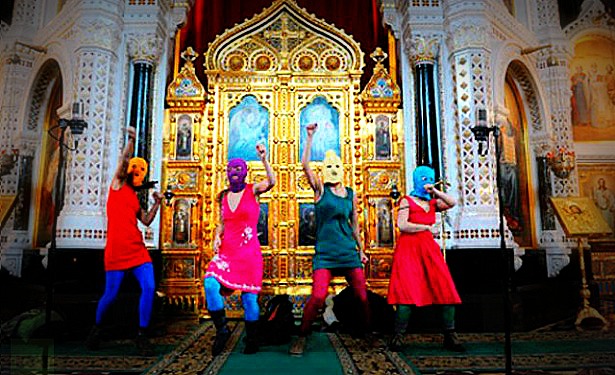
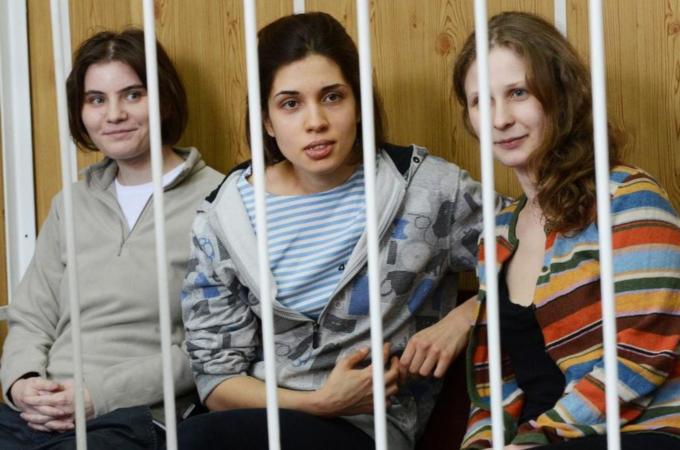
In a country that was willing to [sic] its secular court on a “religious” cause, Pussy Riot are true revolutionaries. Nonetheless, it was not until they delivered these closing statements that their supporters—and opponents—heard what these three brave women stand for. Although they are being crushed in the jaws of the system—and know it!—their courage and steadfast sincerity are sufficient cause for (impossible) hope. If not for the Russian state, then at least for the Russian people. —Bela Shayevich
“When religion puts people in jail it’s unjust” – David Gross
The intermix of religion and politics are familiar, especially after this year’s presidential election. Many supported Mitt Romney out of concern for religious freedom; a stance that had the potential to marry religion and politics in a dysfunctional union. We also witnessed a veiled attempt by the Catholic Church to emphasize and sway the faithful to vote for the one true moral candidate; a stance contradicted by Obama’s ability to carry the Catholic vote. I believe what we see in Russia is a shining example that shows what happens when regulations and laws do not segregate between secular law and church law. Freedoms do not exist, rather, rules and restrictions are imposed creating an institutional prison.
The prosecution of an all girl punk band named Pussy Riot [i] demonstrates a “complete fusion of the institutions of the state and church,” which devalues “women’s rights and freedom of speech.”Members of Pussy Riot are serving a two year sentence of hard labor for “hooliganism motivated by religious hatred.” What was their crime? They went into a Cathedral in Moscow and started singing a punk prayer – “Mother of God, Chase Putin Out!”
They danced, kneeled, and crossed themselves in front of the Church’s high altar. This occurred the day before the re-election of Vladimir Putin. While I do not support going into a sacred space with relics to make a protest, what I find problematic is their harsh sentence. However, it should be noted that with the coverage of the trial and the outpouring of support received from many organizations, and musicians, they did manage to bring to the forefront issues surrounding the government and the Church.
Male feminists must be aware that we not only engage in an ongoing struggle against sexual and gender inequality, but more importantly an ongoing fight with ourselves.
I have often struggled with that little voice, call it my conscience if you will, that speaks to me during times of distress. Although I consider myself a proud feminist, I still struggle with aspects of what I call, internalized misogyny, or more aptly defined as a male born characteristic trait that imparts the idea that men are not only dominant but also more powerful than the other 50% of the species.
One did not have to watch the debate between Barack Obama and Mitt Romney this past Tuesday to know that Romney hit the trifecta in the area of women’s issues. It was all over social media within minutes of statements being made that marginalized or treated women as “less than.”
The issue of contraception and rape is still a topic of debate. Church’s post signs to “Vote for Religious Freedom” and hand out voting guides that help you gauge the moral candidate. Bulletin boards stating that “Obama believes in abortion and gay marriage – do you? vote Republican” appear by the highway. This issue will not be settled during the election.
If people in power set an example of bullying and/or oppressive behavior, this behavior becomes acceptable. If women are treated “less than,” then their dignity as well as their humanity is compromised.
An extreme example of this de-humanizing treatment of women in American society appeared October 13th in Cincinnati.com. A story was published about a flyer found in the men’s restroom of a co-ed freshmen dorm at Miami University. The title of this flyer – “Top Ten Ways to Get Away With Rape:” Continue reading “Hitting the Trifecta in Women’s Issues by Michele Stopera Freyhauf”
The Gospel of “Jesus’ Wife” is certainly at the center of a battle that was last seen when questions of authenticity were raised about the James (Jesus’ brother) ossuary. In a New York Times article, September 30th, Judith Levitt states that this document adds weight to theological and historical flaws surrounding the issue of the ordination of women. The Vatican believes that their theology is still sound, calling the document a forgery.
The Gospel of “Jesus’ Wife.” [www.boston.com]Frankly we do not need this document to validate the existence of female deacons and disciples – we have the biblical text and writings of the early church to validate this position.
Nor do we need this document to show that the standing from the Vatican’s point of view of ordaining women is theologically and historically flawed.
“In 1976, experts of the Pontifical Biblical Commission determined that there were no scriptural reasons preventing women’s ordination. The Congregation for the Doctrine of Faith overturned the commission’s judgment and instead wrote its own statement (Inter Insigniores, 1976) stating that women do not image Jesus who was a man; and therefore only male priests can adequately represent Christ.” – Women’s Ordination Conference
Rage, for me, feels intrinsically connected to instinct, like an uncontrollable urge to fight and fly all at the same time but with no place to flee and a need to literally, physically restrain myself from the “FIGHT,” or violence I don’t want to create.
Many feminist theorists talk about the value of anger and particularly, “women’s (diverse experiences of) anger” for consciousness raising, community building and healing. I remember considering this concept for the first time early in graduate school. I was both scared because I associated anger with abusive control; and curious, as I was finally learning to express this “bad” emotion. Overall, embracing anger taught me to speak up and break out of abusive spaces. But sharing this concept with students last semester and discussing the Bible’s descriptions of “God’s Wrath” this semester, I find myself considering levels of anger. When is or is rage appropriate? Some of the feminist theology I have read definitely advocates for a constructive relationship to rage. But many of my students, who can embrace the creative space of anger, had difficulty embracing this positive valuation of rage (even understanding that it is ‘what we do with our anger’ that counts). I have recently found myself facing my own rage… And I am not sure what to think.
I often consider anger a teacher. It shows me where my boundaries are being crossed or where injustices are rising. I have experienced mild anger that, when mediated through humor, has helped me laugh at life and struggle. I have experienced white-hot anger that left me unable to sleep or function “normally.” Betrayals have dragged me out of my bed early in the morning, seeking to run/ walk so that I could breathe and think at a pace that matched the beating of my heart. Continue reading “Impotent* Rage by Sara Frykenberg”
As we approach the election period infused with controversy, saturated by television commercials, as well as endless advertisements on the radio, Internet, and yes, even Facebook, we must remember the sacrifices made by our foremothers during the suffrage movement, which gave women the right to vote. While all elections are important, this one has targeted issues involving women in a way that could negatively impact our rights – to the point of rewinding the clock on progress made in women’s equality during the last 40+ years. This election needs the voice of all informed voters. However, it is imperative for all women to make their voices heard this year by casting a vote. To turn a blind eye to these issues diminishes the sacrifices our foremothers made for us. To not cast a vote takes away your voice, makes you a silent bystander – something that was tried by the government and patriarchal system during the suffrage movement.
To illustrate this, I would like to highlight Lucy Burns and the Night of Terror endured at the Occoquan Workhouse by her and many of her friends. Of all Suffragettes, Lucy Burns spent more time in jail then any other protesters. Born 1879 in Brooklyn, Lucy was raised in the Roman Catholic tradition by a father who believed that his sons and daughters should be educated equally. Burns gradated from Vassar College in 1902, then attended Yale Graduate School studying linguistics. She eventually went to Oxford University in England to resume her studies. It was at Oxford that she became involved with activism and the suffrage movement. Continue reading “Lucy Burns, A Look at a Catholic American Suffragette by Michele Stopera Freyhauf”


 In recent days I have been pondering the fact that some people and some feminists seem to see the issues of religious faith and belonging to be rooted in birth, family, and community, while for others the question of belonging to a religious community hinges on belief and judgments about the power exerted by religious institutions. What accounts for this difference in the way we view religious belonging?






 Feminism and Religion