Another Excerpt from That Christmas Morning Feeling by Marie Cartier

MarieCartierforKCETa-thumb-300x448-72405Author’s Note:  This post continues to serialize excerpts from my novel, That Christmas Morning Feeling. Please see last month’s post for the initial entry.

****************

Book Number Seventeen

Look, I’m not the one. I don’t have an investment here. This is not about me. But, I think that when you think you can actually do some good in the world you should do it. I mean what if you have this whole body of knowledge. And you say nothing. Is that morally acceptable? I think not. I’m sure everyone has thought it. You are going along in your life, and you stop suddenly. The color of the trees, sparkle on the water, but maybe not so wow world, you are cool stuff. Maybe just the mundane world, maybe even the curve of the paint on the wall, even paint drying as the saying goes, could be enough to catch you up and you realize – life. Life’s here. Right now. And it needs me. Do I love it, or do I not? And if you do, if you love, love it – just life. Then you have to do something about it, to make it better. Like if it was your kid, you couldn’t just sit by – right? Well, you could. People do, God knows.

Or he doesn’t. You’d think he would do something, or she. Guess it doesn’t work that way. Maybe it’s true what they said in the church last Sunday. I’ve been thinking about it… even though I was only half listening. Personally I usually hate being there, big waste of time. But it is a waste of time, and in some ways that’s a good thing…just a predictable waste of time, nothing dramatic happening –that’s a new way to look at Church. I guess. Have to remember that.

Maybe God is in “the least of us.” That would be me. And it is up to us to decide what God does, how God acts, or rather to act like God. Then we can get God to change things. Otherwise God is just an idea…without a body. Not much you can do on planet Earth in that state. We have to figure out we are not really in Oz, like Dorothy, no mystical wizard to help us…just some fabulous dream shoes and a great idea about home, and no place like it, whatever she’s rattling at the end… and then going there to do something about it. She can’t do it from Oz. Too bad, but true. She has to wake up there in the middle of the black and white world and get out of bed, presumably without the fabulous shoes. So she just has to get out of bed and get on with it. At least I hope she gets out of bed; we never really saw that part.

We are really here, so we can do something about the here and now.

So no one is talking Incest. No one I personally know of course, since I talk it. That is not because Incest is not happening as an event. It’s just not a newsworthy concept, really. Because it isn’t a concept is it…? It’s an event, as in, “This happened to me.” But it is not a language that is spoken on planet Earth. No language here, except Incest, could transform that event that happens into a concept that’s newsworthy… not that I know of. And no one is taking language labs in Incest. So no one can write about it in the newspapers, etc., etc. It’s obviously a vicious cycle.

Continue reading “Another Excerpt from That Christmas Morning Feeling by Marie Cartier”

That Christmas Morning Feeling by Marie Cartier

MarieCartierforKCETa-thumb-300x448-72405What follows is an excerpt from my current project—a novel I have been working on for over ten years. It is finished—sort of— in various journals and I am currently trying to pull them all together. These are the opening pages. Thank you so much for your support of my work. The novel is called- That Christmas Morning Feeling.

Book Number Sixteen

This is how I feel about incest, I mean learning to talk about it…speak Incest, as in capital “I” – Incest, like French, German, – Incest…right? Because you don’t talk about it, you talk it…you, as in you alone, you talk it; you use it in a sentence. “This is what happened to me…” And no one talks back.

And, why compare it to French or German? There are whole countries who will talk back to you if you speak French or German. Learning Incest is like learning Martian – you think to yourself, maybe there’s a planet somewhere where learning Martian would be useful…but it is certainly not here… no one can speak Martian here, correct your grammar, help you write a poem, check your iambic pentameter…whatever. My point is, learning Martian, well, if you learned it…how would you ever know if you were speaking it right? If someone on Mars could actually understand you? Of course, you wouldn’t know. You would just have to really love Martian enough to learn to speak it – even though…And then, of course, assume that you might meet and if you ever did meet a Martian and you had invested all this time in learning Martian just in case you would ever run into a Martian, you’d hope that he would understand you. Or she. Whatever. Continue reading “That Christmas Morning Feeling by Marie Cartier”

THE REFUGEE CRISIS IN GREECE: A TEST OF OUR COMMON HUMANITY by Michael Bakas, translated by Carol P. Christ

Note from Carol Christ: I returned home from the Goddess Pilgrimage to Crete a week ago to find my island, Lesbos, and my village, Molivos, overwhelmed with a refugee crisis of enormous proportions. We are a town of about 1000 permanent residents, and I would estimate that 10,000 or more refugees from the wars in Syria and Afghanistan have passed through our village in recent months. Local authorities and volunteers are exhausted, and there is an urgent need for help from the European Union. This week instead of my own blog, I am offering my translation of a moving plea for help from my dear friend and colleague in the Green Party, Michael Bakas, who by the way is himself a feminist.
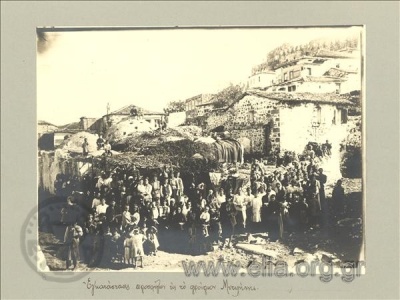
Refugees in Mytiline 1914-1918There is nothing new about refugees fleeing from war. At the beginning of World War I, more than 50,000 people arrived in Lesbos from the nearby shores of what is now Turkey. At the end of the war many of these refugees returned to Asia Minor, but after the Greek army invaded and was driven back, the Asia Minor Catastrophe of 1922 sent nearly a million refugees to Greece.

Faced with an ocean of refugees flooding the island, the local population was dumbfounded, fearful, and tied up in knots. They shut their doors and averted their eyes: “it was as if a dark cloud of death had descended on their minds, and so they felt nothing. They did not want to see anything or to hear anything that was happening on the other side of their doors.” The end of this story is well-known: with courage and a great will to live, the refugees put down roots and found their way.

In the first decade of the 21st century Lesbos again experienced a wave of refugees who came via Asia Minor. This group, mainly from Afghanistan, came to the island with the hope of putting war behind them. Most of them were held for a year or more in cramped conditions near the capital of Lesbos. This center was closed in 2009 due to the efforts of local volunteers who had alerted European groups to the problem.

But the Greek debt crisis soon followed. For several years, the flow of refugees lessened. When it began to increase at the end of 2012, volunteers from all over the island came together without any government support to provide help. Thousands of refugees were housed in a former campground for children’s holidays, where they were offered clean clothing, blankets, and food, as well as love and compassion.

Lesbos became known as an all-European model for solidarity. Resisting the xenophobia that was growing in Greece and in Europe as a whole, the citizens of Lesbos reached out to the refugees, refusing to listen to those who were promoting hate. The neo-fascist anti-immigrant party known as Golden Dawn gained less support in recent elections in Lesbos than in most of the rest of Greece.

refugee children in LesbosThe good will of the people of Lesbos is currently being tested by the wave of migrants now arriving on our shores. Estimates are that more than 20,000 refugees have arrived in our island alone in the first five months of 2015. There are no systems in place to deal with them. Yes, the European Community has dedicated resources to the “refugee problem,” but most of that has gone into patrolling the borders in hopes of stemming the flood of refugees—not to helping those who arrive on European shores.

Those who arrive in northern Lesbos are being welcomed and fed by volunteers, but the Coast Guard does not have the resources to transport them to the capital city for processing. Thus they are being told—mothers and babies among them—that they must walk 60 kilometers on mountainous roads in summer heat to reach their next destination.

Once they arrive in the capital city, the Coast Guard is not able to accept and process all of them, because the reception center cannot cope with the numbers. Thus, thousands of refugees sit in the harbor, hoping the authorities will arrest them and thus be forced to process them.

The residents of Lesbos are once again beginning to become afraid of the influx of refugees. In the touristic village of Molivos, at the same time that both locals and foreigners are helping the new arrivals, others are saying that “it spoils the vacations of tourists to be faced with seeing so many refugees.”

The situation seems to be more than government officials can cope with. The mayor of the island has been trying to find a place where the refugees can stay while they are being processed. The regional government has not yet lifted its hand. The Minister of Immigration visited the island, but no interventions followed. The European Community has yet to act. The UN and international aid groups have not arrived.

This state of affairs plays right into the hands of the racists and xenophobes. Rumors are spreading about the refugees—lies about diseases they are carrying and threats they pose to local and tourist women. People who in the past have been sympathetic to the refugees and the volunteers are getting fed up. Their pent up anger could lead to violence within our own communities or against the migrants.

At the same time more and more refugees are arriving, sleeping in the streets, relieving themselves without toilets–among them pregnant women, babies and old people, and even disabled individuals—all trying to save themselves from violence in their own countries.

Instead of fighting each other, it is time to get serious about finding a solution to a humanitarian crisis of vast proportions. Lesbos—along with other islands of the Aegean—must be declared an “Emergency Zone.” The Greek government, the European Community, and international organizations must provide resources.
We need arrival centers in northern Lesbos, where the immediate needs of the migrants can be met—including shelter from the sun, food, toilets, blankets, and a place to sleep if necessary. Processing centers adequate to the numbers of refugees need to be opened in the island’s capital. Transport to these centers must be provided. Trained Greek or EU officials must be sent to staff them.* We also need a plan for August when the ferryboats being used to transport the refugees to Athens will be full, and if no alternate plans are made, large numbers of migrants will be forced to stay on the streets or in already crowded centers in the worst of summer’s heat.

It is time for us to move forward–Greeks, Europeans, and migrants together–in the name of our common humanity and in concern for the lives of all human beings on our planet. We also need to work to end the wars and the violence that drives people from their homes and homelands.

*We have just learned that the EU is planning to send a team of officials to assist with processing the refugees.


michael bakas2Michael Bakas is a leader of the Green Party in Lesbos, Greece and has been working for many years with its committee on Human Rights. This call to action was originally published in longer form in Greek on June 16, 2015 on Apolotaria.gr., and was published in English in Green European Journal on June 19, 2015, the International Day of the Refugee.


timothy jay smithTimothy Jay Smith  has been working closely with volunteers in Molyvos and Mytilini to provide for the refugees. If you wish to contribute to these efforts, you can donate through Tim’s account at PayPal: kosmosfilms@gmail.com or send a personal check to Timothy Jay Smith in U.S. dollars or Euros (French banks only). Also see his “Mister, They’re Coming Anyway.”


Carol P. Christ leads the life-transforming Goddess Pilgrimage to Crete (facebook and twitter).  Carol’s books include She Who Changes and and Rebirth of the Goddess; with Judith Plaskow, the widely-used anthologies Womanspirit Rising and Weaving the Visions and forthcoming next year, Goddess and God in the World: Conversations in Embodied Theology. Explore Carol’s writing.

 

What’s Wrong with this Picture? by Elise M. Edwards

Elise EdwardsOn Monday, the picture was on my Facebook feed again: The picture of a girl lying face down in the grass under a police officer pressing his knee in her back. It was from the video of an African-American teenager being pinned to the ground by Eric Casebolt, the police officer in McKinney, Texas who was responding to calls about a pool party. When I saw the picture this time, it was in a screenshot with these words below it:

“Funny how a 14 year old bikini-clad black girl being publicly assaulted by an adult male does not accrue mainstream feminist outrage.” – Yohanna

The screenshot was taken of a post to Yohanna’s Twitter account (@maarnayeri). I don’t know her, but she troubled me.

If you haven’t seen the images we’re talking about, you can view the video here with a description of what is concurring or below from YouTube. I was reluctant to watch the video. It seems voyeuristic to view this young woman’s suffering and screaming. And, if I am honest with myself, it also seems useless. Viewing this from my computer screen, I’m in no position to help her. I hear her cries and it make me cry too. But I can’t push him off of her. When other teens tried to come to her defense, Casebolt pulled a gun on them and chased them. I don’t even have the power to get him fired from his position of authority immediately. No, we must have the investigations and inquiries and due process that seems so indiscriminately afforded to the privileged. Casebolt was put on administrative leave on Friday, and on Tuesday June 9, he resigned.

So how should I respond?

I had a conversation with one of my closest friends a couple days ago that provoked me to reflect on what to do when I’m conflicted about how to respond. Her background is in acting and theatre, and now she is a pastor and artistic director of a Christian church and arts initiative who believes in supporting arts, imagination and creativity. In our conversation about discerning the next steps in our lives, she was reminded of a book by Samuel Wells that proposes “theatrical improvisation as a model for Christian ethics.” That reminded me of books I’ve read that talk about musical improvisation or call-and-response as model for living, and some pieces I’ve written about that. Inspired by ethicists and theologians including Emilie M. Townes and H. Richard Niebuhr, I believe that to answer the question of how I should respond, I must first answer ‘What’s going on?” An improvised response or a fitting response is the response to what is already occurring. We must look at the situation critically to respond appropriately.

What’s going on in this video and the controversy surrounding it? I am certainly not an impartial or all-knowing observer, but here’s what I see:

  • A white man forcibly throws an unarmed, African-American teenager to the ground yelling “On your face!” We can see that she is unarmed because she is wearing a bikini.
  • The man is a police officer. He is upset that his authority is being challenged. Other officers are present and seem to be asking questions, but the violent one seems out of control and frantic, running around and yelling. He escalates the situation when he throws the girl to the sidewalk, which causes an outcry in the crowd.
  • As the video went viral, there were many protests and online statements against this violent event, but also statements of support for the officer. And sadly, I agree with Yohanna’s assessment. I may have missed it (and I hope I did), but I didn’t see a broad, mainstream feminist response against this violence.

I’m a feminist. I’m a black feminist. I’m a Christian feminist. I may not be a mainstream feminist (depending on your definition), but I’ll express my outrage anyway. It is sickening to watch his treatment of this teenage girl. This man’s mistreatment of a young black girl’s body is chilling. It is wrong and he should be held accountable for it.

I don’t think outrage is enough. But outrage does express that our moral sensibilities have been awakened and that we recognize that something profoundly wrong has occurred. In the face of comments that say she deserved this treatment, we as feminists must insist on the officer’s wrongdoing. “She had it coming.” “She incited him.” As feminists, we know that these kinds of statements are used in cases of rape and intimate partner violence to explain away violent actions and to shift the guilt from perpetrator to victim. The backlash against feminists and others who oppose these explanations argues that we ignore the victim’s responsibility or agency.

Bloggers and social media users know all too well the horrific statements that often appear in the comments section of online posts, videos, and articles. One comment I saw about the McKinney video says that the girl was “sassing back” at the police and that “if she wants to talk like adult then she’s going to be treated like an adult.” This kind of justification makes my blood boil! Sassing back is speaking up and saying something to an authority figure when you are expected to be silent.  While the term sassing back doesn’t exclusively apply to women and girls, it is nonetheless a phrase with gendered connotations. How many boys are called “sassy”? Is it that no one had the right to say anything to this officer running around yelling at black teen boys to sit on the ground, or is it that this black female should have kept quiet? Regardless, throwing an unarmed person to the sidewalk for supposedly saying something disrespectful is not justifiable behavior to adults or children.

I wish I knew more about what’s going on and how to respond to the violence I see in the world. I know these perennial questions subvert easy answers. I only have a partial response. I am responding with outrage and questioning and take this to my feminist community and into my spiritual practice. “What’s going on?” and “How should I respond?” are questions I ask God. I pray for justice. I pray for God’s presence in the outrage and in the investigations, and in the lives of those children who were violated.

Elise M. Edwards, PhD is a Lecturer in Christian Ethics at Baylor University and a graduate of Claremont Graduate University. She is also a registered architect in the State of Florida. Her interdisciplinary work examines issues of civic engagement and how beliefs and commitments are expressed publicly. As a black feminist, she primarily focuses on cultural expressions by, for, and about women and marginalized communities. Follow her on twitter, google+ or academia.edu.

The Religiosity of Silence by John Erickson

In a repetitive culture of abuse and silence, is it really shocking to find out that an individual who preached such hate and discontent for others actually perpetuated other forms of heinous abuse against others?

John Erickson, sports, coming out.In 2013, I wrote an article about the then latest reality TV scandal featuring A&E’s Duck Dynasty’s Phil Robertson and his rampant foot-in-mouth disease that caused him to express, in the pages of GQ, his true distaste for the LGBT community and specifically for the sexual proclivities of gay men.

Now, two years later in another reality TV show, TLC’s ’19 Kids and Counting’, it isn’t star Josh Duggar’s anti-LGBT statements getting him into trouble but rather his sexual assault and molestation of 5 girls, including two of his sisters. However, while the Internet explodes with attacks against Josh Duggar and his Quiverfull background, it is vital to remember that the silence that he and his family inflicted upon his victims since 2006 has not only been ongoing since then but is also being reemphasized today with each keystroke focusing on the assailant rather than the victims. Continue reading “The Religiosity of Silence by John Erickson”

Traumatic Narrative on the Screen: Is there a Grey Area? by Stephanie Arel

Arel - AAUW HeadshotOn May 8, Fifty Shades of Grey became available in DVD format. Marking its release, this post reflects on the mass consumer consumption of this provocative film and the abuse inherent in its script previously discussed here by Michele Stopera Freyhauf. Grossing $500 million dollars at the box office, Fifty Shades will most certainly sell as an unedited DVD. While some self-proclaimed feminists like Emilie Spiegel commend the story, feminists and conservatives slam it, often pressing viewers to reject the film and deny it financial support. Nonetheless, The Fifty Shade of Grey franchise will most probably have a sequel in 2016, continuing to amass hundreds of millions of dollars.

Concerns about the book and film include how the storyline presents a romantic ideal for women wrapped surreptitiously in abuse. Peering deeper at the narrative reveals the potential for conflicted emotional responses including feelings of guilt and shame, revulsion and interest, disgust and seduction. Confronted with the writing of this post, I responded in turn, torn between whether to watch the film or not. While wanting to deny the franchise any monetary gain, I also wanted to both know what I was rejecting and what, if any, value existed in viewing. Continue reading “Traumatic Narrative on the Screen: Is there a Grey Area? by Stephanie Arel”

Bodies of More and Less Value by Oxana Poberejnaia

oxanaThere is a story in the collection called Avadanasataka (One Hundred Legends) of the Sarvastivadin school, one of the schools of early Indian Buddhism that did not survive to present day, relating one episode from the Buddha’s previous lives. The story is about king Padmaka who sacrificed his life to cure his subjects of a disease. Here is an academic article about this episode.

The Buddha was prompted to tell this story of his previous life in order to illustrate to his monks, once again, the workings of karma. All of the monks in the Buddha’s milieu were sick with a digestive disorder, while he remained well. The Buddha presented the story of king Padmaka as a proof that no good deed is ever lost and that what he had done then has an effect now in that the Buddha has good digestion.

Continue reading “Bodies of More and Less Value by Oxana Poberejnaia”

Abuse Does Not Have “Fifty Shades of Grey” by Michele Stopera Freyhauf

WARNING: This article or pages it links to contain information about domestic abuse and sexual violence which may be triggering to survivors.


Freyhauf, Durham, Hahn Loeser, John CarrollNo matter what you call it abuse is abuse. This is highlighted in the popular book and now movie Fifty Shades of Grey. Because of the stir this book caused, I delved into the first book and my initial reaction was that of repulsion and wonderment. How could a woman let a man control her like that? Why would she let him do things like that to her and continue to come back to him? Why is this book so popular?

Are women sexually repressed in a way that their own sexual experiences are routine and boring (the book is full of BDSM) or they have never orgasmed (every time they have intercourse, Anastasia is guaranteed to orgasm)? Why do we find it okay to label body parts as “love boxes” or “considerable length” or the multitude of references to a man’s penis or woman’s vagina that is meant to sound sexy or romantic? Why does he announce “I am going to f*** you now” every single time they have intercourse? Can’t the reader figure out what is going on without making this announcement?

However, after I got beyond my initial reaction (or shock), I took a step back and became upset and outraged.  In essence, the overall issue with the book can be summed up in one word: control. Some women argue that the awkward doe-eyed virgin journalist exercises control over the sexually deviantPicture from fanpop.com

Picture from fanpop.com

billionaire that keeps him coming back to her – I disagree. I see control exercised by the sexually deviant man over a woman enamored by him in such a way that is sexually, physically, and psychologically exploitative and abusive. Yes – I understand this is fiction, but this type of writing causes immense problems.

In a culture that embraces “Blurred Lines,” money and power, and “the bad boy persona,” this storyline fuels the fodders of the fire with a sensationalism that plays on sexual fantasies and/or those wishing prince charming will sweep them away. One needs to look no further than “The Bachelor” or Bret Michaels’ “Rock of Love” television shows that promote the exploitation of women’s desires to be with the rich handsome man at any cost to self and dignity. In fact, an article posted about the movie stated that if Christian Grey was not a billionaire and behaved in the same way, he would be arrested and labeled a sex offender. So again, is the message we want to send to our daughters, nieces, and friends is that the rich can do whatever they want and you should let him? I think not.

Continue reading “Abuse Does Not Have “Fifty Shades of Grey” by Michele Stopera Freyhauf”

Painting Women from Judges – Part 1: Jephthah’s Reflective Daughter by Melinda Bielas

Melinda BielasThe story of Jephthah’s daughter – found in the Hebrew Bible, Judges 11:29-40 – is a difficult story to read. The first time I read it, I was in my Christian high school Bible class and I could not understand why our teacher did not address the violence done by a father to his daughter. In my experience, Christians dismiss much of the violence done to women in the Hebrew Bible as evidence that ancient fathers, brothers, and husbands really did not care for their daughters, sisters, and wives. Since today men love the women in their lives, the ancient problem is no longer an issue, and we can continue with more pressing issues – or so the unspoken logic goes.

However, some feminist scholars – such as myself and Dr. Tammi Schnider – argue that it was common for fathers to love their daughters in the Hebrew Bible, and Jephthah is no exception. His daughter is his only relative in the text, and presumably the only person impatiently waiting for him to return from the war he led. Yet, because of the vow he makes to the deity – a vow the deity does not request or acknowledge – he sacrifices his only loved one. Why would he make such a vow? Why would his daughter go along with it? These are two of the questions I could not help but yell as I struggled with the text. Continue reading “Painting Women from Judges – Part 1: Jephthah’s Reflective Daughter by Melinda Bielas”

Safety and Vulnerability in a Dangerous and Fertile World: A Meditation on Incarnation

Marcia headshotFeeling safe again is often the healing and elusive aspiration of a person like me.

I have been living with the deep and cellular residuum of sexual trauma for most of my life—over thirty of my going-on forty-six years.

For many years, the grief and shame of losing my innocence cultivated an intense orientation to life’s doing. Safety for me back then was activity, noise, frenetic schedules, and a constant soundtrack to my life that meant I never had to be quiet with myself. Safety was in the predictable metrics of success that I could use to measure my self worth. I never had to stop and admit that I didn’t feel safe, ever.

I got a lot done all those frenetic years and my diligent efforts were affirmed with everything from scholarships to awards to pay raises.

But, trauma does not allow itself to be ignored. It demands attention. Its cellular ghosts haunt their host. They must be acknowledged, sometimes cast out, sometimes befriended, other times adapted or transformed. My trauma is tethered to the violence of a dangerous world, a world that knows no boundaries when it comes to annihilating innocence.

How can I be safe in this kind of world? How can any of us? Continue reading “Safety and Vulnerability in a Dangerous and Fertile World: A Meditation on Incarnation”