The Pomegranate by Sara Wright

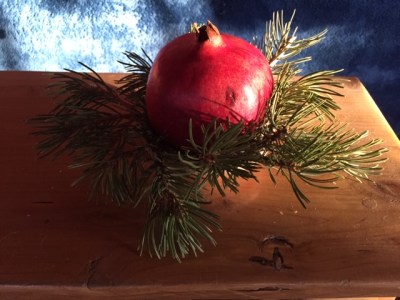
It is mid November and shiny crimson Pomegranates catch the discerning eye in food markets; even Walmart carries them!

Why do these beautiful and very ancient fruits appear during this dark time of the year?

One answer to this question is that in the northern hemisphere the fruit of this deciduous shrub ripens anywhere from September to February. The reverse is true in the southern hemisphere when the fruits ripen during March, April and May. It is important to remember that in the southern hemisphere the seasons are reversed, so in both northern and southern parts of the globe these fruits appear in the fall, during the darkest months of the year.

Pomegranates are native from Iran to northern India and have been cultivated throughout the Middle East, Asia and the Mediterranean region for millennia. (Today they are also grown in California and Arizona, so they no longer need to be imported). The shrub was domesticated as early as the 5th millennium BC. Pomegranates were the first trees to be domesticated in the Mediterranean.

Continue reading “The Pomegranate by Sara Wright”

Let’s Talk About Shame by Janet Maika’i Rudolph

Disclaimer/Trigger Warning: This post includes content about rape, sexual assault, domestic abuse, violence.

The recent, meaningful discussions on this forum about how so many of us feel broken due to our own personal histories have fortified and inspired me. I’ve marveled as women have spoken up so honestly and even brutally about the effects of trauma, rape, cold and dismissive mothers, abusing fathers and so on.

Some of you know my own story. I am a survivor of my father’s childhood abuse and then a rape at knifepoint in my early twenties. I carry a deep and abiding sense of shame. This feeling has always flummoxed me. Why should I feel shame when I didn’t do anything to create my own abuse? Shouldn’t my father have felt the shame? The rapist? Why did I get saddled with it? I was the victim (and survivor), not the perpetrator. But shame is indeed the feeling I carry and I’m not alone. Why is this feeling so pervasive? I don’t have all the answers, but I do have some clues about where to look.

Continue reading “Let’s Talk About Shame by Janet Maika’i Rudolph”

The Man with the Hat by Sara Wright

I met a man on a rumbling train who had hooks in his hat.

A fisherman, I thought with the usual dismay – brutal images of dying fish gasping for air exploded in thin air. Memories of my grandmother who took her eight year old granddaughter fly fishing also flooded my mind (my grandmother was a professional fly fisherwoman). I caught my first fish in the brook – a six inch trout. After landing the desperate creature my grandmother said, “ now we must kill it so the fish does not suffer.” And she looked for a stone.

“Hit it over the head” she instructed handing me a rock she picked up nearby, and I did.  Tears welled up. It broke my child’s heart to murder such a shimmering rainbowed creature.

When we got home that day, my grandmother praised me lavishly for my catch, promptly gutted the fish and fried it in a pan for me to eat. I forgot the anguish I had experienced, basking in my grandmother’s approval. The fish tasted delicious, and to this day I eat fish and other seafood.

As a lobsterman’s wife I learned quickly how to cook crustaceans by sticking their heads in boiling water so they would die almost instantly.

Continue reading “The Man with the Hat by Sara Wright”

“Para limpiar el corazon”: To Cleanse the Heart by Joyce Zonana

It should have been a wonderful journey, organized by three dear friends who run a yoga center in Costa Rica. I would be traveling with my husband, these friends, and thirteen other like-minded folk to the Sacred Valley of the Incas in the Andes highlands of southern Peru. We’d be staying at a lovely retreat center just outside Pisac, an ancient market town encircled by imposing mountains. And our itinerary would take us to some of the most important Inca sites, including the iconic, hauntingly beautiful and remote Machu Picchu.

jz-headshotIt should have been a wonderful journey, organized by three dear friends who run a yoga center in Costa Rica. I would be traveling with my husband, these friends, and thirteen other like-minded folk to the Sacred Valley of the Incas in the Andes highlands of southern Peru. We’d be staying at a lovely retreat center just outside Pisac, an ancient market town encircled by imposing mountains. And our itinerary would take us to some of the most important Inca sites, including the iconic, hauntingly beautiful and remote Machu Picchu.
We’d made the plans almost a year ago, and I’d been looking forward to the trip. But I fell sick several weeks beforehand and was hesitant to leave my Brooklyn home. Everyone assured me the journey would be magical, and so, feeling better but still uncharacteristically fearful, I reluctantly decided to go. Continue reading ““Para limpiar el corazon”: To Cleanse the Heart by Joyce Zonana”

Call Out Culture vs. Mentor Culture: Which one will save us from the apocalypse? by Trelawney Grenfell-Muir

Have you felt the satisfaction of putting someone in their place? Have you ever felt the rush of power that comes with delivering a cutting set-down? Have you ever felt a glow of pride after making fun of a horrible person or group, and having the people around you laugh appreciatively?

I sure have. In high school, the bully-types in my classes learned not to pick on me to my face, and not to pick on my sister when I was in the room. I got damned good at snide, witty comebacks, and so people stopped messing with me. That kind of success was incredibly rewarding. It was a useful skill I honed over the years, so I could trot it out whenever needed. Rare these days, but my sister still occasionally says, “I’m just glad Trelawney’s in my corner.”

Oh, it feels good to WIN, to experience verbal conquest, and to know I’m justified in using my tongue as a sword, because that person SO deserved it! Ah, the adrenaline, the afterglow, the notch in my belt!

Continue reading “Call Out Culture vs. Mentor Culture: Which one will save us from the apocalypse? by Trelawney Grenfell-Muir”

A Blinding Light? by Sara Wright

Nature is a Living Being. Animals and plants have souls, and a spirit. Each species is unique, and yet we are all interconnected, human and non – human species alike. This is more than a both and perspective; its multi-dimensional.

Many books are written about using nature to heal humanity of its ills. ‘Recreate’. Climbing a mountain, or taking a walk are common examples of using nature to help ourselves, but how many of us are asking the question of how we can give back?

This is a question I was obsessed with for about thirty years and may be the reason I gained entrance into this seemingly secret world that we call Nature.* When I experienced unconditional love from both animals and plants I needed to reciprocate in kind. This idea of reciprocity between humans and the rest of Nature is probably similar to what Indigenous peoples experienced because they loved (or feared) and learned directly from animals, plants and trees. They respected animals, for example, for their unique qualities. Indigenous people never psychologized Nature the way westerners routinely do.

I rarely read books about Nature anymore because I am so troubled by this psychologizing. From my point of view psycho-babble is just another way of dismissing the reality of Nature as a living feeling, sensing, sentient Being.

Continue reading “A Blinding Light? by Sara Wright”

On Believing Things That Are Not True by Carol P. Christ

Anyone who is following American politics these days knows that the American President and his acolytes have little respect for what the rest of us consider to be the truth—or at least the best approximation of the truth that we can discern. Last week, while discussing the “lie” of white supremacy that approximately 40% of the American public has bought hook, line, and sinker, I had occasion to reflect again on the relation between traditional religious beliefs and rejection of reason and common sense. As is also well-known the President and his supporters have no respect for factual truth.

In response to a question about how to reach the women who believe whatever the President says, I responded:

I would also say that fundamentalist religion is a big problem because it teaches people to accept things that science and common sense show are not true on the authority of God (who is portrayed as a white male). This teaches people to distrust their own common sense and reasonably reliable facts. I remember growing up with liberal Protestantism and Vatican II Catholicism. In both contexts I was encouraged to think for myself and not to accept everything on the authority of scripture or tradition. Of course when the churches and synagogues encouraged us to think for ourselves, they also opened the door that enabled us to leave. Because we did, liberal and progressive denominations are in decline relative to their more fundamental and authoritarian counterparts.

With these thoughts swirling around in my head, I keep returning to a Ted Talk I came upon a few weeks ago titled “Letting Go of God” by comedian and philosopher Julia Sweeney. Continue reading “On Believing Things That Are Not True by Carol P. Christ”

The Devil’s Bargain: “If You Can Convince a White Woman” by Carol P. Christ

This week’s news from America. Where to begin? When will it end?

The President of the United States is a racist who incites racist violence. Republicans have been slow to condemn the President and are not likely to pass a complete ban on assault weapons and to make those currently in circulation illegal.

After reading a speech condemning hate speech and gun violence that he obviously didn’t write, the President scheduled a round-up of brown people working in chicken-packing factories in Mississippi to coincide with his unsympathetic visits to the cities of Dayton and El Paso, where two recent mass killings by assault weapons occurred. The next morning, we were greeted by images of little children coming home from school in small towns in Mississippi to find their parents missing. We were told that none of the surviving victims of the El Paso shooting wanted to meet the President.

This is not the America I want. But it is the America that many Americans seem to want. I would like to think that women as a group reject the President and his agenda. Sadly, this is not true. Continue reading “The Devil’s Bargain: “If You Can Convince a White Woman” by Carol P. Christ”

Gentle Moments in a Violent World by Marcia Mount Shoop

mms headshot 2015“Be gentle with yourself.”

It may be some of the most redemptive guidance I have ever received.  And I share that invitation daily with people in painful situations.

“Be gentle with yourself.”

In a world seemingly hell bent on self-destruction, being gentle even for a moment is a radical act of resistance. A moment of tenderness. A moment of trust. A moment of attentiveness to need.

But really, what good does gentleness do in a world as brutal as ours can be?  How does being gentle provide any kind of answer to the assault of being commodified or objectified or betrayed or assaulted or oppressed or erased or abused or discarded or exploited? Continue reading “Gentle Moments in a Violent World by Marcia Mount Shoop”

What to Do About Bullies by Deanne Quarrie

I could probably go on and on about this topic, so in the interest of education I offer the following information gathered in my own recovery. Why would I write about bullying at all?  Are we not Goddess lovers, one and all?  How would such behavior ever come into a spiritual path that believes all life is sacred?

Well, we all come to this path with all our old baggage. That baggage may include jealousy, fear, and a desire for the wrong kind of power, that which attempts to control others.

Bullying is not merely, as many believe, an occasional stinging comment made by a significant other at the breakfast table, a bad day with the boss, or children wrestling on the playground.

Bullying is cruelty deliberately aimed at others with the intent of gaining power by inflicting psychological and/or physical pain.

Bullying behaviors are varied: name calling, humiliation, spreading rumors, gossiping, public ridicule, scape-goating or blaming, isolating, assigning poor work conditions and job assignments, or denying holiday and vacation time in the workplace, or more obvious punching, hitting, kicking, taunting, ostracizing, sexualizing, or making ethnic or gender slurs, etc.

Continue reading “What to Do About Bullies by Deanne Quarrie”