


Be afraid. Be very afraid.
That seems to be the refrain these days, particularly in politics. The more you terrify people, the more likely they are to vote, protest, and otherwise engage in political activism.
Well, maybe not. Apparently, hammering people with more and more reasons to live in terror actually tends to demoralize and paralyze us.[1] A little bit of fear goes a very long way. A certain amount does indeed motivate people – like a deadline, for example; that nervous energy can make us highly productive, efficient, and focused. Moreover, Gavin de Becker, author of The Gift of Fear, argues that we need to listen carefully to our bodies’ fear response, because our society has trained people – particularly women – to suppress gut instincts that otherwise would have saved them from violent situations.
Interestingly, when we understand not only how to recognize warning signs but also how to trust our intuition to identify potential danger, we feel empowered and live with less anxiety and fear the rest of the time. Validating the ‘gift of fear’ makes us less fearful. Nonetheless, there must be something lucrative to the politics of fear, because studies have shown fear is at an all time high in America, particularly the use of fearmongering as a political strategy. It turns out, fear sells, big time, and it is a pretty great way to further ideas of us vs. them and to undermine a sense of community, of the “neighborhood.”
 When I first moved to America, I was shocked to learn of the high rate of domestic violence here. Surely, American men weren’t like that. Besides, American women were strong – they would never take BS from their husbands, fathers or brothers. How could this be even remotely possible? Of course, I was younger then, and not quite aware of the insidious workings of patriarchy. But then America is supposedly one of the most liberal and progressive countries in the world. Being of Indian heritage, it was “natural” that I had heard of and witnessed male domination and control. After all, we Indians were “backward.” But America? Really?
 Having seen the image of a toddler crying while law enforcement questioned her mother, my daughter was filled with fear, anxiety, and confusion. After tearfully asking if she would be taken away from me, my nine year old followed up with the question, “Will Donald Trump go to heaven?”
 I bet almost no one knows this secret: the United States is being watched over by two goddesses! One of them stands on top of the Capitol dome in Washington, D.C. The other stands on an island in New York harbor.
 As so many of us recoil in horror at the Trump administration’s cruel attempts to enforce an impenetrable border between the U.S. and Mexico, I find myself struggling to understand what he and his supporters mean by “borders,” and why they are so invested in maintaining them. The administration’s vicious immigration policy, recently epitomized in a brief tweet on June 19th, 2018—Juneteenth, the day in 1865 when slaves were finally freed throughout the U.S. at the end of the Civil War—“If you don’t have Borders, you don’t have a Country” has sent me back to

 I wake up each morning in a simple bedroom lit by the rising sun: a wardrobe, a bookshelf, a small wooden table, and a chair, arranged on painted plank floors. Just outside the window behind my head are the tallest trees I have ever seen, their grey-brown trunks growing straight up into a sky I cannot quite make out from my warm bed, with its white cotton sheets, white coverlet, and cozy down comforter. The room’s soft yellow walls reflect and amplify the winter light. Part of me wants to luxuriate, to lie here for hours, feeling the sun on my face as I gaze up at the trees and allow my consciousness slowly to return from dreams.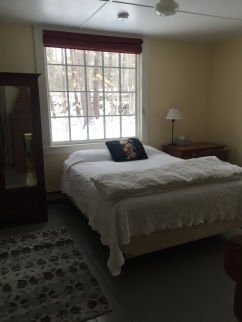
 Feminism and Religion