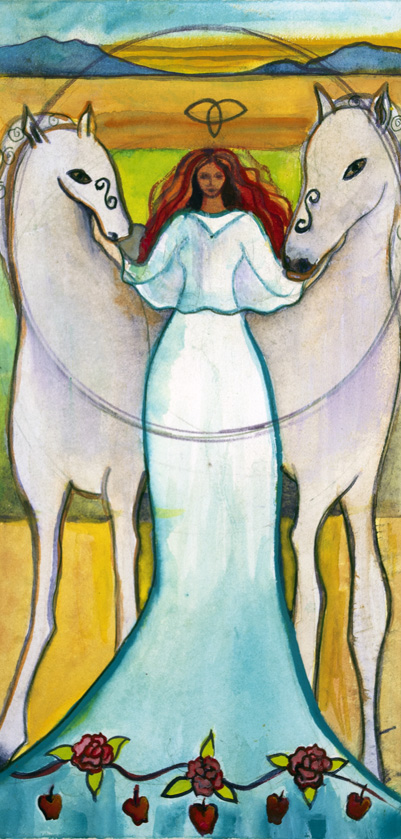
Epona, Celtic Horse Goddess was worshipped by the Gauls (the Celtic French). Her worship spread to Britain and Rome from Western Europe. Hundreds of statues and shrines dating from between the first and third centuries CE have been found in France alone.
Today we can understand Epona mainly from her images, as few stories of her have survived. She is often shown either riding a white horse side saddle or standing or sitting between two horses. Many images show her feeding mares and foals from a cornucopia or a basket of fruit.
She performs ablutions, prays, and mends shoes for years, only to don her death shroud upon her back and place a symbolic tombstone upon her head. With death cloaking her compassionate body, she begins to twirl, invoking the name of the Beloved within her heart. She is a whirling dervish and her name is Fatima. The daughter-in-law of the esteemed Sufi poet, Rumi, joins with the myriad other Holy Women Icons with a folk feminist twist that I write about each month: Virginia Woolf , the Shulamite, Mary Daly, Baby Suggs, Pachamama and Gaia, Frida Kahlo, Salome, Guadalupe and Mary.
Fatima is best understood when placed in an historical context. So, I begin with a very brief history of the whirling dervishes, while also offering glimpses into women’s roles in the Mevlevi Order. The primary Islamic sect that proclaims that dancing is a way of connecting with the divine—for both men and women—is the Sufi Order. Over eight hundred years ago, Mevlâna Jalâluddîn Rumi inspired faithful Muslims to whirl in harmony with all things in nature. The whirling dervishes of Turkey unite the mind, heart, and body, and help to usher peace into the world through their dance by dedicating their lives to service and compassion. After Rumi’s death on December 17, 1273, his followers responded by whirling. These followers of Rumi are known as the Mevlevi Order, or more popularly, the whirling dervishes. Until around the fourteenth century women were included in the practice and leadership of turning. As Muslims in Turkey became more and more conservative, however, women were forced to the sidelines and not allowed to whirl. And even with the secularization of the country with the reign of Mustafa Kemal Ataturk, women were still denied access to the turning path because Ataturk essentially made whirling illegal in an attempt to take away as much religion from Turkish life as possible. Ataturk banned tekkes, or dervish homes, in 1925 as he secularized the state. By the 1970s the Turkish government allowed turning once again, but only if it was a performance and not a prayer. There were even reports of an old dervish being arrested because they saw his lips mouthing “Allah” as he turned in a theatre performance for tourists. Continue reading “Painting Fatima by Angela Yarber”
This “Mountain Mother” painting is an ode to women’s earth wisdom and is my prayer for reclaiming of that wisdom to heal the earth and all her beings.
When I am inspired to paint I can think of nothing else, the desire to put brush to canvas takes over every ounce of my being, and it is difficult to be present in everyday life. There are other times where I’ve wanted to create but inspiration was lacking: I would start a painting and have no desire to finish it. I would often get quite frustrated at myself. It’s only recently that I’ve had the realisation that down time is just as significant as the up time. Rather than get anxious about not creating a masterpiece, I have learnt to go with the flow, take pleasure in the time of rest, because I know it’s all part of the cycle. My inspiration always returns with abundance. Presently I am bursting at the seams with creativity, and I can’t find enough hours in the day to let all this inspired energy out. I am overcome with a sense of urgency I can’t explain. I am committed to paint and write with the intention that my personal message becomes part of the global message for change as our sacred feminine wisdom is being called forth. I am determined and full of courage to be part of the movement that brings about a shift in all aspects of life.
My present state of inspiration can be attributed to my recent Goddess pilgrimage to Crete with Carol Christ. I am sure that anybody who has attended such pilgrimages will attest that these experiences are life-changing. Travel alone is profound, but to share the experience in a circle of twenty amazing women is even more so. We sang, danced, trekked through the Cretan countryside, delved deep into caves; the womb of our great mother, climbed mountains and cleansed in the sea. We prayed and communed with the goddess daily, participating in rituals that were meaningful, un-contrived and safe. While I have always known that the goddess is everywhere, within and without–encountering her ancient past in a present day context is a feeling I’m not sure I can adequately describe with words, hence my desire to express some of these feelings through my art.
If you are reading this, then we survived another apocalypse. People are fixated on end-times; especially predictions, prophecies, etc. Specials on Nostradamus, the Book of Revelation, TV Evangelists looking for end signs plague television shows, movies, and writings. Countdown clocks and reminders to repent are all around us.
What is unnerving is how we obsess about the end of the world instead of living in the world we have right now.
I would like to share a Mayan poem that I came across. It is called “Imix”- a Mayan Oracle Interpretation translated by Ariel Spilsbury and Michael Bruner and I am drawn to it due to the imagery and symbolism:
I Am Imix, Primal Mother.
Still, dark womb of the patterned potential of becoming, sacred, interstellar genesis, I Am.
The Cailleach (KAL-y-ach), which literally translates as the “Veiled One” is an ancient Goddess whose origins are unknown. When the Celts arrived in Ireland and Scotland she was there. Over time Her name came to mean “old wife” or “old woman”. And yet she was thought to never grow old, an all powerful, ageless, Goddess of transformation.
In one of her stories, Cailleach, as an old hag, seeks love from the hero. If he accepts Her, She then transforms into a beautiful young woman, symbolizing the transformation occurring in the depths of winter when the seeds lay dormant in the earth. Yet alive within this dormancy is the promise of rebirth in the spring. She is the guardian of the life force, finding and nourishing the seeds, commanding the power of life and death. As the final phase of the Triple Goddess, she rules the eternal wheel of reincarnation. Cailleach personifies death and the transformative power of darkness. She leads us through death to rebirth. Continue reading “Cailleach, The Queen of Winter by Judith Shaw”
As we feminists struggle to elevate Mary and Guadalupe, we sometimes forget that speaking of birth and gestation is not always empowering or even essential to womanhood.
It is early morning on the Hill of Tepeyak on December 9, 1531 when a wondering peasant named Juan Diego first caught a glimpse of her presence. Diego sees a vision of a teenage girl surrounded by light; the young girl asks that a church be built on the hill in her honor. After hearing her speak and seeing the light emanating from her presence, Diego recognizes her as the Virgin Mary. He rushes to the Spanish archbishop who insists on a sign as proof of Diego’s vision. The young girl instructs Diego to gather flowers from the top of the hill, even though it is past their growing season. Upon climbing to the top of the Hill of Tepeyak, Diego discovers Castilian roses—a beautiful flower otherwise unheard of in Mexico—which the glowing young woman arranges in his cloak. When Diego returns to the archbishop, he opens his cloak to reveal the miraculous flowers and they fall to floor; in their place was an image imprinted on the fabric of his cloak. It was the image of Our Lady of Guadalupe.
Guadalupe is one of Mexico’s most popular religious and cultural images and her icon, now on display at the Basilica of Our Lady of Guadalupe, is one of the most visited Marian shrines in the entire world. On December 12, countless Christians—particularly Catholics—celebrate her feast day. Her feast day occurs within the four week celebration of Advent, which is the period of waiting, expectancy, and gestation before the birth of Jesus at Christmas. Continue reading “Painting Guadalupe and Mary by Angela Yarber”
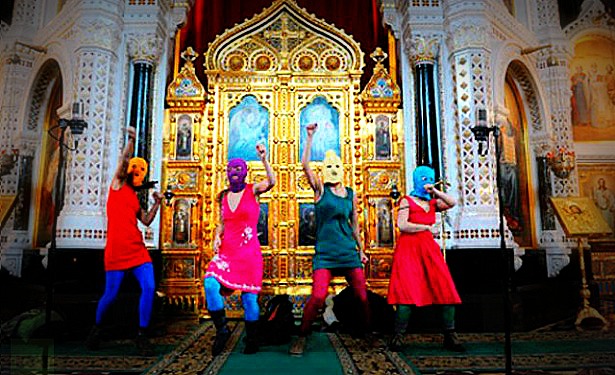
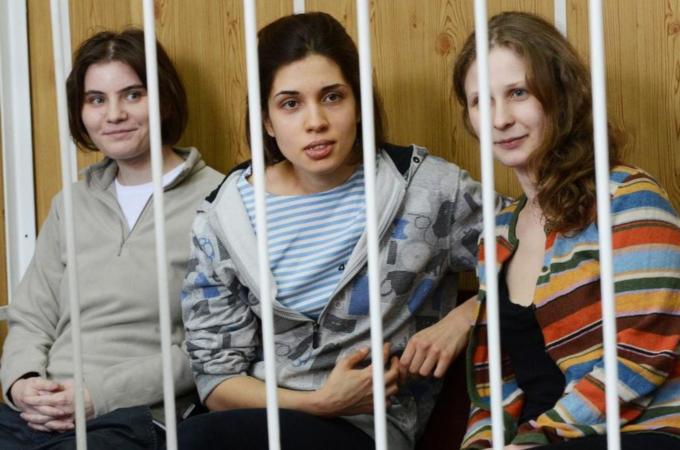
In a country that was willing to [sic] its secular court on a “religious” cause, Pussy Riot are true revolutionaries. Nonetheless, it was not until they delivered these closing statements that their supporters—and opponents—heard what these three brave women stand for. Although they are being crushed in the jaws of the system—and know it!—their courage and steadfast sincerity are sufficient cause for (impossible) hope. If not for the Russian state, then at least for the Russian people. —Bela Shayevich
“When religion puts people in jail it’s unjust” – David Gross
The intermix of religion and politics are familiar, especially after this year’s presidential election. Many supported Mitt Romney out of concern for religious freedom; a stance that had the potential to marry religion and politics in a dysfunctional union. We also witnessed a veiled attempt by the Catholic Church to emphasize and sway the faithful to vote for the one true moral candidate; a stance contradicted by Obama’s ability to carry the Catholic vote. I believe what we see in Russia is a shining example that shows what happens when regulations and laws do not segregate between secular law and church law. Freedoms do not exist, rather, rules and restrictions are imposed creating an institutional prison.
The prosecution of an all girl punk band named Pussy Riot [i] demonstrates a “complete fusion of the institutions of the state and church,” which devalues “women’s rights and freedom of speech.”Members of Pussy Riot are serving a two year sentence of hard labor for “hooliganism motivated by religious hatred.” What was their crime? They went into a Cathedral in Moscow and started singing a punk prayer – “Mother of God, Chase Putin Out!”
They danced, kneeled, and crossed themselves in front of the Church’s high altar. This occurred the day before the re-election of Vladimir Putin. While I do not support going into a sacred space with relics to make a protest, what I find problematic is their harsh sentence. However, it should be noted that with the coverage of the trial and the outpouring of support received from many organizations, and musicians, they did manage to bring to the forefront issues surrounding the government and the Church.
Each month I focus my article on one of my Holy Women Icons with a folk feminist twist. Virginia Woolf , the Shulamite, Mary Daly, Baby Suggs, Pachamama and Gaia, and Frida Kahlo have reputations that match their lived realities relatively closely, so my paintings have attempted to reflect these realities. The subject of this month’s article, however, has been misrepresented and misunderstood throughout the ages. Her “name” is Salome and we read of her dancing story in the Gospels of Matthew and Mark.
If you carefully read Mark 6:17-29 or Matthew 14:3-11, you’re probably wondering why this article features an icon of someone named Salome. There was no mention of anyone named Salome in the text. Rather, in the Markan text both the dancing daughter and her mother are named Herodias. In Matthew’s text, the daughter is nameless. It wasn’t until later when Josephus, a Jewish historian, named her Salome and stated that she was responsible for the beheading of the John the Baptist. Continue reading “Painting Salome By Angela Yarber”
Once the opportunity came my way to spend two weeks with my sister in Paris, I knew I had to visit the Black Madonnas at Chartres. I had been to Chartres many years ago, before I knew about the Black Madonnas scattered throughout Europe. I felt the power of the site at that time, but had little understanding of where that power came from.
History of the Black Madonna
Isis
The indigenous goddess worship of Europe, was influenced by Phoenician traders who introduced statues of dark skinned African and Middle Eastern goddesses such as Isis, Inanna, and others to the European continent from 1550BC to about 300BCE. The worship of these goddesses continued with The Roman invasion of Gaul (France) and other parts of Europe.
Once Christianity took hold in Europe, churches were built on top of sacred pagan sites. But old ways die hard; many of these dark skinned goddesses were incorporated into the newly built Christian churches. Today there are more than 500 known Black Madonna statues and paintings throughout the world, the majority in France. Continue reading “Why are We Drawn to the Black Madonna? by Judith Shaw”


 Epona, Celtic Horse Goddess was worshipped by the Gauls (the Celtic French). Her worship spread to Britain and Rome from Western Europe. Hundreds of statues and shrines dating from between the first and third centuries CE have been found in France alone.
 Continue reading “Epona, Celtic Horse Goddess by Judith Shaw”
 This “Mountain Mother” painting is an ode to women’s earth wisdom and is my prayer for reclaiming of that wisdom to heal the earth and all her beings.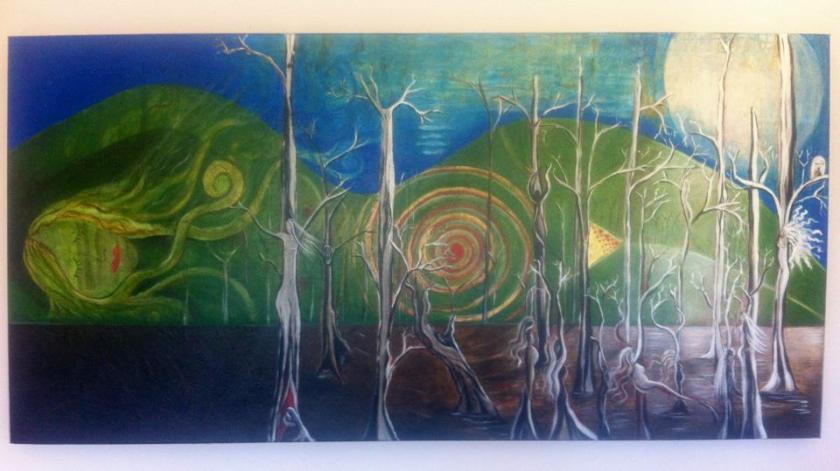
 If you are reading this, then we survived another apocalypse. People are fixated on end-times; especially predictions, prophecies, etc. Specials on Nostradamus, the Book of Revelation, TV Evangelists looking for end signs plague television shows, movies, and writings. Countdown clocks and reminders to repent are all around us.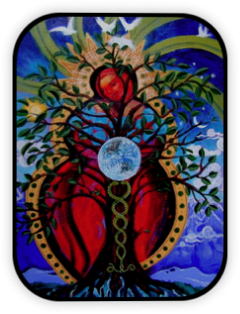



 Feminism and Religion