Interreligious Friends after Nostra Aetate (Book Review) by Janice Poss

JaniceBook Title: Interreligious Friendship after Nostra Aetate
Editors: J. Fredericks and T. Tiemeier
Series Title: Interreligious Studies in Theory and Practice
Publisher: Palgrave Macmillan US, 2015

“… the Jew prayed words of blessing … over his Roman Catholic friend. …Willebrands could not find … words to say to Tanenbaum at that moment. Of course, as is usually the case in friendships, words are not really necessary to express one’s deepest emotions.” – James L. Fredericks, p. 5

Friendship

In 1965, at fifteen, I strategized to become a top women’s fashion designer.  I felt it accessible to me!  The Second Vatican Council’s documents had been published. Nostra Aetate was among them, I was clueless, I could have cared less about anything coming out of the Vatican –especially with a Latin title having no meaning for me — except a bejeweled embroidery that might have inspired a contemporary dress or jacket.  Nothing theological or churchy was in my purview as I exerted my independence from parental authority and had one foot out the door from being a practicing Catholic.  I had had enough of the disciplinary, androcentric, ‘Father’ God who was mean, hypercritical and presupposed that anyone practicing any religion other than Roman Catholicism was doomed forever to hell.  Salvation was not for everyone. Continue reading “Interreligious Friends after Nostra Aetate (Book Review) by Janice Poss”

The Heart of the Labyrinth: BOOK REVIEW by Mary Petiet

the-heart-of-the-labyrinth_cover_front_72What if it really is as simple as changing our minds?
This is the central question of Nicole Schwab’s book, The Heart of the Labyrinth (Womancraft Publishing, 2014). This question paves the way for her eco-feminist approach to balancing the self and the environment. Schwab’s book is a parable as multilayered and complex as human nature, and it moves through the ages to probe the pure core of the self and the sustaining energy that connects all. Continue reading “The Heart of the Labyrinth: BOOK REVIEW by Mary Petiet”

Dystopian Fiction Inspiration and Religious Lessons by Ivy Helman

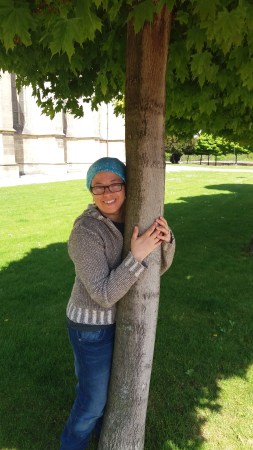
me-hugging-treeWe live in a dystopia.  This world is filled to the brim in dichotomies: poverty and extreme excess, hunger and mountains of food, disease and cutting-edge medicine, materialism and an immense environmental crisis, and hour-long walks for water and hour-long luxurious baths.  There are so many parts of our world that are not just unfair, unequal, broken and undesirable, but violent, traumatic and deadly.  And, sometimes it feels like it is only getting worse, or at least, again teetering on the edge of yet another catastrophe.
Most of the world’s religious traditions agree that this is not the way the world should be.  My own religious tradition, Judaism, traces this separation between the Creator’s utopia, the Garden of Eden, and our current situation all the way back to the beginning of humankind.  The actions of the first two humans resulted in exile from the Garden: enter the world diametrically opposed: dystopia.  Nonetheless, the Jewish religious tradition’s call for tikkun olam (repairing the world) suggests that it is possible to lift the veil between the Divine and us and consequently recreate the utopian Eden once again.  One could say it is why we are here.

That being said, while the dystopian genre has been around for many decades, I have noticed a recent rise in the popularity of dystopian fiction.  While I have always had a keen interest in science fiction, from Star Trek to FireFly and beyond, I myself have, as of late, become an avid reader of dystopian novels.  I blasted through the Divergent series by Veronica Roth, have reread The Fifth Sacred Thing by Starhawk more times than I can count and just began my dip (25 pages) into The Mandibles by Lionel Shriver – not so action-packed as the others.  I’ve also been, one could say, addicted to dystopian films (yes many were books first) like The Hunger Games, Maze Runner, Gattaca, The Fifth Element and Serenity to name just a few.

Continue reading “Dystopian Fiction Inspiration and Religious Lessons by Ivy Helman”

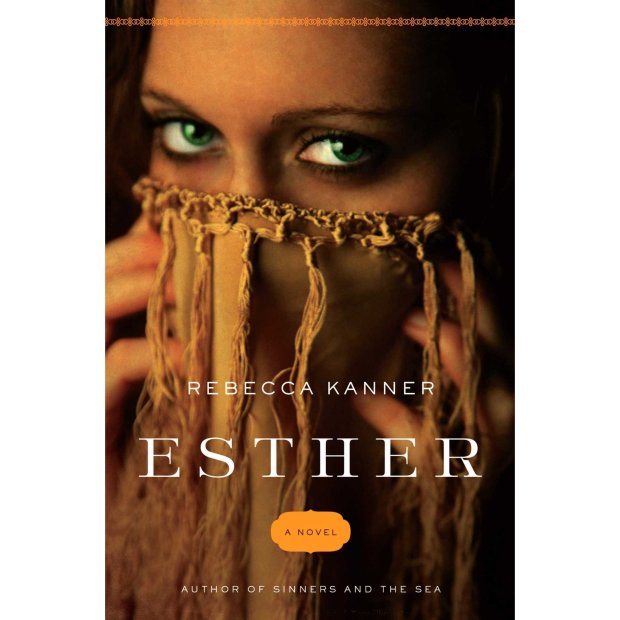
Book Review by Mary Sharratt: ESTHER by Rebecca Kanner

esther


We have been lost to each other for so long. My name means nothing to you. My memory is dust. This is not your fault or mine. The chain connecting mother to daughter was broken and the word passed into the keeping of men, who had no way of knowing. That is why I became a footnote, my story a brief detour between the well-known history of my father and the celebrated chronicle of my brother.

-Anita Diamant, The Red Tent

To a large extent, women have been written out of history. Their lives and deeds have become lost to us. To uncover the buried histories of women, we must act as detectives, studying the clues left from ages lost.

At its best, historical fiction can write women back into history and challenge our misconceptions about women in the past. Anita Diamant’s novel, The Red Tent, became such an iconic classic because she turned our stereotyped image of women in the Old Testament on its head by allowing the biblical Dinah to tell her own story in her own voice. Continue reading “Book Review by Mary Sharratt: ESTHER by Rebecca Kanner”

Reading for Fun and Compromise—My Ongoing Search for Feminist Literature by Sara Frykenberg

What I mean to say is, what if, when I wanted to read for fun or simply for the pleasure of reading, I were to put down any book that demonstrated buy-in to kyriarchal ideas, overtly or even in micro-aggressive ways? I have flippantly responded to this question, “then, I may never read any piece of fantasy literature again.”

Sara FrykenbergI love reading fiction, particularly science fiction and fantasy literature. However, since the birth of my daughter I have been pondering the stories we tell and the language we use a great deal; and I have begun to feel a little bit like my ‘fun’ reading almost always involves some kind of compromise. For instance, when I first started reading  Song of Ice and Fire by George R. Martin (the series which inspired the HBO hit series Game of Thrones), I greatly enjoyed the series. The five competed books are ripe with intrigue, complex interpersonal and political relationships, the rebirth of magic in a world, and characters you love to hate. But, continuing to read and watch this series unfold, I have grown to suspect that Martin may hate women because he seems to punish them over, and over, and over again. The most recent book, A Dance with Dragons is so full of sexual violence it is actually hard stomach.

Continue reading “Reading for Fun and Compromise—My Ongoing Search for Feminist Literature by Sara Frykenberg”

What Dorothee Soelle Taught Me about Creativity by Elise M. Edwards

Elise EdwardsI’m currently developing a book that considers how theological and ethical considerations in architectural design can define good architecture.  My book discusses five virtues related to the architectural design process that promote human participation in bringing out God’s intention of flourishing for humanity and creation.  Those five virtues (or values) are: empathy, creativity, discernment, beauty, and sustainability.  In the book, I’ll explain how these virtues orient design tasks to the social and ethical aims of architecture.

In this virtual space, I want to have a discussion about what these virtues mean from a feminist standpoint.  In my writing, I draw from theological ethics, architectural theory, and feminist theory to emphasize community discernment and participation.  It’s fitting, then, to claim opportunities in my work to acknowledge the feminists who have influenced me while also opening up the dialogue to the feminists in this community who continue to inspire and guide me to do my best work. Continue reading “What Dorothee Soelle Taught Me about Creativity by Elise M. Edwards”

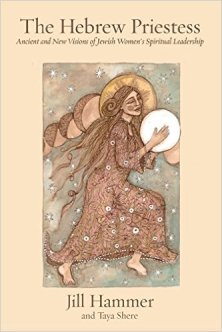
The Hebrew Priestess: A Book Review by Joyce Zonana

Hebrew Priestess coverWeaver, Prophetess, Shrinekeeper, Witch; Maiden, Mother, Queen, Midwife; Wise-Woman, Mourning-Woman, Seeker, Lover, Fool . . . . Thirteen possibilities for the female self, thirteen aspects of the Goddess, thirteen archetypes for the Hebrew (or any other) Priestess . . . thirteen fact- and dream-filled chapters in Jill Hammer and Taya Shere’s thrilling—and much-needed—new book, The Hebrew Priestess: Ancient and New Visions of Jewish Women’s Spiritual Leadership.

Nearly fifty years ago, anthropologist Raphael Patai introduced readers to the Hebrew Goddess, documenting the influence of Near Eastern Goddess religions on the practices and beliefs of the ancient Israelites. Since then, feminist scholars of religion, along with poets and novelists, have offered brilliant new interpretations of Torah and Talmud, creating feminist midrash and liturgy that open the ancient patriarchal faith to modern (and perhaps also ancient) notions of female authority and autonomy. At the same time, the increasing presence of women rabbis has transformed the congregational, communal Jewish experience for many women and men.

But what we have not had is a shamanic, visionary form of Jewish practice—“earth-based, embodied, ecstatic, energetic” (9)—that integrates ancient and contemporary Goddess spirituality with Judaism: while we have had female rabbis, we have not had formally trained and recognized Hebrew Priestesses.

Jill Hammer
Jill
Taya Shere
Taya

Enter Jill Hammer, who in the compelling Introduction to her book recounts with passion and precision her own meandering but steady journey to the Goddess and her establishment, with co-author Taya Shere, of the Kohenet Hebrew Priestess Institute, a school dedicated to ordaining contemporary Hebrew Priestesses, kohanot.Kohenet,” although it does not appear in the Bible, is the ancient Hebrew word for “priestess.” Continue reading “The Hebrew Priestess: A Book Review by Joyce Zonana”

Queering Kenosis: A Review of “God and Difference” by Caryn D. Riswold

caryn2I still think that Valerie Saving was right.

It’s been 56 years since she published her article on “The Human Situation” in The Journal of Religion, and her most basic groundbreaking insight holds true: Under patriarchy, the fundamental sin and danger for women is not too great a sense of self, too much pride as Reinhold Niebuhr would argue; rather, the problem is too small and diffuse a sense of self. Prioritizing others ahead of herself, the woman under patriarchy accepts second-class citizenship and submission to male headship as her rightful place.

Wrong.

Yet, in recent years, when reminding colleagues of this fundamental feminist insight from the second wave, I have received replies that begin “But Sarah Coakley says ….” What they lift up is Coakley’s supposed reclamation of kenosis as feminist, of self-emptying as a revolutionary Christian act in relationship to God. To them, this corrects Valerie Saiving. I have heard variations on this defense from senior male scholars who believe themselves to be quite advanced in their thinking, as well as from female scholars who believe this is the kind of feminist theology they want.

Wrong. Continue reading “Queering Kenosis: A Review of “God and Difference” by Caryn D. Riswold”

Wisdom Fiction (Part 2) by Elise M. Edwards

Elise Edwards“There are years that ask questions and years that answer.” from Their Eyes Were Watching God by Zora Neale Hurston

In my previous two posts, I’ve discussed the wisdom that can be found in black women’s literature. Continuing this series, I’m sharing a statement from the most well-known novel written by Zora Neale Hurston. Hurston was an American novelist, folklorist, anthropologist, and cultural critic whose work was first published in the 1920s-1940s. Their Eyes Were Watching God was published in 1937 and has since been reissued and adapted into film.

“There are years that ask questions and years that answer.” This quote is one that has circled around my mind every New Year and every birthday for many years. These times of year are when I’m likely to reflect on the previous year and wonder what has come from it.

Continue reading “Wisdom Fiction (Part 2) by Elise M. Edwards”

Lucy Pick’s Pilgrimage by Mary Sharratt

mary sharrattIn medieval Europe, religious devotion provided an alternate narrative for women’s lives in a male-dominated culture. Defiant women who stood up for themselves in the face of rape, incest, and murder were hailed as virgin martyrs. Religious vocations, such as becoming a nun or a beguine, provided a viable and esteemed alternative to forced marriage.

Even women who were married with children could escape their domestic entanglements and conjugal duties by taking an oath of celibacy as 15th century English mystic Margery Kempe did, leaving behind her husband and 14 children to go on pilgrimage to Santiago de Compostela, Rome, and Jerusalem. Her Book of Margery Kempe, the tale of her travels, reads like a kind of late medieval Eat, Pray, Love and is the first autobiography written in the English language.

Though it might seem surprising to us today, women of the European Middle Ages possessed more rights and freedoms than their descendants in the Renaissance, Early Modern, and Victorian ages. Women worked as craftspeople and artisans and were members of the guilds, alongside men. Monarchs such as Eleanor of Aquitaine were global power brokers while religious leaders such as Hildegard von Bingen devoted their lives to intellectual and artistic pursuits, composing music and writing weighty philosophical and theological books that are still being discussed today.

lucy pick pilgrimageThe cover of academic historian Lucy Pick’s novel Pilgrimage shows details from a painted altarpiece dedicated to Saint Godeleva. A victim of forced marriage who was strangled by order of her husband, this legendary saint was a patron of abused wives. Lucy Pick’s novel concerns the saint’s daughter, the blind Gebirga of Gistel in Flanders. What would it be like to be the daughter of a martyred saint whose miracles cured everyone except you?

Considered unmarriageable due to her blindness, Gebirga rejects life as a nun in an abbey dedicated to her sainted mother. Instead, in a bid for freedom, she embarks on a pilgrimage to Santiago de Compostela in faraway Iberia, an epic journey for that time. She serves as the companion to a highly strung teenage noblewoman and is charged with delivering the girl to the Spanish king she is contracted to marry. During their travels, Gebirga must use all her intelligence and resourcefulness to protect herself and her young charge from the considerable dangers and political intrigues they face on their way. Though they encounter hardship and heartbreak, this is a pilgrimage of miracles, healing, and redemption.

Lucy Pick, the Director of Undergraduate Studies and Senior Lecturer at the University of Chicago’s Divinity School, has infused her novel with impeccable research into the lives of medieval women. This novel is a medievalist’s delight and fans of the late Margaret Frazer will devour this book.

Mary Sharratt’s book Illuminations: A Novel of Hildegard von Bingen, won the 2013 Nautilus Gold Award, Better Books for a Better World. Her forthcoming novel, The Dark Lady’s Mask: A Novel of Shakespeare’s Muse, tells the tale of the groundbreaking Renaissance women poet Aemilia Bassano Lanier and will be published by Houghton Mifflin Harcourt in April 2016. Visit Mary’s website.