Xmas and Feminine Wisdom by Vanessa Rivera de la Fuente

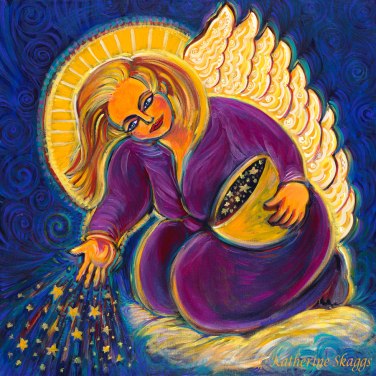
Katherine-Skaggs-1029.ABUNDANCE-ANGELI am not fond of Christmas and these holidays are very difficult for me to deal with. This has nothing to do with me being a Muslim. I have been a Grinch before this. I do not like excessive noise or crowds of people. It bothers me especially the excess, the lack of meaning and loud claims for kindness and mercy to decorate our lives for few days. This year is proving particularly hard for me.

Experiences of 2015 have forced me to question the paradigms under which I had lived until now. Life is suing me for an extra effort of introspective, growth and openness and that can be painful at times. A few weeks ago, I was venting my sorrows and doubts to my mother. I told her that the last thing I wanted to do was install a Xmas tree. She looked at her own Xmas tree full of golden balls and said:

“You know why I like Christmas trees? You were born a week before Pinochet’s coup. That year, the Dictatorship forbade people to buy, sell or cut pines trees under punishment, which ruined our Xmas, since plastic ones were very expensive. I built a tree for you at home, made of brass and wood. The center was a broomstick and the branches of wire. I cut leaves from empty cans of milk. I lost a child before you came to my life. And you were born in a country that suddenly lost freedom. I could not deny you hope. The Christmas tree has been my way to convey hope. That was my present.”

Listening to my mother, Christmas took on new meaning for me, a sacred dimension. I understand the sacred as those things, memories and spaces that are vital for us, all of what gives our lives meaning, purpose, reason and inspiration. I come from a family of women where husbands, brothers and male cousins are scarce. Joy, mourning, religion, knowledge or strength have been developed and shared from womb to womb. Continue reading “Xmas and Feminine Wisdom by Vanessa Rivera de la Fuente”

What If Jesus Had Gone to Daycare? by Katey Zeh

Screenshot 2015-12-08 09.47.34

As a maternal health advocate, I cherish the season of Advent as an opportunity to connect a beloved Christian story to the lives of women today who struggle to bring new life into the world under horrific circumstances. Every year I write something about Mary’s pregnancy and birth. In many ways she is no different from the “Marys” around the world who are young, poor, and unexpectedly pregnant, and who go on to give birth in unclean environments. I often pose the question to communities of faith, wasn’t the Christmas miracle equally that Mary survived the birth? How different would Jesus’s life have been if he’d never known his mother?

I continue asking these questions, but after my daughter was born last October, I have found my Advent reflections shifting to mirror my own parenting experiences. I began to think beyond Mary’s birth and into her early months of motherhood. One morning last December, after a particularly awful night’s sleep, I came downstairs to hear “Away in a Manger” playing on the radio. When it got to the line “But little Lord Jesus/No crying he makes,” I rolled my eyes dramatically and pictured Mary doing the same as she bounced a screaming baby Jesus in her arms. Continue reading “What If Jesus Had Gone to Daycare? by Katey Zeh”

Painting Marys, Welcoming Refugees by Angela Yarber

angelaThis holiday season, in the midst of our ever-repeating mass shootings and debates about the welcoming of Syrian refugees, I have seen a meme, a pithy quote, a bumper sticker time and time again amidst my fellow liberals:

“If only we had a seasonally appropriate story about Middle Eastern people seeking refuge being turned away by the heartless.”

Similarly, many have posted pictures of nativity scenes with a tongue-in-cheek quip, “I’m so glad people are placing these lawn ornaments in their yards to indicate that they welcome refugees into their homes.”

Myriad articles have been published encouraging Christians to remember our calling to welcome the refugee, and as an ordained clergywoman, I affirm these thoughts. I believe it is our responsibility, as Christians and particularly as feminist Christians, to welcome the marginalized, the oppressed, the refugee. I am also a strong believer in the separation of church and state, a distinctive imperative both to my Baptist tradition and to my home country of the United States. So, in many ways, it doesn’t really matter politically that my faith tradition teaches me to welcome the refugee because my country is not a Christian nation, but it does matter that the primary symbol of my country—the Statue of Liberty—proclaims boldly and without apology: “Give me your tired, your poor, Your huddled masses yearning to breathe free, The wretched refuse of your teeming shore. Send these, the homeless, tempest-tossed to me, I lift my lamp beside the golden door!” Continue reading “Painting Marys, Welcoming Refugees by Angela Yarber”

A Prayer for our Troubled Times By Grace Yia-Hei Kao

Grace KaoA few days ago, I received a private message from an old friend who’s now living and working in Taiwan. We hadn’t corresponded in years, but he had heard about the recent shootings in San Bernardino and wanted to check-in after realizing that this was second set of mass shootings that I’d experienced so close to home (i.e., I live in a city just west of San Bernardino County and was faculty at Virginia Tech in 2007 during what became known as the deadliest shooting by a lone gunman in U.S history).

Continue reading “A Prayer for our Troubled Times By Grace Yia-Hei Kao”

What’s in a Community? by Esther Nelson

esther-nelson

Although the specific reasons elude me, I do get nostalgic for “holiday music” during the Christmas season.  I’ve written before about growing up in a fundamentalist, Protestant, missionary family.  My parents left their homeland (USA), their respective families, and everything familiar to them in order to preach the gospel of Jesus Christ to people (mainly Jews) in Buenos Aires, Argentina, believing Jews had been blinded to the “truth” of Jesus being THE Messiah.  My parents’ job (as they saw it) was to be catalytic in removing the scales from blind eyes.

The community they (and I, by default) belonged to and worked with was loosely structured, however, a dour-faced, albeit sincere, Scotsman quietly exerted his will into the day-to-day running of the organization, claiming that his decisions were in fact God’s decisions.  Missionaries who disagreed with him could easily find themselves “placed” (all God’s will, of course) several hundred kilometers away to carry on “the Lord’s work” in a remote location–up the Parana River, for example.  From the community’s viewpoint (informed by the dour-faced Scotsman), Christmas was a “pagan” (heathen, idolatrous) holiday.  We (the church–cult?) did not “esteem one day above another” (see Romans 14:5).  Our church community did not celebrate holidays. Continue reading “What’s in a Community? by Esther Nelson”

A Message from the Ancestors by Carol P. Christ

carol at green party 2014 croppedIn recent weeks and even months I have not been my usual cheerful self. After returning from sharing companionship and spiritual vision with a group of wonderful women on the Goddess Pilgrimage to Crete, I have been feeling lonely. This feeling came to a head on December 7 when it was cold and grey here in Lesbos, as had it been for weeks.

Feeling particularly sad that morning, I realized that December 7 was my mother’s Yahrzeit, the twenty-third anniversary of her death. The fact that I must use a Yiddish word to speak of this important day reflects the fact that we do not have a word (let alone a ritual) in the English language, in our versions of the Christian tradition, or in Goddess feminism to recognize the day a loved one died. As we Americans all know, we are supposed to get on with it and not dwell on death and dying.

A friend called that day to let me know that she was planning to visit me for few days during the holiday season, adding that she was looking forward to enjoying my tree and holiday decorations. “Oh,” I said, “my (live) Christmas tree is so heavy and hard to get into the house, I was thinking of not even bringing it in this year.”

That afternoon, I girded my loins and knocked on a neighbor’s door to ask for help. Of course one of the reasons that I was feeling sad is that as I live alone, I have no one to help me move a heavy tree. The neighbor’s shy son was more than willing to help, and we were lucky that we got the tree in a day before the pounding rains that would have doubled the weight of the soil in its pot.

001dec 2014 232As I decorated my tree over the next two days, memories of my mother flooded into my mind. How I miss my mommy. “Do you still think of your mother?” I asked an older friend shortly after my mother died. “Yes,” she replied, “Every day.” Me too, I thought, as I unwrapped the Christmas tree skirt, one of the last gifts Mom had given to me, and the dolls and pink doggie she had saved for me.

The ritual of decorating my tree for Christmas is my memorial to my mother’s love. How much fun we had choosing what was usually a scrawny tree—the largest we could afford, but not the smaller prettier one my mother would have preferred. How I remember baking and decorating cookie cutter cookies—eating the raw dough, licking the sugar icing from our fingers, and always putting what Mom said were too many red hots and silver dots onto the cookies.

My mother’s memories of Christmas were not all happy. But my Mom tried her best not to dwell on sadness. Shortly before she died, I found my mother baking cookies for a man who also had cancer. “I was feeling sorry for myself,” she said, “so I decided to do something for someone else.” I could hear my mother’s mother speaking through her in that moment.

My grandmother’s attitude, which was Midwestern, Christian, and deeply female, was nearly lost to me, for I come from the generation that discovered therapy. In the process of dealing with our feelings, we criticized our ancestors for not doing the same. As Christmas approaches this year, I wonder: were my Mom and my Grammy right? Is there a profound truth in their knowledge, transmitted through the generations, that the best way to deal with one’s own sorrows is to do something for others?

***

011If so, then I guess it is time to plan my winter solstice birthday party (which I was also thinking of cancelling this year)–pick up the phone and start inviting friends over to enjoy my home, my tree, and my food, the gift of life shared with others.

Happy Winter Solstice to all and to all a good night!

***

Carol leads the life-transforming Goddess Pilgrimage to Crete (facebook and twitter) spring and fall–early bird discount available now on the 2015 tours.  Carol can be heard in interviews on Voices of the Sacred Feminine, Goddess Alive Radio, and Voices of Women.  Her books include She Who Changes and Rebirth of the Goddess and with Judith Plaskow, the widely-used anthologies Womanspirit Rising and Weaving the Visions and the forthcoming Turning to the World: Goddess and God in Our Time. Photo of Carol by Michael Bakas.

Painting Aurora by Angela Yarber

angelaFor those of us in the northern hemisphere, December is one of the darkest months. The days are shorter. Night comes earlier. Each morning I eagerly await the dawn, the potential sliver of sunshine seeping through my window and warming my otherwise cold wintery skin. For those of us who struggle with seasonal depression, December can be difficult. The colder and shorter days cast shadows on our spirits as we yearn for the warm glow of light. Each December as we inch toward the winter solstice, I am reminded of the Goddess of the Dawn, Aurora, and of the unique ways in which a variety of wisdom traditions invoke the coming of light amidst the stark December night skies.

So, this December I welcome Aurora into the vast witness of Holy Women Icon with a folk feminist twist that I feature each month: Virginia Woolf , the Shulamite, Mary Daly, Baby Suggs, Pachamama and Gaia, Frida Kahlo, Salome, Guadalupe and Mary, Fatima, Sojourner Truth, Saraswati, Jarena Lee, Isadora Duncan, Miriam, Lilith, Georgia O’Keeffe, Guanyin, Dorothy Day, Sappho, Jephthah’s daughter, Anna Julia Cooper, the Holy Woman Icon archetype, Maya Angelou, Martha Graham, Pauli Murray, La Negrita, Tiamat/tehom, Mother Teresa, and many others.

Aurora is the Goddess of the dawn in Roman mythology; each morning she soars across the sky to announce the arrival of the sun. As the nights grow longer and longer, I can think of few other goddesses I hope for more than Aurora. In fact, many faith traditions invoke the coming of light during this month of long nights and short days.

In my own tradition, we are not yet celebrating Christmas (despite the capitalist consumer onslaught that has been on full throttle since October). Rather, we still dwell in the deep blue darkness of Advent, when we wait, long, and prepare for light to be birthed into our world. For most Christians, a candle is lit each Sunday during Advent and the light grows brighter as they anticipate the birth of Christ. Continue reading “Painting Aurora by Angela Yarber”