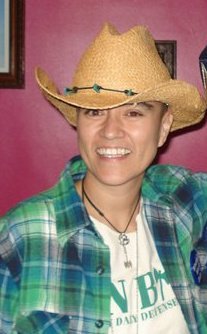
On Friendship: Part Two by Beth Bartlett

In Part One I began the examination of nine requisites of friendship. The first three are love, reciprocity, and honesty and trust. In Part Two, I continue the examination of the final six: world-traveling, commitment, reconciliation, loyalty, fun and play, and graciousness.

4) World-traveling. Maria Lugones’s prescription for truly knowing and loving another is to travel with them to those places where they are most at home, playful, and at ease.  This may mean knowing them in their homes, meeting their families, or literally traveling to their countries, knowing them in what may be cultures and languages different from our own. This has been especially important for me as I’ve sought friendship with those whose identities are different from mine – the lesbian community in the ‘80s, the indigenous community. It has been a vital part of my friendships to travel and be with friends, and create friendships, in those places where they thrive, find meaning, and are most fully themselves.

Continue reading “On Friendship: Part Two by Beth Bartlett”

On Friendship: Part One by Beth Bartlett

I’ve been fortunate in my life to have friends, to be a friend, though I’ve also had periods of drought without the nourishing stream of friendship in my life. The nature of my friendships have changed over time – with friends in childhood being primarily playmates, in adolescence – friends traveling in packs – gangs of girls; in grad school, mostly my colleagues.  And then I discovered feminism.

 I bonded with people with whom I shared a passion, a cause, and the work to bring our vision into being.  We gathered in consciousness-raising groups where, in Nelle Morton’s phrase, we heard each other into speech.  We helped each other discover ourselves by sharing our truths out loud – without criticism, argument, interruption, advice – simply being heard.  The self-discovery in sharing the truths we had not even been willing to tell ourselves was powerful.  Most importantly for me was the feminist theorists I was reading – Adrienne Rich, Audre Lorde, Susan Griffin – who challenged me to be my authentic self, honest, open, no longer hiding behind the façade of being someone I thought others wanted me to be – myself.[i]  

Continue reading “On Friendship: Part One by Beth Bartlett”

La UVA: The Union of Gossipy Women by Xochitl Alvizo

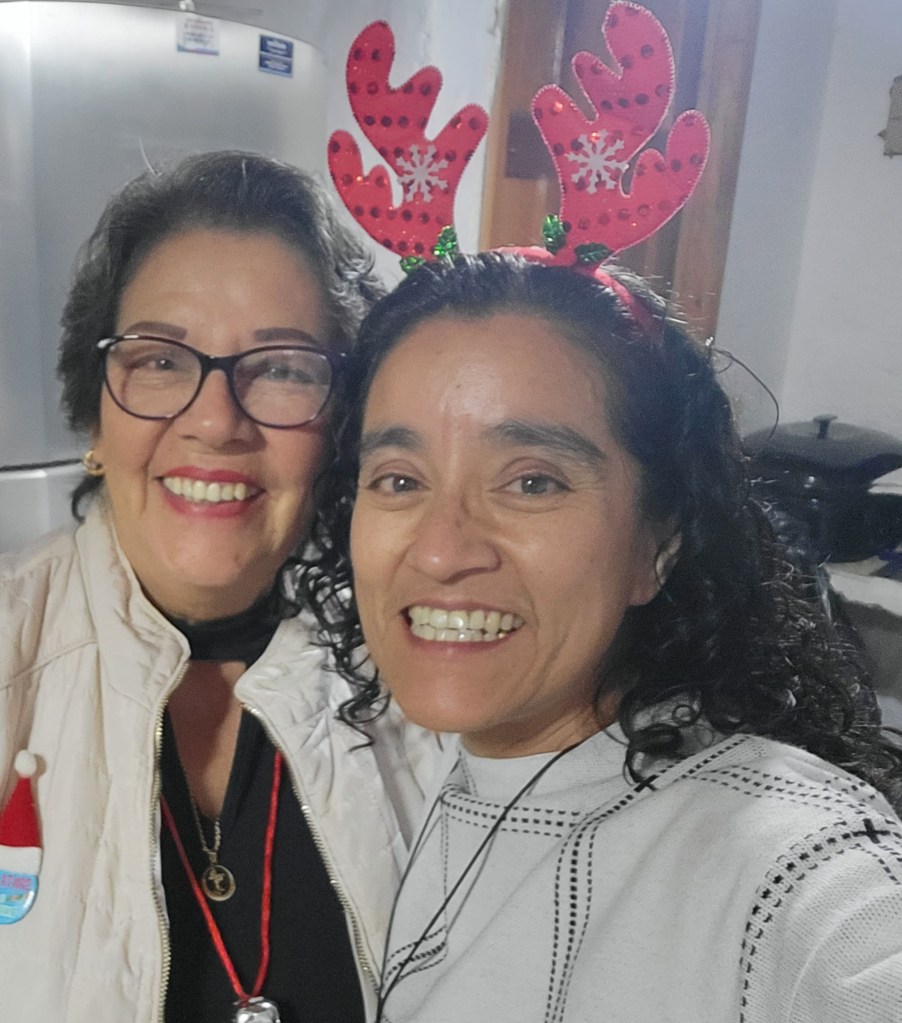
My mom and I this last Christmas

My mom lives in Mexico part of the year. She lives in a beach town that we first visited as a family back in 1979 when I was about five or six years old. It was a random pit stop during a road trip from Los Angeles to Guadalajara as we drove south to visit our relatives. My siblings and I loved it so much that we begged our parents to bring us back the following year. They did, year after year, as it became our family vacation spot—spending almost every summer there as I was growing up.

As my parents planned for their future, they ended up buying a house there and deciding to make it their part-time home during their retirement years. My dad didn’t get to enjoy that kind of retirement for very long, barely six months, before a heart attack ended his life. Still, because of their return to Mexico year after year, my parents developed a strong and connected community of friends with whom my mom still gets to share daily life. And when I say daily, I really do mean daily.

Continue reading “La UVA: The Union of Gossipy Women by Xochitl Alvizo”

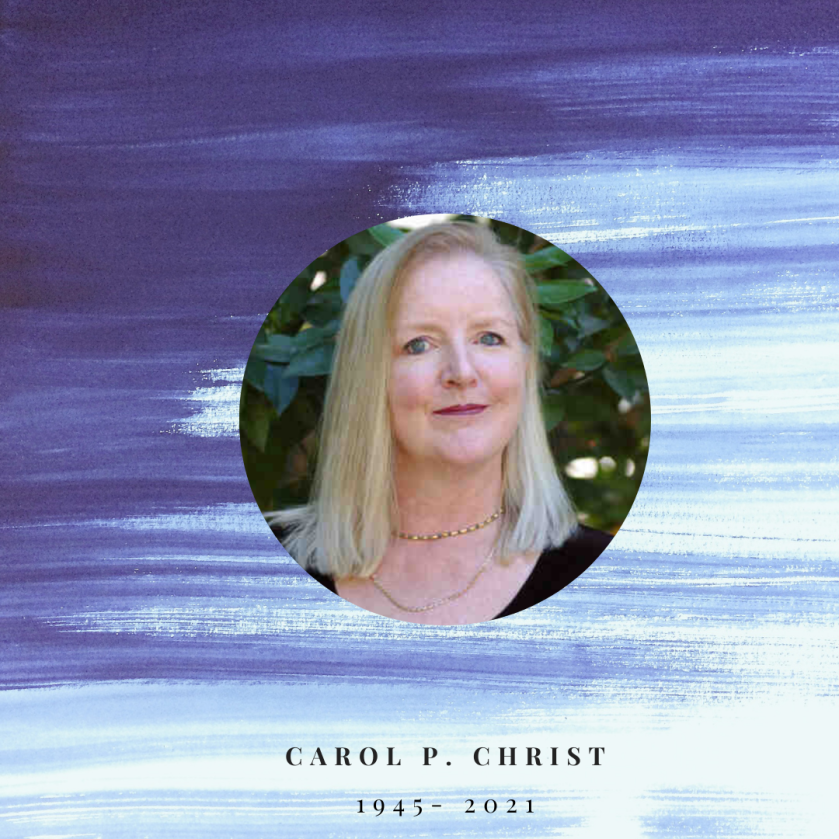
Legacy of Carol P. Christ: Let Us Give Thanks for Feminism and Religion Dot Com

This was originally posted January 6, 2014

Feminism and Religion was founded in the late spring of 2011. Throughout the summer Gina Messina-Dysert hounded me about submitting a blog while I ignored her emails because I didn’t think I wanted to take on a new project.  Gina was persistent nonetheless. Finally I decided that it would be easier to take an excerpt from a book review I had recently written than to explain why I didn’t want to write something for the blog, and so “Exciting New Research on Matriarchal Societies” became my first contribution.

Continue reading “Legacy of Carol P. Christ: Let Us Give Thanks for Feminism and Religion Dot Com”

My Experience at the Parliament of the World’s Religions: Build the Bubble by Caryn MacGrandle

Mid August I went to the Parliament of World’s Religions.  It was one of the most amazing experiences of my life:  7,500 people from all over the world coming together in love.  Christians, Pagans, Sikhs, Jains, Hindus.  All different religions and cultures.  All with the same intention to find common ground and peace between us while respecting our individual rights, religions, preferences, etc.

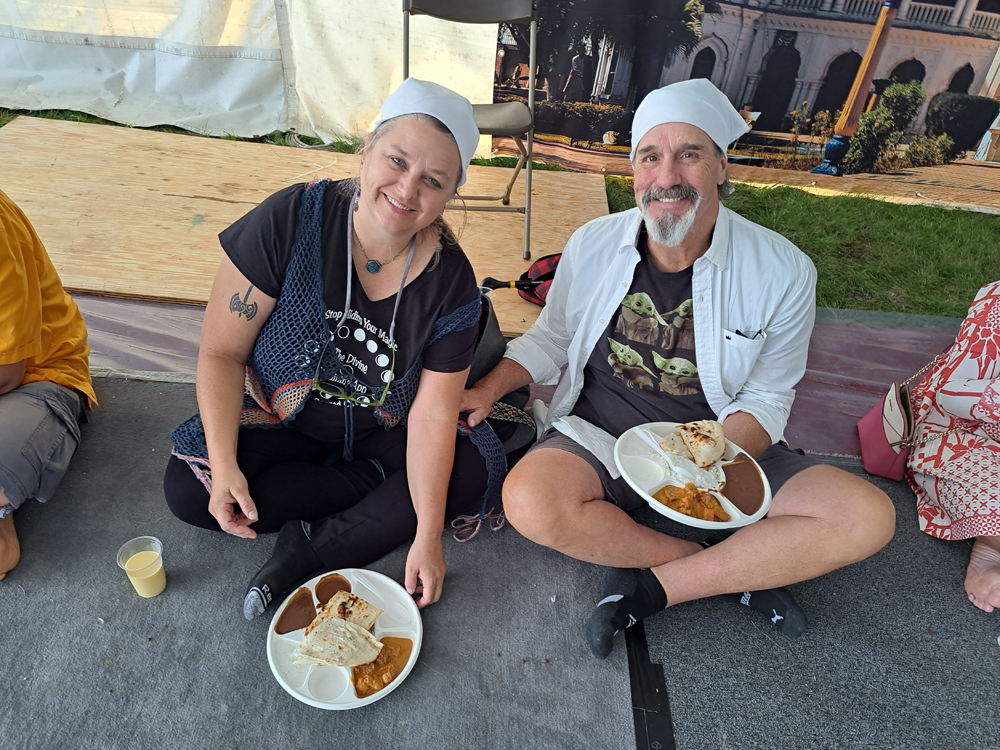
Langar lunch

The Sikhs fed us with their Guru Ka Langar lunch.  ‘Langar’ started about 550 years ago with a simple, but gigantic act by Guru Nanak the founder of the Sikh faith.  He was given funds to start his business.  Instead, he bought food and served the hungry.  This tradition is carried on by Gurdwaras all around the world to this day.

Continue reading “My Experience at the Parliament of the World’s Religions: Build the Bubble by Caryn MacGrandle”

Nitzavim-Vayeilech: Inspiration for a More Egalitarian Judaism.

The Torah portion for yesterday was a double one: Nitzavim-Vayeilech (Deuteronomy 29:9-31:30).  I have already written about Vayeilech here, yet as with any parshah there is always more to say. Nonetheless, I will mainly focus on the motifs that are more particular to Nitzavim (Deut. 29:9-30:20).  Some we have seen before like an obsession with idolatry, threats and punishments in the forms of disease, plagues, destructions, and annihilations, the Israelites’ persistent betrayal, and this-worldly rewards for good behavior.  Yet, there are some ideas we haven’t seen yet.  I want to focus on three: the Torah referring to itself; the idea of the Torah being heard; and the freedom of people to choose their own heart’s inclinations.

Deuteronomy 29:20 refers to the book of the Torah.  However, it is only in verse 31:9, that we learn that Moses is the author of the Torah.  More orthodox versions of Judaism adhere to this belief that Moses wrote the Torah (except for perhaps the last 8 verses or so since he had died), but according to biblical historians, the Torah was compiled out of a myriad of sources during the Babylonian exile.  Nonetheless, I find it interesting that in Vayeilech-Nitzavim, the Torah refers to itself eight times (29:20, 21, 27, 30:10, and 31:9, 12, 24 and 26).  To some extent, it seems to be setting itself up to be an equal to the ten commandments within Israelite temple worship as there are also instructions to put this book of Moses next to the ark of the covenant within the tent of meeting (31:26).  While Moses may not have written the Torah, it is clear that its authors intended for it to be a religiously significant book within Israel.  And, it has become for Jews, the religiously significant book.

Continue reading “Nitzavim-Vayeilech: Inspiration for a More Egalitarian Judaism.”

Snapshots from the Parliament of World Religions by Janet Maika’i Rudolph

The Parliament of World Religions ran from Aug 14th to the 18th  in Chicago.  I returned with my head spinning having met new people, connected with inspiring beliefs, discussed fascinating ideas, watched meaningful performances, engaged in sacred play, danced, sang, cried, ate, and mostly experienced . . . just experienced. It is still overwhelming to sort out individual experiences. I am going to write up a few of my impressions, snapshot style. They scratch the surface, not only of my individual experience but of the Parliament in general where upwards of 7,000 people attended. It was incredible

Setting the tableau: As I was going down the escalator, a woman was followed by 2 groups were heading up. The woman was beautiful and young in full Mayan dress with white blouse, long orange skirt along with headdress and belt with Mayan symbols. Her thick dark hair was flowing down her back.

She was followed by five Sikh men who were dressed head to foot in white. Their heads and hair were covered by white turbans.

They were followed by two Buddhist nuns dressed in grey robes carrying beads. Their heads were shaved.

Such scenes were common.

Continue reading “Snapshots from the Parliament of World Religions by Janet Maika’i Rudolph”

Archives from the FAR Founders: Learning Compassion from Inmate Number 74799 by Cynthia Garrity-Bond

This was originally posted on July 21, 2017. This is the first post of our new series to highlight the work of the four founders of FAR, Garrity-Bond, Caroline Kline, Gina Messina and Xochitl Alvizo

Technically I was employed as a lab assistant at our community

Considered standard prison procedure, Michael was scheduled for an autopsy the following day. While my grief over Michael’s death was considerable, it was the pending autopsy that caused my immediate concern. As I pictured Michael on the cold table of steel, the crude instruments sawing and cutting into his already weathered body, I took it upon myself to somehow ease this last assault. I phoned the Tucson corner’s office, hoping to speak to the pathologist who would be performing Michael’s autopsy. With surprising bureaucratic ease, I was transferred to him. After introducing myself, I explained he would be receiving Prisoner 74799, my brother, from Tucson General, and that by all appearances this was just another disposable inmate whose criminal past simply caught up with him, sort of a karma-like ending. His thin, emaciated body, I warned, is covered in tattoos, which I feared might induce a harsher judgment upon this cast away soul. I asked the pathologist that when he begins the post, he please remember Prisoner 74799 was somebody’s son, somebody’s brother, father and friend and more importantly, that this man was loved. “Please” I pleaded, “try to see beyond the obvious signs of poor choices mapped onto his body, instead see he is more than his prison issued number and that Michael Paul, while far from saint, was a man who loved and was loved.”

Continue reading “Archives from the FAR Founders: Learning Compassion from Inmate Number 74799 by Cynthia Garrity-Bond”

The Czech Tradition of Čarodějnice (Witches).

This post is a follow-up, in a way, to the post I published here on September 11, 2016, entitled “Continuing Pre-Christian Traditions in the Czech Republic,” and will be a combination photo essay* and elaboration on one of the rituals mentioned in that first post.  On April 30th, I was in the small village where my partner’s family has their summer house.  Yes, that same village that has inspired posts like this.  There, we celebrated Čarodějnice, or Witches. This holiday seems to be related to what is called May Day or Beltane in other countries. What is unique about this tradition isn’t necessarily the májka (May Pole) although it is different than other places May Pole, but the burning of the witch.

Throughout the day, everything is gendered.  The women and girls have certain tasks; the men and boys have too.  The women and girls create and decorate.  First, they create a witch to be burned on a large bonfire; the construction and shape of both can vary.  After creating the witch, the women and girls (although it should be virgins – but no one really follows that tradition) decorate the top of a cut-down, very tall pine tree with strips of brightly colored fabric and crepe paper, tying them on to create what will become vertical streamers blowing in the wind, thus creating what is called a májka.  

Continue reading “The Czech Tradition of Čarodějnice (Witches).”

Into the HEaRt of De-Criminalizing Indigenous Worldviews by Margot Van Sluytman

In prisons in Canada and around the world, a large percentage of criminalized people, who are more often than not, victimized people, Indigenous people make up significant percentages. In a recent *talk I gave, accompanying Indigenous Elder and Artist Philip Cote, we addressed what happens when colonial narratives and patriarchal narratives collide. The result is that our worldviews are shattered. When our worldviews, which are our foundational way of meaning-making, are dismissed, denied, and in the case of
cultural genocide: decimated, our heart health fails. Our bodies, our minds, our souls become disconnected become dissociated. Become imprisoned. Imprisoned in the figurative sense and eventually over time, in the literal sense.

Continue reading “Into the HEaRt of De-Criminalizing Indigenous Worldviews by Margot Van Sluytman”