This was originally posted on June 24, 2015. You can see the original comments here.
In the ancient Celtic world the Goddess was the One who expressed Herself through the many. Grainne is such a one. She is both Winter Queen/Dark Goddess, nurturing seeds through winter, and Solar Sun Goddess, welcoming the rebirth of spring. She is Aine’s sister or another aspect of Aine. She, like Aine, was honored at the summer solstice and the first grain harvest of early August with bonfires and torchlit processions on top of her sacred hill at Leinster, Ireland. Remnants of these festivals are still found in folk ritual today.
A warm summer sun smiles down upon the British coastline, the low tide reflecting jewels which are wash up and dispersed upon fine sand. A welcome breeze dances around a gathering of Goddess devotees encircling a small bonfire. Amongst them stands a banner and statue depicting and imitating Botticelli’s Venus and bouquets of roses. Just before the sun sets, those gathered lovingly collect these assembled artifacts, holding them aloft, and begin to process barefoot towards the sea.
Aphrodite-Venus’s banner and sculpted face shines in the low afternoon sunlight. As the procession slowly steps, weaves, and dances, towards the sea to the beat of a drum, the sun reaches further behind the hills, casting a long shadow upon the beach. The Goddess’s image dances with them, banner swaying and statue bobbing with the dance of its carrier. By the time the procession reaches the sea, the sun has dipped behind the now black silhouette of the hills bathing the beach ahead in dusky oranges and brilliant blues. At the shoreline, a priestess steps forward and turns the Goddess’s statue to face the procession, which has now fanning out into a semi-circle.
Reading Elizabeth Ann Bartlett’s beautiful post inspired me to share the following poem. I wrote it many years ago for my friend Lynette Eldridge to honor her love of the darker shorter days of winter.
As a devotee of the Divine Feminine, I have received many gifts that have enhanced and enriched heart, mind and soul. The greatest of these is the friendship of women. I became friends with Nettie during the hours-long drives we made together once a month for nine months from Nevada City, CA to Santa Cruz, CA to prepare for a Vision Quest in the Mojave Desert. Our journeys began in January, in the early morning dark of the short days following winter solstice.
Moderator’s note: This marvelous FAR site has been running for 10 years and has had more than 3,600 posts in that time. There are so many treasures that have been posted in this decade that they tend to get lost in the archives. We have created this column so that we can all revisit some of these gems. Today’s blogpost was originally posted August 2, 2015. You can visit it here to see the original comments.
It’s one of my favorite T-shirts. Every time I wear it, people who know who Durga is comment. So do some people who don’t know who the Hindu goddess is.
“What would Durga do?” is of course an echo of the question What would Jesus Do?
I’ve just done a bit of research and learned that this phrase may come from the Middle Ages, that it was famously used in a sermon in about 1891, and that it became very popular among evangelical Christians during the 1990s. What would Jesus do? I think he’d remind us to pay closer attention to the Sermon on the Mount (Matthew 5, 6, 7), especially the Beatitudes and the Golden Rule: “So whatever you wish that others would do to you, do also to them” (Matt.: 7:12). The Golden Rule is of course given in the other major religions, too. WWJD has also been turned into WWBD—“What would Buddha do?” I think the Buddha would tell us to live more mindfully.
Moderator’s note: This marvelous FAR site has been running for 10 years and has had more than 3,600 posts in that time. There are so many treasures that have been posted in this decade that they tend to get lost in the archives. We have created this column so that we can all revisit some of these gems. Today’s blogpost was originally posted December 25, 2015. You can visit it here to see the original comments.
Marie bringing in Elen of the Ways photo by Tony Mierzwicki
One of my colleagues at Feminism and Religion recently wrote of Xmas and Feminine Wisdom. My blog, for Christmas Day continues this exploration.
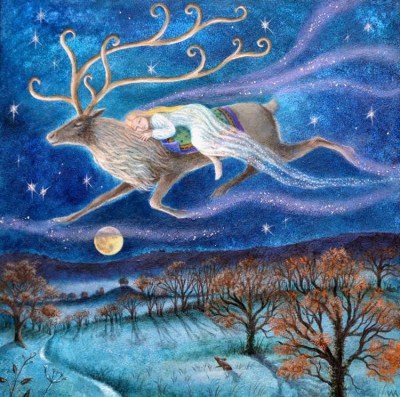
Elen of the Ways is a figure primarily studied by scholar, Carolyn Wise. She wrote two core articles available on the web here and here. Wise writes that in order to “track” and find Elen of the Ways she had to peel back the layers:
…to the earliest track ways, the migratory tracks of the Reindeer and Elk. Elen moves across vast tracts of time, and land, cloaked and masked appropriately for each age.
As the Green Lady, she peers out between the trees in forests …As a British Venus… she is guardian of the underground streams that carry the sacred waters. She is the Guardian of the ancient track ways, the Leys, the Kundalini currents in nature. And as the Horned Goddess, she leads us to the first track ways, the migratory tracks of the reindeer and later, to the path of the red deer through the forests. From here she leads us to the lost Shamanism of the isles of Britain and we can follow her across Scandinavia, Russia, Mongolia, Siberia, India and beyond.
…part goddess, part dream, part saint, a green lady and a water nymph, primordial mother and patroness of deer, and guardian of the Old Straight Tracks and solar alignments. …Elen is as real as the roads named after her, as solid as the ancient paths that carry her presence.
What are these tracks? Part of the story can be explained by understanding that there are ley lines, or energy paths throughout the globe. These paths were “tracked” by shamans, pagans, and regular folk and still exert their influence today in very recognizable ways. People celebrated earlier this week on the Solstice (December 21) at Stonehenge. “One of the most important and well-known features of Stonehenge is its alignment on the midwinter sunset-midsummer sunrise solstitial axis,” a spokesperson said. “The midwinter sun sets between the two upright stones of the great trilithon.” The solsitial axis is part of the ley line network that connects sacred sites such as Newgrange in Ireland, a sacred burial mound which lights up only the morning of Solstice.
At dawn in Newgrange, on the mornings surrounding the solstice a narrow beam of light enters the 62-foot long passage and lights the floor. It moves along the ground, from the window box until it lights the rear chamber. This Neolithic light show lasts 17 minutes….Local expert Michael Fox told National Geographic, “Archaeologists have classified Newgrange as a passage tomb but it is more than that. ‘Ancient temple’ is a more fitting label: a place of astronomical, spiritual, and ceremonial importance.”
If light that travels around the world lighting up sacred sites and bringing the gift of light to all corners of the world starts to sound like Christmas, let’s extend that thought to understand the connection to flying reindeer. According to Caroline Wise,
…the only kind of female deer to have antlers are Reindeer. Not only does the female reindeer have antlers, but she is stronger than the male and does not shed her antlers in winter. It is an older female reindeer that leads the herds.
So as I like to tell my students, “the McDonald drive through version” of what we’ve heard so far is: Most likely, yes, Rudolph is a girl/female reindeer, keeping her antlers leading a herd of female reindeer keeping their antlers, traveling with Elen (Santa) throughout the sky giving the gift of light—the light of Rudolph’s red nose that keeps the sleigh on track—following the ley lines around the world, and lighting up the sacred sites, turning the sacred wheel towards spring.
Wise continues the thread of Elen and Christmas thus:
…Leys as shamanic flight paths was relevant to Elen in her guises of both Empress and the Reindeer-woman…the Father Christmas story is based on the shamans of the Sámi people. These people (and other reindeer societies) had a symbiotic relationship with the Reindeer. They would follow the herds along their migratory tracks. Their food, clothes, homes, tools, even needles and thread came from the reindeer. ..the Father Christmas story is based on the older, non-Christian Shamans of Lapland. …to aid their shamanic flights, the shamans needed the properties of the Fly Agaric mushroom, the fabulous red and white toadstool of fairy stories. Taking the mushroom can be risky, or at least unpleasant, because of toxins it contains. The Shamans noted that the reindeer ate the mushrooms, which grew around the silver birch trees, and suffered no ill effects.
The shaman lets the substance pass through the reindeer, neutralizing the toxins, and then drinks its urine. The active ingredients are unaffected, and the shaman enters his trance and begins his flight. Above the snow he can see the herds, see the predators, and gains helpful knowledge for the tribe. He gains wisdom of the plants and healing, as the Fly Agaric opens the gateways for him to be able to commune with the spirits of the land, the beasts, and the ancestors. He carries back the gifts of healing, and also news of the herds. When finishing his trance session, the shaman would enter the yurt through the smoke hole, and slide down the central silver birch pole with his bag of healing plants and his paraphernalia – Father Christmas coming down the chimney.
And Christmas trees?…the Fly Agaric is found mainly at the base of the silver birch and pine trees. It can be found beneath conifers, mostly evergreens, such as cedar, and the spruce and firs used for Christmas trees. …Reindeer Shaman spirituality was holistic within its environment, a complete cosmology including the people, the herds, the landscape, the stars…Therefore the trees that the mushrooms grew around were an an important part of the whole.
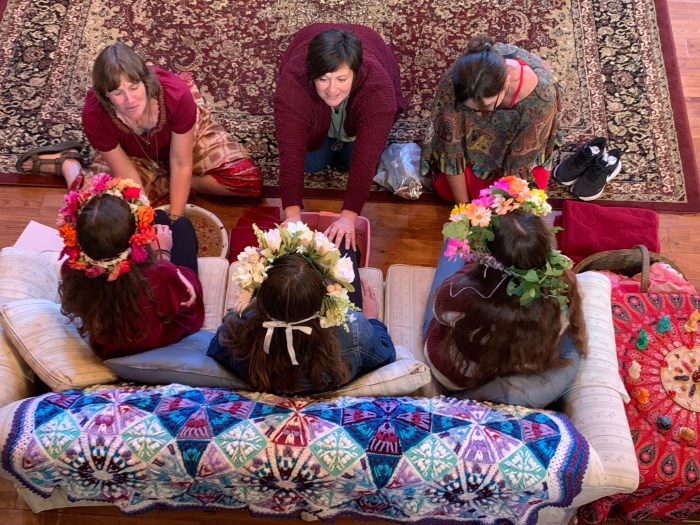
We gathered roses and bright zinnias to crown their heads with flowers, these shining daughters who we’ve cradled and fed and loved with everything we have and everything we are. We knelt before them and sang, our hands gently washing the feet that we once carried inside our own bodies and that now follow their own paths. For a moment, time folded and we could see them as babies in our arms, curly hair and round faces, at the same time seeing the girls in front of us, flowers in their hair, bright eyed and smiling, and so too we see women of the future, tall and strong boned kneeling at the feet of their own girls as the song goes on and on. We tried to tell them what we want them to know, what we want them to carry with them as they go on their ways: You are loved. We are here. You are loved. You are strong. You are magical. We treasure who you are. This love that carried them forth into the very world they walk on, we hope it is enough to embrace them for a lifetime, and so we kneel and sing and anoint and adorn and hold their hands in ours. We are here. You are not alone. You are wise in the ways. You belong. We are not sure if tears can say what we mean to say, but they fall anyway as we try our best to weave our words and wishes and songs and stories, with strength and confidence into a cloak of power that will encircle them with magic, no matter how far away from us they journey.
, elders are people who have illuminated my path, inspired me to see my own potential. To open my eyes, all my senses, even those I did not know I had. Elders show bravery and model for us how to be strong.
What is an Elder?
The word elder comes from an Old English word which also meant ancestor or chief. A lot can change in a thousand years and many of us no longer honor older people or seek out them out for advice.
In my experience, elders are people who have illuminated my path, inspired me to see my own potential. To open my eyes, all my senses, even those I did not know I had. Elders show bravery and model for us how to be strong.
My first wise woman teachings came from my family. My mother, and her mother, taught me to be myself, to love being outdoors and the importance of having a garden. Feeling the joy of flowers, cooking with fresh herbs, planting a tree to honor the dead. These are a few ancient traditions of my ancestors that have survived even in a modernized and urban setting.
As I rediscover my connection with the earth, my eco-consciousness inspires me to transform. As I go back to nature, I re-awaken my ancient cellular memories of living in harmony with the earth. I feel called to dance barefoot, play drums, make offerings, bathe in moonlight, harvest with my own hands. As I move forward on a path which is both new and old, it is my beloved elders who have shown me how to find my way.
What is an Elder?
The word elder comes from an Old English word which also meant ancestor or chief. A lot can change in a thousand years and many of us no longer honor older people or seek out them out for advice.
In my experience, elders are people who have illuminated my path, inspired me to see my own potential. To open my eyes, all my senses, even those I did not know I had. Elders show bravery and model for us how to be strong.
My first wise woman teachings came from my family. My mother, and her mother, taught me to be myself, to love being outdoors and the importance of having a garden. Feeling the joy of flowers, cooking with fresh herbs, planting a tree to honor the dead. These are a few ancient traditions of my ancestors that have survived even in a modernized and urban setting.
We’ve just entered November, the beginning of winter, the season of darkness. Twenty-odd years ago, I led a group of students through the Wheel of the Year in a class I called Practicing the Presence of the Goddess. (I also wrote a book with the same title.
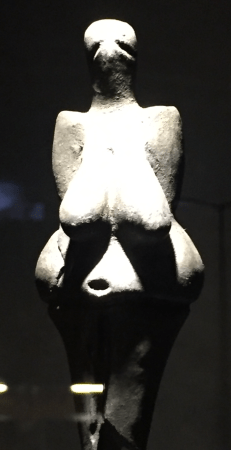
Marija Gimbutas, in her book Language of the Goddess, mentions only one goddess figurine from what was, at the time of her writing, Czechoslovakia (pages 31-32). That figurine comes from Předmosti, in the very eastern part of what is now the Czech Republic. However, there are more, and I would like to introduce you to the one that I encountered during a visit to another part of the Czech Republic several weeks ago.
Meet what Czechs refer to as the Venus of Dolní Věstonice. There is not a lot of information about her, so I have pieced together what I can find. Said to be the oldest known fired terracotta figurine (some 29,000 years old), she was first unearthed in 1925. She was found broken into two pieces at the site of the Stone Age settlement known as Dolní Věstonice, in the southeastern part of the Czech Republic. This settlement, according to Archeo Park Pavlov, was part of the Pavlovian culture, a Stone Age culture local to the area.
Author’s photograph of a replica of the Venus on display at Archeo Park Pavlov.
No one knows why Celtic Crosses have a circle. Guesses include pragmatic utilitarianism (to hold the arms up),1 the sun, Greek laurel wreath, Egyptian ankh, circle of creation,2 the Chi-Ro Greek monogram for Christ,3 the divine light that imbues all creation,4 the “Celestial Sphere” found in earlier Eastern Christianity,5 and a range of fanciful inventions based on modern imagination and pseudo-scholarship about Celtic “paganism.” [Leading scholars of pagan history agree that almost nothing is known about pre-Christian beliefs in Britain and Ireland. The few, conflicting descriptions we have, all come from highly tendentious, frequently incorrect foreigners (such as Julius Caesar, who also claimed that German forests were full of unicorns) or from Christian writers of later periods with strong agendas of their own (such as creating a native pagan history and mythology to rival their snobby Greek and Roman “Classical” neighbors).6] The circles on Celtic crosses remain a mystery.
With that in mind, I do not suggest an historical hypothesis here; rather, I offer a theological insight from a modern Feminist Christian perspective. I ask the invitational question: “What happens when modern Christians allow Celtic Crosses to symbolize the Compassing of the Divine Womb?”







 Feminism and Religion