Legacy of Carol P. Christ: ALTERNATIVE IMAGES OF GOD with Emma Trout

This was originally posted on August 3, 2105
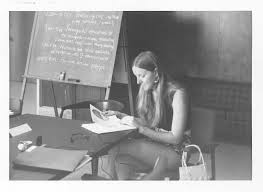
Carol Christ at the Conference of Women Theologians

Today I am publishing an early work on female language for God that I wrote with Emma Trout at the first Conference of Women Theologians in 1971. Highly contested at the conference, this essay is a foreshadowing of my subsequent work on the need for female imagery for divinity.

Rereading this essay more than four decades later, I am gratified to see that though we began our essay with the image of God giving birth (which I still view as an important image), Emma and I were aware of the danger that female imagery for God could reinforce “a false sexual polarity.” We insisted then that female imagery for God must not repeat sex role stereotypes, but rather must shatter them.

I am surprised that we also mentioned the need for a new non-static or process metaphysic, a theme I did pursue until I wrote Rebirth of the Goddess and then She Who Changes several decades later.

While the references in the essay are dated, the issues it raises are not. Though many mainline Christian and Jewish communities have adopted inclusive language, active experimentation with female language for God is relegated to the fringes of these groups. And while Goddess feminists resist gender stereotypes, some New Age teachers and Neo-Pagan groups perpetuate the idea that the Divine Feminine is receptive, loving, and giving, while the Divine Masculine is active, assertive, and aggressive.
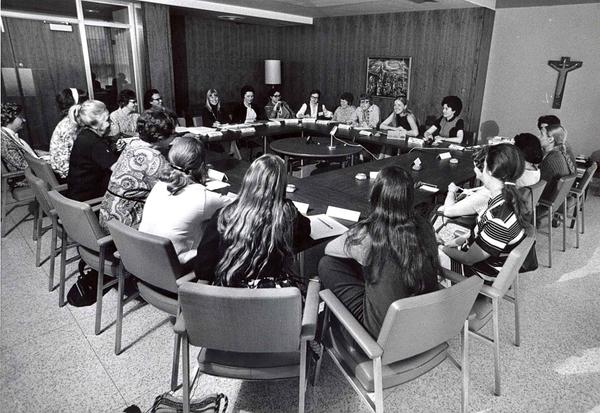
Conference of Women Theologians 1971

ALTERNATIVE IMAGES OF GOD: COMMUNAL THEOLOGY BY CAROL CHRIST AND EMMA TROUT

How much better for theology to conceive of God the Creator as pregnant with the world, giving birth to it and nourishing it, than of God the divine Watchmaker who set the machine ticking millions of years ago. — Penelope Washbourne Chen in “Rediscovering the Feminine in God” The Tower alumni magazine

Even though we know that God Himself is not really a male, we have made use of no other images in talking about Him. As Mary Daly has pointed out, images have a way of perpetuating themselves even though we conceptually know better. (“After the Death of God the Father”) The image of God as a male authority figure serves to legitimize the structures of subordination (oppression) of women to (by) men. The problem is to conceive God in such a way that God’s masculinity does not function as a legitimation system for the oppression of women.

The imaging of God as male has two aspects: 1) the poverty of our language, and 2) the impoverishing of our vision of God by exclusive use of characteristics which our culture has attributed to and limited to the male in conceptualizing and imaging God. In the first of these two aspects we find images of God as Father, King, Lord; our language has no pronoun which is able to embrace and/or transcend both sexes. Our language forces us to think of God as male; we need words like “she-he,” “father-mother,” “daughter-son,” “brother-sister.” Regarding the second aspect: in the Western tradition, particularly the Christian theological tradition our ideas and images have been impoverished by almost exclusive use of “male” characteristics in conceptualizing and imaging God.

For example, initiative, transcendence, authority, primacy, leadership, control and order have all been conceived in static, self-sufficient, abstractly rational terms, in correspondence with masculine stereotypes. An alternative image of God suggested by Penelope Washbourne Chen, imaging God as pregnant, giving birth to, and nurturing the world, presents us with a more dynamic way of conceiving God. Philosophically, this image of God would find expression in the neo-classical metaphysics or process view of reality of Whitehead and Hartshorne, rather than the static ontology of the Greek tradition.

. . .

Let us now turn to the alternatives. Underlying the problem of choosing among the alternative conceptions/images of God is the problem of the evaluation of sexual differences. If, for example, one believes sexual differences are a fundamental polarity in human experience, she will find it appropriate to see this polarity reflected in the deity. If, on the other hand, one does not see sexual differences as a fundamental polarity, she will be wary of correcting a false male image/concept of God by introducing a “female” element which may serve to further legitimize a false sexual polarity.

If one is open to the possibility that sexual differences may not be fundamental, the real question is how to shatter the idol of a male deity without either 1) substituting a reverse idol of a female deity, or 2) legitimizing a false sexual polarity.

Read the entire essay Alternative Images of God-Carol P. Christ & Emma Trout (1971).

Photos of Carol speaking at the Conference of Women Theologians and of the Conference Participants from the Alverno College archives. Thanks to Sarah Shutkin for providing a copy of the essay from the Alverno College Library Archives.
Legacy of Carol P. Christ: Can You Kill the Spirit? What Happened to Female Imagery for God in Christian Worship?

This was originally posted March 16, 2015

When I first began to think about female language and images for God I imagined that changing God-He to God-She and speaking of God as Mother some of the time would be a widespread practice in churches and synagogues by now. I was more worried about whether or not images of God as a dominating Other would remain intact. Would God-She be imaged as a Queen or a Woman of War who at Her whim or will could wreak havoc on Her own people?

Forty years later, very little progress has been made on the question of female imagery for God. I suspect that most people in the pews today have never even had to confront prayers to Sophia, God the Mother, or God-She. Most people consider the issue of female language in the churches to have been resolved with inclusive language liturgies and translations of the Bible that use gender neutral rather than female inclusive language.

Continue reading “Legacy of Carol P. Christ: Can You Kill the Spirit? What Happened to Female Imagery for God in Christian Worship?”

Legacy of Carol P. Christ: Maternal Gift Economy: Webinar Gifts

This was originally posted December 7, 2020

In the 1960s and 1970s, American-born Genevieve Vaughan was living in Rome with her husband, philosopher Ferruccio Rossi-Landi, and their three daughters. When Rossi-Landi, using Marxist models, began to write about language as a form of “exchange,” Vaughan was inspired to articulate her alternative theory based on the idea that language was developed and is learned through the gifts of the mother to the child. From that beginning, Vaughn developed an alternative theory of culture based on what she calls the “gift economy.”

Continue reading “Legacy of Carol P. Christ: Maternal Gift Economy: Webinar Gifts”

Return to Mountain Mother[1] by Jeanne F. Neath

Mountain Mother, I hear you calling me.
Mountain Mother, we hear your cry.
Mountain Mother, we have come back to you.
Mountain Mother, we hear your sigh.

Lyrics by Carol P. Christ [2]. Sung to the tune of “Ancient Mother.” (origin unknown)

What do a bunch of feminist women do while riding a tour bus around the Mediterranean island of Crete? If they are on the Goddess Pilgrimage started by Carol Christ and continued by Laura Shannon, they sing songs honoring the Goddess. The song that drew me most from the first time I heard it on the fall 2022 Goddess Pilgrimage was “Mountain Mother.” Not surprising since the rocky, sparsely vegetated, yet hauntingly beautiful mountains of Crete surrounded us much of the time as our trusty bus wound its way up and down and around the island.

Continue reading “Return to Mountain Mother[1] by Jeanne F. Neath”

Elena and the Reindeer Goddess by Judith Shaw

The mad pre-Christmas rush of activity has passed and we find ourselves again in the quiet, dark and cold of winter. Winter Solstice, the longest night and shortest day of the year in the Northern Hemisphere, occurred last week. With a gain of only a few seconds of daylight each day in the ten days after Winter Solstice, we can take advantage of the stillness offered to seek within ourselves for the seeds laying dormant, waiting to be recognized and nurtured into fruition and manifestation. 

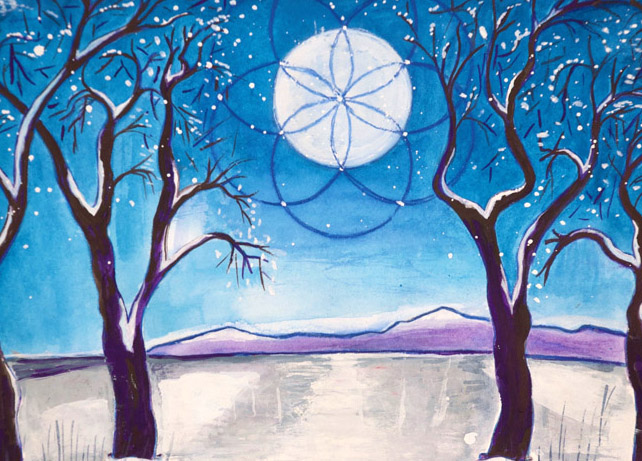
Bright Solstice Night by Judith Shaw

Having just finished all the pre-press and pre-order fulfillment of the first of the Animal Wisdom Oracle decks, now is the perfect time for me to work on seeds of my own – another project that has long been in the works. This project has gotten back burnered every spring for the past couple of years as I seem to need the dark of winter to complete the art. It’s a folk tale inspired by the ancient stories of the Reindeer Goddess. It’s a tale that honors the Sacred Feminine. The story is written and now I have the illustrations to complete. Here’s a little taste of what’s to come:

Elena and the Reindeer Goddess

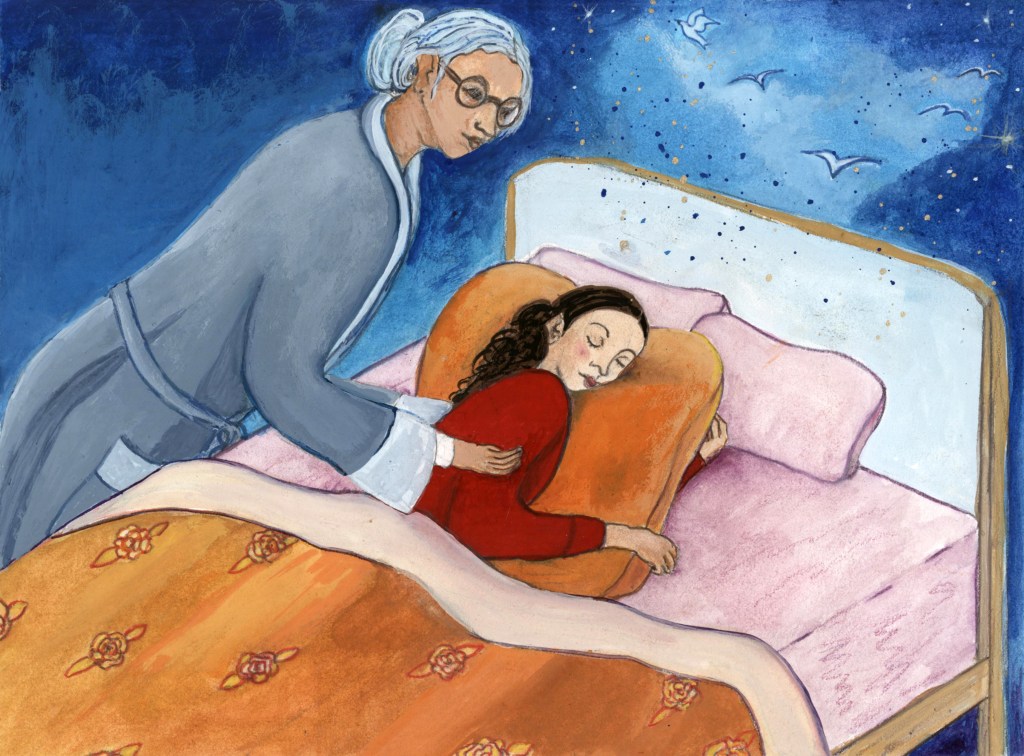
Just before dawn on a cold winter morning, Grandmother woke up with a smile on her wrinkled face and a feeling of hope in her heart. She had had a dream, one that had come from her ancestors, and from her own deep knowledge. It was a dream of prophecy.

“The Reindeer Goddess returns,” Grandmother whispered to herself.

She threw back her quilts and rose, shoving her cold feet into soft wool slippers, and hurried to wake her granddaughter, Elena.

She rushed into Elena’s cozy little room, then leaned over her and shook her gently, saying, “Elena, Elena, wake up. Quickly Elena, there’s no time to lose!”

Elena opened her eyes and yawned. “What’s wrong Grandmother? What’s happened?”

“It’s more about what will happen,” Grandmother said. “Come, let’s put on our coats and boots and while we walk I’ll explain everything. I need your pure heart, your quick wit, and your strength.” 

Elena and Grandmother bundled up against the cold and stepped outside. They began to trudge through the snow lying thickly on the ground, past little puddles here and there, glinting hard as stone in the light from a million stars.

Grandmother gathered her coat more tightly around her as she began telling Elena the story, her breath puffing out like mist in front of her.

“Long, long ago in the northern lands of snow and ice – the Old World of our ancestors – the Reindeer Goddess was alive in the hearts of the people. It was she who took flight on the Winter Solstice bringing understanding of the power that lies in darkness and of the hope that spring would return.

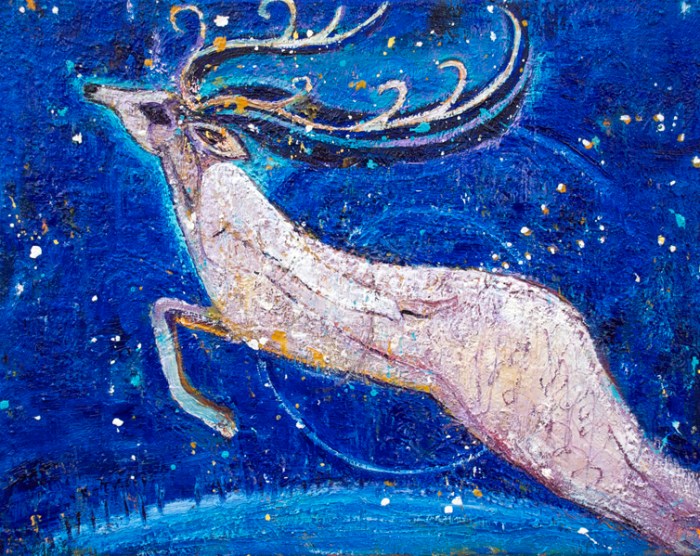
“Our people knew her as Reinna. Sometimes she was seen as a woman who flew through the skies in a chariot pulled by reindeer. At other times she was seen as a flying reindeer herself.

Flight-of-the-Reindeer-Goddess-painting-by-judith-shaw
Flight of the Reindeer Goddess by Judith Shaw

Look for more excerpts over the winter months and discover how Elena helps the Reindeer Goddess accomplish her very important mission of love. The book should be ready for the printers by the end of summer – early fall 2024.

Reindeer are the only deer species in which the females grow antlers. And the females’ antlers are larger and stronger than those of male reindeer. So who was Santa Claus really and who were his flying reindeer?

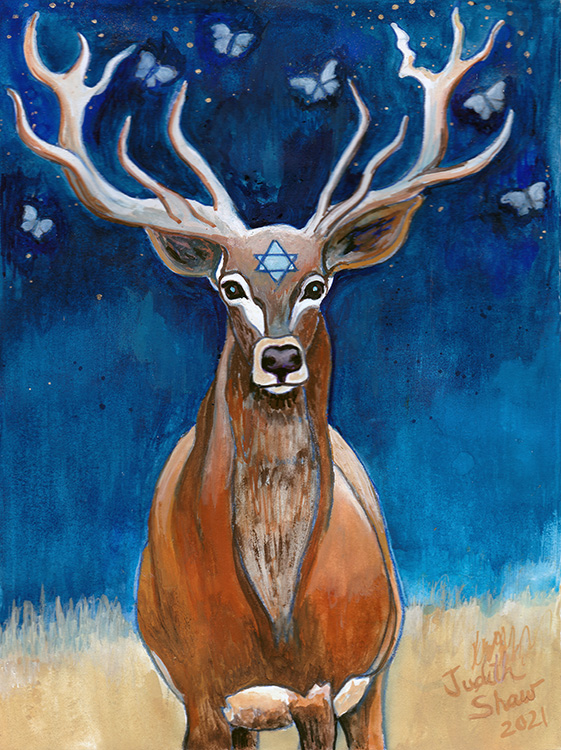
As our ancestors were well aware of the need for balance, Stag – the male red deer indigenous to the UK – is also celebrated at this time. Stag, who grows a massive rack, is symbolic of the masculine power of regeneration, a messenger from the spirit world and one who leads humans to spiritual enlightenment. Males are called bucks in other deer species.  

The racks found on bucks from other deer species during the fall rut are also impressive. I was lucky to see many mule deer during my Thanksgiving stay in the Jemez Mountains of New Mexico. Deer who wander into town are protected and thus not afraid of humans. This allowed me to get very close to this magnificent buck and capture his photo. He was not at all interested in looking at me so it took awhile to get this shot from just a few feet away.

And finally I’ll share my painting of Stag with you all again.

May the Reindeer Goddess continue to nurture you with her love and gifts of abundance while Stag guides you to spiritual enlightenment.

Judith Shaw, a graduate of the San Francisco Art Institute, has been interested in myth, culture and mystical studies all her life. Not long after graduating from SFAI, while living in Greece, Judith began exploring the Goddess in her art. She continues to be inspired by the Goddess in all of her manifestations, which of course includes the flora and fauna of our beautiful Earth. Originally from New Orleans, Judith makes her home in New Mexico, The Land of Enchantment.

Judith’s illustrated fairytale: Elena and the Reindeer Goddess — A Magical Winter Solstice Mission — will be released by late January 2024. Sign up for Judith’s  newsletter on her website for more info on the release.

Judith’s oracle decks are available on her website:
Celtic Goddess Oracle — order your deck here.
Animal Wisdom Oracle – order your deck here.

“Our Lady of the Shards”: Icons for the Buried and Rising by Lauren Raine MFA

Our Lady of the Midwives (2019)

When I became a feminist, I realized that somebody had to write all about this women’s art that was out there being totally ignored, and it was going to be me. And of course the ideas and the discoveries about what women’s art was……. I look at it for the information it gives me about women’s imagery, women’s psyches, women’s lives, and women’s experience.” 

 Lucy Lippard in Talking about Art Since 1976

I have been making art, masks, and theatre about “surfacing” for a very long time. As a child I was always digging at the roots of trees, fascinated by their interwoven strength, wondering how far down they went. That fascination never really left me. Sometimes it occurs to me that I and most of my colleagues are “spiritual archeologists”, sorting through artifacts and the mythic overlay of the past to re-discover and re-vitalize the present. I joined many of those colleagues for over 20 years:  un-earthing, re-inventing, and animating stories of the Great Goddess throughout world culture with the Masks of the Goddess Project (1999-2019), among other collaborations.  I am not religious, so much as I am a mythologist, following archetypal trails of myth back and back, seeking the sacred source they often reveal.

Continue reading ““Our Lady of the Shards”: Icons for the Buried and Rising by Lauren Raine MFA”

Asking Her Blessing by Christine Irving

… if the carving is in reach of its admirers,

the yoni will often be polished to a shine

by the touching fingers wishing to evoke

 the blessings of the Goddess.

~Adele Getty, Goddess: Mother of Living Nature

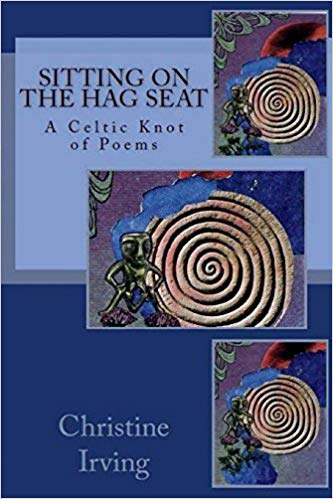
My book Sitting on the Hag Seat carries the blue cover I designed. Buried in the blue, riding the spiral Wheel of Return, stands a small Sheela-na-gig. The Sheela’ s origins remain unknown and controversial. It sometimes seem to me that the less explanation exists for a mysterious object or occasion, the more emotional attachment accrues to the opinions of diverging theorists. However, no matter what symbolism is ascribed to Sheela-na gig, her frequent placement above church doors or in the walls of cities, castles and watch towers, does seem to support a protective aspect not necessarily at odds with other attributions.

Continue reading “Asking Her Blessing by Christine Irving”

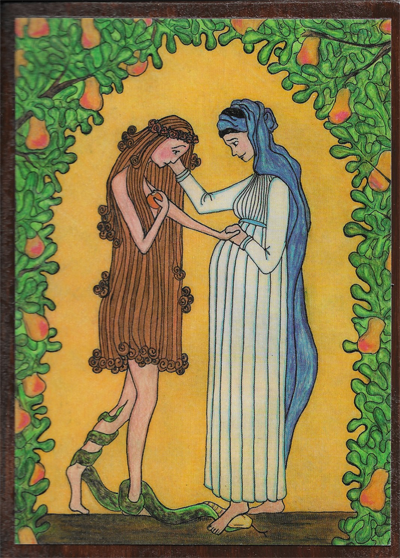
What is Wrong with This Picture? Rewriting Eve by Caryn MacGrandle

One of my oldest friends who I met when I was eight years old reached out to me the other day saying that if there was ever anything she could do, please let her know. She lives in another state far away but is a subscriber to one of my blogs so she has been aware of the various things going on in my life (second divorce, so many changes and transitions in my life yet again, etc.)

Her note said if there was ever anything she could do to help, just let her know.

And I thought to myself: hmmmmmm.

You see I just put a new feature on my app where it emails local events to local users, and one of the first steps in getting this to work is having those local events on the app. So I asked her if she would mind helping me put local events on the app.

We had not actually talked in a long time, and when we had a zoom call to discuss this, I broke down crying.

I felt the pity from her. I also saw just how far I had departed from ‘normal.’ 

But I don’t want to be ‘normal’. 

Continue reading “What is Wrong with This Picture? Rewriting Eve by Caryn MacGrandle”

The Legacy of Carol P. Christ: What if Divine Feminine and Divine Masculine Are Not Oppositional Categories?

Moderator’s Note: The blog was originally posted May 18, 2015

A friend who is a spiritual teacher speaks often “bringing back the values associated with the Divine Feminine.” For her this has to do with helping women to understand the beauty of our bodies and the importance of ways of being such as giving and caring for others that have been associated with the undervalued so-called “feminine” side of the masculine-feminine polarity. Though she also speaks about the Goddess, I think she prefers the term “the Divine Feminine” because of the implication that men too have their “Divine Masculine.”

This friend has a wonderful husband who is a teacher in his own right and who often ends up spending a lot of his time among powerful women who enjoy talking about the Goddess. In these conversations he sometimes speaks of the need for men to “recover the Divine Masculine” if they are to become whole.

Continue reading “The Legacy of Carol P. Christ: What if Divine Feminine and Divine Masculine Are Not Oppositional Categories?”

From the Archives: Answering the Call by Joyce Zonana

This was originally posted on April 30, 2020

Very early in Henri Bosco’s 1948 novel Malicroix, a young man, Martial de Mégremut, living placidly amid fruitful orchards in a tame Provençal village, receives a letter informing him he has inherited “some marshland, a few livestock, a ramshackle house” from a reclusive great-uncle, Cornélius de Malicroix. Against his family’s strenuous objections–with alarm they speak of “marshes, mosquitoes, miasmas”–Mégremut resolves to travel alone to the remote Camargue to claim his “wild” Malicroix inheritance. The house is on an island, and to reach it Mégremut must cross a rough river, at night, in a frail wooden boat piloted by a taciturn old man who meets him at dusk in the middle of a vast plain.

So begins a deeply internal quest narrative, an initiatory journey that forces Mégremut to come to terms with himself and with the elements–earth, water, wind, and fire–that are ever-present, sometimes terrifyingly so, on the island. For once he arrives, he learns that he must remain there alone for a full three months if he wishes to obtain the inheritance. Torn about whether to stay or leave, he finds that the decision to stay is made of its “own accord,” unconsciously.

Continue reading “From the Archives: Answering the Call by Joyce Zonana”