Matriarchies Are Not Just a Reversal of Patriarchies: A Structural Analysis by Heide Goettner-Abendroth

Matriarchies are not just a reversal of patriarchies, with women ruling over men – as the usual misinterpretation would have it. Matriarchies are mother-centered societies. They are based on maternal values: care-taking, nurturing, mothering. This holds for everybody: for mothers and those who are not mothers, for women and men alike.

Matriarchal societies are consciously built upon maternal values and motherly work, and this is why they are much more realistic than patriarchies. They are, on principle, need-oriented. They aim to meet everyone’s needs with the greatest benefit. So, in matriarchies, mothering – which originates as a biological fact – is transformed into a cultural model. This model is much more appropriate to the human condition than the patriarchal conception of motherhood which is used to make women, and especially mothers, into slaves.

Within matriarchal cultures, equality means more than just a levelling of differences. Natural differences between the genders and the generations are respected and honoured, but they never serve to create hierarchies, as is common in patriarchy. The different genders and generations each have their own dignity, and through complementary areas of activity, they function in concert one other. More precisely, matriarchies are societies with complementary equality, where great care is taken to provide a balance. This applies to the balance between genders, among generations, and between humans and nature. Maternal values as ethical principles pervade all areas of a matriarchal society. This creates an attitude of care-taking, nurturing, and peacemaking. Continue reading “Matriarchies Are Not Just a Reversal of Patriarchies: A Structural Analysis by Heide Goettner-Abendroth”

Spiritual without a Tradition and Feminist to the Core! by Carol P. Christ

In “Who Owns the Sacred?” Eline Kieft, who was raised Protestant and considers nature and the ancestors her teachers, noted that those of us who have left the Christian tradition but who have not signed on to another tradition are often demeaned; she writes:

any form of spirituality outside the five major religions is considered as empty, eclectic, post-modern consumerist product that lacks meaning and substance because of its diluted, selective ‘picking’ of traditions from other times and contemporary contexts.

I have heard this criticism from feminists and non-feminists alike.

Since 9/11, Christian feminists have questioned the widespread assumption that Christianity is the only true or important religion. However, recognition of religious diversity among Christian feminists is frequently limited to the 3 so-called Abrahamic traditions. More rarely Buddhists and Hindus are included. In either case, religious diversity is defined in terms of the 5 so-called “great”—and patriarchal–religious traditions: Christianity, Judaism, Islam, Hinduism, and Buddhism. Ironically (or not!) the recognition of religious diversity among feminists serves to underscore the notion that the only legitimate feminists in religion are those who are working to transform patriarchal religions. Continue reading “Spiritual without a Tradition and Feminist to the Core! by Carol P. Christ”

Let’s Try Creativity This Year by Barbara Ardinger

As usual, I’m writing my post a couple weeks before you’ll be able to read it. I bet we’re all wondering in mid-December if 2020 is really gonna happen. Will we still be living in a civilization? Will there still be wild animals (outside of zoos)? Will trees and other plants still be growing? Well, my friends, if we all woke up last Wednesday and opened our eyes and it’s all still here……hooray!

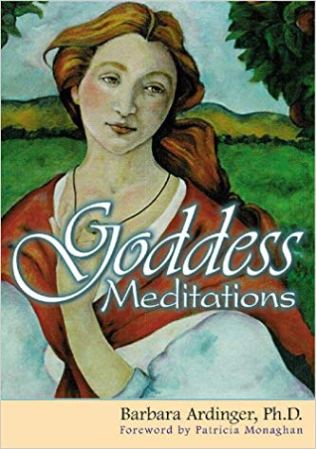
Way back in 1998 I wrote a book called Goddess Meditations. It was the first-ever book devoted to guided meditations centered only on goddesses. No gods. No empty minds or asanas. Goddesses, some well known, others obscure, from many pantheons. One chapter in the book is “Chakra Goddesses,” in which I assigned a goddess to each of the seven major chakras. The goddess of the throat chakra—which rules clear communication, self-expression, and creativity—is Sarasvati. Here (with comments that pop out of my mind and into my fingers as I type) is part of what I wrote about communication.

Continue reading “Let’s Try Creativity This Year by Barbara Ardinger”

Week 3 – Goddess Birthing Liberation: A Feminist Advent Daily Devotional by Trelawney Grenfell-Muir

If you have not yet realized that the Christmas story is a story of liberation from oppression, it is time to realize that. I like to dust off the patriarchy and mysogyny of scriptural writers to find the beautiful wisdom within the stories and songs. Here is my daily devotional for the third week of Advent, the week of Joy. May our ever-birthing Goddess guide you to recognize and birth Joy, with all Creation. As the sky turns dark, may our candles shine ever brighter, together.
 

Feminist Advent Devotional, Day 15:

Isaiah 35 (NRSV, revised)

The wilderness and the dry land shall be glad,
the desert shall rejoice and blossom;
like the crocus it shall blossom abundantly,
and rejoice with joy and singing.
The glory of Lebanon shall be given to it,
the majesty of Carmel and Sharon.
They shall see the glory of the Womb,
the majesty of Gaia.

Strengthen the weak hands,
and make firm the feeble knees.
Say to those who are of a fearful heart,
‘Be strong, do not fear!
Here are your kindred.
We will come with compassion,
with holy power.
We will all heal and lift each other.’

Then the wounds of the sufferers shall be healed,
and the griefs of the broken-hearted be comforted
then the fainting ones shall leap like deer,
and the tongues of the mourners sing for joy.
For waters of new birth shall break forth in the wilderness,
and streams in the desert;
the burning sand shall become a pool,
and the thirsty ground springs of water;
the haunt of jackals shall become a swamp,
the grass shall become reeds and rushes.

A highway shall be there,
and it shall be called the Holy Way;
the greedy shall not travel on it,
but it shall be for the kindred of Gaia;
no traveller, not even infants, shall go astray.
No robber shall be there,
nor shall any ravenous ruler come up on it;
they shall not be found there,
but the kindred shall walk there.

And the kin-dom of Gaia shall return,
and come to each other with singing;
everlasting joy shall be upon their heads;
they shall obtain joy and gladness,
and sorrow and sighing shall flee away. Continue reading “Week 3 – Goddess Birthing Liberation: A Feminist Advent Daily Devotional by Trelawney Grenfell-Muir”

Adoring God in Labor by K Kriesel

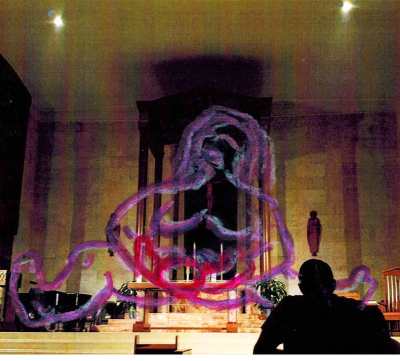
The day before the 2019 Nevertheless She Preached conference at First Baptist Church of Austin, TX my own Catholic church’s young adult ministry hosted Eucharistic Adoration. Although I’ve enjoyed Adoration dozens of times, several factors made this evening different. I was preparing for cervical surgery for one. My Hebrew Bible class at Austin Presbyterian Theological Seminary was grappling with Rebekah, Rachel, Leah, and the voiceless Dinah. The call to write the history of 20th century Catholic women theologians had been at my ear all day. The catalyst was when two men at the Adoration began leading a song about God the Father.

Maybe it was just the incense but I swear I saw something. An image of the baby crowning from the womb, God gasping in labor, as the Eucharist wore the gold of the monstrance as a crown before the tabernacle. God was pushing the Body of Christ into creation while I prayed for my own sick body. God was crying out with the voices of these thousands of unheard women. We were all there. I snuck out my phone and took a picture, determined to put the scene to paper.

Continue reading “Adoring God in Labor by K Kriesel”

PENTECOST a time to FILL THE WORLD WITH SPIRIT by Mary Jane Miller

Pentecost is followed by Ordinary time, the longest season of the church year. It gives us plenty of time to think about what happened when the Holy Spirit descended on the Apostles. I have always loved the idea that this one moment changed us, it was and is the fulfillment of God’s promise to pour out the Holy Spirit on all flesh, empowering diverse people to exercise divine power. It is commonly understood that the first to receive the power from on high are the male disciples, “locked in a closed room for fear of persecution.” Apparently these Jewish disciples were not too worried about their wives and children.

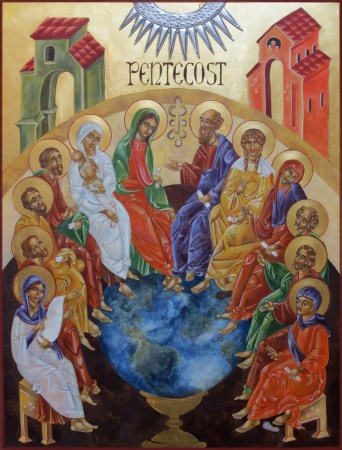
After painting several Pentecost Feast Day icons as an artist, iconographer and child of God I cannot remain silent with what I think the icon has taught me. It feels obvious that the great gift of the Holy Spirit was for all of humanity. I want to commemorate an ongoing Pentecost, a time to fill the world with spirit, where women and children are invited into the closed room and given a rightful place at the table. Images have a great deal of influence in opening the heart and the mind. Imagine a new contemporary understanding of divine light touching all human beings as well as the planet.

The Spirit Descending

A half circle of twelve descending rays is commonly found at the top of any Pentecost icon. This representation is critically important for the beginning of our narrative. “Then there appeared to them divided tongues, as of fire, and one sat upon each of them.  And they were all filled with the Holy Spirit and began to speak with other tongues, as the Spirit gave them utterance. (Acts 2:2-4)

Imagine that these rays represent the uncreated energies filling the universe, the same rays any of us might feel when touched by grace. These divine rays envelope us as they come from beyond time and space.

Continue reading “PENTECOST a time to FILL THE WORLD WITH SPIRIT by Mary Jane Miller”

We Are Not Alone: Embodying and Re-enacting Ancient Wisdom by Carol P. Christ

A few nights ago, on the way to dinner, two friends and I passed by a small church near the old fortress in Ierapetra, Crete. The liturgy was broadcast via microphone and a crowd of people gathered outside the church. “Must be some kind of name day,” one of my friends commented, but I could not think of a saint celebrated on August 1.

We decided to light candles and make our prayers. I asked one of the Greek women the reason for the ceremony. “This is the first night of our celebrations for the Panagia,” she responded, referring to the Assumption of Mary that would occur on August 15. I looked around and saw that indeed many of the women were wearing black. “Of course,” I thought to myself. Continue reading “We Are Not Alone: Embodying and Re-enacting Ancient Wisdom by Carol P. Christ”

My Near-Death Experience, Or How I Met the Goddess Face to Face By Barbara Ardinger

Oh boy oh boy oh boy—another June 17 has passed (I’m writing this on June 18) and I’m still here. Every year, this is my day to be careful. And to keep breathing. I have two specific associations with June 17. The first, and lesser, is that it is (or was) the birthday of my last serious boyfriend. I really thought we were going to get married. That didn’t happen, and as we were breaking up, he gave me a (probably expensive) bottle of My Sin perfume. I hurled it against the wall behind the dumpster. So much for that. And him.
The real story: I began having asthma attacks in the late 80s. Nearly every night. A friend took me to every doctor we could think of, but none of them helped me. (At the time, my asthma was acute; now it’s merely chronic and under control.) In June 1992, I was very busy doing freelance writing when I could find an assignment, looking for a real job, serving as vice president of the Orange County chapter of Women In Management (which meant I booked the speaker every month)…and breathing. My second book, A Woman’s Book of Rituals and Celebrations, was being published, and I was teaching a weekly class called Practicing the Presence of the Goddess in my living room. Continue reading “My Near-Death Experience, Or How I Met the Goddess Face to Face By Barbara Ardinger”

The Gift by Sara Wright

We drifted through

the green

hungrily absorbing

plant souls,

each twig, flower, and tree

has her own story to tell…


Such a joyful way

for me

to spend a

‘mother’s day.’

Being with him

when family

extends sharp claws

is an antidote to suffering.


“This is my church”

He said,

not for the first time.

I nodded.

He and I are almost

always in agreement

when it comes

to plants

and people.

Continue reading “The Gift by Sara Wright”

Embracing Lost Vocation: Painting Mother Goddess by Angela Yarber

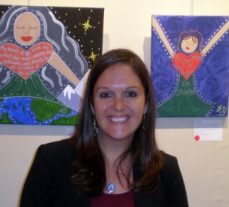
The awakening occurred at 1:27am with the pterodactyl-cry only uttered by toddlers. It continued around 2am when said pterodactyl joined weary moms in bed. Stinging tears splattered pillows with a swift headbutt to my nose, later accompanied by footied talons jabbing my ribcage as this tiny person became the human crossbar of a giant “H,” vertical moms arching precariously on either edge of the overstuffed bed. 5:30am came all too soon as both children arose, crows louder than any rooster, tired moms stretching their aching backs. Navigating this whole feminist parenting thing is complicated, y’all. As an artist, author, activist, and academic, I thought I had a handle on my identity and vocation; now I feel like motherhood is the only moniker defining my exhausted reality.

I was recently given the opportunity to speak at a conference for artists, academics, and activists, the so-called spiritual weirdos who think and create and do at the intersections of art, scholarship, spirituality, and social justice. It was enlivening and inspiring. What struck me, though, were the asides that often occurred when anyone asked whether I had children, and if so, what ages. Throughout my travels and during the conference, the consistent reaction upon sharing that I’m a mother of a two and five-year-old was, “Woah. You’re in the thick of it.” “Don’t worry. It gets easier.” “This, too, shall pass.” Rarely have I felt so validated. Continue reading “Embracing Lost Vocation: Painting Mother Goddess by Angela Yarber”