Summer is a time when we are surrounded by the power of Nature, the impulse to life, balance, and well being. Even small actions to align ourselves with it can create momentous changes and healing within ourselves and towards a more sustainable world. Over the past couple of years, I have noticed a decline in pollinators like bees, butterflies, and birds in the small garden behind my home. This may be part of the worldwide pollinator crisis, or the result of nearby housing developments overtaking wild land, or my own past bad gardening decisions. I decided that this year it was time for me to join the many other gardeners worldwide who are creating pollinator-friendly spaces.
So, I did some research into what native and non-native plants already growing in the garden are good for pollinators and which native plants I should acquire from gardener friends or native plant organizations. I also learned to make a better environment for pollinators by waiting to move or shred leaves until warmer weather so as not to disturb pollinators wintering over, making sure that plants on which insects are making homes are left alone, and building up berry brambles, shrubs, and brush piles for birds and butterflies to find food and shelter in.
This is the 4th in a series of work I have been doing to translate passages of the bible into poetry that strips out the patriarchal overlays. You can read the previous ones here: Part 1, Part 2, and Part 3.
In this installment I have picked out some passages I really like but that I feel their power and beauty have been deeply hidden. I seek to reveal those hidden wisdoms.
To review; my usage of the 2 main names of divinity:
YHVH or LORD, I translate as Vibration.Being
EL or god, I translate as All-Potential Powers.
I discuss my reasons for these translations in my prior posts referenced above.
Genesis 3:6
And when the woman saw that the tree was good for food, and that it was pleasant to the eyes, and a tree to be desired to make one wise, she took of the fruit thereof, and did eat, and gave also unto her husband with her; and he did eat. KJV (King James Version)
and the woman saw that the function of the tree is for nourishment and that he is yearning to the eyes and the tree was a craving to make calculations and she took from his produce and she ate and she gave also to the man with her and he ate Benner Mechanical Translation[i]
When the woman saw the tree, she recognized herself She recognized and remembered beauty and wisdom She took its seeds within her in knowing wholeness She gifted its seeds to her husband in knowing wholeness MPV (Mystic Pagan Version – my own translations)
Note for Genesis 3:6 – the word for “food” in the KJV version of this passage is “maakal” (Strong’s 3978). The word used for to eat is “akal” (Strong’s 398). Both are built on the root word “kl” which means complete or whole and traditionally refers to how food or nourishment makes us whole.[ii] I would add that in the context of spirit, it is that essence or element that we fill ourselves with to achieve a sense of wholeness.
Genesis 49:25
Even by the God of thy father, who shall help thee; and by the Almighty, who shall bless thee with blessings of heaven above, blessings of the deep that lieth under, blessings of the breasts, and of the womb: KJV
from the mighty one of your father, he will help you, and with Shaddai [my breasts] he will respect you, presents of the sky from upon the presents of the deep sea stretching our underneath presents of the breasts and bowels. Benner
The All-Potential Powers of your ancestors Who watches compassionately over you With nourishment from the dripping milk of the cosmos And blessings from the misty cauldrons of the goddess Tiamat Blessings of the breast, and the loving womb MPV
Notes on Genesis 49:25: this passage had to have been a very old pre-biblical blessing. We don’t often see blessings that are clearly given by female divinity figures, or in this case, a divinity that has breasts and womb. Even in the conservative, male-centric King James Version the blessing is of the breast and the womb. The word for breasts is “shad.” To take this theme a step further, the phrase El Shaddai or Shaddai appears 48 times in the Bible. In English, El Shaddai is usually translated as “God Almighty” and Shaddai as “Almighty.” Sometimes they are translated as “God, the One of the Mountain.”[iii] Both are almost always referred to in scholarly discussions with the pronoun “he.”
I have put the following two passages together because they speak to the same theme. One is a Psalm and the other a Proverb. I really like them because they both speak to the condition of our hearts. As some of you know I am an alaka’i of Aloha International. That is a spiritual guide of Huna or Hawaiian Adventure Shamanism. I love the lessons of Huna which foremost and foundationally remind us to keep a loving and open heart. Aloha not only means hello and good-bye, it means “the breath [ha] we all share,” and it means LOVE. Picture this, the Hawaiian people greet and part from each other which a statement of connection and love. The first principle of Huna is “the world is what you think it is.” The lesson behind this is that what is in our hearts will shape our experiences and ultimately our world. I believe that this is the lesson behind these biblical passages. (I have also included the New International Version for Proverb 4:23 because I think it is particularly beautiful.)
Psalm 37:4
Delight thyself also in the LORD; and he shall give thee the desires of thine heart. KJV
Cherish thyself in harmony with Vibration.Being And gifts will be returned as per the radiance of thy heart. MPV
Proverbs 4:23
Keep your heart with all diligence, For out of it spring the issues of life. KJV
Above all else, guard your heart, For everything you do flows from it. (New International Version)
Treasure your heart in lovingkindness, For it is the wellspring of your life.
Janet Maika’i Rudolph. “IT’S ALL ABOUT THE QUEST.” I have walked the spirit path for over 25 years traveling to sacred sites around the world including Israel to do an Ulpan (Hebrew language studies while working on a Kibbutz), Eleusis and Delphi in Greece, Avebury and Glastonbury in England, Brodgar in Scotland, Machu Picchu in Peru, Teotihuacan in Mexico, and Giza in Egypt. Within these travels, I have participated in numerous shamanic rites and rituals, attended a mystery school based on the ancient Greek model, and studied with shamans around the world. I am twice initiated. The first as a shaman practitioner of a pathway known as Divine Humanity. The second ordination in 2016 was as an Alaka’i (a Hawaiian spiritual guide with Aloha International). I have written three books: When Moses Was a Shaman, When Eve Was a Goddess, (now available in Spanish,Cuando Eva era una Diosa), and One Gods. In Ardor and Adventure, Janet.now available in Spanish. Cuando Eva era una Diosa
One of the key factors to me that differentiates feminist spiritual paths from many dominant religious traditions and frameworks is the recognition and acknowledgement of the body as a source of wisdom, a source of pleasure, a source of learning, and a source of knowing. Not viewed as unclean, dirty, or as something to be mistrusted or transcended, we can return to our bodies again and again, dropping down into our bellies, bones, and blood, returning to center, and returning home to ourselves. Those who embark into thealogy quickly realize that it is a spirituality better lived than analyzed. My own experience of my goddess-oriented path is an intensely embodied one. I am here on this earth, in this body, my feet on the ground, my eyes on the sky, listening, feeling, and sensing. This, to me, is sacredness in motion, this is the Goddess right in front of me, she is witnessed in the very fact that my pulse beats in my wrist and that my eyes alight on those three crows coasting lightly into the treetops.
Sara Avant Stover, writing in the Book of SHE says: “Our bodies aren’t indentured servants here to labor for us until we take our dying breath. They are sacred chalices . . . . Our bodies always tell the truth and hold the information we need to thrive” (p. 43).
And, one of my favorite quotes of all comes from Camille Maurine in Meditations Secrets for Women who writes: “Your body is your own. This may seem obvious. But to inhabit your physical self fully, with no apology, is a true act of power.
At one time, I would have focused my attention primarily on women and encouraging women to trust their bodies, to listen to their bodies, and to honor their bodies. I’ve come to see that a goddess-centered approach to ethics, values, and embodied spiritual experience includes all people who have a body. In my heart of hearts I would like all people to value their bodies, honor their bodies, trust their bodies, and listen to their bodies. I think if this was true, the fundamental way in which we relate to, treat, and care for one another would change and the feminist values of cooperation, compassion, and empathy would come to form the foundation of society. Every single one of us begins life within someone else’s body. We enter the world through someone’s body. And, we have a body that interacts with other bodies for our entire lives. This is altogether simple, obvious, and profound. Our bodies are our seats of reality, of being human, of being present in the world. A life firmly rooted in concept of the body as sacred, no longer allows room for violation of or harm to others.
Carol Christ writes in Rebirth of the Goddess: “The rituals and symbols of Goddess religion…[bring] experience and deep feeling to consciousness so that they can shape our lives; helping us broaden and deepen our understanding of our interdependence to include all beings and all people; binding us to others and shaping communities in which concern for the earth and all people can be embodied.”
When I talk to other people about self-trust and building self-trust, I often encourage them to check in with their bodies for a physical response to a decision, idea, choice, or happening. Where does it land in your body? What do you feel inside when you think about making this decision or taking this action? Does your body respond with a “yes” or a “no” when you think about this idea? For me, the sensation comes in my chest, around my heart—a lightening or expansion or a contraction or heaviness. This is not what all people will experience, perhaps you feel the answer in your belly, in your head, around your jaw. Perhaps you feel it as a color, sensation of warmth or coolness, or as a “rightness of being.”
I must also acknowledge that many people have experienced some form of physical trauma or abuse in their lives and that these experiences can complicate our relationships with our bodies, our sense of intuition, and our trust in ourselves. If your body has been a site of violation, it may be more difficult or complex to connect to this body-based sense of “knowing” or intuition that I reference and I do not wish to oversimplify what can be a complex and multilayered personal experience of embodiment.
If you mentally walk through your body, what do you see?
What is your body as home like for you? How re-sourced is it?
What needs attention within you?
Do you have a sense of your inner and outer ground?
What do you feel in your belly, right now?
I have been leading a process this year called #30DaysofGoddess and one of the things I suggest on some of the days is to offer a “body prayer.” Since people have asked for additional guidance with what that means, I sat on my yoga mat one morning and let a body prayer emerge. After I moved through the motions, I typed it out and I offer it to you now (as well as prayercard version of it). May it nourish you.
A Body Blessing: Fold your hands in front of your heart, feel your palms warm and your pulse beat. Kiss your fingertips. Raise your hands and cradle your face with love and then, move one hand to the top of your head and one to your heart. Pause. Cross your arms over your chest, one hand on each shoulder and sway back and forth gently. Kiss your palms and lay them upon your belly. Run your hands down your legs. Wiggle your toes. Fold your hands in prayer pose and bring them back to your heart-level. Breathe deeply and then open your hands. Gaze into them. Envision the day’s potential nestled there. What do you see in your own cupped palms? Kiss your fingertips again and whisper what it is you need to hear. Say: thank you.
Note: I do have a companion video about the body as home here.
Molly Remer’s new book Walking with Persephone is now available for pre-order from Womancraft Publishing. Her prayerbook, Whole and Holy: a Goddess Devotional was published in November. Molly has been gathering the community to circle, sing, celebrate, and share since 2008. She plans and facilitates women’s circles, seasonal retreats and rituals, mother-daughter circles, family ceremonies, and red tent circles in rural Missouri. She is a priestess who holds MSW, M.Div, and D.Min degrees and wrote her dissertation about contemporary priestessing in the U.S. Molly and her husband Mark co-create Story Goddesses, original goddess sculptures, ceremony kits, mini goddesses, and more at Brigid’s Grove. Molly is the author of Womanrunes, Earthprayer, Sunlight on Cedar, the Goddess Devotional, She Lives Her Poems, and The Red Tent Resource Kit and she writes about thealogy, nature, practical priestessing, and the goddess at Patreon,Brigid’s Grove, Feminism and Religion, and Sage Woman Magazine.
Bull, with its components of aggressiveness, stubbornness, virility, and ferocity, is emblematic of masculinity. But Bull is also associated with fertility, abundance, strength, and determination. Viewed by some cultures as a solar symbol – in the oldest myths, we find Bull connected to the moon.
Last month, I wrote about a new project I have been playing with which is to re-write biblical verses as spiritual poetry rather than follow along with stricter translations (although truth be told, my translations have never been strict). My main goal is to strip away the layers of patriarchy that grew up around universal, earth-based, mystical lessons. In my last blogpost I wrote about why I translate El (god in English versions) as All-Potential Powers. You can read it here: https://feminismandreligion.com/2021/04/15/biblical-poetry-by-janet-maikai-rudolph/
YHVH, the sacred 4 letter tetragrammaton, is always translated as LORD in the bible. It is truly a wondrous name with many layers of meaning which the English one-word term LORD doesn’t capture. I find that the English translations of these two words – LORD and god – are dull and without sacred energetic aspects. In ancient times, the words used to depict divinity in general, and YHVH specifically, were meant to be intoned and chanted.
As I have gotten older, I find I am drawn more to non-anthropomorphic, inexpressable-in-words, nature, and everyday focused visions of the Divine. Whereas before my spiritual practice involved more rituals and circles, unusually indoors, with others, now I more often engage in solo quiet contemplation, outside in the wild when I can. I think more about ways of being rather than ways of doing and more about the small messages I want to leave to generations to come instead of major accomplishments. I feel as if I am contracting in towards the center of the spiral of my spiritual journey.
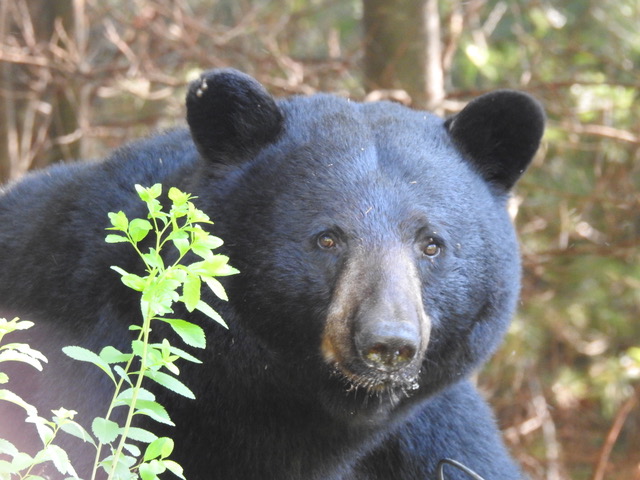
As an eco feminist I am deeply concerned with the loss of the animals I love. One of these is the Black bear whose visits are becoming more and more scarce as the forest around me disappears. The bear in this poem is unlike the bears I used to know in that he is terrified of me. When I first fell in love with bears it was because they embodied the soul and body of the Great Mother in a way that was meaningful to me. It is no accident that Black bears were honored as great healers by Indigenous peoples around the globe. The first images of them appeared on cave walls approximately 50,000 years ago.
Visionary Night
A furry shadow – ever dimming vision – did I imagine him? The woods are needled – Bare twigs stick out, pine spears behind Her. Mother Tree – She who sheltered his kin. He thinks rough elephantine arms will provide protection from his greatest threat – human supremacy. I cry out in desperation: “I am not one of them”. (this woman who loves bears)
I was recently asked how I reconcile being a Christian with also being a critic of Christian theology, traditions, and culture. I am asked this often and my answer is always the same. I have not found reconciliation and might always be finding a way to reconcile this – an endless cycle of trying to make my heart fit into a structure in which centers whiteness and domination.
This time is different though. When I was asked my mind immediately returned to the Earth. Nature. Creation. How I have always longed for a plot of sacred Earth of my own in which I would continually give birth to and create life in various ways. How so far this dream has seemed from my brown fingertips. Never in my almost twenty-nine years, have I imagined I would have the opportunity to own my own land. However, in the last few years since I worked and lived on a farm and have been manifesting with lunar energy and ritual that one day I would harvest and care for a land of my own. A land that I would pass down to my children. A land in which we would find God. A land which would sustain us.
This blogpost is about biblical verses and uncovering the magic and spirit behind its words. Why, you might ask, is this a project that belongs on a blog dedicated to feminism?
I believe it does because it helps us to strip away the many layers of patriarchy with its attempts to hide and/or change original teachings. Remember; these stories were originally oral wisdom teachings of the “folk.” They weren’t written down until the Babylonian exile, hundreds if not thousands of years removed from their origins. And who was doing the writing? Priests, scribes, and prophets, all with their own agenda. Even the earliest writings we have, the Dead Sea Scrolls, were still written in patriarchal times.
May you witness a growing trust in the guidance around you. May you allow magic to find you where you are.
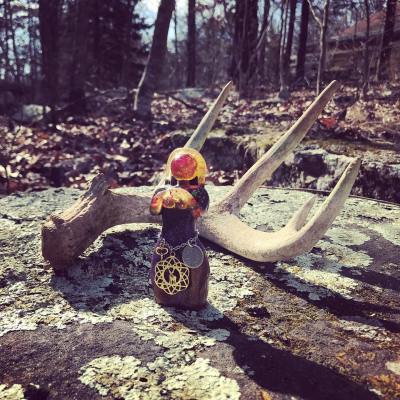
Seven years ago, I did a drum-guided meditation in which I journeyed deep into the forest. On my head as I walked, antlers grew, curving above me. As I followed the sound of drums and the glimmer of firelight, I kept raising my hand to check to see if they were still there, firm beneath my hand. I reached the fire and met the Goddess there, she reached up and took the antlers off my head and cast them into the flames, where they twisted and glowed until they became a golden ring, which she removed and placed on my finger, antlers now wrapped around my index finger. In waking life, I scoured etsy and two years later located a bronze antler ring extremely similar to my vision, which I bought and placed on my own finger in the woods as a symbol of my earth based path, my priestess vows, and some kind of unspoken dedication, felt within but not able to be fully verbalized at the time.





 Feminism and Religion