Mountain Mother, I Hear You Calling by Carol P. Christ

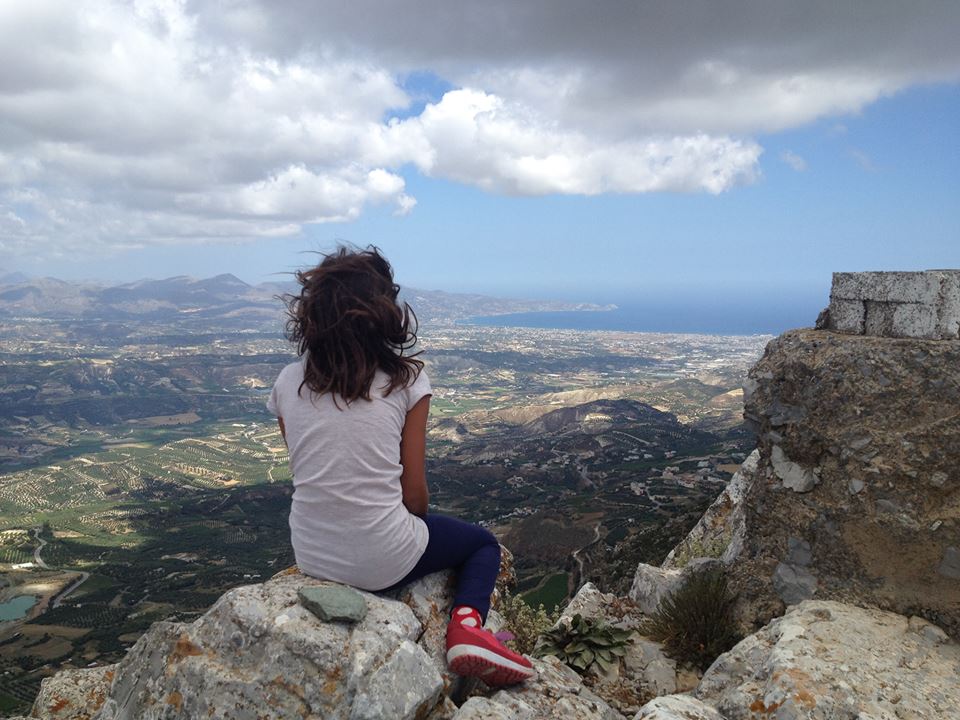
carol christThe mountaintop shrines of Mount Juctas in Archanes, Crete are situated on twin peaks, which may have symbolized breasts. Ancient shrines on the northern peak date from 2200 BCE until at least the end of the Ariadnian (Minoan) period in 1450 BCE. A crevice in the rock was filled with offerings of pottery, clay images of women and men in ritual dress, diseased bodies and body parts, sheep and cattle, and other objects. Excavations to a depth of 13 meters did not reach the bottom layers. Many offerings had been burned, suggesting that the objects were first thrown into fire and then dropped into the crevice. People who climbed the mountain for the festivals would have spilled over both peaks and there may have been shrines as well as fires on both of them.

Goddess Pilgrim on Mount Juctas

With lack of imagination, archaeologists often write that worship in mountaintop shrines in Crete began when the king ascended the mountain to survey his realm. This ignores the fact that people are like goats and will climb anything if they can. Bones provide evidence of domesticated sheep, goats, and cattle in Crete long before there were kings. Surely shepherds climbed Mount Juctas before any kings did.

The idea that mountains are for kings also ignores the fact that there are no kings in Crete today, no realms to be surveyed, and yet the people of Archanes still ascend the mountain for the summer festival known as the Transfiguration of Christ on August 5th and 6th. A church called Afendis Christos or Christ the Lord on the southern peak of Juctas is the destination of current pilgrims. Today the uneven dirt road recently cut into the mountain is clogged with cars (only) during the festival. Continue reading “Mountain Mother, I Hear You Calling by Carol P. Christ”

The Outraged Ancestral Mother by Molly


crop027During the fifth week of the Rise Up and Call Her Name curriculum by Elizabeth Fisher, “We honor the Outraged Ancestral Mother and the belief that the sacred and secular are one.” When I priestessed this session for my women’s circle, I was caught by the idea of the Outraged Ancestral Mother and we spent some time discussing her and the degree to which humanity has hurt our planet. The next morning while I was practicing yoga, snippets of a poem came floating to my mind. I had the distinct feeling that the Outraged Ancestral Mother was ready to speak to me. I went down to the woods to listen to what she had to say.

Continue reading “The Outraged Ancestral Mother by Molly”

Redefining Spirituality, One Church for All by Andreea Nica

Andreea Nica, pentecostalismAs a former lover of Christ and ex-Pentecostalist, I had countless visions and dreams that one day I would be a spiritual leader. While growing up in the charismatic church, it was even prophesied that one day I would become one.

Nearly ten years after leaving the church, I carried a distrust in religion’s relationship with women and its barrier to free thought. My work as a freelance journalist led me to discover a spiritual women’s retreat held in North Bend, Washington. Inspired to experience a non-religious, spiritual gathering, I registered for the retreat held by Center for Spiritual Living (CSL) in Seattle.

CSL is described as a:

“Trans-denominational, inter-generational, not-your-usual church, that was started in 1921. A safe place for ‘the rest of us’ who are looking to connect with God/Higher Power/Universal Presence, but don’t really fit in with any one religion.”

The spiritual center’s core teaching philosophy derives from “Science of Mind” or Religious Science, a New Thought spiritual, philosophical, and metaphysical movement founded by practical mystic Ernest Holmes. The spiritual principles rely on the laws of physical science in establishing its core beliefs. Continue reading “Redefining Spirituality, One Church for All by Andreea Nica”

A Tiny Life by Barbara Ardinger

Barbara Ardinger

The news is getting me down. Nearly three hundred Nigerian schoolgirls kidnapped by Boku Haram. The capsized South Korean ferry and more than 300 drowned students. Kids taking guns to school and the governor of Georgia signing a law that says anyone can carry a gun almost anywhere in the state. The ever-continuing feminization of poverty. A couple Saturdays ago, I heard an enormous noise of cawing and shrieking and wings flapping outside my window. It went on for several minutes, so I finally set my book aside (I was trying to ignore Eyewitless News), got up, and looked out into the courtyard. Two huge, noisy crows were chasing a smaller bird. I think it might have been a scrub jay. I have no idea what the jay’s crime had been in the crows’ eyes, but they were chasing it back and forth, up and down, and one of them finally speared it with its beak. The jay fell. The crows landed on the roof of the building across the courtyard and strutted back and forth for several minutes. One of them went down for a closer look at the fallen jay. Then they flew away.

I’ve seen crows attacking other birds before. They’re extremely intelligent birds, but they also get aggressive. Some years ago, I sat at a desk in an office, gazing out the window, and saw a crow destroy a hummingbird’s nest and eat the babies. Sad, yes, but this is how crows around the world find food. My coworkers wanted to storm outside immediately and (I guess) shoot the crow and maybe tear the little tree out of the ground. “No,” I said. “Leave it alone. Tennyson was right when he wrote that nature is bloody.” Continue reading “A Tiny Life by Barbara Ardinger”

Reincarnation – A Belief Found Worldwide by Judith Shaw

judith Shaw photo

Reincarnation is a spiritual belief that our souls are reborn many times to this physical Earth plane. These many lives give us the opportunity to experience a variety of circumstances and create karma, the law of cause and effect. Through these experiences one grows, until ultimately one’s soul reaches a level in which it transcends to another dimension. Once in these other dimensions our souls continue their evolution toward oneness with Source.

I have always believed in reincarnation myself and have explored the idea in various paintings. This painting, Many Lives, illustrates that belief. The far left figure is my present self and the other figures represent selves I might have been in past lives. But the concept of reincarnation is not as ancient as I thought it was.

Many Lives, painting by Judith Shaw

It is difficult to known exact beliefs of peoples who lived before written history began but some scholars feel that ancient cultures who practiced shamanistic Earth-based religions had a concept of reincarnation. But other scholars believe that these tribes taught only of the preexistence of the soul before birth or its independent survival after death in an Otherworld. Continue reading “Reincarnation – A Belief Found Worldwide by Judith Shaw”

A Love Poem for My Mother, On Earth Day by Candice Rose Valenzuela

Candice Rose Valenzuela teaches English Literature at Castlemont High School in East Oakland, California, and she has been teaching and organizing inner-city youth for the past eight years. She is currently pursuing a Masters in East-West Psychology at the California Institute for Integral Studies, and desires to bring indigenous healing methodologies into teaching and learning in the inner-city.

I wrote this poem in observance of Earth Day, April 22nd 2014, and it was inspired by the work of Audre Lorde, Starhawk and Christine Hoff Kraemer in their discussion of the powerful erotic pulse underpinning our connection with ourselves and with all beings on Earth. 

as a child, i spent a lot of time wondering what love is.
and this was because

expressions of it around me were unclear, inconsistent, fleeting or unnamed

but mostly because no one

could teach me to see

what they themselves were blind to.

this is for my Mother. To let her know I see.

Continue reading “A Love Poem for My Mother, On Earth Day by Candice Rose Valenzuela”

A Beltane Story by Barbara Ardinger

Barbara ArdingerOnce upon a time there was a beautiful princess—NO, stop right there. Tales like this do not require princesses. Let’s try again. Once upon a time there was a sturdy young woman who lived in a small town in Mitteleuropa not too far from the castle of the Holy Roman Emperor.

The girl’s name is Madchen. Her parents are a Farmer and a Cunning Woman. She is proud to say that just last fall she actually saw the Emperor, who is a stiff, elderly man who always wears a fussed-up military uniform and a pince nez and has enormous sidewhiskers. The Emperor did not, of course, notice the girl as he sat in his carriage and waved stiffly to his subjects. But what Madchen doesn’t know is that Crown Prince Rufus, whose uniform and sidewhiskers are considerably more modest than his father’s and who was riding on a great red Royal coachstallion in the parade behind his father’s coach, noticed her immediately. That girl, he said to himself, is a girl I must have! Continue reading “A Beltane Story by Barbara Ardinger”

THE DIVINE DRAMA AND THE UNIVERSALITY OF DEATH by Carol P. Christ

carol christIn Greece the liturgies of lent and especially of the week before Easter are known as the “divine drama,” in Greek theodrama.  This may refer to the “drama” of the capture, crucifixion, and resurrection of Jesus and to the suffering of God the Father and Mary.

However, it is important to recall that the drama in ancient Greece referred to both the tragedies and comedies, most specifically, those that were performed in the theater of Dionysios in Athens.  While we have been taught that the Greek tragedies celebrated “downfall of the hero” due to his “tragic flaw,” it is important to remember that Dionysios was the original protagonist of the Greek tragedy: it was his death and rebirth that was first celebrated.

Some have argued that the Greek tragedies should never be “read” alone, for they were always “performed” in tandem with the comedies, which were followed by the bawdy phallic humor of the satyr plays.  The tragedies end in death and irreparable loss.  But if the comedies and satyr plays are considered an integral part of the cycle, death is followed by the resurgence of life. Continue reading “THE DIVINE DRAMA AND THE UNIVERSALITY OF DEATH by Carol P. Christ”

Resurrection Garden, Resurrection Feast by Elizabeth Cunningham

Elizabeth Cunningham headshot jpegIn John’s account of the Resurrection, Mary Magdalen mistakes Jesus for the gardener.  Or perhaps it is not a mistake or not just a mistake but also a poetic truth. In any event, John’s Gospel makes clear:  the Resurrection takes place in a garden!

(For the feminist significance of horticulture, I refer you to Carol Christ’s recent post on this site: Women and Weeding, the first 10,000 years .)

Many  prominent (male) theologians, historians, anthropologists, and psychoanalysts among them James Frazer, Jung, and C.S. Lewis made the case for and/or against (in Lewis’ case) Jesus being another dying rising god of vegetation with Christianity borrowing imagery and ritual from earlier or even contemporary cults. The argument against insists that Jesus’s life, death and resurrection is historical, redemptive, and unique.  From a tour of Bloglandia, the debate pro and con appears to continue unabated.  I say better to pull weeds (if you are lucky enough to have a garden) than pontificate. Continue reading “Resurrection Garden, Resurrection Feast by Elizabeth Cunningham”

TWO TORTOISES IN THE WEB OF LIFE by Carol P. Christ

carol-christThe Gods made only one creature like them—man.  Greek TV documentary

The sight of a reptile or an amphibian usually provokes, at the very least, a feeling of repulsion in most people. Natural History of Lesbos

In the past days and weeks the two tortoises with whom I share my garden have woken up from a long winter’s sleep.  Henry, testudo marginata, has been up for a while now.  More than a month ago when I was cutting back and weeding in the area of the garden where he had been sleeping, Henry roused himself to sit in the sun near me for a few hours each day before creeping back under a shrub.  At first I thought I had disturbed him, but when he came back out day after day while I worked, I began to wonder if he was coming out to say hello.

KONICA MINOLTA DIGITAL CAMERAScotty, testudo graeca, was nowhere to be found.  As I moved my work around the garden, I did not find him in the corner where he had slept the previous winter.  This worried me slightly, but I figured he must be under the rue in the one area of the garden still to be trimmed back.  Imagine my surprise when I almost tripped on him on my way down the stairs to the cellar.  Clever boy, he must have found the garden entrance to the cellar open one day in early winter and slipped in.  The fact that I found him at the foot of the stairs and not in a dark corner was evidence that he too had heard the call of spring.

What we love we protect and what we know we love.  Natural History of Lesbos Continue reading “TWO TORTOISES IN THE WEB OF LIFE by Carol P. Christ”