Learning Compassion from Inmate Number 74799 by Cynthia Garrity-Bond

Technically I was employed as a lab assistant at our community hospital. This position entailed multiple responsibilities, from receptionist to actual bench work within the laboratory. The task I dreaded most was my assistance at autopsies. Beyond a strong constitution, it required no measurable skill set. This job was not the high-tech, immaculate setting of any of the CSI programs of today; instead the morgue was a stark, condensed room with two pullout refrigerators for the deceased, a stainless steel table the autopsy was performed on, and the necessary instruments and accouterments, some suspended from what appeared thin air. These tools of the trade ranged from the expected scalpels and retractors to saws and garden-like shears.

Fast-forward fifteen years. It is the morning of July 11, 1991. Prisoner number 74799 has just been transferred from the Department of Corrections, Arizona State Prison in Florence to Tucson County General Hospital in critical condition. Eight months prior to his admittance to the prison hospital, Prisoner 74799 was diagnosed with metastatic lung cancer. While considered inoperable, he was administered the customary chemotherapy treatments until four months later when the cancer spread to his brain, taking most if not all of his cognitive abilities away. Within one hour of his transport, Prisoner 74799, my brother, Michael Paul, died at the age of thirty-nine.

Continue reading “Learning Compassion from Inmate Number 74799 by Cynthia Garrity-Bond”

Beginning Conversations about the Body at Ease by Stephanie Arel

A topic that continually perplexes me, both personally and professionally, concerns the connection, or harmonization if you will, between our cognitive capacities and our physical expression and comfort, between thinking and feeling. Yoga, dance, working out, meditating, and other modalities which explicitly bring body and mind together often achieve their goal at the point of practice, and while these disciplines have residual effects, how do they have staying power?

For instance, how do we maintain rootedness in the body when we are caught off guard – for instance, by traumatic affect? When we are faced with information about reality that disturbs us – the truth about a relationship or a physical illness – how do we stay physically present? Or when we (I) spend an inordinate amount of time immersed in activities that are essentially not embodied despite the efforts at theorizing such embodiment – reading, researching and writing – what happens to the body?

Sustaining a mind/body (and spirit) connection is a little tricky. Some psychologists would call this connection a kind of attunement (between a dyad) that fosters a form of affective regulation. This means that subjective experiences, correlating thoughts, physiological responses, and the bodily expressions these provoke come into alignment but not in the manner of repression or suppression, rather as a form of accord or modulation that brings us to our best adult selves and enables decision making that supports our most core self. Capable of achieving this? I think it’s an art. Continue reading “Beginning Conversations about the Body at Ease by Stephanie Arel”

Woman and Nature: Our Bodies Are Ourselves by Carol P. Christ

This earth is my sister; I love her daily grace, her silent daring, and how loved I am how we admire the strength in each other, all that we have suffered, all that we have lost, all that we know. We are stunned by this beauty, and I do not forget: what she is to me, what I am to her.

These words are from Susan Griffin’s Woman and Nature which I often recommend as one of my favorite books. Over the years I have read this passage and others from Woman and Nature aloud with my students, and we have always been moved, most  of us to tears. More recently these words have become the center of the “Morning Blessing” on the Goddess Pilgrimage to Crete.

In the epigraph to the book Griffin writes,

These words are written for those of us whose language is not heard, whose words have been stolen or erased, those robbed of language, who are called voiceless or mute, even the earthworms, even the shellfish and the sponges, for those of us who speak our own language . . .

Continue reading “Woman and Nature: Our Bodies Are Ourselves by Carol P. Christ”

How do you feel about me now? by Natalie Weaver

How do you feel about me now?

I was talking to an old friend the other day, and when I asked how he was, he said, “I’m getting by.”  “Getting by?  Not tearing it up, not taking ‘em down, and taking names?”  I joked. “No,” he replied too dryly, “not at my age.”

“Well, how old are you now?” I inquired playfully.  “Eighty-three,” he said.  “Oh,” I paused.  “And, I tell you, Nat,” he continued, “I don’t know about these last twenty years.  I just don’t know what happened to me.  Never imagined my life would turn out like this…” he spoke, trailing off.

His talk prompted me to wonder about the girl I once was, the woman I used to be, the mother I had imagined in myself at the outset, the scholar I prepared, the indefatigable friend I was to my peers as a teenager, the filial duty I felt in my youth, the honor I ascribed to my vocation as an educator, the family I tried to create.  I have changed too, I realized.  These last twenty years have been markedly transformational for me as well.  As I considered, I saw in all of the things I tried to do how my spirit and my faith walked alongside my life unfolding as companion and guide and interlocutor.

At each step along the way, my faith both informed and framed the meaning of my choices and my disposition toward the outcomes of my efforts.  For a long time, there was a harmony and an alignment between my meaning, my disposition, and my experience of living purposefully.  But then, sure as rain, the wheel turned, and I began to lose clarity on that alignment.  The idealism I had brought to each of my roles and endeavors was tested and tried as a matter of course.  But, in some instances, the trial was egregious.

I concluded that some disappointments run so deep they change who we are.  Some wounds are structural enough that they scar the tissue permanently and alter the curvature of our spines.  Some blows are so devastating that our speech transforms and our thinking must be rewired to survive.  Whether they are inflicted by the self or by others, whether by accident or intent or illness, injury has a common thread – it calls the Spirit to awaken and challenges it with the question: “How do you feel about me now?” Continue reading “How do you feel about me now? by Natalie Weaver”

A Mother’s Gifts by Dawn Morais Webster

Dawn Morais Webster, the Pope off to his summer palace, Castel Gandolfo. He tells the world he will now become just a “humble pilgrim.”Parvati is a gentle mother goddess. But as Kali, she also wields enormous power. The daughter of Himavan, the king of the Himalayas, consort of Lord Shiva, and mother of Ganesha, the Elephant-Headed Lord, Parvati is the embodiment of all the energy in the universe.  Her seat is on a lion or a tiger.  In the words of a hymn to this goddess, she is “the auspiciousness of all that is auspicious.”

Lakshmi, the consort of Sri Maha Vishnu is often depicted as a very beautiful woman, seated on a full-bloomed lotus, holding lotus buds in two of her hands, a pot of gold in the third. She is flanked by elephants, reflecting her royal status. Lakshmi, as the Goddess of Prosperity, is brilliant in red silk, gold and precious stones. She also offers peace and a sense of balance.

Mother’s Day provided good reason to remember these Hindu deities. They lent their names to the two cows who were milked daily to feed me in the first six months of my life in my grandparents’ home by the sea in Thiruvananthapuram—or Trivandrum, Kerala. I wrote those foreign place names for decades in application letters and immigration forms but it was more than five decades before I first returned to the place where I was born. Continue reading “A Mother’s Gifts by Dawn Morais Webster”

Sexuality and Spirituality: Convergence or Alienation? by Stephanie Arel

stephanie-arelI just finished reading for review The Bloomsbury Reader in Religion, Gender, and Sexualityedited by Donald L. Boisvert and Carly Daniel-Hughes. Targeting an undergraduate audience, the text explores ways that religion, gender, and sexuality intersect and interact in a variety of religious traditions.

The book’s essays traverse a wide sampling of religious inheritance including indigenous traditions, Christianity, Judaism, Islam, and various Asian religions. The topics examined range from the culture of male love in Japanese Buddhism to various themes of love in Haitian Voodoo, from sexual desire in Beguine communities to Gandhi’s experiments in sexual chastity, and from the passion of St. Pelagius to the transgender performance characteristic of the Hijra identity in India. Among other things, the book offers a wide array of interpretations regarding how sexuality emerges in particular traditions and contexts. One is left with a feeling that nearly anything goes depending on which set of rules or religious mores a particular group of people follow. The variations presented in each chapter related to the interpretation of sexuality’s embeddedness in spiritual expression problematize the notion of the “normal” emerging in sexual desire and expression. Continue reading “Sexuality and Spirituality: Convergence or Alienation? by Stephanie Arel”

Writing Through the Body: Betty Smith’s A TREE GROWS IN BROOKLYN by Joyce Zonana

 TreeGrowsInBrooklynIn her 1975 manifesto, “The Laugh of the Medusa,” French feminist Hélène Cixous urges women to write: “Writing is for you, you are for you; your body is yours, take it. . . . Women must write through their bodies, they must invent the impregnable language that will wreck partitions, classes, and rhetorics, regulations and codes . . .”

“The Laugh of the Medusa” remains a thrilling essay, challenging and inspiring women to “return to the body” and to language.  “Woman must write woman,” Cixous insists, “for, with a few rare exceptions there has not yet been any writing that inscribes femininity.”

Although Cixous may not have been aware of it, Betty Smith’s beloved, perennially popular 1943 novel, A Tree Grows in Brooklyn is one of those “rare exceptions” that “inscribes femininity” in precisely the way she advocates. This autobiographical novel, so often dismissed as sentimental or as a children’s book, is actually written through the female body—which may explain its lasting popularity and power. Continue reading “Writing Through the Body: Betty Smith’s A TREE GROWS IN BROOKLYN by Joyce Zonana”

Feeling the Earth Move by Carol P. Christ

carol-p-christ-photo-michael-bakasMagnitude 5.2 earthquake Feb 6, 5:51 AM I awake to the sound of the windows and shutters rattling and the bed moving up and down beneath me for a few seconds.

Magnitude 5.4 earthquake Feb 6, 12:58 PM This is the first time I can remember two big earthquakes coming so close together.

Magnitude 4.9 earthquake Feb 6, 1:45 PM A friend calls to ask if I think the earthquakes are building up. “The big ones are rare” I say.

The first seismologist to weigh in assures us there is nothing to worry about, as this new series of quakes is not on a major fault.

Magnitude 5.1 Tuesday Feb 7, 2:24 Shake, rattle, and roll.

Magnitude 4.5 Tuesday Feb 7, 5:15 Awakened.

Magnitude 4.6 earthquake Feb 7, 21:35 PM Another jolt.

Magnitude 4.3 earthquake Feb 8, 12:53 AM The bed shaking and the windows rattling.

Magnitude 4.9 earthquake Feb 8, 3:38 AM Awakening again, feels bigger this time.

A second seismologist warns that the series of quakes could be building up to a big one like the 6.6 quake that caused significant damage to the island in 1865.

I become uneasy. My friend decides to move temporarily to a hotel at the other end of the island, farther away from the epicenter.

Magnitude 3.5 Feb 8, 15:31 I wonder if I should leave the village too.

I decide to sleep in my study, fearing the ceiling fan above my bed could fall on me.

Magnitude 3.6 Feb 9, 12:37 AM The couch makes less noise than the bed.

Magnitude. 4.0 Feb 9, 10:13 AM Louder than the one in the night.

Magnitude 3.6 Feb 9, 15:01 PM  Not as big as the last one.

I sleep in my study a second night. No quakes.

In the morning I move my blankets and pillows back to the bed.

Magnitude 4.5 earthquake Feb 10, 10:55 AM. The house shakes.

Magnitude 4.3 Feb 10, 12:27 PM A sharp jolt gives me a slight whiplash.

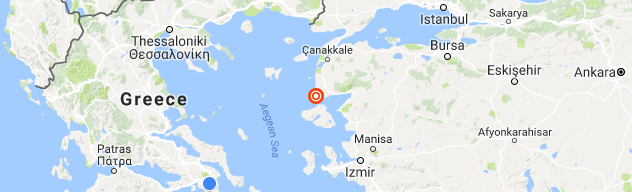
earthquake-map

Mithimna (also known as Molivos), Lesbos, where I live is at the top of the triangle that is Lesbos, about 11 miles from the epicenter of the earthquakes. Besides the larger quakes, there have been one or two smaller ones just about every hour during the past week.

There have been no major quakes for more than twenty-four hours. Is it over?

In the long run, it is not. The Anatolian fault runs from below Istanbul to just above Lesbos and out into the Aegean Sea. The Anatolian plate is being pushed westward by the Arabian plate and northward by the African plate. The Anatolian plate is being prevented by moving northward by the European plate. Many years from now the African plate will collide with the European plate and there will be no Mediterranean Sea.

The movement of the earth’s plates is a result of its molten core. “The planetary community has long accepted that as the Earth lost its internal heat, it would eventually settle into a quiescent stagnant state much like Mars.”

Like it or not, uncertainty and instability in the ground under our feet is part of what makes ours a living planet. This is the literal truth. Is it also a metaphor for our lives?

Update: After a quiet day on Saturday we had a 4.8 at midnight and a 5.2 at about 4 in the afternoon. 3.7, 3.6, and 3.5 on Sunday night and early Monday morning, rounding out a full week of tremors. NO it is not over.

(Note: Though there are cracks in the plaster in many of our buildings, including in my house, there has been no significant damage at this time.)

***

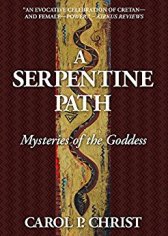
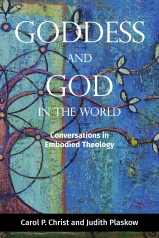
a-serpentine-path-amazon-coverGoddess and God in the World final cover designBe among the first to order A Serpentine Path, Carol’s moving memoir. Carol’s new book written with Judith Plaskow is Goddess and God in the World: Conversations in Embodied Theology.

Carol wrote the first Goddess feminist theology, Rebirth of the Goddess and with Judith Plaskow co-edited the path-breaking Womanspirit Rising and Weaving the Visions.

Join the spring Goddess Pilgrimage to Crete by Feb 15. Save $200.


A Serpentine Path: The Dance Is About To Begin by Carol P. Christ

carol-p-christ-photo-michael-bakasEntering the archaeological site of Kato Zakros, which includes a Sacred Center and part of a town on a small hill above it, I felt too tired to continue with the others. As we passed a stone bench to the north and west of the open court, I lay down and closed my eyes. I don’t know if I actually slept, but when I opened my eyes, I was in a trance.

I could see the air vibrating, and as I looked up the hill, I could almost see women walking up and down the stepped paths. My eyes were fixed on the path where women I could not quite see with my eyes went about their daily tasks. After a while Cathleen joined me. “I don’t want to talk,” I said, “but if you sit quietly beside me, you will see women walking in the village. She sat down and said nothing, but smiled broadly and nodded when I asked her if she could see what I saw.

After a while, I moved and sat facing the Central Court. I could still see the vibrations of the air, and as I looked across the court, I felt a sense of anticipation. “The dance is about to begin,” I told Cathleen when she joined me a few minutes later. She nodded. It was an hour before sunset, and the ancient stones were bathed in the last light of day. Jana and Patricia were talking in the central shrine room, while the others leaned over the ancient cistern watching turtles and turtle babies dive into the water and emerge again. “The dance is about to begin,” I said again.

kato-zakros-central-court

Cathleen exclaimed, “I see the path of the dance rising up in the court. It looks like the Processional Paths we saw at Knossos, Phaistos, and Malia. Do you see it?” Though I did not “see” it, I was moved to the court, where I could “feel” it. I raised my arms, bent at the elbows, and slowly wove my way back and forth across the court, following a snakelike path I could feel with my feet. As I neared the center of the court, I almost lost my footing. Turning to face Cathleen, I gazed at her solemnly, sending energy through my palms. Cathleen raised her arms in greeting. I turned again, continuing to trace the snakelike path, back and forth, across the court. When I reached the south end of the court, I turned again to greet Cathleen and Robin who was sitting next to her. “The path you followed was exactly the path I saw,” Cathleen cried out with astonishment. “You were meant to stop at the center.” “It was an ancient path,” I said solemnly. 

Jana and Patricia, who must have been watching, entered from the northwest entrance to the court. Jana was leading, arms upraised, tracing another path, walking with the same slow rhythm in which I had been led. I turned and slowly walked towards Jana until I could sense the energy flowing between our palms, then we softly touched our upraised hands. Carol, Patricia, Cathleen, and Robin formed a circle around us, and stood, arms upraised one in each of the four directions. Sensing that we were meant to share the blessing with the others, Jana and I turned, walking slowly towards the women standing in the north and south, feeling the energy, then touching their palms. Back to the center, we turned to the east and the west, completing the ceremony. As we turned to face each other again, I whispered to Jana, “We were called to this dance. It was an initiation.”

. . .

[A few days later] thinking of the snakelike path I had traced on the ancient stones, my eyes fixed on the gold snake bracelet on my right arm. I reviewed the many meanings the symbol of the snake held in ancient cultures. Goddess temples were used for storing grain, the harvest returned to She who presided over it. Snakes were guardians of the temples, eating the mice and rats that came to take the grain. The coiled snake and the snake biting its tail are symbols of wholeness. Snakes shedding their skins are images of rebirth and regeneration. Snakes hibernate under the earth and are reborn. But there was more: the rhythm of the snake in movement. I picked up a pen and wrote: “a serpentine path.”

These words described our initiation in the dance at Zakros: the serpentine path is the path of life, a snakelike, meandering path, winding in and out, up and down, with no beginning and no end, into the darkness, into the light. There is no goal, only the journey.

A cycle was coming to completion in my life. Through hard work and amazing grace, I found my way back to the Goddess, to myself. The mystery that was revealed to me as my mother died was unfolding in my life. Love had never abandoned me and never would. The Goddess would be with me at every turn in the path, and in that knowledge. I could give up control and open myself to life.

***

a-serpentine-path-amazon-coverThis is an excerpt from A Serpentine Path, Carol P. Christ’s newly released, moving memoir of transformation. Order it now in paperback or on Kindle. Carol’s other new book written with Judith Plaskow is Goddess and God in the World: Conversations in Embodied Theology. Carol also wrote the first Goddess feminist theology, Rebirth of the Goddess.

Join Carol on a Goddess Pilgrimage to Crete in 2017. Save $200.

Read two more the chapters in the book: Mysteries and Dionysian Rites.

Thanks to Judith Shaw for the cover art “Downward Serpent.”

If the paperback is unavailable on Amazon, you can order it from Barnes and Noble.

 

As It Might Have Been: Ancestor Stories in the Dreamtime by Carol P. Christ

carol-p-christ-photo-michael-bakasIn the middle of the night in waking sleep, I asked my great-great grandmother Annie Corliss to tell me the story of how she met and married James Inglis. This story came through me in a place I have come to call the Dreamtime. The Aboriginal term feels right. As I understand it, this is not a place where the dead speak to the living but rather a space where boundaries blur as the ancestors speak in us.

Annie Corliss’s Story: As It Might Have Been

My mother decided to come to America after my father died. My brother Hudson was 7 and my brother Hugh was a baby. I was 13. Mother had a little money, and she said we would have a better life in America. We left Ireland on a boat that took us to Liverpool. There we boarded the big ship Continent that took us to America. The trip took about 6 weeks. While we were at sea, first Hudson, and then Hugh died. Their bodies were wrapped in the blankets that had covered them in the filthy cabins on the ship. The priest said a few words of blessing, and they were dumped into the cold angry sea. Every day, another body was thrown overboard, sometimes two. So much grief, so many tears in the night. After Hudson died, Mother wouldn’t let go of Hugh, so afraid was she of losing him. After he died, she would not stop crying. I kept telling her she still had me. She didn’t care anymore. “America is cursed,” she kept repeating. (1) Continue reading “As It Might Have Been: Ancestor Stories in the Dreamtime by Carol P. Christ”