Even though Jesus was born during the reign of Augustus, first Roman emperor, the empire didn’t celebrate that birth until three centuries later when his birth date was moved to mid-winter to match the birth date of the sun god Mithra. The Romans already had a long tradition of celebrating the winter solstice. This celebration was called the Saturnalia. Here are three days in December, taken from my daybook, Pagan Every Day. (When I wrote this book in 2003, I wrote longer days. The publisher demanded that I reduce every day to 300 words. I edited them all down to 301 words.)
December 17: Saturnalia begins
Saturn, who was conflated with the Greek Titan, Cronus, was an ancient Latin agricultural god whose name may derive from satur, “stuffed,” or sator, “a sower”; in either case he stands for abundance. He was a working god who oversaw viniculture and farming, the king of Italy during the golden age. When Jupiter conquered him, he hid himself (latuit) in the region that came to be called Latium. The Romans said Saturn’s body lay beneath the Capitol in Rome. Because his reign brought prosperity to the city, the state treasury and the standards of the Roman legions were kept in his temple when the army was at home. Saturn’s statue was bound in woolen strips to keep him from leaving Rome.
This is a time of increased vulnerability for many minority populations in the United States: people of color, immigrants, LGBT people, native peoples. The policies and rhetoric of the current administration have left all these groups exposed to hostility. Women are also feeling the pressure, as the gender split in voting in the past election suggests. And, Jews also are facing increased visibility. In addition to the murders in Pittsburgh, anti-Semitic incidents around the country have increased in the last few years. All this has me thinking about visibility, chosen and unchosen.
My father, an Ashkenazi Jew with curly black hair, green eyes and dark skin, came from an immigrant family that arrived here in the early 20th century from the region of Poland known as Galicia. His mother in particular valued assimilation into American identity, and prized blond hair as a sign of this identity– she in fact later dyed her black hair blond. His aunt had blond hair and it was considered a family coup. (There’s much to say here about developing an assumed American identity of whiteness, as well as the presumption of Christianity.) When I was a little girl, I had blond hair and blue eyes. My father used to call me his blond-haired, blue-eyed girl.
Trigger warning: rape, sexual assault, domestic abuse, graphic sexual content
In Part 1 of this story, I introduced a discussion of Johan Galtung’s theory of cultural violence as it relates to my experience as a young woman in an abusive relationship. To recap:
Cultural violence is: “…any aspect of a culture that can be used to legitimize violence in its direct or structural form. Symbolic violence built into a culture does not kill or maim like direct violence or the violence built into the structure. However, it is used to legitimize either or both.”
Cultural violence against women is: Normalization and promotion of pornography, prostitution, degradation, and sexual objectification of females in media, predominantly male language in civic, business, and religious institutions, gender roles and stereotypes, misogynist humor, gaslighting, minimizing or denying any of these forms of violence.
It is October, the veil is thin the year is waning the leaves are turning I am trying to say goodbye to my grandmother she is dying. I do not know what to say.
The leaves are red the sky is blue I saw a crow in the tree behind the house.
The threads of this year are becoming thinner.
The threads of her life too are becoming thinner
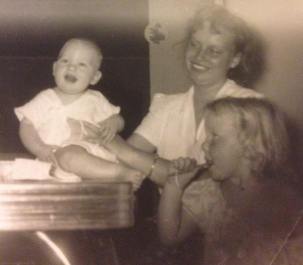
What do I say to the one who breathed life into my father who wove his cells into being who cradled him as a baby who wept into his hair.
Twyla with my dad, Tom, in 1953.
Carrying the cells
of the generations The chain of life
continuing to spiral through time, and place,
and distance and falling leaves.
What do I say as life thins, as breath fades
What do I say when all that remains is the space between us
What do I say
when I catch a glimpse of the swift unraveling of time the wrinkles in eternity
What do I say
as time folds in on itself and now it is me in the bed and my son, gray-haired, blue-eyed is reading to me in a quiet voice
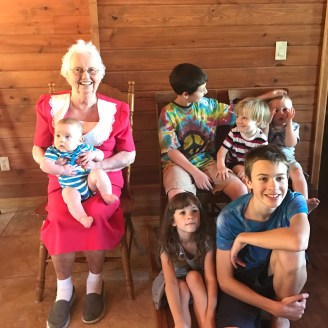
Grandma Johnson with her great-grandchildren in April, 2017.
as the chapter comes to a close.
Part 2: The Answer
That night, I dreamed of my grandmother she shrank to the size of a small child I picked her up and held her against my body We looked in the mirror cheek to cheek and smiled together I kissed her face and told her: “You are wonderful.” Then we danced around the room together her head against my shoulder I kissed her again on her white hair and no more words were needed.
Part 3: The Memorial
At this time last year, as the leaves fell and the wheel of the year dipped into darkness, my last grandparent died. I recognize that I am fortunate in having reached nearly forty while still having a living grandmother, but there is still such a sensation of finality and ending in saying goodbye to the final grandparent. Twyla was my paternal grandmother and I was not as close to her as I was to my maternal grandmother who died in 2013, but she is the woman who wove my father’s bones into being, and her death left a hole in our family and a sensation of an ended section in the tapestry of generations.
After the dream I write of above, I went back to see her a final time, five hours before she took her last breath. This time, I sat with her alone. I kissed her on her white hair and told her she was wonderful. I played her a song (Beyond the Gates by T. Thorn Coyle and Sharon Knight). I spoke to her of her good work in the world, that she had done it, that she’d finished her work, and that she had given so much and done so well. As a mother myself, the sensation of how powerful it is to have seen all your babies through to adulthood and into grandparenthood themselves filled the room. My dad, her second child and only son, has teenage grandchildren now himself. My grandmother’s youngest child of her five children is in her mid-fifties (and also a grandmother to teenagers). Sitting in the darkened room, listening to the song play, I was staggered by the magnitude of having seen each of your own children through their lives and into grandparenthood. While there are many ways to leave a legacy and it is not a “failure” by any means to not see all of your children into grandparenthood or to not have children yourself, what a gift it must be to bear witness to these generations if it does, in fact, unfold in that way, and to see your own tiniest baby have grandchildren of her own. This is something I hope to see for myself.
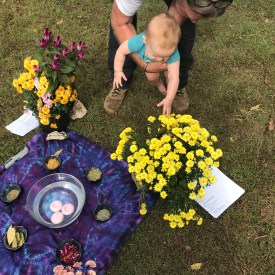
My dad holding his youngest grandchild at the memorial.
I then had the blessing, the honor, the privilege of being asked to prepare a memorial service for my grandmother. Five years ago, I was also asked to facilitate the memorial ceremony for my other grandmother. The unique, uncommon blessing of fulfilling this role for both of my grandmothers is not lost on me, as I know no one else who has had the experience of serving both sides of their family of origin in this way. I felt so honored to be trusted to help guide my family through both of these experiences of loss and grief. I spoke to my husband of how humbled, grateful, and fortunate I feel that I have a family who would let me do this, not just for one grandma, but for both of them, and he said, “you know, honey, maybe we should all be grateful to you that you’re willing to do this for us.” So, I received that recognition into my heart with appreciation as well.
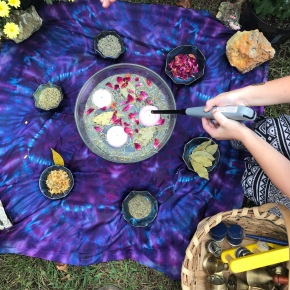
My daughter, then six, keeping the candles lit and tended on the altar space during the memorial.
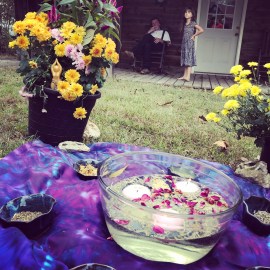
It is powerful to create ceremonies that acknowledge transitions within the life of your family. During this ceremony for my grandmother we each had time to speak of her, I had poems I had written, and readings to share. We had a centerpiece with flowers, floating candles, and photos of her, and we each held handfuls of herbs that we offered into the bowl of water as we shared our stories and memories. Each person took time to do so and spoke with care, tenderness, love, and laughter. Sharing this time and space together and creating a container for people to be heard in their grief and love rather than participating in the type of “canned” or impersonal memorial service that may be more commonly offered by religious groups, was what we needed to say goodbye to this woman who wove a part of our souls. My aunt said: this is the kind of send-off that everyone needs, and that felt very true and real.
My extended family is not pagan or liberal or alternatively religiously minded and as I planned the memorial I was conscious of not wanting it to be “too much” for them. As I typed my outline, I’d first included a song and other practices common to other rituals and retreats I lead and when I heard that my aunts and cousins were coming, I’d removed the song and some ritual elements, fearing making them uncomfortable. They then said they weren’t coming, so I added the singing back in. On the day of the memorial, they did in fact come, and I decided we would sing anyway, whether comfortable and familiar or not. We sang the same song to begin and to end the memorial (“We Are a Circle”) and when I looked around the circle the second time we sang and saw that everyone there holding hands, their faces wet with tears, were all singing too, I knew that it had worked.
If you have the opportunity to create ceremonies and rituals of personal meaning for your own family, please do it. It holds so much value, such life and power and love, in a way that is difficult to create by someone outside of the family. A small group of people who really care and who are willing to connect with each other in a meaningful, connected, vulnerable way, births so much real magic together. This container can be created by you, for you, and for the ones you love the most.
“Everyone can do the life-changing, world-renewing work of magic…the Dalai Lama said, ‘It’s not enough to pray and meditate; you must act if you want to see results.’ We are called to offer real service to others, to the Goddess. That service may take many forms: mopping the floor after the party, priestessing rituals, healing, planning, teaching, carrying the heavy cauldron from the car, sitting with a dying friend, writing up the minutes for a neighborhood meeting, organizing a protest to protect a sacred place from development, writing letters to Congress, training others in nonviolent civil disobedience, growing food, or changing the baby’s diapers. All of these can be life-changing, world-renewing acts of magic…”
—Starhawk and Valentine, The Twelve Wild Swans
There is a companion audio recording available about this memorial service preparation, the death of my grandmother, and about how to weave a strong “ritual basket” to carry a ceremony. The first part is an audio ritual for my online circle with thoughts about claiming your magic, fear of the label of witch, etc., so if you want to skip past that only to the memorial information and ritual theory, skip to 16:20 in the audio:
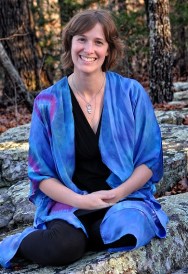
Molly has been “gathering the women” to circle, sing, celebrate, and share since 2008. She plans and facilitates women’s circles, seasonal retreats and rituals, mother-daughter circles, family ceremonies, and red tent circles in rural Missouri and teaches online courses in Red Tent facilitation and Practical Priestessing. She is a priestess who holds MSW, M.Div, and D.Min degrees and wrote her dissertation about contemporary priestessing in the U.S. Molly and her husband Mark co-create Story Goddesses, original goddess sculptures, ceremony kits, and jewelry at Brigid’s Grove. Molly is the author of Womanrunes, Earthprayer, and The Red Tent Resource Kit and she writes about thealogy, nature, practical priestessing, and the goddess at Patreon and at Brigid’s Grove.
In 1929, my grandmother wrote the word “HOME” in resounding letters across the bottom of a photo of a herself and my grandfather, smiling lovingly and confidently, with my infant mother propped in between them on a rattan chair.Within a few years the Great Depression stole that house, rendering them desolate and homeless, cutting a psychic wound so deep that it never healed.
I recently found the photo and thought of our family’s ancestors who, millennia ago in Old Europe, worshipped the Goddess in peaceful, egalitarian societies.Then and there, as in so many cultures outside modern western societies, “home” was a sacred place. As discovered by Marija Gimbutas and others, small statues of the Goddess were frequently found by the ovens inside family dwellings, and temples included rooms for both sanctuaries and workshops for making bread and weaving cloth. Houses and temples were extensions of one another.
My husband’s stepmother, Ginny, died last week. She lived several months past her 97th birthday. Here is her obituary.
Ginny shared her life with three husbands, outliving each one. Three sons were born from her first union. She then married John, my husband’s father, and warmly welcomed us (John’s family) into her life. When John died, Ginny married Fred. After Fred’s death, Ginny told me, “Of all my husbands, Fred was my favorite. He was fun.”
Ginny lived at the Brethren Village Retirement Community in Lancaster, Pennsylvania—a home with several levels of care—for over 30 years, moving there a few years after marrying my father-in-law. She said, “We made a good decision. I never wanted to be a financial burden on my children.” And she wasn’t.
Throughout her life, Ginny attended a fundamental, evangelical church. Had she been able to vote in the 2016 national election, she would no doubt have voted Republican. She had no use for feminism (women who rail against God’s ordained order), liberalism (the Devil’s message), homosexuality (perversion of God’s perfect creation) and immigrants (they siphon resources from hard-working Americans).
Yet, at the same time, Ginny was generous, giving to causes that fit with her ideological worldview such as missions. It was important to her that people come to understand the “truth” as seen through the prism of the theology she embraced. Within her community, she was loving, actively engaged, and caring, helping people in practical ways—donating food and other necessities to organizations sponsored by her church.
During a meditation before bed, I saw an image of a candelabra similar to what Jewish people use for Hanukkah. It was yellow/gold in color, engraved/etched onto a surface. All at once I saw the imagery of a star, a silhouette of a woman, and a beam of light move from the base of the candelabra through the top and beyond.
In these moments, I did not understand the significance of or the relationship between these images. What did a feminine figure have to do with the Jewish candelabra? What is the name of their candelabra? I could not even recall the name of it. It was something I grew up knowing the name of, as it was an image that I frequently saw beside the kinara of Kwanzaa in my school-aged years.
Because I was sheltered from the Abrahamic religions, my mother opted for participating in Kwanzaa as a means to shield me from any potential bullying from my classmates, and to celebrate a part of my diverse heritage. It was already a problem for my peers and the adult staff at school that I chose to identify as a Jamaican-American or a mixed person, as opposed to African-American. To tell a group of African-American Christians or those with an Afro-centric view that I didn’t celebrate Christmas or Kwanzaa, or that my mother taught me to listen to my dreams and intuition, would only serve as a means to further isolate myself; and by extension, my little sister. So celebrate Kwanzaa we did, until I began high school.
One of my Facebook friends—someone I’m quite fond of—posted the following remarks given by her pastor, Dr. Jim Somerville, First Baptist Church, Richmond, Virginia, to the congregation on July 15, 2018:
It was Thanksgiving 2016, and my brothers and I were headed toward a family reunion of sorts in Franklin, West Virginia, where my mother now lives. Four of us were carpooling together and one of us asked another one of us, ‘Can you please help me understand why you voted for Donald Trump?’ And we all listened. And my brother who was asked the question explained his position in a very clear way, in a very gentle way, in a very loving way, so that his brother could understand his reasons. And when he was finished he said, ‘Maybe you could tell me why you voted for Hillary Clinton?’ And my brother responded in the same gentle, kind, and loving way… Continue reading “Time to Stop Talking by Esther Nelson”
Why can’t social media be fun anymore? Why can’t we spread happy pictures of puppies, babies, and rainbows? While the answer may be simple to many of us, let me state it plainly to my relative: Because the world is on fire and we have a racist in the White House creating edicts that call for babies and children to be placed in ‘tender age’ facilities.
Don’t look away. I know how hard it is to say this but don’t look away. All of those images, recordings, and other horrific accounts of the deplorable, sickening, and unconstitutional events at the camps they have set up along the southern border need to be your fuel to take action, get fired up, and take back this country from those that would want to destroy everything we hold dear.
I’ve written a lot about how the 2016 election has impacted my family. If you want to catch up on any of those posts, you can click here: *A Letter to Those I’ve Lost *Happy Anniversary
I didn’t think I’d be writing a series about my family post-2016, but if I learned anything, it is that the personal is political, and sadly, things don’t seem to be getting any better. Continue reading “Don’t Look Away by John Erickson”


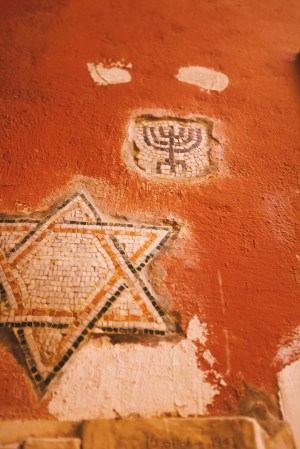
 This is a time of increased vulnerability for many minority populations in the United States: people of color, immigrants, LGBT people, native peoples. The policies and rhetoric of the current administration have left all these groups exposed to hostility. Women are also feeling the pressure, as the gender split in voting in the past election suggests. And, Jews also are facing increased visibility. In addition to the murders in Pittsburgh, anti-Semitic incidents around the country have increased in the last few years. All this has me thinking about visibility, chosen and unchosen.
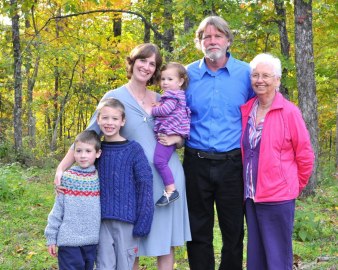
 comfortable and familiar or not. We sang the same song to begin and to end the memorial (“We Are a Circle”) and when I looked around the circle the second time we sang and saw that everyone there holding hands, their faces wet with tears, were all singing too, I knew that it had worked.
 ‘It’s not enough to pray and meditate; you must act if you want to see results.’ We are called to offer real service to others, to the Goddess. That service may take many forms: mopping the floor after the party, priestessing rituals, healing, planning, teaching, carrying the heavy cauldron from the car, sitting with a dying friend, writing up the minutes for a neighborhood meeting, organizing a protest to protect a sacred place from development, writing letters to Congress, training others in nonviolent civil disobedience, growing food, or changing the baby’s diapers. All of these can be life-changing, world-renewing acts of magic…”
 She plans and facilitates women’s circles, seasonal retreats and rituals, mother-daughter circles, family ceremonies, and red tent circles in rural Missouri and teaches online courses in
  In 1929, my grandmother wrote the word “HOME” in resounding letters across the bottom of a photo of a herself and my grandfather, smiling lovingly and confidently, with my infant mother propped in between them on a rattan chair.
 One of my Facebook friends—someone I’m quite fond of—posted the following remarks given by her pastor, Dr. Jim Somerville, First Baptist Church, Richmond, Virginia, to the congregation on July 15, 2018:
 Feminism and Religion