Temple Magdalen by Elizabeth Cunningham

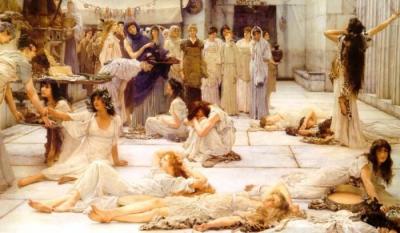
The Women of Amphissa, 1887, by Lawrence Alma-Tadema

Since I began writing for FAR in July 2012, I have written about Mary Magdalen, or excerpted a passage from one of my novels, near or on her July 22 Feast Day. For why I made the controversial choice to depict her as a prostitute, see last year’s post. The below excerpt is from The Passion of Mary Magdalen. I made this selection in remembrance of all the refugees in the world today. In this passage, Judith, a Jewish widow whose family was driven from the land by tax collectors, returns to the place where Maeve (my fictional Celtic Magdalen) and her friends have recently founded a Temple to Isis on the outskirts of Magdala. Maeve has just invited Judith to join them. (Edited for brevity.)

She stared at me, her eyes full of anger and longing.

“I will not be a slave and a whore where I was once a wife, the one who made the challah bread, who said the Sabbath prayers over it. This was our place, my husband’s and mine. We brought the best we had to the temple, the finest oil and wine, the unblemished kid—”

“Goats? You kept goats? You know how to make cheese?”

She sat quietly for a moment before she answered. “How can I live here with you?” she wondered. “I don’t understand.”
Continue reading “Temple Magdalen by Elizabeth Cunningham”

The Sanctuary of One Another by Molly Remer

53850207_2292227257656150_5800641319395131392_o“Please prepare me
to be a sanctuary.
Pure and holy
tried and true.
With thanksgiving
I’ll be a living
sanctuary
for you.”*

Beautiful Chorus (Hymns of Spirit)

In March, my husband drove our daughter into town to work at her Girl Scout cookie booth and released me to prepare for an all-day Red Tent retreat for my local women’s circle. After I packed my supplies for ritual, I set off on a walk in the deepening, rain-dark twilight. As I walked, I sang a song of sanctuary over and over, until I felt transported into a different type of consciousness, my feet steady on muddy gravel, the leafless branches stark against grey sky, moss and stones gleaming with sharp color against the roadside. A fallen tree absolutely carpeted with enchanting mushrooms caught my eye and invited me off the road and into its arms. As I stood there, feeling as if I had stepped out of ordinary reality and into a “backyard journey,” the spring peepers in the ephemeral pool in our field began their evening chorus. It has been so cold out with below freezing temperatures, snow, and ice for days since first hearing them in early March that I actually wondered if they would survive to continue their song.

Mercifully, though, it is not a silent spring. Continue reading “The Sanctuary of One Another by Molly Remer”

Exercising Women’s Religious Voice and Authority – Why is this Still an Issue? by Elise M. Edwards

elise-edwardsOver the past few days, I’ve been spending time at a church in Alexandria, Virginia conducting oral history interviews.  I’m doing research for a project about the arts and the church that has me diving deep into the church’s congregants’ and leaders’ experiences. Yesterday’s conversations offered insight about many theological topics that interest me, but what was particularly encouraging was what I witnessed concerning women in ministry.  That’s not what I was looking for, but it is what I needed to see.

Before beginning these interviews, I had already been thinking about the ways women’s authority and voice are often challenged.  This past weekend, I attended a regional religion conference where I assumed a leadership position and my voice was sought out for advice and insight.  I had great conversations with other women in academia about wellness and success while I was there.  Attending the conference provoked fond memories of a similar conference many years ago, when I connected with many colleagues in this FAR community and we discussed the theme of “Women and Authority.” Those were positive experiences.  But I had an unpleasant encounter, too, when I was on the receiving end of a male colleague’s condescending remarks.  I was also made aware of a disturbing incident in which a woman of color was publicly disrespected while speaking at a university event and subsequently trolled.  Those experiences triggered anger and deep sadness. To be honest, I also felt a sense of resignation and defeat.  Patriarchy is just so persistent.

Continue reading “Exercising Women’s Religious Voice and Authority – Why is this Still an Issue? by Elise M. Edwards”

The Lost Is Found by Carol P. Christ

Since I wrote “Claiming the Power to Choose to Our Lovers” and “Choosing to End Love” in the spring, my beloved and I came back together and parted again, not once, but twice.  At the end of the summer, believing our separation to be final, I decided to drop a miniature copy of the Minoan bee pendant, symbol of my desire to “let go of a beautiful dream,” into a crevice in the Skoteino Cave while on the Goddess Pilgrimage to Crete.

I don’t believe in divine intervention, but something happened to stop me. The day before the ritual, the pendant disappeared. It was not in my jewelry case, not in my handbag, not anywhere in my suitcase or my hotel room: it was nowhere to be found. That same day I received a gift of a large jar of honey from a local shopkeeper. In the end, I dropped a sugar-coated almond into the crevice and poured every bit of the honey onto the altar of the cave, asking for transformation and love. Continue reading “The Lost Is Found by Carol P. Christ”

Moving On by Carol P. Christ

Last year when I was newly in love, I found myself wondering if my boyfriend would ask me to move to Crete to be closer to him. Pondering this possibility, it suddenly dawned on me that I was ready to move on. I had been living in Lesbos for twenty years, and I never expected to leave such a stunning island. I have an incredibly beautiful home that I renovated at great emotional cost. Nonetheless, I had been mildly depressed for a number of years and seriously distressed for three.

I consider myself intelligent and charming and fun to be around. Though I am highly educated and involved in environmental work and politics, I can also talk about the weather, people, and television programs. Despite the diversity of my interests, I find myself isolated in my village.

I have many Greek friends, but we rarely socialize together. Greek men in my village still often go out with each other, leaving their wives at home. The women meet for coffee parties in the winter, but because Greeks are very family oriented, they rarely develop the kinds of close female friendships we cherish in North America.

In the summer when the days are long and lovely, most of the locals are working day and night in the tourist industry. In the winter, they rest and spend time with their families. Since the economic crisis that began in 2009, most Greeks cannot afford to go out on a regular basis. Continue reading “Moving On by Carol P. Christ”

I Was Brainwashed to Believe I Wasn’t Human. Now I’m on a Mission Against that Cult-Part 3

Trigger warning: rape, sexual assault, domestic abuse, graphic sexual content

In Part 1 of this story, I introduced a discussion of Johan Galtung’s theory of cultural violence as it relates to my experience as a young woman in an abusive relationship. To recap:

Cultural violence is: “…any aspect of a culture that can be used to legitimize violence in its direct or structural form. Symbolic violence built into a culture does not kill or maim like direct violence or the violence built into the structure. However, it is used to legitimize either or both.”

Cultural violence against women is: Normalization and promotion of pornography, prostitution, degradation, and sexual objectification of females in media, predominantly male language in civic, business, and religious institutions, gender roles and stereotypes, misogynist humor, gaslighting, minimizing or denying any of these forms of violence.

Continue reading “I Was Brainwashed to Believe I Wasn’t Human. Now I’m on a Mission Against that Cult-Part 3”

“First Blood” Celebration by Esther Nelson

This semester I’m teaching a course titled “The Abrahamic Traditions: Women and Society.”  Because I believe story is one of the best ways to understand a point of view, I use a novel or memoir to accompany each tradition. The novel I use in the Judaism unit is Anita Diamant’s, The Red Tent.

The Red Tent focuses on Dinah, Leah and Jacob’s daughter.  Early in the novel, the narrator says, “My name [Dinah] means nothing to you.  My memory is dust….The chain connecting mother to daughter was broken and the word passed to the keeping of men who had no way of knowing.”

The biblical account (Genesis 34) tells us that Shechem, King Hamor’s son, “seized her [Dinah] and lay with her by force.”  It also says that Shechem’s “soul was drawn to Dinah” and “he loved the girl,” and insisted that his father arrange things so Dinah could be his wife.  Nowhere in the biblical account do we hear Dinah’s voice. She’s portrayed as a victim and used as a bartering tool by Jacob and his sons in their attempt to gain power in the region.  Jacob and his sons required that Hamor and all the men within his kingdom be circumcised as a condition for the marriage between Dinah and Shechem.  King Hamor agreed, but on the third day after the men were circumcised and in pain, Simeon and Levi, two of Jacob’s sons, entered the city “and killed all the males,” for “defiling” their sister.  “Should our sister be treated like a whore?” Dinah then disappears from the narrative.

Continue reading ““First Blood” Celebration by Esther Nelson”

Don’t Be Surprised… by Valentina Khan

We are people, navigating in a large world filled with expectations, hopes & dreams. I find that happiness is comprised when we share our expectations with other people. I do think it’s right to expect things, and hope to receive things like love, respect, and honesty. However, I just want to share that when it doesn’t happen, not to be surprised… Continue reading “Don’t Be Surprised… by Valentina Khan”

On a Friend’s Departure by Vanessa Rivera de la Fuente

photo

On June 25th, I received the news that my friend Zubeida Shaikh had passed away in South Africa. This took me by surprise. The last time Zubeida and I exchanged communication, she was as always, strong, determined and full of life, ready to realize her dreams. Zubeida Shaikh was an avid reader of feminism and religion. I would like to remember her in this space, thanks to which she and I met in life. In 2015, a little before my trip to South Africa, Zubeida sent me an email. She had read my article “Enemy of Islam” and it “was speaking to her”.

So, few weeks after my arrival in Cape Town, we met in the Parliament of the Republic of South Africa, her place of work until 2017, where I visited her in her office and we talked at length about feminism, violence against women and resilience, putting our own stories with patriarchy and abuse on the table. Then we spent the afternoon together. She was the first person from South Africa that I met. She was my first friend in South Africa. Continue reading “On a Friend’s Departure by Vanessa Rivera de la Fuente”

Gardening through Grief by Marie Cartier

A friend of mine has been in hospice with Alzheimer’s. And she died today. There will be a  day when I write about Barbara… what a great friend she was. How I hate that she is no longer in my life. How I know how hard it is for her spouse to lose her. How hard it is when someone so vibrant leaves your community.

But writing about her was not what I could do today. And today is when I had this blog due.  I decided after I learned that she had passed – to garden. Barbara used to help my wife water the garden. It was something comforting and familiar and useful that she did with us.

Continue reading “Gardening through Grief by Marie Cartier”