Painting “Unknown” Holy Women: Commissions, Gifts, and the Unsung Stories of “Ordinary” Women by Angela Yarber

angelaEach month on Feminism and Religion, I feature a Holy Women Icon with a folk feminist twist. The painting is accompanied by an essay describing the holy woman’s life and the ways she stood for justice and peace, the ways in which she embodied feminism. Thus far, we have explored the stories of holy women that are well-known, perhaps not by the wider public, but by feminists seeking to uncover the forgotten truths of holy women throughout history. They are goddesses, saints, artists, dancers, scholars, clergy, and pillars of the faith: Virginia Woolf , the Shulamite, Mary Daly, Baby Suggs, Pachamama and Gaia, Frida Kahlo, Salome, Guadalupe and Mary, Fatima, Sojourner Truth, Saraswati, Jarena Lee, Isadora Duncan, Miriam, Lilith, Georgia O’Keeffe, Guanyin, Dorothy Day, Sappho, Jephthah’s daughter, Anna Julia Cooper, the Holy Woman Icon archetype, Maya Angelou, Martha Graham, Pauli Murray, La Negrita, Tiamat/tehom, and Mother Teresa, just to name a few.

We tell their stories in our classrooms. Other artists paint them. Many have biographies or autobiographies recounting their lives. Their stories embolden us to stay strong, and continue working for justice and equality. But what of the women whose songs really are unsung, whose stories never grace the pages of our textbooks? What about the “unknown” women who have, indeed, emboldened us, paved the way for us to be who we are, but who most people have never heard of? Many such women are also holy, thus deserving of canonization as Holy Woman Icons.

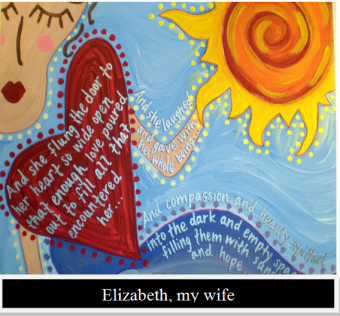
ElizabethI would like to dedicate this post to all the holy women who fill our lives, yet whose stories we never hear. Because it is not only these seemingly famous women—these heroines of feminism—who are holy and whose stories matter.   Continue reading “Painting “Unknown” Holy Women: Commissions, Gifts, and the Unsung Stories of “Ordinary” Women by Angela Yarber”

Hildegard: A Saint Eight Centuries in the Making

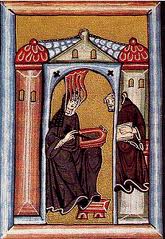
hildegard & volmar

The visionary abbess Hildegard von Bingen (1098-1179) has long been regarded as a saint, with her feast day of September 17, yet she was only officially canonized in May 2012. Why did it take the Vatican over eight centuries to canonize this great polymath, composer, and theologian?

The first attempt to canonize Hildegard began in 1233, but failed as over fifty years had passed since her death and most of the witnesses and beneficiaries of her reported miracles were deceased. Her theological writings were deemed too dense and difficult for subsequent generations to understand and soon fell into obscurity, as did her music. According to Barbara Newman, Hildegard was remembered mainly as an apocalyptic prophet. But in the age of Enlightenment, prophets and mystics went out of fashion. Hildegard was dismissed as a hysteric. Even the authorship of her own work was disputed as pundits began to suggest her books had been written by a man.

Newman states that Hildegard’s contemporary rehabilitation and resurgence was due mainly to the tireless efforts of the nuns at Saint Hildegard Abbey in Eibingen, Germany. In 1956 Marianna Schrader and Adelgundis Führkötter, OSB, published a carefully documented study that proved the authenticity of Hildegard’s authorship. Their research provides the foundation of all subsequent Hildegard scholarship.

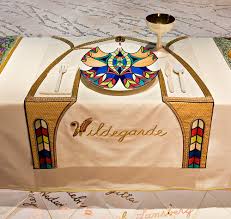
In the 1980s, in the wake of a wider women’s spirituality movement, Hildegard’s star rose as seekers from diverse faith backgrounds embraced her as a foremother and role model. The artist Judy Chicago showcased Hildegard at her iconic feminist Dinner Party installation.

hildegard judy chicago dinner party setting

Medievalists and theologians rediscovered Hildegard’s writings. New recordings of her sacred music hit the popular charts. The radical theologian Matthew Fox adopted Hildegard as the figurehead of his creation-centered spirituality. Fox’s book Illuminations of Hildegard of Bingen remains one of the most accessible and popular books on the 12th-century visionary. In 2009, German director Margarethe von Trotta made Hildegard the subject of her luminous film, Vision. And all the while, the sisters at Saint Hildegard Abbey were exerting their quiet pressure on Rome to get Hildegard the official endorsement they believed she deserved.

Pope John Paul II, who had canonized more saints than any previous pontiff, steadfastly ignored Hildegard’s burgeoning cult, possibly because he was repelled by her status as a feminist icon. Ironically it was his successor, Benedict XVI, one of the most conservative popes in recent history—who, as Cardinal Ratzinger, expelled Matthew Fox from the Dominican Order where Fox had served for thirty-four years—finally gave Hildegard her due. Reportedly Joseph Ratzinger, a German, had long admired Hildegard. He not only canonized her but elevated her to Doctor of the Church, a rare and solemn title given to only the most distinguished theologians.

But I believe the true credit for Hildegard’s triumph is due to the Benedictine Sisters at Saint Hildegard Abbey for keeping Hildegard’s flame burning.

Meditation:

This is drawn from Ann K. Gebuhr’s book, Hildegard!

Take some time to listen to and contemplate Hildegard’s beautiful musical meditation on the Holy Spirit, O ignis spiritus paracliti:

O spirit of fire, bringer of comfort,

Life of the life of every creature,

You are holy, anointing those perilously broken;

You are holy, cleansing festering wounds.

O breath of loveliness,

O fire of love,

O sweet savour in our breasts,

Infusing heart with the scent of virtue.

O clearest fountain,

In which we see

How God gathers the alienated

And finds the lost.

O breastplate of life

And hope of the whole human body,

O belt of honour, save the fortunate.

Guard those imprisoned by the enemy

And free those who are bound,

Whom the divine power wishes to save.

O mightiest course

That has penetrated all things

In the heavens and on earth

And in every abyss–

You reconcile and draw all humanity together.

From you clouds flow, wind flies,

Stones produce moisture,

Water flows in streams,

And the earth exudes living greenness.

You are always teaching the learned,

Who, through wisdom’s inspiration,

Are made joyful.

Thence praise be to you who are the sound of praise,

And joy of life,

And hope and greatest honour,

Granting the gift of light.

(This is Susan Hellauer’s translation from the insert booklet of Anonymous 4’s CD, The Origin of Fire: Music and Visions of Hildegard von Bingen.)

Read Hildegard’s poem slowly as a prayer, contemplating how the Sacred Flame, however you envision it in your own spiritual tradition, relates to your life.

Mary Sharratt’s Illuminations: A Novel of Hildegard von Bingen won the Nautilus Gold Award and was a 2012 Kirkus Book of the Year. Visit her website: www.marysharratt.com.

Painting La Negrita by Angela Yarber

angelaOne week ago thousands of Costa Ricans made a pilgrimage to visit their patron saint on August 2. Some penitents walked the 22 kilometers on their knees from the capital of San José to the Nuestra Señora de los Angeles Basilica in Cartago where the small statue of La Negrita is now on display. Joining Virginia Woolf , the Shulamite, Mary Daly, Baby Suggs, Pachamama and Gaia, Frida Kahlo, Salome, Guadalupe and Mary, Fatima, Sojourner Truth, Saraswati, Jarena Lee, Isadora Duncan, Miriam, Lilith, Georgia O’Keeffe, Guanyin, Dorothy Day, Sappho, Jephthah’s daughter, Anna Julia Cooper, the Holy Woman Icon archetype, Maya Angelou, Martha Graham, Pauli Murray, and all my other Holy Women Icons with a folk feminist twist is this seemingly small saint who has done big and mighty things: La Negrita.

Also known as La Virgen de los Angeles, the Black Virgin is a very small representation of the Virgin Mary. She was originally discovered by an indigenous woman on August 2, 1635. When the poor indigenous woman tried to take the stone statuette, it miraculously reappeared. The people responded by building a shrine around her. Continue reading “Painting La Negrita by Angela Yarber”

Women are like countries: both need to fight hard for independence by Oxana Poberejnaia

oxanaRita M. Gross in her book Buddhism After Patriarchy presents portraits of prominent women from Buddhist history. Some stories are extraordinary for the brutal details they contain. For example, Yeshe Tsogyel was raped, kidnapped and beaten by her suitors to the point that her back was a bloody pulp. She subsequently escaped to meditate in a cave.

In a patriarchal society, religious fervour is not recommended for women. Submission and obedience – yes. The life of an ascetic, a wanderer or a hermit – no. A son is relatively free to pursue religious activities (especially if he is one of the younger children and the issue of inheritance is sorted out). However, all daughters are better off tucked into a marriage. Supporting your husband and sons on their spiritual path – yes. Independent striving away from family life – no. Continue reading “Women are like countries: both need to fight hard for independence by Oxana Poberejnaia”

Queering Iconography, Painting Pauli Murray by Angela Yarber

angelaEven as my book, Holy Women Icons, is printed, bound, and available for purchase, filled with the stories of nearly fifty holy women, my project of painting these beloved saints continues. Joining all my other Holy Women Icons with a folk feminist twist is the brave, bold, and revolutionary Pauli Murray.

This month is a celebration of Murray’s life and witness is several meaningful ways. The first of July was her feast day, as she was deemed an Episcopal saint in 2012. LGBTQ author and activist, Kittredge Cherry, detailed Murray’s feast day, celebrating her as a “Human rights champion and queer saint…renowned civil rights pioneer, feminist, author, lawyer and the first black woman ordained as an Episcopal priest.” And the celebration of Pauli Murray’s radical witness continues as the icon bearing her image joins seventeen of my other Holy Women Icons at the North Star LGBTQ Center Gallery in Winston-Salem, NC for an exhibition entitled, “Queering Iconography: Holy Women Icons from Sappho to Pauli Murray.” Continue reading “Queering Iconography, Painting Pauli Murray by Angela Yarber”

Book Review: Hild & The Patron Saint of Ugly by Mary Sharratt

OLYMPUS DIGITAL CAMERA

Literature touches our spirit in a way that film, television, and even art cannot. Instead of presenting the passive viewer with a visual image, good writing demands our participation and co-creation. The words become the springboard for our own imagined vision of other worlds and other lives. In this imagined space, we can experience profound insights and revelations–soul-growing experiences we carry with us forever.

Books that try too hard to be spiritual can have the opposite effect. Discerning women demand books that respect us instead of preaching to us. Too often religion has been interpreted by and for men, but when women writers reveal their spiritual truths, a whole other landscape emerges, one we haven’t seen enough of.

Marie Manilla’s The Patron Saint of Ugly (Houghton Mifflin Harcourt, June 17, 2014) and Nicola Griffith’s Hild (Farrar, Straus and Giroux 2013) are two such transporting novels. They both draw on the lives of female saints in fresh and evocative ways.

Continue reading “Book Review: Hild & The Patron Saint of Ugly by Mary Sharratt”

Jesus, Mary and Joseph: Who Are Our Saints? by Marie Cartier

Tomorrow I will be going to a friend’s 7th grade classroom presentation of “famous people in history.” She has 120 students who will be dressing up as someone in history and doing a presentation board about this person—as well as dressing in costume. She asked me to come in costume as Frida Kahlo. As many of you know, I admire/adore Frida Kahlo and wrote a blog last year extolling her praises; actually it was a “valentine towards an ethics of loving women and art.” (And every year I dress as Frida and help a friend do a lively lotería game at an LGBT celebration of Cinco de Mayo at our Church.)

My friend told me that while there would not be a Diego Rivera in her crowd of costumed living historians—there would be Frida’s lover Josephine Baker (someone saw the movie Frida and knew Josephine and Frida were “friends”), and there would be several Guadalupes.

This got me thinking that for children/teens – especially children brought up in religious households (and especially Catholic households, of which I was such a child) – saints and real people are often conflated. And famous real people one admires often are given “sainthood” in one’s imaginary church. Continue reading “Jesus, Mary and Joseph: Who Are Our Saints? by Marie Cartier”

The Soul is Symphonic: Reclaiming Sacred Music

https://i0.wp.com/media.tumblr.com/55c2821e2413450d48ec03b96e4cd426/tumblr_inline_mqcp4y6ZwN1qz4rgp.jpg

Here is a hymn of praise, a beautiful and intimate piece meant to be sung.

Hail, O greenest branch,

sprung forth on the breeze of prayers.

. . . . a beautiful flower sprang from you

which gave all parched perfumes their aroma.

And they have flourished anew  in full abundance.

The heavens bestowed dew upon the meadows,

and the entire earth rejoiced,

because her flesh brought forth grain,

and because the birds of heaven built their nests in her.

Behold, a rich harvest for the people

and great rejoicing at the banquet.

O sweet Maiden,  no joy is lacking in you . . . .

Now again be praised in the highest.

When I posted this sacred text on my blog back in 2008, I asked my friends who come from a diverse range of spiritual backgrounds to guess the author and the divine figure to whom the text is addressed. Some thought it might be an ancient hymn to Persephone. In fact, it is one of Hildegard von Bingen’s ecstatic odes to the Virgin Mary. This song, O viridissima virga, can be found on a number of CDs of Hildegard’s music.

Born in the rich green hills of the German Rhineland, Hildegard von Bingen (1098-1179) entered the religious life at the age of eight. A Benedictine abbess, she composed an entire body of sacred music, including seventy-seven songs and a musical morality play which can be regarded as our first surviving opera. A polymath well versed in science and the healing arts, she developed her own form of natural medicine that is still practiced in Germany today. During her own lifetime, she was most famous for her prophecies which earned her the title Sybil of the Rhine.

Since earliest childhood, Hildegard experienced profound visions which directly influenced her music, theology, and healing practices. Her visions revealed the feminine face of the divine, which is mirrored in her music. Many of her songs are addressed to Mary or female saints, such as Ursula. Even the Godhead itself appeared to her in feminine form. In Scivias, her first book of visionary theology, she writes, “She is with everyone and in everyone, and so beautiful is her secret that no person can know the sweetness with which she sustains people, and spares them with inscrutable mercy.”

Hildegard’s sacred songs are filled with a deep sensuality and reverence for the natural world. In her hymn O viridissima virga, she transforms the Latin word virgo, or virgin, into virga, or branch, addressing Mary as the most verdant and lushly abundant branch on Jesse’s tree. Hildegard was Christian, yet her music and visions have profound resonance for people from all spiritual backgrounds. The more I study mystics and visionaries, the more I am convinced that they draw on the true heart of divinity. They tap into the ineffable.

Sacred music was the bedrock of Hildegard’s spirituality. For her, song was the highest form of prayer, sacred harmonies rising like incense in a perfect offering to heaven. Hildegard believed that the soul is symphonic. Such is the sweetness of music that it banishes human weakness and fear, and draws us back into our original state of grace, reuniting humans to their divine Source.

Benedictine monastic life was structured around the Divine Office: eight times a day, from the dawn office of Lauds to the night vigil of Matins, the choir nuns gathered to sing the Psalms of David and other sacred songs. Near the end of her long life, Hildegard and her nuns at Rupertsberg Abbey were subject to an interdict, or collective excommunication. A supposed apostate lay buried in their churchyard and they refused to allow the ecclesiastical authorities to exhume this man and desecrate his grave. As a result of the interdict, Hildegard and her nuns were denied the Mass and the sacraments—a very old woman, Hildegard herself might have died without the final sacraments or Christian burial. Yet what infuriated her most was that she and her sisters were forbidden to sing the Divine Office. Sacred song was absolutely central to her identity as a religious woman. The interdict was lifted only shortly before her death. I imagine her singing until her dying day.

What relevance does this have for us today? When I listen to recordings of Hildegard’s music, I am struck by its ethereal beauty. Nowadays, for people across the spiritual spectrum, there seems to be a dearth of good music. Much of what is sold as meditation music or inspirational music seems shallow and insipid to me. A regular church-going Catholic is more likely to experience the guitar mass than the mysterious beauty of Hildegard’s music.

As contemporary spiritual people, are we to live our lives severed from the kind of music that can truly feed our souls?

What can we do to reclaim the power of sacred song? Few of us are gifted composers. Many of us cringe to even hear ourselves sing. How do we integrate sacred music into our spiritual practice? Most of us lead busy lives and the stillness of a monastic lifestyle remains an impossible dream. Yet we might find sung devotions at morning and twilight to be deeply enriching. We might start by listening to recorded music that inspires us. From my own practice, I’ve discovered that Hildegard’s music definitely works as a backdrop to meditation and contemplation. It soothes the soul and draws the heart and mind to a higher place. Over time we might gain the courage and will to take the leap to sing for ourselves. It’s not necessary to play an instrument. The voice  God gave us is enough. The next logical step is creating our own new music.

If we can’t find the music to nourish our soul, we must create it. Hildegard took the established tradition of plainchant and wedded it to her own vision to create hymns of incomparable beauty that still move us today. Most of us aren’t visionaries like Hildegard, but we can write our own heartfelt lyrics in praise of the Divine as we see Her. We can write songs to celebrate the sacred cycles of the year and the days we hold sacred. We can take ancient sacred texts and find a melody to carry the words. Medieval plainchant is beautiful in its simplicity. Or perhaps a haunting old folk air will inspire you.

When you offer your songs as prayers, sing like you mean it. It’s not a performance to impress other humans but a pure act of devotion. Meet together with friends in an informal devotional gathering. Share your songs. Inspire each other. Our modern sacred music will inevitably keep evolving as people compose new songs and add to the canon. We each have the opportunity to be part of this evolution.

Mary Sharratt is the author of Illuminations: A Novel of Hildegard von Bingen (Houghton Mifflin 2012, Mariner 2013), winner of the Nautilus Gold Award: Better Books for a Better World. Visit her website.


Sacred Music Discography:

Hildegard von Bingen:
11,000 Virgins: Chants for the Feast of St. Ursula, Anonymous Four, Harmonia Mundi, USA.
The Dendermonde Codex, Dous Mal/Katelijne Van Laethem, Etcetera.
A Feather on the Breath of God, Gothic Voices, Hyperion.
Canticles of Ecstasy, Sequentia, Deutsche Harmonia Mundi.
Voice of the Blood, Sequentia, Deutsche Harmonia Mundi.

Awakening to Life: Hildegard’s Cure for Seasonal Depression by Mary Sharratt

mary sharratt

In midwinter 2002, I moved from the sun-drenched San Francisco Bay Area to Lancashire, in northern England, further north than I had ever lived. In bleak December, it was as though someone had switched off the lights. The sun barely managed to rise at 8:45 am. By 4:00 pm, it was pitch black. Even during the daylight hours, the sky remained muffled in oppressive clouds. There was no glittering white snow, either, just lashing, relentless rain. It was so oppressively dark, I felt as though I were trapped inside some claustrophobic gothic novel. For the first time in my life I began to suffer what they call winter depression. It didn’t help that it was Christmas and that I was new to the country and didn’t know anybody.                 

Every religious tradition that evolved in the northern reaches of the Northern Hemisphere honored the great mystery of the birth of the Divine Light from teeming midwinter darkness. As well as formal religious observances, countless folkways, carols, and mumming plays helped bring meaning and radiance to cold midwinter nights. Continue reading “Awakening to Life: Hildegard’s Cure for Seasonal Depression by Mary Sharratt”

Longing for Hermitage by Elizabeth Cunningham

Elizabeth Cunningham headshot jpegAt least since the days of the Desert Mothers in the 4th and 5th centuries CE, there have been women in the Christian tradition (and doubtless other traditions) who have lived lives in religious solitude, whether by choice or circumstance.  In Medieval Europe many churches had anchorholds, small enclosures inhabited by men or women dedicated to a life of solitude and prayer. The word anchorhold implies that the presence of the anchoress or anchorite grounded the church community, but the word derives from the ancient Greek verb (pronounced anachōreō) for to retire or withdraw.  Anchoress Julian of Norwich is still revered as the author Revelations of Divine Love, possibly the earliest surviving book written by a woman in the English language.  Six centuries after her death, her vision of Jesus our Mother continues to challenge, comfort, and inspire.

I grew up in an Episcopal rectory, daughter of a secretly agnostic mother who loathed being a minister’s wife (living in a fishbowl, she said) and a father who preached and practiced the social gospel as had his father before him. If you weren’t directly feeding, clothing, visiting “the least of these my brethren,” your pieties (as my father dismissed them) were worthless. At every meal we prayed, “make us always mindful of the needs of others.”  Selfishness and individualism were synonymous. The pronoun “I” was frowned upon.  The only route to salvation was social and/or political activism. My father walked his talk, literally, taking part in the 1965 march from Selma to Montgomery.

Continue reading “Longing for Hermitage by Elizabeth Cunningham”