Recognizing Our Mentors by Joyce Zonana

Ever since I first read it when I was sixteen, I have loved Homer’s Odyssey. For many years I was lucky enough to teach it almost every semester, and so I came to know it intimately. Despite the valid feminist critique of the ancient Greek epic—that it glorifies patriarchy, justifying and perpetuating men’s control over women—I still find it to be an inspiring evocation of female autonomy and power, both human and divine. Especially divine.


At the close of the introduction to her exquisite new translation of Homer’s Odyssey, classical scholar Emily Wilson directly addresses the reader. “There is a stranger outside the house,” she tells us:

He is old, ragged, and dirty. He is tired. He has been wandering, homeless, for a long time, perhaps many years. Invite him inside. You do not know his name. He may be a thief. He may be a murderer. He may be a god. He may remind you of your husband, your father, or yourself. Do not ask questions. Wait.

There is much to explore in this passage and the lines that follow. But what strikes me today is Wilson’s simple sentence: “He may be a god.” 

The stranger may be a god. Or a goddess.

Ever since I first read it when I was sixteen, I have loved Homer’s Odyssey. For many years I was lucky enough to teach it almost every semester, and so I came to know it intimately. Despite the valid feminist critique of the ancient Greek epic—that it glorifies patriarchy, justifying and perpetuating men’s control over women—I still see it as  an inspiring evocation of female autonomy and power, both human and divine. Especially divine. Continue reading “Recognizing Our Mentors by Joyce Zonana”

Matriarchal Politics The Vision of an Egalitarian Society (Part 2): Macrostructures by Heide Goettner-Abendroth

Regionalism

In a new matriarchal society, “bigger” is not necessarily “better.” The smaller units of society, responsible for engendering person-to-person and transparent politics, are given preference. They must not become so big that people cannot see through them, and cannot participate in their decisions, as is the case in so many of today’s national states and super-powers. But they must be big enough to safeguard their self-sufficiency by a subsistence economy, and the diversity of their handiwork, technologies and arts. The ideal dimension is that of the region.

The borders of a region are not random, like national borders are; rather they have developed out of the conditions of the landscape and out of cultural traditions. Regional borders are formed by the decisions of the people themselves who want to live together on the basis of common cultural and spiritual traditions; this avoids any war of culture or of religion. Often the landscape corresponds to these cultural borders, because natural borders can be formed by mountain ranges, rivers, big lakes, or the sea which bind and bound people into their regional places. Continue reading “Matriarchal Politics The Vision of an Egalitarian Society (Part 2): Macrostructures by Heide Goettner-Abendroth”

The Sacred HU by Janet Maika’i Rudolph

Sing to the LORD, all you godly ones! Praise his holy name.
Psalm 30:4 (New Living Translation)

Therefore I will give thanks unto thee, O LORD, among the heathen, and I will sing praises unto thy name.
2 Sam 22:50

Let them praise the name of the LORD: for this name alone is excellent.
Psalm 148:13

The wording of these passages is very odd. After all, why is God’s name always being praised? It’s like saying to someone, “you must be a wonderful person because you have a lovely name,” or “the LORD must be great because ‘he’ {sigh} has such a great name.” Actually though, as I began to go deeper into my own personal practices of spirit work and chanting, I found that there is a profound truth to this use of praise. Most, if not all, of the ancient names of deities are made up of power syllables. By this I mean certain sounds that have a vibrational essence which not only resonate within our bodies but connect us with all the vibrations that surround us. Sounds made by these syllables are a bridge between worlds created by our breath.

Mystically speaking we could say that the breath of creation and our own breath interfuse. We can experience this through the vibration of power syllables. The most common syllables in the west are familiar ones – AL LA HA AH YA LO WAH and the mighty HU. Think of all the names of divinity that can be created by experimenting with these syllables. Continue reading “The Sacred HU by Janet Maika’i Rudolph”

Coming Out of Quarantine by Angela Yarber

As Pride Month and Black Lives Matter protests co-exist, the spirituality of queer women of color teaches white allies how to listen.

After nearly eighty days of sheltering in place, I feel like I’ve stepped out and found the world on fire. June isn’t supposed to be this way. It’s Pride Month, after all, and I’m queer, eager to dance alongside my favorite drag queens, albeit reticent to embrace capitalism’s commodification of our beloved rainbows.

Most of our annual Pride events have been cancelled due to concerns of social distancing amid a global pandemic. I support these cancellations, though my first family outing since quarantine was a Black Lives Matter protest in Hilo, Hawai’i; we all stood six-plus feet apart, wore masks, and waved our signs beneath the King Kamehameha statue. As my six-year-old was complimented on how he wrote his own sign, I adjusted my three-year-old daughter’s face mask and thought about how queer BIPOC started the Stonewall riots only 51 years ago. I thought about how we queers would have every right to demand our Pride celebrations, storming capitals with glitter bombs, and demanding our civil liberties, not completely dissimilar to the myriad gun clad white dudes demanding haircuts only weeks ago. But we don’t. Continue reading “Coming Out of Quarantine by Angela Yarber”

Her Magic in the Stone Circle by Glenys Livingstone

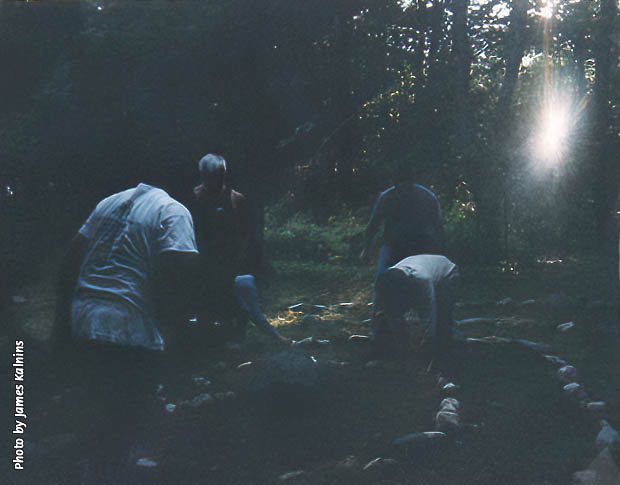
My ancestors built great circles of stones that represented their perception of real time and space, and enabled them to tell time: the stone circles were cosmic calendars. They went to great lengths and detail to get it right. It was obviously very important to them to have the stones of a particular kind, in the right positions according to position of the Sun at different times of the year, and then to celebrate ceremony within it.

I have for decades had a much smaller circle of stones assembled, representing the ‘Wheel of the Year’, as the annual cycle of Earth around Sun is commonly named in Pagan traditions. I have regarded this small circle of stones as a medicine wheel. It is a portable collection, that I can spread out in my living space, or let sit in a small circle on an altar, with a candle/candles in the middle. Each stone (or objects, as some are) represents a particular Seasonal Moment, and is placed in the corresponding direction. I have found this assembled circle to have been an important presence. It makes the year, my everyday sacred journey of Earth around Sun, tangible and visible as a circle, and has been a method of changing my mind, as I am placed in real space and time. My stone wheel has been a method of bringing me home to my indigenous sense of being.  Continue reading “Her Magic in the Stone Circle by Glenys Livingstone”

The Poiesis of Celebrating Earth’s Seasonal Moments by Glenys Livingstone

Amongst Celtic peoples, the capacity to speak poetically was a divine attribute, regarded as a transformative power of the Deity, who was named by those peoples as the Great Goddess Brigid: She was a poet, a Matron of Poetry (along with her capacities of smithcraft and healing). And at Delphi in Greece, the oracular priestesses delivered their prophecies in poetic form: Phemonoe invented the poetic meter, the hexameter. And from Sumeria, humans have the first Western written records of literature, which is poetry written by the High Priestess of Inanna, Enheduanna in approximately 2300 B.C.E.. Poetry has been recognised as a powerful modality: Barbara Mor and Monica Sjoo described “poetic thinking” as an wholistic mode, wherein “paradox and ambiguity … can be felt and synthesized. The most ancient becomes the most modern; for in the holographic universe, each ‘subjective’ part contains the ‘objective’ whole, and chronological time is just one aspect of a simultaneous universe” (The Great Cosmic Mother, 41).

Poetry could be described as an “Earth-centred language”: it has the capacity to hold multivalent aspects of reality, to open to subjective depths, to allow qualitative differences in understanding. Hence it is especially suited to expressing and bringing together a multitude of beings. Cosmologist and evolutionary philosopher Brian Swimme and the late cultural historian/geologian Thomas Berry have called for such a language – the kind of language “until now enjoyed only by our poets and mystics” that may express the “highly differentiated unit”, the organic reality such as Earth is (The Universe Story, 258-259), and such as “Gaia” was understood of old, and in recent scientific theory: that is, Earth is understood as a highly differentiated unity, which any expression must aim to emulate. Continue reading “The Poiesis of Celebrating Earth’s Seasonal Moments by Glenys Livingstone”

Reaching for New Language for the Sacred by Glenys Livingstone

The term ‘PaGaian’, which became the title of my work, was conceived in at least two places on the planet and in the opposite hemispheres within a year of each other, without either inventor being aware of the other’s new expression. It was some time before they found each other … one party in Australia, myself having published a book with PaGaian in the title; and the other party, Rob Blake – in the UK having registered the domain pagaian.org as the term seemed to him to express a cosmology constellating in his mind. The term PaGaian was actually conceived by my partner Taffy Seaborne in late 2003, enabling the book to manifest: heretofore the body of work developed there took six lines to express.

This reaching for a new word, was the reaching for a language, which is a power; to bring together an Earth-based – ‘Pagan’ – spiritual practice indigenous to Western Europe, with recent Western scientific understandings of the planet as a whole living organism – ‘Gaia’ as it has been named, and which by its name acknowledged resonance with ancient Mother Goddess understandings of our Habitat, as an alive sentient being. So, the term ‘PaGaian’ splices together Pagan and Gaian, and it may express a new autochthonic/native context in which humans find themselves: that is, the term may express for some (as it did and does) an indigeneity, a nativity, in these times, of belonging to this Earth, this Cosmos. For myself, the new expression consciously included and centralised female metaphor for sacred practice: that is, practice of relationship with the sacred whole in which we are, and whom I desired to call Mother, and imagine as the Great She. Continue reading “Reaching for New Language for the Sacred by Glenys Livingstone”

Women Invented Agriculture, Pottery, and Weaving and Created Neolithic Religion by Carol P. Christ

When I look at the two chapters on Goddess history in my book Rebirth of the Goddess (1996), there is very little I would change, but there is new evidence I would add.* Before discussing that, I would like to underscore two important points I made in discussing Goddess history that are often overlooked or ignored by other writers. The first is that women were the likely inventors of three new technologies at the beginning of the Neolithic age: agriculture (because they were the gatherers of plants and the preparers of plant foods), pottery (primarily used for food storage and preparation), and weaving (women’s role in almost all traditional societies). The second is that the so-called “age of the Goddess” is not a more “primitive” or “unconscious” stage of culture that needed to be superseded or overthrown by more “evolved” or more “rational” patriarchal warrior cultures.

Cultural theorists like the archetypal psychologist Carl Jung assert that “the feminine” represents the unconscious and nonrational ways of knowing such as intuition. From this it follows for them that the age of the Goddess was the age of the unconscious. This sounds good to some women and even to some feminists who have experienced aspects of so-called rational philosophical, theological, and scientific traditions as dogmatic, authoritative and wrong! Wrong about women and wrong when they exclude other than narrowly defined “rational” ways of knowing. However, there are important reasons to reject Jung’s theory.

The theory that earlier more “feminine” or pre-patriarchal cultures are unconscious or pre-rational has been used by Jung and his followers to justify the overthrow of earlier cultures by patriarchal warrior groups in order to allow humanity to develop so-called rational ways of thinking which are identified as “masculine.” That the so-called rational men of these cultures were warlike, subordinated women, seized other people’s lands, and held slaves is rarely counted against their alleged superiority. Moreover, the theory that the pre-patriarchal Goddess cultures of the Neolithic can be categorized as unconscious in no way accounts for the technological inventions that define the Neolithic era. Continue reading “Women Invented Agriculture, Pottery, and Weaving and Created Neolithic Religion by Carol P. Christ”

Writing Women Back into Jewish History: Interview with Michelle Cameron by Mary Sharratt


My friend Michelle Cameron’s powerful new novel, Beyond the Ghetto Gates, is a deep dive into women’s history that I thoroughly enjoyed.

This is a passionately compelling saga of an ancient way of life on the threshold of radical change. Young Mirelle longs to dedicate her life to running her aging father’s workshop, but her rabbi forbids her on account of her sex. Chafing against the constraints of both her gender and the suffocating strictures of the Ancona Ghetto, Mirelle sees no way forward but dutiful arranged marriage. Yet Napoleon’s armies, sweeping across Europe, threaten to change her way of life forever.
I learned so much from reading Michelle’s novel and from my conversation with her below. I hope my readers are likewise compelled! Reading is our great solace in this time of lockdown.


Mary Sharratt:  Michelle, tell us about your new novel, Beyond the Ghetto Gates.

Michelle Cameron: Beyond the Ghetto Gates is a historical novel set during Napoleon Bonaparte’s Italian campaign (1796-97). When French troops occupy the port city of Ancona, freeing the city’s Jews from their repressive ghetto, two very different cultures collide. Mirelle, a young Jewish maiden, must choose between her duty – an arranged marriage to a wealthy Jewish merchant – and her love for a dashing French Catholic soldier. In the meantime, Francesca, a devout Catholic, must decide if she will honor her marriage vows to an abusive and murderous husband. Beyond the Ghetto Gates depicts how the Jews and Catholics of Ancona wrestle with ancient traditions, prejudices, and the challenges of a rapidly changing world.


MS.: How does your faith inspire your fiction?

MC: People often ask if I’m religious, because my historical novels focus on Jewish characters, issues of antisemitism, and the deep conflict between religious tradition and assimilation. I believe it’s precisely because I am a non-observant Jew with deep roots in my ancestral traditions and culture that I can wrestle with these issues in ways that a more religious writer could not. I’ve felt the attraction of being part of “the norm,” much as my characters do, that tug-of-war between religious identity versus being accepted in a secularized society, which is a constant theme in my fiction.


MS: What is the most surprising fact you’ve gleaned from your research into women in Jewish history?

MC: That Jewish women could divorce if their husbands fail in their marital duties. These are spelled out in the marriage contracts (ketubot) that Mirelle’s father creates:

Be my wife according to the law of Moses and Israel. I will work, honor, feed, and support you in the custom of Jewish men, who work, honor, feed, and support their wives faithfully. I will give you the settlement of ______ as well as your food, clothing, necessities of life, and conjugal needs, according to the universal custom.

The shocker here is “and conjugal needs.” Once, when speaking about my previous novel, The Fruit of Her Hands, I was questioned on the pleasure that Shira’s rabbi husband gave her in bed. There’s a common misconception that intercourse is a duty whose sole purpose is procreation. Luckily for me, the group included the rabbi’s wife, who explained that men are actually taught in the Talmud how to satisfy their wives sexually.

But since observant women are discouraged from studying Talmud, men who aren’t adequate to the task aren’t always condemned for their failures. But the fact remains that men are supposed to make the act pleasurable for both parties – and that they can be divorced if they don’t do so.

MS: How do you hope your work might inspire your readers to gain new insights about history and faith?

MC: I hope that, by learning about the cultural underpinnings and the historical struggles of my Jewish characters, my novels might promote greater understanding between all faiths.

MS: What is the one question you never get asked in interviews, but wish you did?

MC: Did you always want to write Jewish historical fiction?

In fact, I did not. My first book, In the Shadow of the Globe, a verse novel about William Shakespeare’s life and loves, was actually the type of book I thought I’d be writing. But then I discovered that I could trace my roots back to my 13th Century rabbi ancestor – Meir of Rothenberg – and realized his life story was the stuff of a novel. Writing that book set me on this path. It helps that I had a much more thorough grounding in Jewish history than most, because I lived in Israel during my high school years.


MS: What are you working on now? Will you continue to explore themes of women and Jewish history?

MC: I’m working on the second book in the series – which takes Napoleon and his troops on a bizarre expedition to Egypt and Israel. Many of the same characters from Beyond the Ghetto Gates will be part of this novel. So yes, I’ll be continuing to explore these themes.


MS: How would you like readers to connect with you?

MC: Via my website. This includes my various social media links, as well as a contact page, allowing readers to write me directly.


Author, Michelle Cameron


Mary Sharratt is on a mission to write women back into history. Her most recent novel Ecstasy is about the composer Alma Schindler Mahler. If you enjoyed this article, sign up for Mary’s newsletter or visit her website.


The Messy, Wild Mystery that’s Stronger than Wrong by Trelawney Grenfell-Muir

I am an annoying feminist. I annoy pretty much everyone about it, because I’m never NOT applying a feminist lens to every aspect of life: science (looking at you, Larry Summers), politics (Joe Biden is a rapist), art (objectification is NOT empowerment), culture (make-up is a prison), and, of course religion. I’m perhaps most annoying of all when it comes to religion. I annoy Christians by raving about Christ The Cosmic Vagina, and I annoy secularists by raving about feminist Jesus. I especially annoy my church friends and colleagues by refusing to use the (male) word “God” to talk about the Infinite Divine Mystery, much less male pronouns or oppressive symbols such as Lord, King, or Kingdom.

Yep, I’ve been cheerfully annoying the hell out of everyone for decades, drawing vagina art during male-centric worship services, changing lyrics on the fly, slipping female words and symbols into prayers and startling whomever sits near me… I am a feminist. Not the fun kind. Continue reading “The Messy, Wild Mystery that’s Stronger than Wrong by Trelawney Grenfell-Muir”