

 My eleven-year-old son, Nathan, a fifth grader, is doing his best to deal with changes the coronavirus pandemic has brought to his life. Before this time, Nathan’s biggest daily worries have been keeping his school papers organized and staying on top of his sometimes rigorous homework assignments. Nathan has ADHD, which poses certain challenges to his learning and behaviors, making some tasks that have many intermediary steps nearly intolerable for him. Nathan’s learning is complicated by the fact that, while it has always been apparent that his learning style was different, his teachers and family (including me) have not always had the skills or patience to see Nathan’s exceptional gifts and insights from Nathan’s own point of view.
While his ADHD is a challenge, Nathan has a more ominous, lurking, daily concern. Nathan has a life-threatening allergy that has made him keenly aware that every visit to a strange house, every meal at a restaurant, every bakery product, every school treat, every friend’s birthday party, and even touching a doorknob or library book could mean a painful and terrifying hospital experience. Since his allergy was first discovered, Nathan has been keenly aware of dust, germs, and particles. He washes his hands to a fault, both as a result of ADHD compulsive behaviors and his deep awareness of his vulnerability to invisible, yet deadly particle foes. Nathan’s allergies also give him extremely sensitive skin, predisposed to eczema, severe rashes, dryness, and splitting, so gloves, soaps, and sanitizers are at once necessities and risks to the largest organ in Nathan’s body. Continue reading “Community Immunity by Natalie Weaver and Nathan”
 Have you forgotten yet? Have you forgotten what it felt like to go about your life pre-pandemic?
 Imagine that you are a young mother of three from Syria, and that after fleeing your home with your husband and family, you arrived in Lesbos and have been waiting for months to have your asylum papers processed. You don’t know when that will happen, it could take more than a year, you have been told. You are staying in a tent with other families because the containers are full. You have no privacy. When it is cold you are cold, and when it rains you get wet. You try to keep your family clean and healthy, but there are not enough toilets and showers for everyone. In addition, you are afraid to leave the tent at night because some of the men without families drink too much and harass you and the other women.
  Feminist spirituality is often disparaged in academic feminist and progressive communities. Many of the strongest critics are Marxists, but there is a general agreement that religion is the opiate of the people, a false belief system that diverts energy from the difficult work of creating justice in this world. This view is rooted in the habit of thought known as classical dualism in which spirit and nature, spirit and body, and this world and the next are viewed as antithetical. From this, it would seem to follow, feminist spirituality focuses attention on an imagined spiritual world as opposed to the material world in which real people live and interact with each other. Nothing could be farther from the truth.
 Over the past few weeks of lockdown in Greece, I have asked myself numerous times: if we can shut down the world economy because of a virus, why don’t we shut everything down until we end war or find real solutions to global climate change? In my mind the horrors of war are much worse than the horrors of disease and dying and the threat and reality of global extinctions pose a much greater threat to humanity (not to mention nature) than the Coronavirus.
 Just over a month ago and shortly before Greece went into Coronavirus lockdown, I signed the contract on my new apartment in Crete (after waiting 6 months for the owner to submit his paperwork). Though I did not realize it until I had been sitting in the notary’s office for several hours, the date of the signing was February 25, my father’s birthday. My father and I had a troubled relationship, due to the fact that he could not accept that I did not “know my place” in a world where women were expected to be submissive to men.
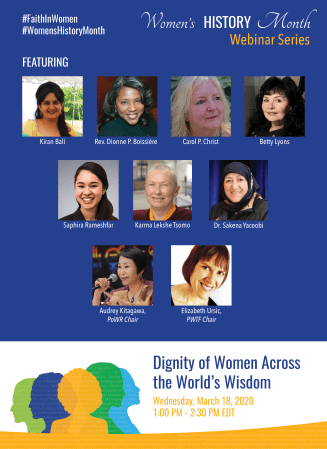 I have been asked to post my contribution to the Parliament of World Religions Webinar: Dignity of Women Across World’s Wisdom.
  In a recent blog on Feminism and Religion,
 Feminism and Religion