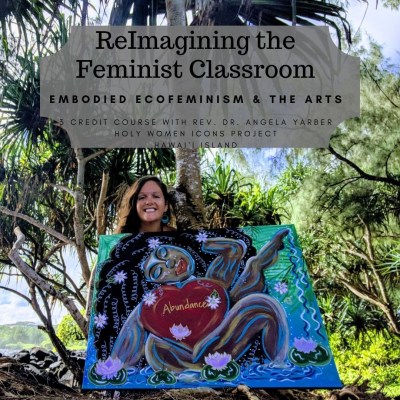
Reimagining the Classroom: Embodied Ecofeminism and the Arts Course on Hawai’i Island by Angela Yarber

“The classroom remains the most radical space of possibility in the academy.”-bell hooks

Like many academics, my “in the box” dream was to be a professor. The full-time, tenured kind. Like many queer feminist academics, I know that such dreams are rarely reality. When you’re also an artist and activist with a strong penchant for wanderlust, these dreams are simply unattainable fairytales. Never one for “in the box” living, I left the traditional academy and traditional church years ago, wandering over the garden’s walls with Lilith as my intrepid guide. I’ve told the story before. My wife and I left our jobs, sold our home, traveled full-time with our toddler, and turned the Holy Women Icons Project into a non-profit while building an off-grid tiny house on the television show Tiny House Nation in Hawai’i. It’s become old news. But since we’ve been doing this for several years now, those faraway dreams are finally starting to become reality. The academic classroom, the activist’s platform, the artist’s studio, the feminist’s megaphone, and the farmer’s orchard are fusing into one creative, life-giving, empowering space for teaching. The Holy Women Icons Project’s first academic course, “Embodied Ecofeminism and the Arts,” is actually happening. Seminarians and doctoral students from Berkeley join us in January. They’re soon followed by undergraduates from New York and seminarians from Atlanta. And I’m reaching out to more and more schools interested in creatively, subversively, and sustainably decolonizing the classroom with us for one week on the Big Island.

Continue reading “Reimagining the Classroom: Embodied Ecofeminism and the Arts Course on Hawai’i Island by Angela Yarber”

Mother – Daughter Betrayal by Sara Wright

(1)

Today is my mother’s birthday and although she has been dead for more than a decade I still think of her almost every day. At the time of her death I had not seen her for twelve years. Not by choice. After my father’s sudden demise my mother chose my children, her two adult grandsons to be her protectors, and dismissed me from her life, permanently.

When she died, my mother divided her assets evenly between my children and me, forcing her only daughter to live beneath the poverty level for the remainder of her life.

The final betrayal.

At the time of her death I was teaching Women’s Studies at the University.

Continue reading “Mother – Daughter Betrayal by Sara Wright”

This is for colored girls who are movin to the ends of their own rainbows: Ntozake Shange’s Choreopoem of Spiritual Healing by Carol P. Christ

Ntozake Shange’s choreopoem for colored girls who have considered suicide/when the rainbow is enuf has reopened at the Public Theater in New York City to rave reviews.

A scene from the new production of for colored girls

I first saw for colored girls in 1976 after my friend Carolyn Broadaway, who was visiting me in the city, insisted that we must see it.

Here is what I wrote about that experience:

Each of the three times I saw for colored girls performed on Broadway and each of the many times I read it or heard it performed [on the original cast album] on my stereo, I have felt chills of recognition up and down my white woman’s spine—shocks of recognition that tell me that something deep within me has been unlocked as I hear my experience voiced. (103)

Continue reading “This is for colored girls who are movin to the ends of their own rainbows: Ntozake Shange’s Choreopoem of Spiritual Healing by Carol P. Christ”

Metamorphosis and a Press Conference: A Kafkaesque and Shakespearean Fantasy about an Unreal Individual by Barbara Ardinger

Donald wakes up too early. Feeling confused and disoriented, he looks around the room. His bed has disappeared! He seems to be lying on the floor. Why? he asks himself, how’d I fall off my king-size bed? The floor (uncarpeted??) seems to go on around him forever, sans furniture, sans TVs, sans his solid gold toilet, sans even the doors and windows. It’s all a great big blank. All around him. Where am I? he asks himself.

He had disturbing dreams all night, and not just last night, but for…well, awhile. Since the subpoenas. He keeps seeing big, strong, silent men wearing jackets with initials on the back carrying big boxes out of his various offices. All of them. All over the world. In one repeating dream, a man dropped a box. It fell open, scattering papers filled with names and numbers. The men picked everything up, put the papers back in chronological order, and resealed the box. They kept carrying the boxes out to black vans that didn’t have names painted on them.

Continue reading “Metamorphosis and a Press Conference: A Kafkaesque and Shakespearean Fantasy about an Unreal Individual by Barbara Ardinger”

What I Learn from Women in Southern Morocco by Laura Shannon

I feel deeply fortunate to be able to travel regularly to southern Morocco. In Taroudant in the Souss Valley, and further south in the Anti-Atlas Mountains, my groups of students have the chance to discover women’s cultural traditions including music and dance, weaving and embroidery, household and healing rituals. In the seven years I have been leading these tours, women have joined me from a dozen different countries and as many different faiths, and most of them end up feeling at home here just the way I do.
What makes southern Morocco so special? Many threads come together to create the extraordinary ambience which permeates this part of the country. First of all, there is the Berber influence: a large percentage of Moroccans in the South are Berbers, and many elements of ancient North African Berber culture, with roots in Neolithic times, remain percepible beneath the relatively recent overlays of Arabic culture and Islam.

Continue reading “What I Learn from Women in Southern Morocco by Laura Shannon”

Mother of All Fears by Trelawney Grenfell-Muir

This time of year, the general public tends to pay more attention than usual to witches. Much of it is lighthearted – halloween costumes and memes about where to park your broom. Some of it is spiritual – adherents of the modern religions of Wicca and neopaganism discussing symbolic and supernatural beliefs. And some of it is historical – analyzing the witch trials of past centuries and wondering how they apply, ethically, to modern day intolerance and violence.

Within all these discussions, usually unnamed and unexamined, is the framing metaquestion: what should we fear? And what should we do about that which we fear?

Historic witch trials (from a time when witches were believed to be evil agents of Satan) reveals how we humans always try to externalize badness and goodness, so we can exterminate badness and excuse ourselves for our lack of goodness. So we have heroes and villains, neither of them very human, but rather idols and symbols of our fears. I honestly think the patriarchy’s fear of females is as strong as it ever was. When the most popular videos on the most popular internet porn sites are of ****TRIGGER WARNING RAPE, INCEST**** raping a stepsister, or doctors raping a teenage girl in the hospital for cancer, or of border agents raping a pregnant young refugee, and these sites are visited by 98% of the men in our society, what does that say about us as a species? Or a culture? As Tallessyn Grenfell-Lee says, “Scary, scary vaginas!

Continue reading “Mother of All Fears by Trelawney Grenfell-Muir”

Double, double… rhymes are trouble by Katie M. Deaver

I never considered myself one of those people who gets really “into” Halloween. But, as one might expect having an eight year old, especially an eight year old who celebrates her birthday shortly before the holiday, has made me much more in tune with the excitement and preparation which surrounds Halloween.

One of the traditions that I do very much enjoy is watching Halloween movies like Hocus Pocus and Double, Double, Toil and Trouble and, new to us last year, drinking warm mulled wine after coming home from a chilly (and this year possibly snowy!) night of Trick or Treating.

In my work as a church musician Halloween is book-ended by the celebration of Reformation and All Saints Day, so it tends to be a fairly busy time for my work schedule. As a result this is often the time of year that I reconsider my self-care and centering routines in the hopes of somehow preparing myself for the coming holiday season and the end of the year. This year, as I checked in on my current practices I realized that I haven’t been reading as much poetry as I used to when I was in grad school. As a result I have been trying to get back in the habit of reading some poetry a few times each week to help center myself. As luck would have it the last few weeks have found me stumbling upon poetry with connections to the Halloween season. I want to share with you a portion of two seasonal poems that I have encountered and are sticking with me.

Continue reading “Double, double… rhymes are trouble by Katie M. Deaver”

Blinded by the White by Marcia Mount Shoop

mms headshot 2015White supremacy culture is on full display day in and day out in America.  You don’t have to strain to see it—the President’s recent comparison of the impeachment proceedings to a lynching is the latest example.

Of course, even such an extreme example is still defended by white people of all shapes and sizes: senators, voters, talking heads, and the offender himself.  The grotesquery of such a distorted perspective is emblematic of a sickness in our country to be sure.

But there are even more sinister forms of white supremacy that afflict our collective lives.  They are harder for many white people to see. And they are, therefore, harder for us to believe. This kind of whiteness is the whiteness that blinds us. This is the whiteness that creates the conditions for the extremes to be mistaken for the whole problem.  But more importantly, this is the kind of whiteness that creates the conditions for whiteness to be even more tenacious in some dangerous and annihilating ways.

Continue reading “Blinded by the White by Marcia Mount Shoop”

The Man with the Hat by Sara Wright

I met a man on a rumbling train who had hooks in his hat.

A fisherman, I thought with the usual dismay – brutal images of dying fish gasping for air exploded in thin air. Memories of my grandmother who took her eight year old granddaughter fly fishing also flooded my mind (my grandmother was a professional fly fisherwoman). I caught my first fish in the brook – a six inch trout. After landing the desperate creature my grandmother said, “ now we must kill it so the fish does not suffer.” And she looked for a stone.

“Hit it over the head” she instructed handing me a rock she picked up nearby, and I did.  Tears welled up. It broke my child’s heart to murder such a shimmering rainbowed creature.

When we got home that day, my grandmother praised me lavishly for my catch, promptly gutted the fish and fried it in a pan for me to eat. I forgot the anguish I had experienced, basking in my grandmother’s approval. The fish tasted delicious, and to this day I eat fish and other seafood.

As a lobsterman’s wife I learned quickly how to cook crustaceans by sticking their heads in boiling water so they would die almost instantly.

Continue reading “The Man with the Hat by Sara Wright”

Why Can’t a Man Be More Like a Woman? by Carol P. Christ (and Hannah Gadsby)

Women are loving, caring, and clever. Why do men say: “I will not be like that, never?”

In a recent article in Gentlemen’s Quarterly, my favorite comedian, Hannah Gadsby, said:

Hello, the men. My advice on modern masculinity would be to look at all those traits you believe are feminine and interrogate why you are so obsessed with being the opposite. Because this idea that to be a man you have to be the furthest away from being a woman that you possibly can is really weird.

A butch lesbian, Gadsby is not advocating traditional sex role stereotypes. She is questioning them. She continues:

Women are always being encouraged to stir masculine traits into their feminine recipe. We are told to “be bolder!” “Speak up in meetings.” “Exaggerate your skills.” All that Lean In sort of crap. So perhaps it’s time for you, the men, to be more ladylike.

Even as she recognizes that it is becoming OK for women to express so-called “masculine traits,” she understands that so-called masculinity is often based on a lie. It may be fine to “be bolder” (but not when you have nothing to say at the moment) and to “speak up” (but not to the exclusion of others), yet it should not be necessary to “exaggerate your skills” to make yourself look better than other people—and better than you are! No one should not have to be “the best” in order to be accepted or acceptable.

Gadsby feels for the men who are trying to live up to masculine stereotypes:

I can see how it is a tough spot. It is not your fault. You didn’t build this mess. You were born into it, like the rest of us. What I am saying is, I have empathy for you.

And then the comedian’s zinger:

And empathy, by the way, is one of the traits that women are most famous for. You might know it by its other name: “weakness.” But don’t be fooled—empathy is a superpower, and it’s the only one that any human has to offer.

*

Empathy is a superpower, and it’s the only one that any human has to offer.

*

All joking aside, this is a profound statement. Many feminists have been saying for a long time that qualities defined as “female” or “feminine” are in fact human qualities that should be embodied and emulated by all.

*

Gadsby takes this a step further. When she says that empathy is a super power and the only super power available to humans, she is saying that a quality often identified as “female” or “feminine” is in fact the highest value and the most important one for everyone, whether they identify as male, female, or something else, to express. This is a truly radical point of view and perhaps the only one that can save our species and our planet from destruction. Without empathy we and many other forms of life are doomed. And as long as empathy continues to be defined as the opposite of masculine strength, the men who rule the world will continue to turn against the only superpower that can save us.

*

In recent years I have been inspired by egalitarian matriarchal societies. What is most amazing to me about these cultures is not that women have power (though this is amazing) nor even that there is no rape (this too is amazing). What is most amazing to me is that these societies place values they associate with mothers and mothering at the center.

For the Minangkabau of Sumatra, nurturing the weak and the vulnerable is the highest value. Nurturing the weak and the vulnerable is what (good) mothers do. In Minankabau culture, not only women and girls, but also men and boys, are expected to nurture the weak and the vulnerable above all else. For men and boys, there is no shame in this. They are not considered weak or effeminate (a word that could not exist in their culture) for doing so. Rather they take pride in being able to express and embody the values that ensure the continuation of life.

In The Kingdom of Women, Choo WaiHong writes about an appointment she made to speak with an elder man about the egalitarian matriarchal Mosuo culture. She arrived on time, but before he could speak with her, he fed, bathed, and put a set of small twins to bed. For him, nurturing the weak and vulnerable came first. Speaking about his culture could wait, and so could his guest. In fact, he could not have chosen a better way to explain Mosuo values to the Han Chinese woman who waited while he, a respected elder man, cared for two little babies. In his culture, caring for the weak and the vulnerable is important. It is what people do. And it comes first!

*

When will we ever learn? Oh when will we ever learn?

*

Carol P. Christ is an internationally known feminist and ecofeminist writer, activist, and educator who will soon be moving permanently to Heraklion, Crete. Carol’s recent book written with Judith Plaskow, Goddess and God in the World: Conversations in Embodied Theology, is on Amazon. A Serpentine Path: Mysteries of the Goddess is on sale for $9.99 on Amazon. Carol has been leading Goddess Pilgrimage to Crete for over twenty years: join her in Crete. Carol’s photo by Michael Honneger.

Listen to Carol’s a-mazing interview with Mary Hynes on CBC’s Tapestry recorded in conjunction with her keynote address to the Parliament of World’s Religions.