

 Max Dashu’s Witches and Pagans: Women in European Folk Religion 700-1000 challenges the assumption that Europe was fully Christianized within a few short centuries as traditional historians tell us. Most of us were taught not only that Europe became Christian very rapidly, but also that Europeans were more than willing to adopt a new religion that was “superior” to “paganism” in every way. Careful readers of Dashu’s important new work will be challenged to revise their views. When the full 15 volumes of the projected series are in print, historians may be forced to hang their heads in shame. This of course assumes that scholars will read Dashu’s work. More likely they will ignore or dismiss it, but sooner or later–I dare to hope–the truth will out. Continue reading “Weaving and Spinning Women: Witches and Pagans by Max Dashu: Reviewed by Carol P. Christ”
Category: Feminism
“And God Said It Was So”: Donald Trump Is the Spittin’ Image of Bad Theology by Carol P. Christ
 I try very hard this election season to avoid reading about, watching, or listening to Donald Trump: the man is a liar, a cheat, a bully, a narcissist, a racist, a sexist, the list goes on. Yet even progressive commentators are talking almost exclusively about him. And now I am joining them–despite my best intentions.
Reflecting on why facts seem to matter so little to Trump, Patricia J. Williams characterizes his campaign as an exercise in one-way communication:
Elegy for An Old Life Gone: A Feminist Says Goodbye to Football by Marcia Mount Shoop
I married into your strange cadence
A drumbeat that never felt natural
All consuming was your intention
But I protected pieces of myself from your designs
And more pieces retrieved me
As you showed me your true colors
You were a ruthless, untrustworthy friend
You were a harsh, seductive suitor
You gave me just enough of what
I never dreamed of
To capture my attention
My intentions, all these years
You, an adored brother of the one I love
You, a superlative dissembler
And people love you for the mythic way you tell
A story
Yours, ours, theirs
I gave into parts of you, I found some contorted freedom there 
Some iteration of voice
Some impulse to make the best of you
Laying you to rest is cumbersome, Continue reading “Elegy for An Old Life Gone: A Feminist Says Goodbye to Football by Marcia Mount Shoop”
In Search of Ancestral Wisdom by Max Dashu
What is the preserving shrine? Níansa (not hard).
The preserving shrine is memory and what is preserved in it.
What is the preserving shrine? Níansa.
The preserving shrine is Nature and what is preserved in it.
—Senchas Mór, Ireland
In a world in extremity, we are searching for the wellspring, the inexhaustible Source known to all our ancient kindreds. Many of us have been cut off from our deep roots, and especially from the ancient wisdom of women, and female spiritual leadership.
My long quest has been to discover the lost strands of my own roots, the old ethnic cultures of Europe, and to reweave those ripped webs. I have spent decades searching for authentic cultural testimony about women’s spiritual ways before Christianity, before the Roman empire, before men commandeered all positions of religious leadership. My book, Witches and Pagans: Women in European Folk Religion, brings together these ripped strands of the cultural web. Continue reading “In Search of Ancestral Wisdom by Max Dashu”
Can Good Theology Change the World? Part 3: Embodied Theology by Carol P. Christ
 In an earlier blog I asserted that one of the hallmarks of good theology is understanding that the only valid source of authority is to be found in individuals and communities that continually interpret and reinterpret texts and traditions in new situations.
For most of its two thousand year history, Christian theology was understood to involve rational reflection on revealed truths. It was assumed that revealed truths found in the Bible, the decisions of church councils, and church traditions are a fixed set of facts (such as the death and resurrection of Jesus Christ) and doctrines (such as the Trinity) that are eternally true. It was further thought that the theologian is able to rise above his body and history in order to contemplate these eternal truths. Thus, it was said, theology considers eternal truths from an objective and essentially unchanging vantage point.
For the past several hundred years, theologians have begun to realize that both of these traditional assertions are false. There is increasing recognition that the Bible can no longer be understood as having been dictated by God. Instead, revelation (if it exists at) comes through the minds and bodies and experiences and histories of those who write the sacred texts and doctrinal statements. Revelation can only be expressed in the language or languages known to the individual or group who receive it, and experiences and ideas will inevitably be conveyed using symbols and metaphors taken from a wider cultures.
As “the process of interpretation” is acknowledged, it is also understood that theologians can never reflect on eternal truths in any simple way. They must consider the circumstances in which facts and doctrines are received and written down. Some seek to remove the wheat from the chaff, hoping to discover a kernel of eternal truth encased in language and symbols that are relative. Thus, for example, it has become commonplace for liberal theologians to say that the kernel of truth in Genesis 1 is that God created the world, while the story that He created it in 6 days is not literally true.
While non-fundamentalist theologians generally understand that the process of interpretation of revealed truths is complex, they have been less eager to turn a critical eye on the standpoints from which they carry out the process of interpretation themselves. Many theologians recognize the relativity of all standpoints in principle, yet do not hesitate to assert that they have found “the true” meaning of a particular text or tradition. Rosemary Radford Ruether believes that her reading of the Bible from a liberation perspective is more true to the original meaning of the texts than alternative readings. Elizabeth Schussler Fiorenza, in contrast, always qualifies her readings, stating that what she asserts about the early Jesus tradition is true from the perspective of “wo/men seeking liberation.”
Schussler Fiorenza’s position is rooted in “standpoint theory,” which argues that every interpretation of a text or tradition is influenced by the standpoint of the interpreter. Taking standpoint theory seriously means that we cannot make statements like “the message of Jesus was concern for the poor” without adding that this interpretation is made “from a liberation perspective.” This qualification makes a lot of people—and not only fundamentalists—uncomfortable, because it means that all so-called “truths” are in fact relative to those who assert them.
It is not surprising that those whose voices are relatively new to the theological conversation are more likely to acknowledge their standpoints than those writing from traditional white male European perspectives. Many white male theologians continue to believe that they are writing “theology,” while theologians of color and female theologians of all colors are writing from particular perspectives. When theologies are acknowledged to be perspectival, more often than not, the perspective is a general one, such as “black,” “Asian,” “African,” “feminist,” “womanist,” or “queer.” But even standpoint thinking can fail to be inclusive. A ground-breaking book on black women’s studies pointed out that All of the Women Are White, All of the Blacks Are Men, But Some of Us Are Brave. By the same token, some have wondered why all of the feminist theologians (who are invited to contribute to books and conferences) are Christian. And so on.
In our new book Goddess and God in the World, Judith Plaskow and I reconsider the question of standpoint in theology. We have been engaged in a theological argument about the nature of divinity that we could not resolve through rational argument for a number of years. We have discussed the general differences in our standpoints as reasons for our differences. Both of our theologies are “feminist” and both of us are “white.” As white and feminist, our theologies have certain commonalities, yet they also diverge.
My view that divinity is a loving and personal but not omnipotent is based in Goddess Spirituality, yet it is virtually identical with the views of Christian process theologians such as John Cobb and Monica Coleman and Jewish process theologians like Bradley Shavit Artson. Judith’s view that divinity is an impersonal creative power that is the ground of both good and evil is as likely to be shared with Neo-Pagans as with other Jews. Thus, we found that it would not do simply to further locate Judith’s position as “Jewish feminist” and mine as “Goddess feminist.”
We discovered that the ways in which our theological viewpoints are rooted in our experiences cannot be explained through a simple application of standpoint theory. Thus, we took the radical step of combining autobiography and theology in our new book, Goddess and God in the World, exemplifying a new method we call “embodied theology.” Embodied theology is rooted in personal experiences in our individual bodies. At the same time, we all live in a relational world, shaped by social and historical events and forces that are shared. The relationship between theologies and experiences is embedded in complex webs, with the precise factors that lead to the differences in view being impossible to untangle from the whole.
Still, we found that theological views can be judged by criteria that are in the broadest sense rational and moral: do they make sense of the world we share; and do they promote the flourishing of the world? Though different experiences may lead to different views of divinity, we can enter into conversation with each other about them, based on criteria that are shared. In the process of debating our views, Judith and I concluded that both of our views make sense of the world we share (though we each remain committed to our own view) and that both promote the flourishing of the world. At the same time we agree that other views such as the notion that divinity is exclusively male, or omnipotent and totally transcendent of the world, not only make less sense of our shared experience, but also hinder and obstruct the flourishing of the world.
At the end of our book, we invite others to join with us in a fully embodied theological dialogue that heretofore has been unimaginable, unthinkable, unspeakable. In an embodied theological discussion, we will be able to identify relatively more and less adequate theologies, but we will not be able to prove the truth of particular views.
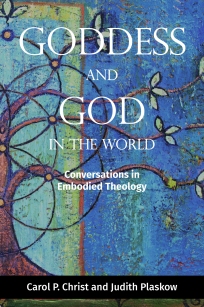 This is discussed further in the newly published Goddess and God in the World: Conversations in Embodied Theology by Carol P. Christ and Judith Plaskow–order now. Ask for a review copy (for blog or print) or exam or desk copy. Please post a review on Amazon. Share with your friends on social media using the links below.
Listen to Judith and Carol’s first interview on the book on Northern Spirit Radio.
Carol P. Christ leads the Goddess Pilgrimage to Crete. Space is available on the fall tour October 1-15. Join now and save $150. With Judith Plaskow, she is co-editor of Womanspirit Rising and Weaving the Visions. Carol wrote the first Goddess feminist theology, Rebirth of the Goddess and the process feminist theology, She Who Changes.
Digging My Well by Joyce Zonana

I write this from the heart of a ten-day silent yoga retreat deep in central Virginia. The peace within and without fills me as I gaze over the James River, meandering through its wide valley, thickly carpeted in green. The late summer thrum of cicadas rises and falls around me, and in the far distance I hear what sounds like a mower circling a field. Earlier today, during meditation, I watched a pileated woodpecker pry its meal from the hollow of an ancient oak. Rather than silently repeating my mantra with eyes closed, I had my eyes open, and I experienced the sacred vibration in the bird’s rhythmic taps.

Now a soft breeze touches my face, bringing with it the sweet scent of wet grass. “There is a blessing in this gentle breeze,” I remember the opening of William Wordsworth’s Prelude, and I am reminded as well of Elizabeth Barrett Browning’s heroine Aurora Leigh, celebrating “the body of our body, the green earth.” Yes. This earth is my body, and I am blessed to be in it, here, at the ashram of my guru, Swami Satchidananda, silently practicing hatha yoga, meditating, breathing, simply being.
Can Good Theology Change the World? Part 2 by Carol P. Christ
 In the first blog in this series, I argued that one of the hallmarks of a good theology is recognizing that the source of authority must be located in individuals and communities who interpret texts and traditions as they encounter divinity anew in the present. In our new book Goddess and God World, Judith Plaskow and I suggest that a second hallmark of good theology is the “turn to the world.” What we mean by this is not only that divinity is immanent in the world, but also that the purpose of human life is to be found in this world—not the next.
The God of traditional theologies is pictured as an old man with a long white beard who rules the world from heaven. It is commonly assumed by those familiar with this picture that the purpose and meaning of human life is not to be found in this world—but rather in heaven. This assumption is increasingly being challenged. Many people no longer believe in life after death. The purpose of morality is increasingly being understood as improving the conditions for the flourishing of human and other forms of life—not on gaining the approval of a God who has the power to assign individuals to heaven or hell in the next world. Continue reading “Can Good Theology Change the World? Part 2 by Carol P. Christ”
Body Sovereignty: Tracing the Relationship Between Feminism & Fat by Sydney Bell
 Acknowledging and responding to feminine divine energy is an inherently radical, feminist act. With age my feminism and spiritual path have become inexorably intertwined and I have become more comfortable and confident in my identity as a daughter of the goddess, a priestess, and as a feminist. My feminism is continually being shaped by a call to serve the goddess in a variety of ways, particularly in response to an activating third element in my feminist goddess path (no surprise for fellow triad lovers who practice a Celtic spiritual path). This third activating element is my relationship with my body and my work to reclaim Body Sovereignty.
As with many readers of this site, mine is not an uncommon journey. I’ve heard the stories of women whose feminism and/or goddess path has either sparked or been sparked by their desire to have a positive relationship with their body and break free from oppressive cultural body norms. I believe many feminists realize societal expectations of beauty are restrictive and contain a harmful element of required thinness. Yet even among feminists there seems to be a reluctance to engage in a collective response to weight stigma and the oppression and injustice faced by fat people. This is perplexing considering the available data demonstrating inequities in areas like educational attainment, employment, income, and access to healthcare due to body size (see list of data sources below).
When trying to understand this strained relationship between feminism and weight stigma I’ve found it helpful to look at the historical relationship between the two. A great resource is Amy Farrell’s book Fat Shame: Stigma and the Fat Body in American Culture. Farrell takes us to the early years of the feminist movement and suggests that the politics of fatness or body size was not explored by the first feminists. Interestingly, as the fight for women’s right to vote raged in the early 19th century, Farrell points out that the attack used by both the suffragettes and those working against women’s right to vote was to publish political cartoons with unflattering ‘fat’ images representing their respective opponents. It wasn’t until the second wave of feminism in the 60’s and 70’s when Susie Orbach’s ground-breaking work Fat is a Feminist Issue opened up the discussion of body size through a gendered lens and set the tone for early feminist thinking about body size. Continue reading “Body Sovereignty: Tracing the Relationship Between Feminism & Fat by Sydney Bell”
Can Good Theology Change the World? Part 1 by Carol P. Christ
 Theology is often viewed as abstract and removed from the problems of the real world. Yet many of the problems of the real world are caused by bad theologies. If bad theologies shape the world, might the same not be true of good theologies?
Opposition to a woman’s right to choose birth control and abortion is fueled by appeals to the command of God to protect life. Opposition to lgbtqi rights is couched in divine authorization of normative heterosexuality. Opposition to efforts to counter climate change are challenged by those who claim to believe in the Bible, not science.
All of these claims are rooted in a prior claim that God is and must be the only source of authority for human beliefs and moral decision-making. This view can and often does lead its adherents to distrust scientific and other humanly created forms of knowledge. In America, supporters of Donald Trump routinely dismiss not only the claims of modern science, but also every attempt to disprove the assertions of their candidate by citing facts. Continue reading “Can Good Theology Change the World? Part 1 by Carol P. Christ”
Honoring St. Mary of Magdala by Gina Messina
 While I am joining the conversation a bit late, I find it necessary to comment on the significance of the “upgrading” of the celebration of St. Mary of Magdala to a feast – on par with the male apostles. While such a day that honors her is quite overdue, I am grateful to Pope Francis for acknowledging this incredible woman and her leadership in the Christian movement.
As we know from the Gospels, it was Mary Magdalene who stood at the foot of the cross with Mary the mother of Jesus, during his crucifixion. When the male apostles ran in fear – and rightfully so – Mary of Magdala stood with Jesus refusing to disavow him and was a face of love for him to see during his darkest moment.
It was Mary of Magdala who was the first witness of Christ’s resurrection. The very first Easter began with her and she was commissioned by Jesus to go and share the good news – to tell the other apostles – and that is why she is known as the apostle to the apostles. Continue reading “Honoring St. Mary of Magdala by Gina Messina”

