

In previous articles I have developed my personal perspective on Islamic feminism as a third narrative pathway that responds to the two traditional hegemonic discourses that exist on Muslim women, which I call “idealization of inequality” and “demonization of Islam
The search for gender justice within the framework of Islam has been called Gender Jihad is focused on installing a legal and social equality for Muslim women and groups or identities in the otherness, in line with the equality of divine origin established in the Qur’an. I think this socio-political equality begins with unpacking the epistemic violence prevailing in religious narratives that affects the representations and validation of women and persons in the otherness as equals, ie, like people, like men, the discursive and biopolitics referent of what is “Humankind”.
Islamic feminism is a narrative that provides answers to the epistemic violence represented by the speeches of idealization and demonization. As Gayatri Spiviak said, such epistemic violence is an orchestrated, widespread and heterogeneous project to constitute the colonial subject, as other. Women in religion are colonized subjects. Epistemic violence leads to epistemic injustice that results in unfair practices such as, for example, considering that the testimony of some people is less credible because they belong to certain gender, based on a distorted image of the other, which dehumanizes the individuals who are giving testimony.
The Gender Jihad posed by Islamic Feminisms seeks to establish a declaratory place that is an authentic expression of the agencies women and people in the otherness in relation to a hegemony with a strong colonial bias, represented for the narratives of idealization and demonization. Gender Jihad is the building of an episteme, understanding the right of Muslim women to enunciate and interpret a reality that challenges them, for and by themselves since, as Amina Wadud says “defining religion is to have power over it.”
This discursive possibility is possible thanks to the Tawhidic paradigm developed by Amina Wadud in the early 90s and in her book “Qur’an and Woman,” a methodology that can decolonize fields of knowledge, bodies and representational policies of the mainstream narrative about Muslim women and Others.
The merit of her paradigm, among many, is to systematize existing concepts in the Muslim cosmogony, in a way that provides a frame for gender analysis from Islamic theology and promoting the empowerment of women through it. Recognizing, on the one hand, the inherent equality of women as human beings, it gives theological support to a legal equality that for centuries have been at the discretion of Muslim scholars. On the other, it enables women, through rescuing Ijtihad, in our enunciation and narrative capacity as religious subjects. If humans are equal before God, then Women and Others are, by divine right, equally able to read, decipher, interpret and convey their perspective on religious matters.
There cannot be any political transformation, without having an equal right to speak, equal freedom to express thoughts, equal entitlement of movement of the body and ideas, equal agency to occupy material and symbolic spaces, without restrictions.
There can be no Gender Jihad without appropriating the readings and discourses on gender, religion and jihad.
Gender Jihad begins with the recovery of the right to say and represent, therefore, is a struggle that could have as a prior aim the acquiring of epistemic justice.
This is relevant because “Who can speak” will mark simultaneously “on what terms that person talk.” What concepts and meanings can be used within the framework of the construction of a particular view of reality? What terms become the lens for discerning reality: development, democracy, gender equality, civil society, religion, social agency, etc. Only and exclusively from the enunciation (the power to speak) and from the ability to define the context in which speaking occurs, can one have a voice, that is, be a subject.
This framework for a new reality, based on the epistemic justice, will allow Muslim women to define their own place and have a voice to counteract epistemic injustice. Wadud offers a system of hermeneutic model that enables a “who can speak” and “on what terms” from an interpretation of the Quran from a gender perspective, which recognizes Muslim women agency to define and interpret religion, to build a speech based in empowerment and to rise as “political individuals of faith,” establishing a mapping for the construction of a reality in which they position themselves as people, beyond stereotypes and myths.
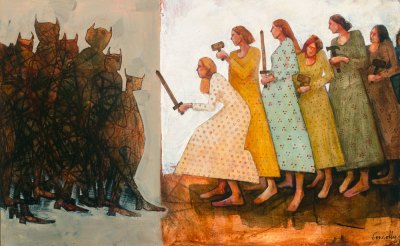
Image: Women Fighting Demons – Caitlin Conolly
Vanessa Rivera de la Fuente is a social communicator, writer, mentor in digital activism and community educator in gender and capacity development. She has led initiatives for grass roots female leaders’s empowerment in Latin America and Africa. She is an intersectional feminist interested in the crossroads between Religion, Power and Sexuality. Her academic work adresses Feminist Hermeneutics in Islam, Muslim Women Representations, Queer Identities and Movement Building. Vanessa is the founder of Mezquita de Mujeres (A Mosque for Women), a social media and educational project based in ICT that aims to explore the links between feminism, knowledge and activism and highlights the voices and perspectives of women from the global south as change makers in their communities.


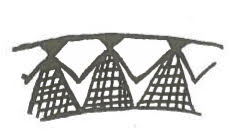
 The image of the Goddess as Maiden, Mother, Crone is widespread in contemporary Goddess Spirituality. The Triple Goddess honors three ages of women, in contrast to the wider culture that: affirms young women as sex objects while shaming them as sluts; celebrates mothers on Mother’s Day, while providing few legal and economic protections for mothers; and ignores older women.
 Autumn of 1977. The faculty wives have come together in the modest University Heights home of a physics professor. Their Aquanet hair is sprayed to the heavens and at significant risk of igniting from lipstick-stained cigarettes that are resting precariously in the cradle a heavy crystal ashtray. Their business is serious. They are putting together a cookbook. The Faculty Wives Cookbook of 1977, to be precise. It is a noble task. They will cook from it for their young families, for their husbands, that is, the faculty. Even more, they will use each other’s recipes. Martha will cook Mary’s chili; Margaret will lose weight on Donna’s diet cabbage stew. It is an achievement that will be smugly displayed on bookshelves for decades. It will yellow, and the black plastic spiral binding will wear and crack. The Kinko’s heavy card stock cover will be ringed with coffee marks. And, one day, daughters-in-law will decide whether to keep it or to pitch it out.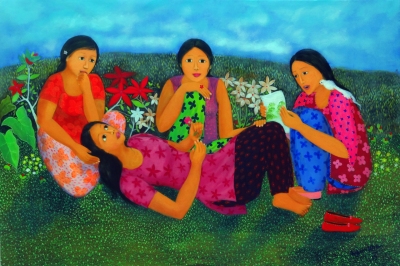
 History offers few instances of women helping create scripture. Hinduism’s sacred Rigveda may have been partly composed by women, and scholars believe the biblical Book of Ruth was possibly written by a woman, but the evidence for each is wanting. And while Muhammad’s widow was entrusted with the manuscript that would become the Quran, its scribe was a man named Zayd ibn Thabit. The only clear exception to this is the Book of Mormon, which Joseph Smith partially dictated to his wife Emma. The central role of Mormon women in the church was therefore fixed from the start.
 Recently FAR contributor
  I’ve been married for most of my life. Marriage, along with all our institutions, is influenced by and therefore takes shape from the culture/society in which it exists. When I got married, I had certain expectations that I’d absorbed from my environment. Attaining “marital bliss” by achieving an indistinguishable oneness with my spouse was part and parcel of it all. Popular thought tells us that marriage (especially heterosexual marriage) brings about the completion of two individuals. How often do we hear about people searching for, and sometimes finding, a person they label as their soulmate? People seem to long for that one human being they think will make them happy.
