Biblical Poetry – Trees by Janet Maika’i Rudolph

Image from an Egyptian tomb ca. 1314-1200 BCE. Isis is giving nourishment in the form of fruit and drink,

In many cultures of the world, including our own, trees are considered the ancestors of humanity – own our ancestors.

Trees are connected with great goddesses throughout antiquity. We see this in the bible where, as I’ve noted before, the Tree of Life is Eve’s tree for the word Eve means life. It is, in essence, the Tree of Eve. Goddesses in trees feeding humans were common themes in ancient Middle Eastern art. The tree was Hers to give freely of as she wished.  

Anthropologist and religious scholar, Mircea Eliade writes extensively about the associations of trees ancestral connection to humans. He calls them both mystical and mythical.[1] His examples include the Miao groups of Southern China and Southeast Asia who “worship the bamboo as their ancestor.” He also notes Australian tribes who view the mimosa as their progenitor. And there is a tribe from Madagascar, called Antaivandrika which means “people of the tree,” who considered themselves descended from the banana tree.

Continue reading “Biblical Poetry – Trees by Janet Maika’i Rudolph”
My Daily MEDS by Xochitl Alvizo

After a spring semester-long sabbatical this year, I am back to campus and to teaching. I was effectively off from January to August and the timing could not have been better. After my dad’s death last July (2021), my world was turned upside down. One of the things that happened with his death was a deep realization that he had a lot to do with my sense of grounding. I wrote about this in a previous post, but I hadn’t quite realized how much he was a source of affirmation and grounding for me, an external one—his death was a catalyst for me to learn how to access that grounding more fully for myself, from within.

Having been on sabbatical, then, was helpful in terms of regaining my brain for research and writing, which was its objective, but also for giving me the time and mental space to work on the grounding aspect of my internal life. A few things came together for me during this time. Leading up to the sabbatical and overlapping with it, I got to participate in the Latinas in Leadership (LIL) program with the Hispanic Theological Initiative – a program designed to strengthen the professional development of the Latina women participants.

Continue reading “My Daily MEDS by Xochitl Alvizo”

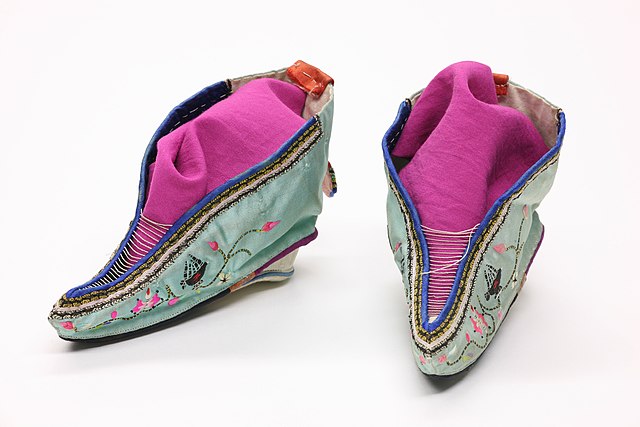
From Footbinding to Abortion and Beyond – This Has to Stop! by Janet Maika’i Rudolph

Children’s Museum of Indianapolis

My husband, Marty, is a retired podiatrist.  He worked in pockets of New York City that were poor and largely immigrant. When he first started his practice, he treated women from China whose feet had been bound. Despite being officially outlawed 1912, footbinding was still being practiced well into modern times. He saw these patients in the 1970s and 80s.

For those who don’t know what it is, young girls, as young as 3-5 would have the bones in their feet broken and then the feet bound with cloth strips. Every few years, the feet would be broken again until the desired result was created. To create that affect, the toes would be flattened against the bottom of the foot and arch would be so broken and damaged that the heel would curl back to the front of the foot. At each of the breakings the girl would need to learn to walk again.  One can only imagine that pain of walking on foot bones that had been repeatedly broken. And here is an especially chilling part. The mothers would do it to their own daughters. I won’t go into further gruesome details because they can be easily looked up on the internet.  It left the girls crippled for life.

Continue reading “From Footbinding to Abortion and Beyond – This Has to Stop! by Janet Maika’i Rudolph”

In Memoriam: Rosemary Radford Ruether by Elizabeth Ann Bartlett

Yet another of my great feminist and spiritual teachers has died.  Rosemary Radford Ruether, ecofeminist Catholic theologian, died on May 21st.  Her work challenged my thinking and gave me new understandings and perspectives. She was a prolific writer, authoring hundreds of articles and 36 books, and was the quintessential scholar and historian of world religions and ecofeminist thought and theologies. A scholar of the scholastics, she examined the three strains of Western thought: the Hebraic tradition; Platonic-Gnostic; and Pauline-Augustinian in all their complexities to develop an understanding of the nature of Western thought and its implications for the domination of women, nature, and colonized others. As she described her own approach, she drew out the contradictions and complexities in these theologies, careful “to see both negative and positive aspects . . . and to be skeptical of exclusivist views on either side.”[i] Her thought and writing was ever-expanding, and always striving “to see the dominant system of patriarchy, including its racism, classism, and colonialism, in critical perspective,” and to put herself “in places where in solidarity with its victims, I can see it from its underside.”[ii]To this end, she brought together the ecofeminist theologies of women from around the globe, particularly the global south.[iii] Her thought also grew to include critiques of militarism and corporate globalization.  Needless to say, I cannot begin to encompass all of her contributions here. So I will focus on the ways her thought has most deeply influenced and inspired my own, as well as my students’.

Continue reading “In Memoriam: Rosemary Radford Ruether by Elizabeth Ann Bartlett”

My Accidental Baptism into the River by Caryn MacGrandle

Yesterday I fell into the river. I had had a long afternoon and had gone to escape for a bit sitting on a bench by the river I live by. I had just gotten done with reading about Venus, Mars, Jupiter and Neptune all being in Pisces. ‘Drip, drip, drip or maybe a huge wave.’ Elsaelsa – The Astrology Blog I had also just gotten done with a Yemaya Mother of the Ocean meditation that I had done for Circle a while back. And as I got back up to go home, I slip-slided all the way down the steep incline in front of the bench.

Plop. Into the river.

I was holding my wallet, my phone, my keys, my glasses and a water bottle. I instantly lost the water bottle but managed to hold the rest above water. I tried to start back up the river bank. And could not. ‘Woman Accidentally Falls Into Raging River and Dies’. My heart rate went up. Okay, it wasn’t raging. I reminded myself that I most likely would not die as I can swim, and I could just go down river to a less steep bank.

But it was most disconcerting.

I forced myself to take a deep breath, threw all my stuff up the significantly steep bank and tried again. My shoe fell off. I was in panic mode. ‘Just get out of the river, Caryn’

Continue reading “My Accidental Baptism into the River by Caryn MacGrandle”

The Gendered Temptation of Jesus by Liz Cooledge Jenkins

As Luke’s Gospel tells it, at the beginning of Jesus’ public ministry, the devil comes to him in the wilderness and tempts him.[1] First, the devil latches onto Jesus’ hunger after forty days of fasting: “If you are the Son of God, tell this stone to become bread.”[2]  Then, he shows Jesus “all the kingdoms of the world.” He says, “I will give you all their authority and splendor; it has been given to me, and I can give it to anyone I want to.If you worship me, it will all be yours.”[3] 

I’ve been thinking about this second temptation: all the authority and splendor of the kingdoms of the world. All can be yours. You just have to worship me. Did Jesus find this appealing? Personally, I find it a little hard to relate to. I have zero interest in ruling the kingdoms of the world, however splendid they might be. The whole proposition sounds like too much limelight and far too much stress. Thank you, devil, but I’m good.

Continue reading “The Gendered Temptation of Jesus by Liz Cooledge Jenkins”

On The Baby and The Bathwater by Liz Cooledge Jenkins

It wasn’t until seminary—and even then, only sporadically—that I learned that many of the foundational figures in Western Christianity held some incredibly sexist attitudes. Somehow, in all my years of attending church, hearing sermons, participating in (and leading) Bible study groups, reading Christian books, and working in ministry, I had missed this historical reality. I just hadn’t thought about it. And the (mostly white male) Christian leaders who shaped my own faith apparently hadn’t thought about it, either. That, or they didn’t think it was important enough to talk about. Or they intentionally tried to keep it on the down low. Or some combination of these things.

In seminary, when influential theologians’ sexist views came up in class, inevitably someone would say—in a wise-sounding tone—“Well, we don’t want to throw out the baby with the bathwater, do we?”

Continue reading “On The Baby and The Bathwater by Liz Cooledge Jenkins”

Queering the American Dream by Angela Yarber

As Florida politicians try to ban teachers from including LGBTQ+ issues in the curriculum, admonishing them, “Don’t Say Gay” at school, I’m shouting “GAY!” from the rooftops. Because I’m celebrating the release of my eighth book and first memoir, Queering the American Dream. It’s my queer family’s story of leaving it all and the revolutionary women who taught us how.

Our story began the day the Supreme Court ruled our marriage legal and ended the moment my younger brother’s addiction spiraled into a deadly overdose. In-between were eighteen months of full-time travel with a toddler in tow. Criss-crossing the American landscape, my wife and I came face to face with jaw dropping natural beauty on the one hand, which contrasted with the politics, policies, and people who continued to discriminate against marginalized families like ours on the other. At each stop along the way, a different revolutionary woman from history or mythology guided our footsteps, reminding us that it’s not simply our family who dared to queer the American dream, but a subversive sisterhood of saints who have upended the status quo for centuries. From Vermont to Hawai’i, and everywhere in between, the beauty of the American landscape bore witness to a queer clergywoman whose faith tradition was not enough to sustain her. But the revolutionary women were.

Continue reading “Queering the American Dream by Angela Yarber”

In Memoriam: bell hooks by Elizabeth Ann Bartlett

In a world where the words of black women writers, even our very names are often soon forgotten, it is essential and necessary that we live through writing and teaching the words of our great and good writers, whose voices must no longer be silenced, even by death.[i]

                                                                                    – bell hooks

On December 15, 2021, the world lost the great feminist theorist, teacher, activist, and writer bell hooks.  As a white feminist theorist, I valued immensely the ways her work widened my partial perspective, challenged my blind sports, and gave me important viewpoints on everything from sexism, racism, classism, pedagogy, militarism, work, and parenting.   Her piece on feminist solidarity is the best I know — examining not just the ways we are divided by classism and racism, but also by sexism, addressing the very real and destructive ways that women undermine, abuse, and disregard each other, and how important it is to unlearn this with each other. She used the term “feminist movement,” rather than the feminist movement, knowing it not to be one thing, but rather a verb, a process of moving, changing, and transforming. Championing the power of coming to voice, she spoke truth to power, engaging in honest exploration of often difficult and divisive topics. It was this honest, liberatory voice that spoke throughout her work and made her voice so compelling, and so valuable.

Continue reading “In Memoriam: bell hooks by Elizabeth Ann Bartlett”

From the Archives: I Am in Peace: the Ministry of Margaret Fell by Mary Sharratt

Moderator’s note: This marvelous FAR site has been running for 10 years and has had more than 3,600 posts in that time. There are so many treasures that have been posted in this decade that they tend to get lost in the archives. We have created this column so that we can all revisit some of these gems. Today’s blogpost was originally posted March 6, 2019. It is paired with a new guest post abut Margaret Fell which will be posted tomorrow. You can visit the original post here to see the comments.

margaret fell

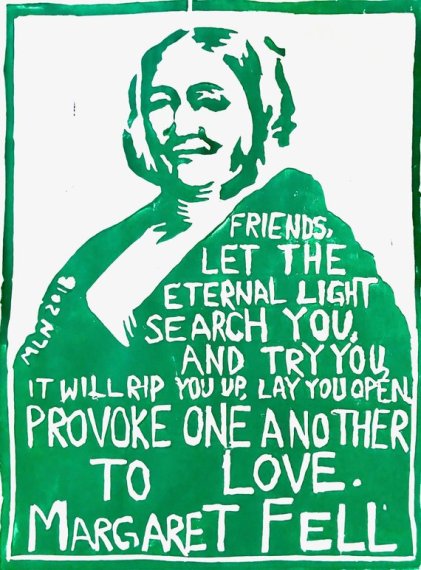
This linoprint of Margaret Fell can be ordered here.

Pendle Hill will forever be associated to the Pendle Witches of 1612 who live on in the undying soul of the landscape and its folklore and who inspired my 2010 novel, Daughters of the Witching Hill. Pendle Hill also gave birth to the Quaker movement.

In 1652, George Fox, a simple weaver’s son and cobbler’s apprentice turned dissenting preacher, wandered across England on a spiritual quest. When he climbed Pendle Hill, his revelation came to him—an event that would change both Fox and the world forever. He envisioned a “great multitude waiting to be gathered.”

Continue reading “From the Archives: I Am in Peace: the Ministry of Margaret Fell by Mary Sharratt”