

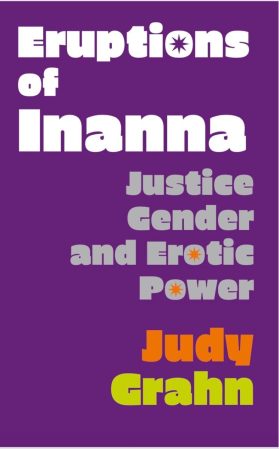
Any new book by Judy Grahn is cause for celebration. For decades, Grahn has been a lyrical and passionate poet, author, mythographer, and cultural theorist whose work features both goddess wisdom and contemporary culture centering on women and queer people. Nightboat Books has just published her newest book, Eruptions of Inanna: Justice, Gender, and Erotic Power, which offers ancient yet fresh world views with which to approach such issues as injustice, sexuality and gender, climate change, and more just when we need it most.
In Eruptions of Inanna, she brings what she calls her “poet’s eye” to eight stories featuring the Sumerian goddess Inanna as well as religious practices of those devoted to her. She explores how these have directly influenced our world and, in her words, can continue to “feed our needs and help us take better care of each other and our world.” According to Grahn, Inanna “is a combination of human, creature, erotic and other energetic forces, and civilization. She also inherited very old powers that grew out of women’s rituals” (55). Her essence engenders sovereignty and self-worth, especially in women and queer people. She is a goddess of love, espousing passion and the joy of eroticism as integral to both life and society. She practices an expansive justice that creates positive outcomes in response to horrific acts. She creates a civilization of the arts, beautiful and useful crafts, abundance, and a jubilant communal life. She demands respect for nature and ecological sustainability.
Continue reading “Eruptions of Inanna: Justice, Gender, and Erotic Power by Judy Grahn BOOK REVIEW by Carolyn Lee Boyd” Read Part I
 It is the weekend before Thanksgiving, in the ominous year of 2020. The CDC urges people not to gather with others outside of the household on Thursday. COVID infections rise exponentially. Schools are closing, and in the much of the country, winter is foreboding.
 Around the age of 8, or maybe 10, I learned my aunt had had a hysterectomy. I remember visiting her house either shortly before or after the operation. I can’t remember which, and it doesn’t really matter. At the time, I don’t think I even knew what a uterus was or that I too had one.
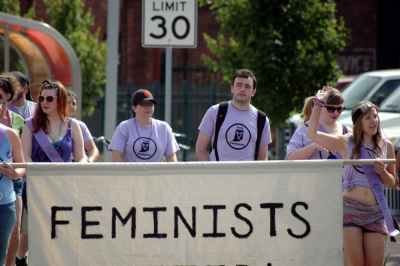
  I am an annoying feminist. I annoy pretty much everyone about it, because I’m never NOT applying a feminist lens to every aspect of life: science (looking at you,
 Feminism and Religion